The Woven Garments & Denim Industry in Bangladesh: Capacity, Clusters and Key Players
Woven garments earned 18.18 billion US dollars in fiscal year 2024-25. This pillar guide covers products, clusters, supplier verification, MOQ, pricing, quality, Incoterms and duties for buyers.
Short answer
The woven garments industry in Bangladesh makes shirts, trousers, denim jeans, jackets, dresses and workwear for export, concentrated in Dhaka, Gazipur, Narayanganj and Chattogram. Woven garments earned 18.18 billion US dollars in fiscal year 2024-25. Buyers source them by specifying each style in writing, verifying the factory, approving samples and agreeing MOQ, price and lead time per order.
On this page
Key takeaways
Woven garments earned 18.18 billion US dollars in fiscal year 2024-25, within garment exports of 39.34 billion dollars, per EPB data reported by The Financial Express.
Bangladesh was the top denim supplier to both the United States (675.65 million dollars) and the European Union (1.28 billion dollars) in 2024, per BGMEA-compiled data.
BGMEA reports around 4,500 member factories, about 60 percent of them woven garment manufacturers, accounting for 100 percent of woven garment exports.
There is no industry-wide MOQ, price or lead time; all three are set per factory and per style against a written specification.
On Exportain, trust badges are a document and photo review, not a factory inspection, and membership never grants a badge.
The woven garments industry in Bangladesh produces shirts, trousers, denim jeans, jackets, dresses and workwear for buyers in the United States, the United Kingdom, the European Union and other markets. This guide explains the scale of the sector, its products and clusters, and the checks a buyer should run before placing an order. It covers supplier verification, minimum order quantity (MOQ), pricing, lead times, quality control, compliance, shipping and duties, and it ends with a step-by-step buying process for a first or a repeat programme.
Woven garments are the non-knitted half of the ready-made garment (RMG) sector. In customs terms, most woven apparel is classified in HS Chapter 62, which covers articles of apparel and clothing accessories that are not knitted or crocheted, while knitted apparel sits in Chapter 61.1 That distinction shapes this guide: woven production uses cut-and-sew lines fed by woven fabric, and denim adds weaving, washing and finishing capacity that knitwear does not need.
Market overview with latest data
Start with the export record, because it shows how much of the country's trade the sector carries. In fiscal year 2024-25, Bangladesh earned 48.28 billion US dollars from merchandise exports, and ready-made garments accounted for 39.34 billion dollars of that total, or 81.49 percent. Within garments, knitwear earned 21.15 billion dollars and woven garments earned 18.18 billion dollars, up 7.82 percent on the year before.2 Woven garments alone therefore brought in more than a third of all merchandise export earnings, from a single product family.
The association structure behind those figures is concentrated. According to figures published on the website of the Bangladesh Garment Manufacturers and Exporters Association (BGMEA) and reported in December 2025, the association has around 4,500 member factories, of which about 60 percent are woven garment manufacturers, and its member factories account for 100 percent of the country's woven garment exports.3 The Bangladesh Knitwear Manufacturers and Exporters Association (BKMEA) represents the knitwear side, and some groups operate factories in both segments. Our explainer on BGMEA and BKMEA sets out what each body does and what membership does and does not prove about an individual factory.
Denim is the strongest single story inside the woven segment. Bangladesh remained the top denim supplier to both the United States and the European Union in 2024, earning 675.65 million dollars from the US market and 1.28 billion dollars from the EU market. In the first two months of 2025, denim exports grew again, by 56.33 percent to the United States and by 32.43 percent to the European Union, on data compiled by BGMEA.4 Reporting links that position to sustained investment in local denim fabric production, which gives factories a domestic fabric base for many standard denim qualities instead of an imported one.4
Market access explains part of the sector's economics, and it is changing. The European Union is Bangladesh's largest trading partner, and textiles accounted for almost 94 percent of EU imports from Bangladesh in 2025. Bangladesh is the largest beneficiary of the EU's Everything But Arms (EBA) arrangement, with 19 billion euros of exports benefiting from those preferences in 2024 at a 96 percent utilisation rate. EBA grants duty-free, quota-free access for all products except arms and ammunition.5 That treatment is tied to least developed country (LDC) status. The United Nations records that Bangladesh is scheduled to graduate from LDC status on 24 November 2026, and that approximately three-quarters of its merchandise exports currently enjoy duty-free access under preferential schemes.6 Treat today's EU duty position as a dated fact to re-check at order time, not as a permanent feature of sourcing from Bangladesh. The duties section below returns to this in detail.
Two cautions belong in any market overview. First, trade statistics differ by source and period: the Export Promotion Bureau (EPB) reports by Bangladeshi fiscal year, while destination-market import statistics report by calendar year. Small differences are normal, and the figures here are labelled with period and source so you can repeat the check; see Bangladesh export and import data for the underlying flows. Second, headline growth does not describe any single factory. Capacity, quality and reliability vary widely across thousands of factories, which is why the verification section matters more than the market totals.
Main products and production clusters
The woven offer covers most everyday apparel categories. The table below groups the main products, the fabric base each one usually needs, and the point a buyer should test hardest during sampling.
Product group | Typical items | What to test hardest |
|---|---|---|
Denim bottoms and jackets | Five-pocket jeans, denim jackets, denim shirts and skirts | Wash approval against a standard, shrinkage, fabric weight and shade consistency |
Woven shirts and blouses | Formal and casual shirts, yarn-dyed checks and stripes | Collar and cuff construction, pattern matching, ironing and packing finish |
Trousers, chinos and shorts | Flat-front trousers, cargo styles, school and casual shorts | Waistband construction, measurement tolerance, colourfastness |
Dresses and women's woven tops | Day dresses, skirts, blouses and woven tops | Fabric handling, lining quality, delicate trims and finishing |
Jackets and light outerwear | Unlined and lightly lined jackets, overshirts | Layer assembly, zip and button quality, shape retention |
Workwear and uniforms | Coveralls, service uniforms, institutional clothing | Specification discipline, repeat consistency, strength of seams |
Children's woven clothing | Shirts, trousers, dresses and denim for children | Destination safety rules for children's products, drawcords and small parts |
Factories tend to specialise. A factory built around denim bottoms is a different supplier from one built around formal shirts, even when both call themselves woven garment manufacturers. Shortlist by product fit first and by size second, and ask which products make up most of a factory's current production, not which products it can make in principle.
Production is geographically concentrated, and the cluster affects how a programme runs in practice.
Dhaka and Gazipur. The capital region, extending north to Gazipur, holds the densest concentration of sewing factories, fabric suppliers, washing plants, embroidery and printing units, accessories suppliers, testing laboratories and inspection services. Many larger exporters are based in this belt, so sampling, approvals and inspector visits are usually straightforward to arrange.
Narayanganj. Close to Dhaka, Narayanganj is an older industrial centre with textile roots in dyeing and finishing as well as garment making, with a long-established local workforce.
Chattogram. The port city is both a production centre and the country's main maritime gateway, covered in the shipping section below. Factories in and around Chattogram, including in export processing zones, sit close to the port their goods will leave from.
Other areas. Garment activity also exists around Cumilla, Khulna and Mymensingh, often at smaller scale or in specific niches, and export processing zones in several locations host factories under zone authorities.
The key players are best understood by role rather than by ranking. BGMEA is the trade association whose membership covers the woven export trade.3 Around the factories sit fabric mills, washing plants whose work decides the final look of a denim garment, buying houses and sourcing agents, testing laboratories, inspection companies, freight forwarders and banks. A buyer deals with several of these roles on a single order, and the buying process below assigns each step to the party that controls it.
How to find and verify suppliers
Finding woven garment exporters is easy. Verifying them protects an order, in five stages.
1. Define the product before you search. A search without a specification produces replies you cannot compare. Prepare a tech pack or, at minimum, a written specification covering product type, fabric composition and weight, sizes and size ratio, colours or washes, construction details, labels, packing, target quantity and destination market. Our guide on how to write an RFQ shows how to turn that specification into an enquiry suppliers can price accurately.
2. Search through more than one channel. Use trade association directories, B2B marketplaces, referrals and sourcing platforms, and cross-check any factory found on one channel against at least one other source. On Exportain, you can browse suppliers by product before you make contact.
3. Check the documents, and understand what they prove. Ask for the factory's trade licence, its Export Registration Certificate, its BGMEA membership record where it claims one, and evidence of export history for your product type. Confirm the factory address and ask directly whether production happens there or is subcontracted. Documents and memberships expire, so check dates rather than accepting copies at face value. On Exportain, trust badges come from a review of documents and photos by Exportain staff; the platform states that this is a document and photo review, not a factory inspection, and that membership never grants a badge.7 See how supplier verification works on Exportain for each check. Treat every platform's badges the same way: as a starting filter, never as a substitute for your own verification.
4. Verify capacity and compliance at the factory. A visit by you, a local representative or an inspection company confirms what photographs cannot: the production floors, the products actually being made, the quality control points, and whether running lines match the claimed capacity. For denim, check the washing arrangement with particular care, in-house or external, because wash quality decides whether a jeans style succeeds.
5. Test with samples and with communication. Judge sampling accuracy against the tech pack, the speed of corrections and the clarity of answers. How a factory handles a sample correction is a strong predictor of how it will handle a problem in bulk production.
Pause if you meet any of these warning signs: a price quoted without a specification, reluctance to identify the production address, certificates the factory will not let you verify with the issuing body, pressure to pay outside normal banking channels, or a lead time promise that ignores fabric availability. Each is a reason to stop and check, not to negotiate harder.
MOQ, pricing and lead times
Buyers ask for a typical MOQ, a typical price and a typical lead time for woven garments from Bangladesh. None of the three has a single industry figure, and a source that quotes one without a specification is not describing your order. This section explains what sets each number, so you can obtain a figure that applies to your style.
What decides the MOQ for a woven garment order?
The factory sets the MOQ, and four inputs drive it. Fabric minimums from the mill come first: a style in a fabric the mill holds or weaves regularly can start smaller than one needing a special weave, dye or finish. Wash and dye batch sizes come second, and they matter most for denim, where each wash is a separate batch. Third, the number of sizes, colours and washes multiplies setup work. Fourth, the factory's line setup and current loading decide how small a run it can accept. State your quantity honestly in the enquiry, ask each factory for its minimum for that exact style, and, if your quantity falls short, ask what change would make the order workable: fewer washes, a stock fabric or combined colourways. See MOQ and minimum order quantity for the same method in other product types.
How is a woven garment price built up?
A woven garment price is built from fabric, trims and accessories, washing and finishing, cutting and sewing, factory overhead, testing and inspection, packing, inland transport and the exporter's margin. Washing is a minor line for a plain shirt and a major line for a treated jean, which is why two quotes for what sounds like the same product can differ for legitimate reasons. Give every factory the identical specification and delivery term, and ask for the price split at least into fabric, wash or finish, and making. Confirm what the quote excludes, such as testing or inspection fees, before treating the lowest total as the cheapest order. This guide publishes no price figures, because a price detached from a dated specification and current fabric conditions would mislead more than it would help.
What makes up the lead time?
Lead time is a sum, not a single number: fabric production or procurement, sampling and approval, bulk cutting and sewing, washing and finishing, final inspection and shipment booking. Locally available fabric can shorten the first stage, which is one reason the domestic denim fabric base matters to programme planning.4 Imported or specially finished fabric, complex washes and peak-season loading lengthen the total. Ask for a stage-by-stage timeline, agree the ex-factory date in writing in the purchase order, and track the two early milestones that predict the rest: the fabric in-house date and pre-production sample approval. Build your own buffer between ex-factory and the delivery date your customers need.
Quality, certifications and compliance
Quality in woven and denim production is controlled at four points, and each point catches faults the next one cannot fix cheaply.
Fabric inspection on arrival. Check composition, weight, shade, shrinkage and defects before cutting. A fabric fault cannot be sewn away, and a shade variation accepted here becomes a mixed-shade order at the end.
In-process checks. Measurement drift, stitching faults and shade mixing are cheap to correct while production runs and expensive afterwards. Agree the check points and tolerances in the purchase order.
Wash approval for denim. Approve a wash standard or range board before bulk washing, and check bulk production against it under consistent light. Wash disagreement, where buyer and factory hold different pictures of the agreed finish, is a recurring source of denim disputes, and a signed standard removes most of it.
Final inspection on packed goods. Inspect a sample drawn from across the packed order for style, measurements, workmanship, labels, packing and carton ratios against the purchase order and the sealed approval sample. Sampling inspection commonly uses an acceptable quality limit (AQL) plan agreed in advance; see AQL, the acceptance quality limit and pre-shipment inspection for how sampling and the decision rules work.
Which certifications matter for a woven garment buyer?
The certifications that matter are the ones your destination market and your own customers require. They fall into three groups. Social and safety compliance covers how the factory treats workers and whether the building is safe. In Bangladesh, factory safety oversight includes the RMG Sustainability Council (RSC), a tripartite body of brands, factory owners and workers that succeeded the Accord in 2020 and now oversees safety issues at 1,885 factories; its mandate has since been extended to labour rights investigations alongside electrical, fire and structural safety.8 Many buyers also run their own social audits or accept reports under schemes in their code of conduct. Product safety certification covers what is in the garment: OEKO-TEX Standard 100 is a label for textiles tested for harmful substances, under which every thread, button and accessory of a certified article has been tested against a list of over 1,000 harmful substances, with stricter limits for products with more intensive skin contact.9 Material claims are the third group: an organic or recycled claim needs a chain-of-custody certificate, from the scheme that owns the claim, that covers it.
Three rules protect you on every certificate. Match the requirement to the market first, because the tests a children's denim programme in the EU needs differ from those for adult workwear sold elsewhere. Verify directly with the issuing body or the scheme's public database, and confirm the certificate is in date and covers the factory address that will make your goods; OEKO-TEX certificates, for example, are issued for one year.9 Finally, keep laboratory testing separate from trust in the factory: test production fabric, and finished goods where the programme warrants it, for fibre composition, colourfastness, shrinkage and restricted substances.
Shipping, Incoterms and duties
Most woven garments leave Bangladesh by sea through Chattogram, which the Chittagong Port Authority describes as handling more than 92 percent of the country's export and import cargo and 98 percent of its containers; the port handled 3.40 million TEUs in 2025.10 Air freight through Dhaka serves urgent or replenishment shipments. Routing and transit time depend on the destination and on transshipment through regional hub ports, so confirm the current schedule and transit estimate with your freight forwarder for the specific destination instead of planning from a general figure.
The Incoterms rules, published by the International Chamber of Commerce (ICC), are eleven three-letter terms that clarify the tasks, costs and risks of delivering goods from seller to buyer; the current edition, Incoterms 2020, entered into force on 1 January 2020.11 The terms you will meet most often on garment orders are set out below, summarised in plain language. Read the full comparison in our Incoterms guide for shipments from Bangladesh.
Term | Who arranges the main freight | Where the seller's delivery duty ends |
|---|---|---|
EXW (Ex Works) | Buyer | At the seller's premises, with the goods made available for collection |
FOB (Free On Board) | Buyer | With the goods loaded on board the vessel at the port of loading |
CFR (Cost and Freight) | Seller | On board at the port of loading, with freight paid to the destination port |
CIF (Cost, Insurance and Freight) | Seller | On board at the port of loading, with freight and insurance paid to the destination port |
Under FOB, the buyer controls the main freight and usually nominates the forwarder, which suits buyers with their own shipping contracts; see the FOB explainer. Under CIF, the seller arranges freight and insurance to the destination port while risk still passes to the buyer at loading, a split first-time importers often misread; see CIF: cost, insurance and freight. EXW places almost every task on the buyer and is rarely right for a first order; see the EXW explainer. Whichever term you choose, record in the purchase order who arranges inspection, who pays for testing, which documents the seller provides and when payment falls. The standard document set is covered in export documents from Bangladesh.
Duties are set by the destination, by HS classification, and they change with policy. Classify your product first: woven garments sit in HS Chapter 62 and knitted garments in Chapter 61, and the wrong chapter produces the wrong duty line before any preference is considered.1 See how to classify your product with HS codes for the method. Then apply the destination's current treatment. EU buyers should price both the present EBA position and the post-graduation position into multi-season programmes, because Bangladesh graduates from LDC status on 24 November 2026 and roughly three-quarters of its merchandise exports currently receive duty-free access under preferential schemes.5 6 US buyers should work from the current US tariff schedule for their exact classification, through a customs broker, because apparel rates are product-specific. Build the result into a full landed cost before committing to a selling price; see landed cost for imports from Bangladesh.
Payment terms should align with verifiable milestones. Garment orders are commonly paid by letter of credit, or by telegraphic transfer on agreed milestones in established relationships; see the letter of credit and telegraphic transfer explainers for how each works. Tie each payment to a document or event the other side can verify: order confirmation, an inspection pass, or the shipment documents.
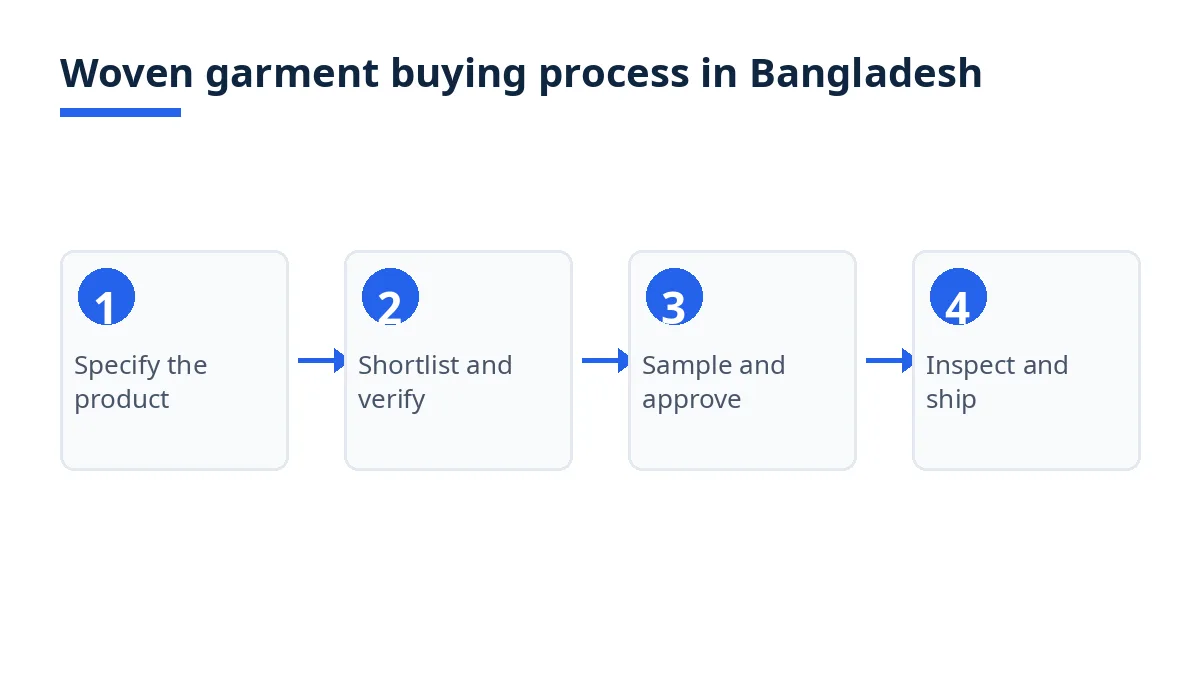
Step-by-step buying process
The process below applies the earlier sections in order. New buyers should read how to import from Bangladesh alongside this guide, and buyers comparing the two garment segments should read the companion pillar on the knitwear industry in Bangladesh.
Prepare the specification. Tech pack, measurements with tolerances, fabric and wash references, labels, packing and the destination compliance requirements for the product.
Shortlist suppliers by product fit. Start from factories whose current production matches your product group, then apply the verification stages in section 4.
Request quotations on the identical specification. Ask each factory for fabric, wash or finish, and making shown separately, with its MOQ and a stage-by-stage lead time for that style.
Order and approve samples. Fit sample first, then a pre-production sample in the actual fabric and wash. Approve in writing and keep a sealed approval sample for the inspection stage.
Confirm the purchase order. Style, quantities by size and colour or wash, price and Incoterm, ex-factory date, inspection and testing requirements, document set and payment terms, in one document both sides sign.
Approve pre-production. Fabric test results, trim and label approvals, the wash standard for denim, and the pre-production sample, all checked before bulk cutting begins.
Monitor production. Agree update points in advance, confirm the fabric in-house date, and arrange an in-process check for large or time-critical orders.
Inspect before shipment. Final inspection on packed goods against the approval sample and the purchase order, with measurements, defect counts and photographs recorded in the report.
Ship and clear. Confirm the document set before the vessel sails where the term allows it, track the shipment, and have your HS classification and duty position settled with your broker before the goods arrive.
Review on arrival. Check the goods against the inspection report, send the factory evidence of any defect or measurement issue, and record its performance to inform the next order decision.
Frequently asked questions
Is Bangladesh a good place to source woven garments and denim?
Bangladesh is a strong option for buyers whose products match its production base. Woven garments earned 18.18 billion dollars in fiscal year 2024-25, and Bangladesh was the top denim supplier to both the United States and the European Union in 2024.2 4 The sector offers scale, product specialisation and a mature export infrastructure of mills, washing plants, laboratories, inspectors and forwarders. Results still depend on factory-level choices: a well-matched, well-verified factory with a managed sampling and inspection process is what turns national capacity into a reliable programme.
What is the typical MOQ?
There is no typical MOQ for woven garments or denim, because each factory sets its minimum from the fabric minimum, the wash and dye batch size, the number of sizes, colours and washes in the style, and its own line setup. A basic style in an available fabric will usually be possible in a smaller quantity than a multi-wash programme in a special fabric. State your target quantity in the enquiry, ask each factory for the minimum for that exact specification, and ask what change to the specification would make a smaller order workable.
How long is the lead time?
Lead time is the total of fabric procurement or production, sampling and approval, cutting and sewing, washing and finishing, inspection and shipment booking, so it varies by order and by season. Locally available fabric shortens the first stage, and imported fabric, complex washes and peak-season loading lengthen the whole chain. Ask the factory for a stage-by-stage timeline, agree the ex-factory date in the purchase order, and monitor the fabric in-house date and pre-production approval, because delay at those two points predicts delay at shipment.
Which certifications matter?
The certifications that matter are the ones your destination market and your customers require. Buyers most often need safety and social compliance evidence for the factory, product safety testing for the garment itself, and a chain-of-custody certificate behind any organic or recycled claim. Building and fire safety in Bangladesh is overseen in part by the RMG Sustainability Council, and product labels such as OEKO-TEX Standard 100 certify that a textile has been tested for harmful substances.8 9 Verify every certificate with its issuing body, confirm it is in date and covers the producing factory, and support it with your own laboratory testing for your market.
Next steps on Exportain
Browse suppliers to shortlist woven garment and denim factories by product, read how to buy for the platform order process, or post an RFQ with your specification so matching suppliers quote against the same document. Keep the discipline of this guide: one written specification, factory-level verification, an approved sample and an inspection before shipment.
Sources
- Harmonized System: Chapter 62, Articles of apparel and clothing accessories, not knitted or crocheted. World Customs Organization (accessed )
- Exports fetch $48.28b in FY25. The Financial Express (accessed )
- BGMEA sets new membership criteria to ensure factory safety, operational standards. The Financial Express, (accessed )
- Denim exports to US, EU up 56pc, 32pc. The Financial Express, (accessed )
- EU trade relations with Bangladesh. European Commission, (accessed )
- Bangladesh Graduation Readiness Assessment. United Nations Office of the High Representative for the Least Developed Countries (UN-OHRLLS) (accessed )
- Supplier verification: Earn trust badges buyers can see. Exportain (accessed )
- RMG Sustainability Council can now oversee labour issues too. The Business Standard, (accessed )
- OEKO-TEX Standard 100. OEKO-TEX (accessed )
- Ctg Port breaks all previous records in 2025. The Financial Express (accessed )
- Incoterms® rules. International Chamber of Commerce (ICC) (accessed )
About the author
Sourcing from Bangladesh?
Post a request for quotation and suppliers on Exportain can send you their quotes directly.
Post an RFQ