The Knitwear & T-Shirts Industry in Bangladesh: Capacity, Clusters and Key Players
Knitwear earned $20.62 billion in FY2025-26, more than half of Bangladesh's garment exports. This guide covers the products, clusters, verification steps, MOQ, compliance and shipping a buyer needs.
Short answer
The knitwear industry in Bangladesh makes T-shirts, polo shirts, sweaters and other knitted apparel for export, concentrated in Dhaka, Gazipur, Narayanganj and Chattogram. Knitwear earned $20.62 billion in FY2025-26, more than half of Bangladesh's garment exports, per EPB data. Buyers source it by specifying the product in detail, verifying suppliers through association and audit checks, approving samples, and agreeing MOQ, price and lead time per style in writing.
On this page
Key takeaways
Knitwear exports were $20.62 billion in FY2025-26, more than half of Bangladesh's $38.70 billion garment exports, per EPB data.
In July to September 2026, knitwear exports rose 6.88 percent year on year to $5.96 billion, ahead of woven garments at $4.61 billion, per EPB data.
Production is concentrated in Dhaka, Gazipur, Narayanganj and Chattogram, and most knitwear is classified under HS Chapter 61.
There is no industry-wide MOQ, price or lead time; all three are quoted per supplier and per style against a written specification.
The knitwear industry in Bangladesh is the larger half of the country's garment export trade and the first place many international buyers look for T-shirts, polo shirts, sweaters and other knitted basics at scale. In FY2025-26 (July 2025 to June 2026), knitwear exports were $20.62 billion of the $38.70 billion earned by ready-made garments, per Export Promotion Bureau (EPB) data reported by The Financial Express.1 This guide explains how the industry is organized, where production is concentrated, which products it makes, and how to find, verify and work with its suppliers. Where a number depends on your product, order size or destination, the guide says so instead of giving an industry-wide figure that does not exist.
Key takeaways
Knitwear is the bigger of Bangladesh's two apparel segments. Garment exports were $38.70 billion in FY2025-26, 80.6 percent of merchandise exports of $48.0 billion, and knitwear accounted for $20.62 billion of that garment total, per EPB data.1
The segment kept its lead in the first quarter of FY2026-27 (July to September 2026): EPB reported knitwear exports of $5.96 billion, up 6.88 percent year on year, ahead of woven garments at $4.61 billion.2
The European Union took 46.36 percent of garment exports and the United States 20.99 percent in July to September 2026, more than any other single country, per EPB destination data.3
Production is concentrated in and around Dhaka, Gazipur, Narayanganj and Chattogram, which makes factory visits, audits and shipment consolidation practical to plan.
The core products are knitted basics and mid-range items, mostly classified under HS Chapter 61: T-shirts, polo shirts, sweatshirts, sweaters and pullovers, underwear and loungewear.
There is no single industry-wide minimum order quantity (MOQ), price or lead time. Each depends on fabric, construction, order size and destination, so confirm all three per supplier, per style, in writing.
Verification is a process, not a promise: check association membership, export record, audit and certificate scope, and an approved sample before placing a production order.
Market overview with latest data: the knitwear industry in Bangladesh today
Garments are the backbone of Bangladesh's export economy. EPB figures reported for FY2025-26 show merchandise exports of $48.0 billion, down 0.58 percent on the previous year, with ready-made garments contributing $38.70 billion despite a 1.64 percent decline.1 Within garments, knitwear earned $20.62 billion, down 2.53 percent, while woven garments earned $18.07 billion, down 0.61 percent.1 Knitwear therefore made up about 53 percent of garment exports in FY2025-26, and garments as a whole made up about four-fifths of everything Bangladesh sold abroad.
Measure | FY2025-26 | First quarter FY2026-27 (Jul-Sep 2026) |
|---|---|---|
Merchandise exports | $48.0 billion | $13.09 billion |
Ready-made garment exports | $38.70 billion | $10.58 billion |
Knitwear exports | $20.62 billion | $5.96 billion |
Woven garment exports | $18.07 billion | $4.61 billion |
The quarterly figures show the current direction of travel. In July to September 2026, merchandise exports rose 6.34 percent year on year to $13.09 billion, garment exports rose 6.10 percent to $10.58 billion, knitwear rose 6.88 percent to $5.96 billion and woven garments rose 5.11 percent to $4.61 billion, per EPB data.2 Knitwear grew faster than woven in the quarter and accounted for about 56 percent of garment exports in those three months.
Destination data for the same quarter shows where the garments go. The European Union took $4.90 billion of garment exports, a 46.36 percent share, and the United States took $2.22 billion, a 20.99 percent share, more than any other single country, followed by the United Kingdom at $1.29 billion and Canada at $350 million, per EPB data compiled by Bangladesh Apparel Voice.3 Non-traditional markets, including Japan, Australia, the United Arab Emirates and Malaysia, took $1.81 billion, a 17.13 percent share.3 For a knitwear buyer, the practical reading is that Bangladeshi factories are set up first for EU and US programs, with a growing set of buyers in the Gulf and Asia-Pacific.
Three structural features sit behind the numbers. First, backward linkage: Bangladesh has domestic spinning, knitting, dyeing and finishing capacity, so many knit factories can source fabric inside the country, which shortens the pipeline compared with production models that depend on imported fabric for every order. Second, the product mix suits repeat, program-based ordering: T-shirts and polo shirts are ordered in volume, season after season, which matches the way the factories are organized. Third, the industry is institutionally dense, which helps a buyer verify claims. The EPB is the official source of export statistics. The Bangladesh Knitwear Manufacturers and Exporters Association (BKMEA), established in 1996, is the dedicated knitwear trade body and says it represents approximately 2,540 knitwear member factories.4 The Bangladesh Garment Manufacturers and Exporters Association (BGMEA) represents garment manufacturers and exporters across both knit and woven production. Membership of one of these bodies is a checkable fact about a supplier, not a claim you need to take on trust.
Main products and production clusters
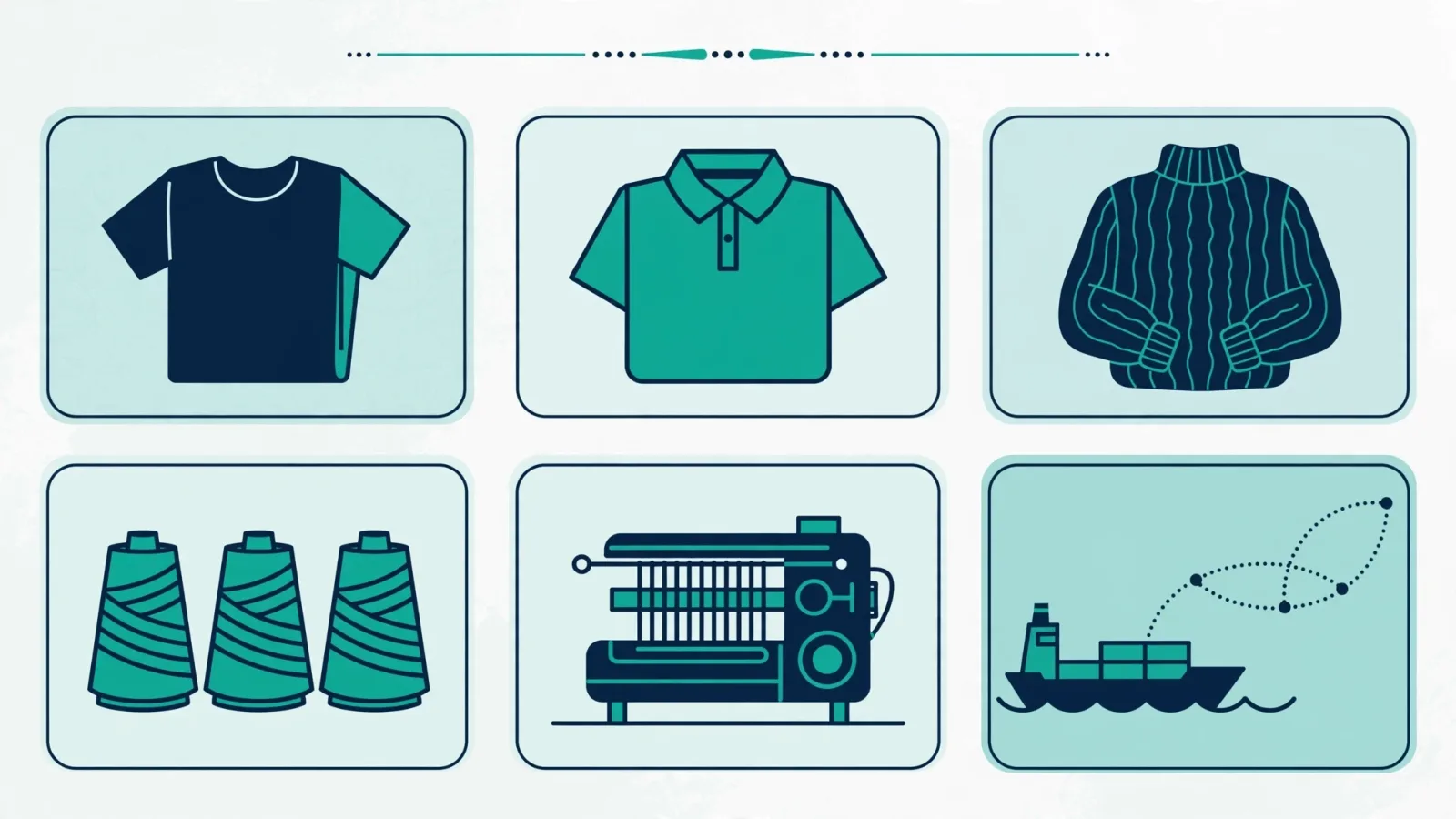
Bangladesh's knitwear output concentrates on the products buyers order in volume: T-shirts and other basic tops; polo shirts; sweatshirts, hoodies and fleece; sweaters, cardigans and other pullovers; underwear and nightwear; loungewear and activewear basics; and children's knitwear. In trade statistics these products sit mainly in HS Chapter 61, which covers articles of apparel and clothing accessories that are knitted or crocheted. The Bangladesh Customs Tariff places T-shirts, singlets and other vests under heading 6109 and jerseys, pullovers, cardigans, waistcoats and similar articles under heading 6110.5 Confirm the exact classification with your customs broker before you cost an order, because fiber content and construction can move an item between headings, and the heading decides the duty treatment at destination. Our guide to how HS codes classify your product explains how chapters, headings and subheadings fit together.
Capacity is organized in clusters, and the cluster map is one of the most useful planning facts in this guide. Mapped in Bangladesh (MiB), the open registry of the garment industry, counted 3,555 export-oriented garment factories across the country, of which 2,720 were associated with BGMEA or BKMEA as of December 2024.6 An MiB survey reported the geographic spread as 1,351 factories in Dhaka, 1,057 in Gazipur, 615 in Narayanganj and 386 in Chattogram, with the rest in other parts of the country.7 In practice, that means most knitwear sourcing happens inside one triangle and one port city:
Dhaka and its outskirts, including Savar and Ashulia, hold the deepest pool of factories and supporting services, from testing labs to buying offices.
Gazipur, north of the capital, is a dense knitwear zone with many factories focused on T-shirts and polo shirts, including large composite units that knit, dye, cut and sew under one roof.
Narayanganj, south-east of Dhaka, is one of the oldest textile centers in the country, with strength in yarn, knitting and dyeing alongside garment making.
Chattogram combines production with the seaport through which most Bangladeshi garment exports leave, which matters for consolidation and shipping schedules.
Factories fall into recognizable types, and the type shapes what an order looks like. Large, vertically integrated groups run their own knitting, dyeing, sewing and finishing and handle big program orders. Specialist factories focus on a narrower range, only T-shirts or only sweaters, and are efficient within it. Smaller units take simpler products and smaller runs, usually with less in-house compliance infrastructure. Buying houses and sourcing agents sit between buyers and factories, coordinating sampling, follow-up and inspection for a fee or commission, which can be useful on a first order. The goal is to match the factory type to your product, volume and compliance requirements, not to default to size alone.
How to find and verify suppliers
Start from your specification, not from a supplier list. An inquiry that states the product, fabric type and weight, composition, colors and sizes, quantity, labeling and packing, destination and delivery window will get meaningful replies. A request for a "cheapest price for T-shirt" will not, because no factory can price a garment it cannot see.
Build a longlist from several channels: BGMEA and BKMEA member information, trade data on which exporters ship your category to your market, referrals from other buyers, and marketplaces where suppliers answer against a structured specification. The association route matters in this industry: BKMEA represents the knitwear sector specifically,4 and our explainer on BGMEA and BKMEA sets out what each body does and what membership does and does not prove.
Verification then works in layers:
Identity and status. Confirm the business is a real, operating exporter. Check association membership, export registration, and that the factory address it gives is where your goods would be made.
Trading reality. A genuine exporter can discuss past programs in specific terms: products, markets, volumes and seasons. Vague answers at this stage rarely improve later.
Capability. Ask what is done in-house, meaning knitting, dyeing, cutting, sewing, finishing and packing, and what is subcontracted, and to whom.
Compliance. Request current audit reports and certificates directly from the supplier, and check the scope and expiry of each one, as the next section explains.
Samples. Order samples made to your specification, not a stock sample from the showroom. Check fabric weight, measurements against your size chart, stitching, color accuracy and labeling. Approve or reject in writing, because the approved sample becomes the production reference standard.
Finally, protect the transaction. Agree everything in a written purchase order or confirmed proforma invoice, use payment terms proportionate to a first order, and treat pressure to pay into an unrelated personal account, or a refusal to provide basic documents, as reasons to walk away. These are not edge cases in cross-border sourcing; they are the standard warning signs.
MOQ, pricing and lead times
Buyers regularly ask for the industry's typical MOQ, price and lead time, and the honest answer is that the knitwear industry in Bangladesh has no single standard for any of the three. Any source that gives one figure for the whole industry is guessing. What can be explained is what drives each number, so you can judge the quotes you receive.
What decides the MOQ for a knitwear order?
MOQ, the minimum order quantity, is set by the economics of a specific style at a specific factory. Fabric is the main driver: a factory knitting or buying fabric for one style works within the minimum quantities and dye-lot sizes of its fabric pipeline, and a custom color or specialized yarn raises that floor compared with a stock fabric. Construction matters too: a basic T-shirt is a simpler production than a multi-component sweater. The MOQ may be quoted per style, per color or per size ratio, and those bases produce very different totals, so always ask which basis applies. Smaller factories generally allow more flexibility and large program factories need larger commitments, but the only MOQ that matters is the one your shortlisted suppliers quote for your specification, in writing.
How is a knitwear price built up?
A knitwear price is built from yarn and fabric cost, dyeing and finishing, cutting and sewing labor, trims, labeling and packing, testing, and the trade term you ask for. That is why this guide states no prices: a figure quoted without fabric weight, composition, size range, quantity and destination cannot be compared with anything. Request quotes from several suppliers on the identical specification and the same Incoterm, then compare the full landed picture, meaning goods, freight, insurance, duty and clearance, not the factory price alone.
To make quotes comparable, send every supplier the same specification sheet. An example specification for a first inquiry looks like this:
Field | Example specification |
|---|---|
Product | Men's crew-neck T-shirt, short sleeve |
Fabric | 100 percent cotton single jersey, 180 GSM |
Colors | Black, navy, white |
Sizes | S to XXL, ratio supplied with the order |
Quantity | 10,000 pieces split across the three colors |
Labeling and packing | Buyer's neck label, single polybag, 24 pieces per carton |
Destination and term | FOB Chattogram, delivery window stated in the inquiry |
Example specification only: the quantities and fabric are illustrative, and each supplier will quote its own MOQ, price and dates against it.
What makes up the lead time?
Lead time is a chain, not a single number: fabric production or procurement, sampling and approval, production scheduling, finishing, inspection and transport to port each take time and each depends on your order. A repeat order in a stock fabric moves faster than a first order in a custom-dyed fabric, and peak seasons stretch schedules across the industry. Ask each supplier for a dated plan, covering the fabric ready date, production start, inspection window and ex-factory date, and build your own planning around the dates the supplier commits to in writing.
Quality, certifications and compliance
Compliance is where Bangladesh's apparel industry has changed most visibly over the past decade. The RMG Sustainability Council (RSC) was registered on 20 May 2020 as a permanent safety monitoring body for the garment sector, and on 1 June 2020 it inherited the operations of the Bangladesh Accord office, including health and safety inspections, remediation monitoring, safety training and a worker complaints mechanism.8 Alongside structural, electrical and fire safety, buyers also assess labor and social compliance, environmental management in wet processing, meaning the water- and chemical-intensive dyeing and finishing stages, and product safety for their own market.
Which certifications matter for knitwear buyers?
The certifications that matter are the ones your market, your customers and your product claims require. The recurring set for knitwear includes OEKO-TEX Standard 100 testing for harmful substances; GOTS where organic fiber content is claimed; social audit evidence such as amfori BSCI or Sedex SMETA; WRAP; and management system certificates such as ISO 9001 and ISO 14001. A certificate only helps if it is current, issued to the factory entity that will make your goods, and scoped to the site and activities involved. A certificate held by a head office or a sister factory does not cover your order. Check the issuer, scope and expiry date on every document, and verify commercially important claims, organic content being the standard example, in the scheme's own database.
How should quality be managed during production?
Quality is managed during production, not inspected in at the end. Agree the standard before production starts: the approved sample, a measurement chart with tolerances, fabric performance requirements such as shrinkage and colorfastness testing, and an inspection plan with an inline check and a final random inspection against a recognized sampling standard such as AQL (acceptable quality limit). Our guide to AQL and the acceptable quality limit explains how AQL sampling works in practice. Define in the purchase order what happens when an inspection fails: rework, re-inspection, and who bears the cost of each. Knitwear has its own defect families, including spirality, shrinkage, shading variation between dye lots and needle damage, so budget for third-party inspection on at least the first orders with any new factory.
Shipping, Incoterms and duties
Most Bangladeshi knitwear leaves by sea through Chattogram port, with air freight reserved for urgent or high-value shipments through Dhaka's airport. Sea transit to European, US and Middle Eastern ports takes weeks rather than days and varies by carrier, routing and transshipment, so work backwards from the delivery date your market needs, using your forwarder's sailing schedules. Knitwear is light, compressible and not fragile, but it must be packed dry and protected from moisture, and carton, polybag and labeling requirements should follow your destination market's rules.
Which Incoterm should you use for knitwear from Bangladesh?
The Incoterm you agree decides who arranges and pays for each leg of the journey and where risk passes from seller to buyer. FOB (Free On Board, Chattogram) is the most common basis for Bangladesh apparel: the supplier delivers the goods on board the vessel and the buyer controls the main freight. EXW (Ex Works) puts almost everything on the buyer. CIF (Cost, Insurance and Freight) and DDP (Delivered Duty Paid) move more to the seller: freight and insurance under CIF, and duties and clearance as well under DDP. No term is right for every order. What matters is that the term, the named place and the Incoterms version are written into the order, and that every quote you compare uses the same term. Our Incoterms guide for shipments from Bangladesh works through each term in detail.
What duty will you pay on Bangladeshi knitwear?
Duties are destination-specific and product-specific, and this guide deliberately states no rates. Your item's HS heading, fiber composition and the preference arrangements in force at the time of import decide the duty. Market access is also in transition. Bangladesh is scheduled to graduate from least developed country (LDC) status on 24 November 2026, and the United Nations LDC Portal records that in 2026 the Committee for Development Policy considered a government request to extend the preparatory period, with the General Assembly still to act before that date.9 For the European Union, Bangladesh currently has duty-free, quota-free access under the Everything But Arms (EBA) arrangement; after LDC graduation, a three-year transition applies, and EBA access is expected to end around the end of 2029 unless the transition is extended.10 Because the rules after that point depend on arrangements still being settled, verify the duty treatment for your product in your destination's official tariff, the USITC Harmonized Tariff Schedule for the United States, EU TARIC for the European Union and the UK Trade Tariff for the United Kingdom, or ask your customs broker to confirm it in writing before you cost the order.
Step-by-step buying process
Define the product and the numbers. Write the full specification: garment type, fabric composition and weight, construction, colors, size range, labeling, packing, quantity, destination and delivery window, plus the compliance evidence your market requires.
Build a longlist and request comparable quotes. Approach several suppliers through association directories, trade data and marketplaces, sending each one the identical specification, Incoterm and destination, so the quotes can be compared.
Verify before you sample. Run the identity, association, trading history and compliance checks described above on your shortlist, and remove any supplier whose documents do not match its claims.
Sample to your specification and approve in writing. Have samples made to your specification, measure and test them, and record the approval, or the corrections required, in writing. The approved sample and specification become your production standard.
Confirm the commercial terms in one document. Record the price, quantity and its basis, specification, packing, inspection plan, payment terms, milestones and ex-factory date in a purchase order or confirmed proforma invoice.
Monitor production, then inspect. Stay in contact during production, require the agreed inline and final inspections, and act on the reports before shipment, not after arrival.
Ship, clear and review. Book freight against the confirmed ready date, check the shipping documents, including the commercial invoice, packing list, bill of lading and certificate of origin, against the order, clear the goods with your broker, and review supplier performance before placing repeat orders.
Related guides
Read the end-to-end overview of how to import from Bangladesh for the full importing process, the document set and the common pitfalls at each stage.
If your first order is a T-shirt program, the focused guide on how to import cotton T-shirts from Bangladesh covers fabric choices, sizing and packing for that product in more depth.
FAQs
Is Bangladesh a good place to source knitwear & t-shirts?
Yes, for buyers of knitted basics and mid-range items at meaningful volume. Knitwear is the bigger of Bangladesh's two apparel segments, at $20.62 billion of the $38.70 billion in garment exports in FY2025-26, per EPB data,1 supported by domestic fabric capacity and concentrated clusters in Dhaka, Gazipur and Narayanganj. It suits buyers whose specification, quantity and compliance requirements match what its factories do well, provided they run proper verification, sampling and inspection. It is a weaker fit for very small, highly customized or extremely time-critical orders.
What is the typical MOQ?
There is no single typical MOQ for Bangladeshi knitwear. The minimum is set per factory and per style by fabric minimums, dye lots, construction and the factory's production model. A basic T-shirt in a standard fabric carries a very different minimum from a custom sweater program in a large composite factory, and the MOQ may be stated per style, per color or per order. Ask each shortlisted supplier to quote its MOQ for your exact specification, confirm the basis, and get the answer in writing.
How long is the lead time?
Lead time is the sum of fabric preparation, sampling and approval, production scheduling, finishing, inspection and transport, so it varies with your fabric, order size, the factory's order book and the season. A repeat order in a stock fabric moves faster than a first order in a custom-dyed fabric, and peak periods stretch timelines across the industry. Require a dated plan for your order, covering the fabric ready date, production start, inspection window and ex-factory date, confirm it in the purchase order, and add your forwarder's transit time for a realistic in-market date.
Which certifications matter?
The certifications that matter are the ones your market, customers and product claims require. For most knitwear buyers, the recurring set is OEKO-TEX Standard 100 product safety testing; GOTS where organic claims are made; social compliance evidence through amfori BSCI, Sedex SMETA or WRAP; and evidence of recognized building and fire safety monitoring through the RMG Sustainability Council.8 Verify that each certificate is current, issued to the factory making your goods, and scoped to the right site and activity.
Next steps on Exportain
Browse Bangladeshi suppliers to build your knitwear longlist by product and cluster, then post a free RFQ with the specification format used in this guide so suppliers quote against the same requirements. Exportain is a marketplace that connects buyers with suppliers and service providers; it does not inspect goods or act as a party to your contract, so keep the verification, sampling and inspection steps in this guide in your own process.
Sources
- Tail-end upturn keeps exports afloat. The Financial Express, (accessed )
- Bangladesh's garment exports grow 6.10% in Q1 of FY27. Business Mirror, (accessed )
- RMG exports to major markets grow in July-September. New Age, (accessed )
- BKMEA at a Glance. BKMEA (accessed )
- Bangladesh Customs Tariff, Chapter 61: Articles of apparel and clothing accessories, knitted or crocheted. National Board of Revenue (accessed )
- Most non-member apparel units ship to non-traditional markets. The Financial Express (accessed )
- 2.7m workers on database. The Financial Express (accessed )
- About Us: RMG Sustainability Council. RMG Sustainability Council (accessed )
- Bangladesh graduation status. United Nations LDC Portal (accessed )
- EU GSP rules and Bangladesh's RMG. The Daily Star, (accessed )
- Knitwear Bangladesh
- Knitwear Exporters
- Bangladesh Export Data
- Category Pillars
- T-Shirts
- Supplier Sourcing
About the author
Sourcing from Bangladesh?
Post a request for quotation and suppliers on Exportain can send you their quotes directly.
Post an RFQ