How to import from Bangladesh: a step-by-step guide for buyers
A practical walk-through of an import order from Bangladesh, from the first specification to the documents your customs broker needs, with the checks that prevent expensive surprises.
Short answer
To import from Bangladesh, write a clear product specification, shortlist Bangladeshi exporters and check their registration documents, compare written quotations on the same Incoterm, approve samples, and agree payment terms such as a letter of credit or bank transfer. The supplier clears export customs in Bangladesh. You or your customs broker clear import customs at destination, using the commercial invoice, packing list, transport document and any proof of origin.
On this page
Key takeaways
Put the specification, quantity, target price and delivery date in writing before you ask anyone for a price.
Ask exporters for their trade license, TIN, VAT registration and Export Registration Certificate (ERC), and read trust badges for what they actually cover.
Compare quotations only after converting them to the same Incoterm and named place.
A letter of credit makes payment depend on documents, not on the goods, so add an inspection certificate if quality matters.
Duty depends on your product's classification in your own country's tariff. Confirm it with a customs broker before you accept a price.
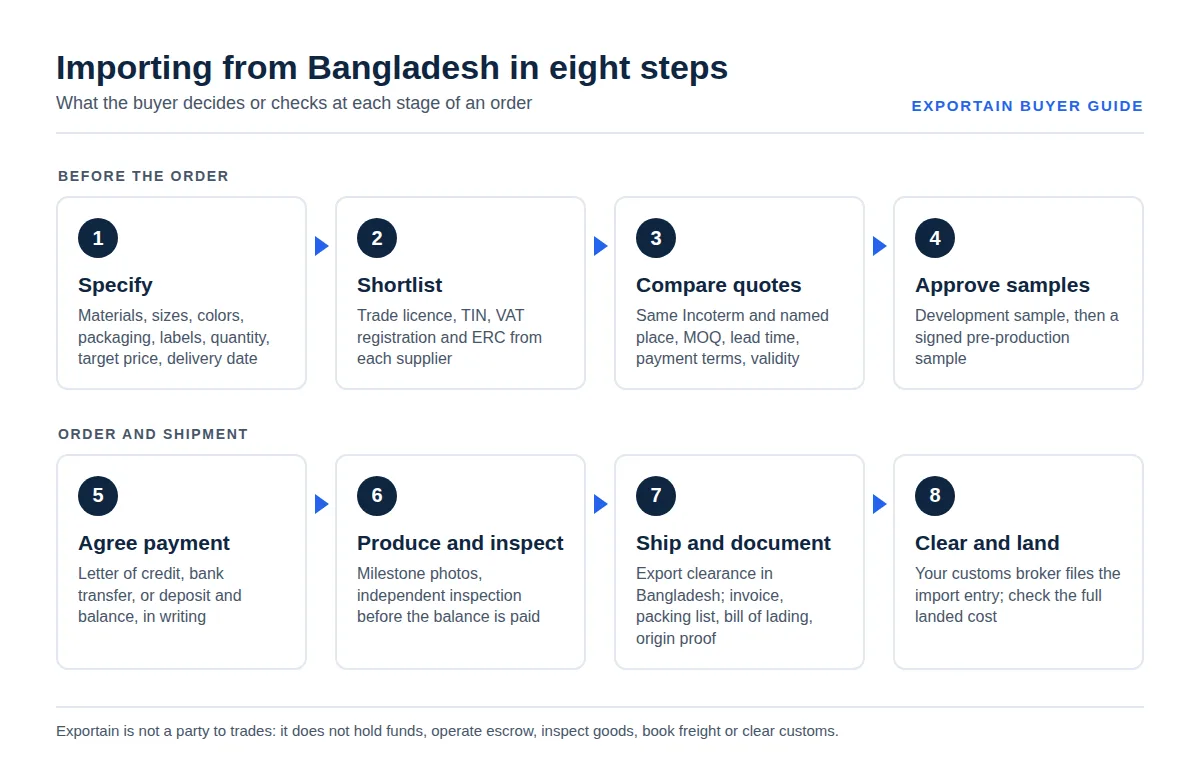
The short version
Write down what you are buying: specification, quantity, target price, currency and the date you need the goods.
Shortlist Bangladeshi suppliers and ask for their registration documents.
Send the same request for quotation (RFQ) to each one and compare the answers on the same Incoterm.
Approve a sample, then a pre-production sample, before bulk production starts.
Agree payment terms in writing: a letter of credit, a bank transfer structure, or a mix.
Follow production, arrange an inspection if quality matters, and book freight according to the Incoterm.
Collect the shipping documents and pass them to your customs broker early.
Check the landed cost, not just the unit price, before you commit.
Decide what you are buying
A factory can only quote what you describe, and it fills every gap with its own assumptions.
A useful specification covers:
Product details: materials and composition (for textiles, the fiber content and fabric weight), dimensions or size chart, colors, and any construction details that affect cost.
Packaging and labeling: units per carton, carton marks, hang tags, care labels and any language your market requires on the label.
Compliance: the tests or certificates your market or your customers require. Name them. "Good quality" is not a specification.
Quantity: per style and per color, not just an order total.
Target price: a number, a currency and the Incoterm it refers to.
Delivery date: say whether you mean the date the goods leave Bangladesh or the date they reach your warehouse. These can be weeks apart.
Know where the supply base is deep
Bangladesh's export base is concentrated. Export Promotion Bureau figures for July 2025 to June 2026 put total merchandise exports at US$48.00 billion, of which ready-made garments (knitwear and woven garments) accounted for US$38.70 billion.1 Several other sectors each exported close to or above US$1 billion in the same period.
Sector (EPB summary, July–June 2025-26) | Exports, US$ million |
|---|---|
Knitwear (HS chapter 61) | 20,623.83 |
Woven garments (HS chapter 62) | 18,077.32 |
Leather and leather products | 1,226.25 |
Agricultural products | 975.39 |
Home textiles | 928.42 |
Jute and jute goods | 883.69 |
Engineering products | 652.15 |
Frozen and live fish | 443.42 |
A large sector means more suppliers to compare. It says nothing about any one supplier.
Find and shortlist suppliers
On Exportain you can search the supplier directory by product and category, and filter to suppliers that hold trust badges.
Before you spend time on samples, ask each supplier for:
the legal company name and address, and whether it makes the product itself or sources it from another factory;
its trade license, Taxpayer Identification Number (TIN) and VAT registration;
its Export Registration Certificate (ERC).
These are not arbitrary requests. Bangladesh Customs lists a VAT registration certificate and a TIN among the documents an exporter attaches to the export declaration.2 Bangladesh Bank's foreign exchange guidelines tell banks to confirm that an exporter is registered with the Office of the Chief Controller of Imports and Exports (CCI&E) before certifying its export form.3 An exporter that ships regularly should have these papers ready.
On Exportain, a trust badge tells you which of these checks the Exportain team has reviewed. Export Verified means the team has checked the seller's ERC. Factory Verified means it has reviewed photos of the manufacturer's factory.4 A badge is a document and photo review. It is not a factory inspection and not a guarantee of capacity, quality or delivery, and membership plans never grant one.4 Read what each badge covers before you rely on it, and see how supplier verification works on Exportain for the detail.
Request quotations and compare them
Send every shortlisted supplier the same RFQ. On Exportain, an RFQ states the quantity and unit, target price, destination, Incoterm, required certifications and a deadline, and suppliers in that category can quote against it.5 You can post an RFQ here. Our guide to writing an RFQ that gets useful quotations covers the fields in detail.
Compare the replies line by line:
Term | What to check |
|---|---|
Unit price | Currency, and whether packing and labels are included |
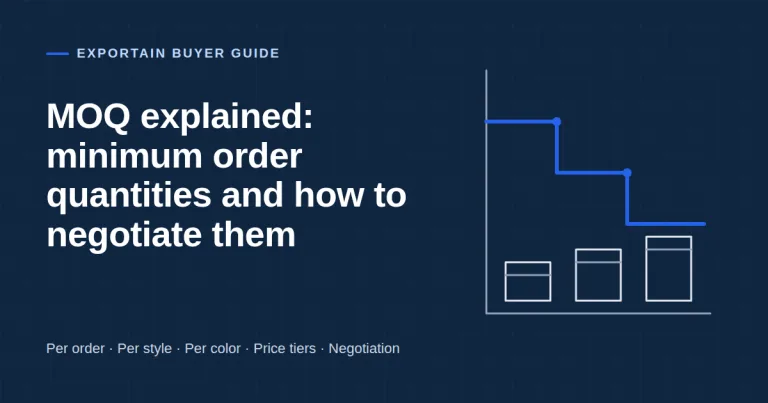
MOQ | Per order, per style or per color (see MOQ explained) |
Lead time | Counted from what: order, deposit, sample approval or LC receipt |
Incoterm | The rule and the named place, for example FOB Chattogram |
Payment terms | When each payment is due and against which document |
Validity | The date after which the price no longer holds |
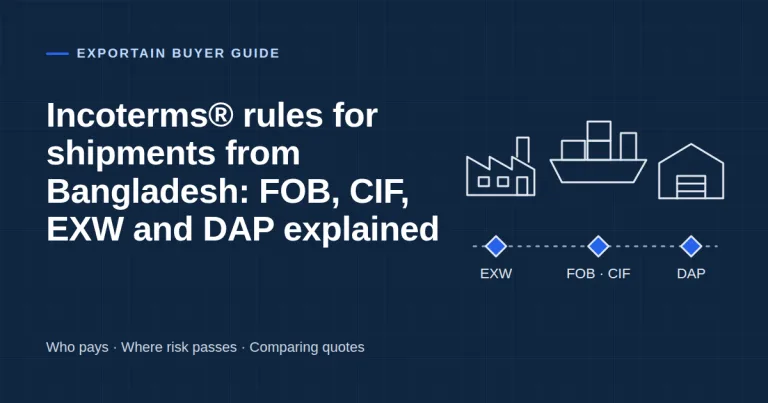
Two prices on different Incoterms are not comparable. The Incoterms® 2020 rules are a set of eleven trade terms that clarify the tasks, costs and risks between seller and buyer.6 7 A CIF price includes sea freight and insurance to the destination port, and an FOB price does not,6 so convert both to one basis before you decide. Our Incoterms guide explains FOB, CIF, EXW and DAP side by side.
One detail worth raising with a supplier: when goods are handed to the buyer's forwarder before they are loaded on the vessel, Bangladesh Bank's guidelines point to FCA rather than FOB, because FOB in that situation adds risk and cost for the exporter.3
Samples and pre-production approval
Treat samples as part of the contract, not a courtesy.
Development sample. Confirms the supplier understood the specification. Expect comments and a second round.
Pre-production sample. Made with the actual materials, trims and labels for the bulk order. Approve it in writing and keep one signed or sealed piece yourself, with a matching piece at the factory.
Shipment sample. Taken from finished production, so you can compare it with the approved sample before the goods leave.
Agree in advance who pays for samples and courier costs, and whether sample charges are credited against the order.
Agree payment terms
Payment terms decide who carries the risk if something goes wrong:
Letter of credit (LC). Your bank commits to pay the supplier once the supplier ships and presents the documents the credit requires.8 The banks check those documents against the credit's terms. They do not look at the goods, so if quality matters, make an inspection certificate from a company you name one of the required documents. LCs involve bank fees, and documents with discrepancies delay payment.8
Bank transfer in advance. Simple and quick, but it gives the supplier the money before you have the goods. The U.S. International Trade Administration calls cash in advance the least attractive option for the buyer, because of cash flow and the risk that goods are not sent.9
Deposit and balance. A partial transfer before production and the balance against shipping documents or an inspection result. It splits the risk; the split and the trigger for the balance are what you negotiate.
Documentary collection and open account. Banks can handle documents without guaranteeing payment (a collection), or the supplier can ship and wait to be paid (open account). Both need more trust on the supplier's side.9
Exportain is not a party to the trade. It holds money for a goods order only when both parties agree to a funds hold; otherwise payment is settled directly between you and the supplier. When you accept a quotation on Exportain, the platform records an order and a proforma invoice with the quoted terms, and you settle payment directly with the supplier on those terms.5 10
Production, inspection and shipping
During production, ask for dated photos at agreed milestones, and confirm the shipping date as it approaches.
If quality matters, book an inspection by an independent company before the balance is paid or before the LC documents are presented. Exportain lists quality inspection providers, but Exportain itself does not inspect goods.10
Who books the main freight depends on the Incoterm. Under FOB you or your forwarder book the vessel; under CIF the supplier does. You can compare freight rates that forwarders have published on Exportain for your lane.
On the Bangladesh side, the supplier submits an export declaration (the bill of export) with the required documents. Customs checks the documents and verifies the goods, and the cargo is loaded once the declaration is approved.2 Chattogram, at the mouth of the Karnaphuli river, is Bangladesh's main seaport.11
If your goods go to the United States by sea, most elements of the importer security filing are due no later than 24 hours before the cargo is loaded on the vessel at the foreign port.12 Your broker needs the supplier's details early to meet that deadline.
Documents you will receive and what your customs broker needs
For a typical sea shipment, expect a commercial invoice, a packing list, a bill of lading, and, where it applies, a certificate or statement of origin plus product-specific certificates. Our guide to export documents from Bangladesh explains each one.
What your broker needs depends on your country. Two examples:
United States. Entry documentation includes the entry form, evidence of the right to make entry, a commercial invoice and, where appropriate, a packing list.13 The invoice must be in English or come with an accurate English translation, and must show details such as a full description, quantities, the purchase price and the country of origin.14
United Kingdom. Your import declaration needs the commodity code and the value of the goods. Some goods, including plants and animal products, need licenses or certificates, and you must keep commercial invoices and customs paperwork.15
Preferential duty needs the right proof of origin. The EU says Bangladesh, scheduled to graduate from least developed country status in 2026, will keep Everything But Arms preferences at least until the end of 2029.16 The UK lists Bangladesh in the Comprehensive Preferences tier of its Developing Countries Trading Scheme.17 Whether your product qualifies depends on the rules of origin, so confirm with your broker before the goods ship.
Landed cost: what you pay beyond the unit price
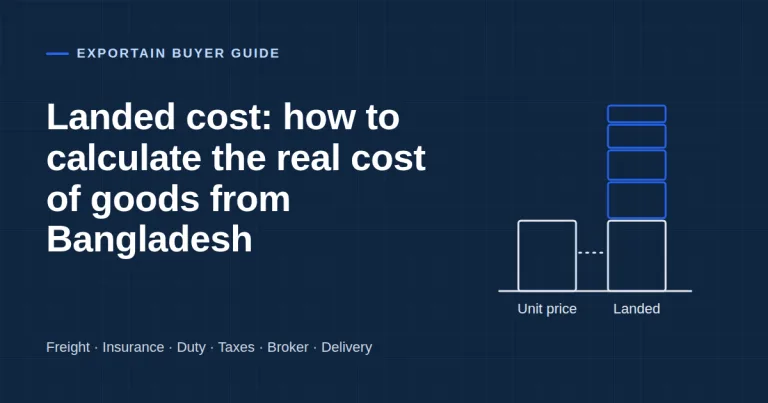
Landed cost is everything you pay to get the goods into your warehouse:
product cost on the quoted Incoterm;
main freight and cargo insurance, if not included;
import duty and import taxes;
customs broker and port or terminal charges;
inland transport at destination;
inspection, testing and sample costs;
bank charges, LC fees and currency conversion.
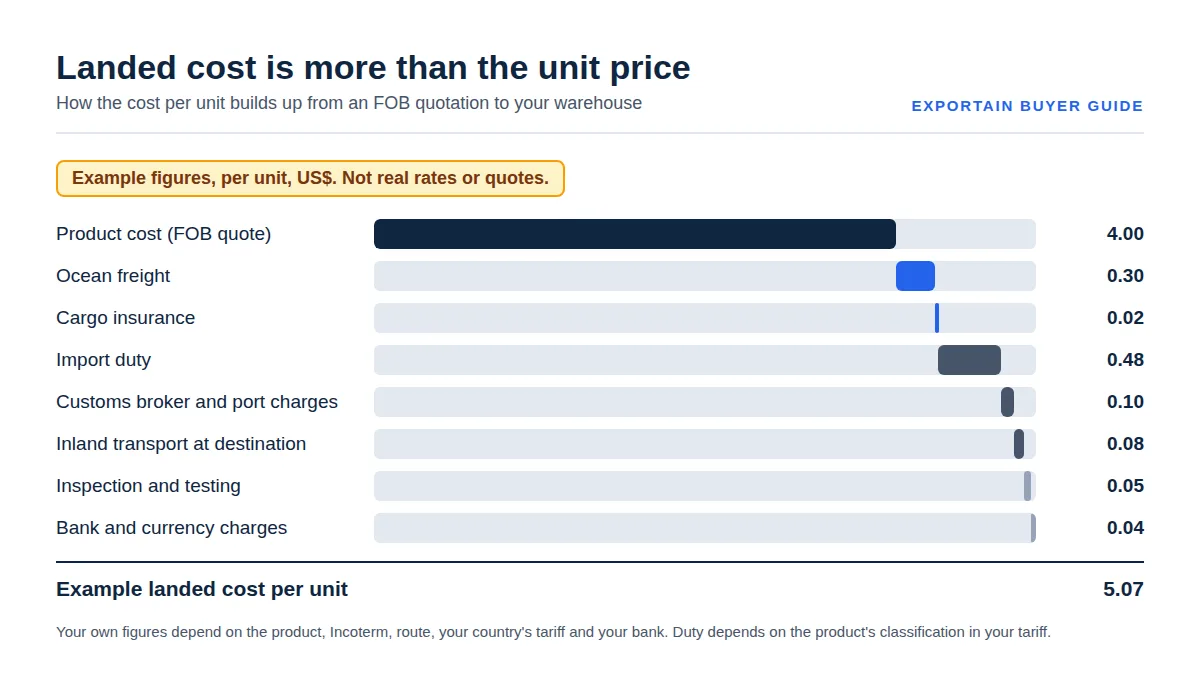
Duty depends on classification. The Harmonized System gives goods a six-digit code used by more than 200 countries and economies as the basis of their tariffs, and each country makes its own product decisions beyond those six digits.18 19 Look up your rate in your own tariff, such as the UK Trade Tariff or the EU's TARIC database.19 20 Our HS code guide walks through classification, and the landed-cost estimator on Exportain lets you enter your own figures. For a full worked method, see how to calculate landed cost.
Common mistakes
Comparing an FOB quote with a CIF quote as if they were the same. Convert them first.
Using the supplier's HS code without checking it. Only the first six digits are shared internationally, and the UK government advises importers to check how an overseas supplier's code applies in their own tariff.19
Paying before the specification and the pre-production sample are approved in writing.
Opening an LC with conditions the supplier cannot meet. Send the draft to the supplier before your bank issues it.
Treating a trust badge as a factory audit. It records which documents and photos were reviewed.4
Leaving origin documents to the last minute. Preferences are claimed with proof of origin that the exporter provides, so agree early who issues it and when.21
Forgetting import licenses and labeling rules in your own market.15
Next steps on Exportain
Browse Bangladeshi suppliers in your category, or post an RFQ with your specification and let suppliers quote against it. The How to buy page shows each step on the platform, including what happens when you accept a quotation.
Sources
- Summary Sheet: Export Performance for July-June 2025-2026 (Excel file on the EPB export data page). Export Promotion Bureau, Bangladesh (accessed )
- Procedures: Export. Bangladesh Customs, National Board of Revenue (accessed )
- Guidelines for Foreign Exchange Transactions (GFET) 2018, Vol. 1, Chapter 8, Section I: Exports. Bangladesh Bank (accessed )
- Trust & Safety Center. Exportain (accessed )
- How to source and buy from Bangladesh. Exportain (accessed )
- Incoterms® 2020. International Chamber of Commerce (ICC) (accessed )
- Incoterms® rules. International Chamber of Commerce (ICC) (accessed )
- Letter of Credit. International Trade Administration, U.S. Department of Commerce (accessed )
- Methods of Payment. International Trade Administration, U.S. Department of Commerce (accessed )
- About Exportain. Exportain (accessed )
- পটভূমি ও কার্যক্রম (Background and activities). Chittagong Port Authority (accessed )
- 19 CFR 149.2 Importer security filing: requirement, time of transmission. Electronic Code of Federal Regulations (U.S.) (accessed )
- 19 CFR 142.3 Entry documentation required. Electronic Code of Federal Regulations (U.S.) (accessed )
- 19 CFR 141.86 Contents of invoices and general requirements. Electronic Code of Federal Regulations (U.S.) (accessed )
- Import goods into the UK: step by step. GOV.UK (accessed )
- Questions and answers on the new EU Generalised Scheme of Preferences. European Commission, Directorate-General for Trade (accessed )
- Preference tiers under the Developing Countries Trading Scheme. GOV.UK (Department for Business and Trade), (accessed )
- What is the Harmonized System (HS)?. World Customs Organization (accessed )
- Finding commodity codes for imports or exports. GOV.UK (HM Revenue & Customs), (accessed )
- EU Customs Tariff (TARIC). European Commission, Taxation and Customs Union (accessed )
- How to claim preferences under the Developing Countries Trading Scheme (DCTS). GOV.UK (Foreign, Commonwealth & Development Office and Department for Business and Trade), (accessed )
About the author
Sourcing from Bangladesh?
Post a request for quotation and suppliers on Exportain can send you their quotes directly.
Post an RFQ