

Export Documents from Bangladesh: Every Document a Shipment Needs, Explained
Every export document from Bangladesh explained, from commercial invoice and EXP form to certificate of origin, insurance and inspection, with a copy-ready checklist.
Short answer
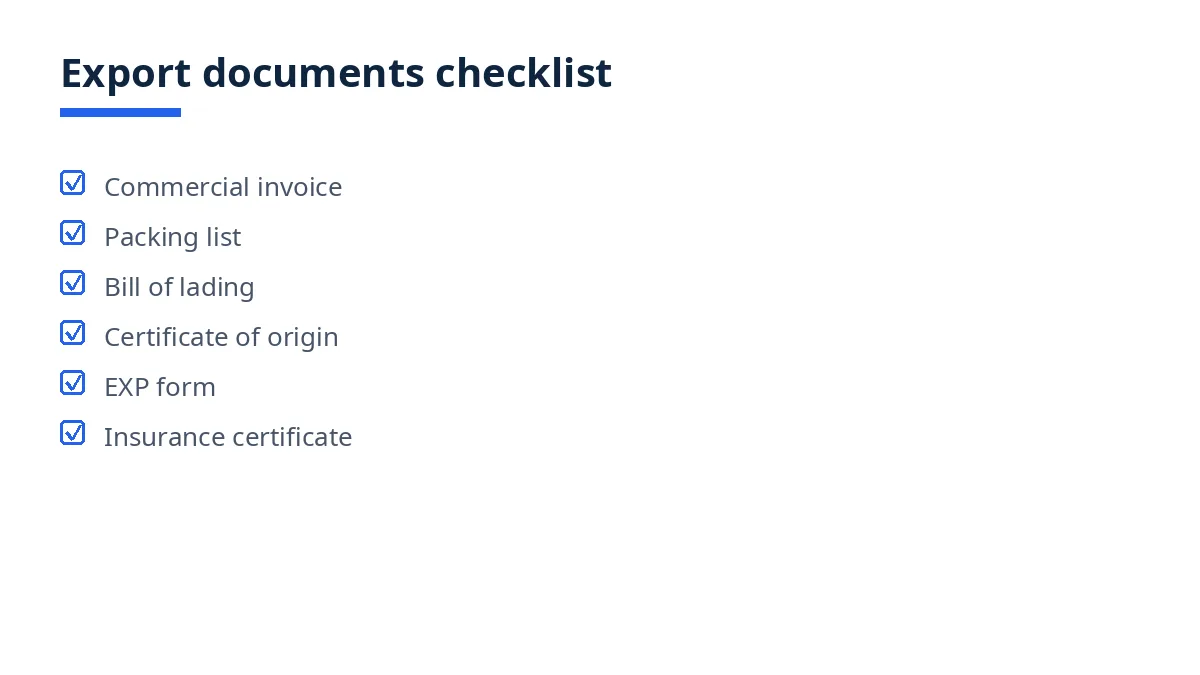
An export shipment from Bangladesh needs a commercial invoice, a packing list and a bill of lading for sea freight or an air waybill for air freight. The exporter also files a bank-certified EXP form and a Bill of Export with Bangladesh Customs, supported by a certificate of origin. Insurance, inspection, phytosanitary and fisheries certificates are added when the product, destination, Incoterm or payment method requires them.
On this page
Key takeaways
Every shipment starts with three documents: commercial invoice, packing list, and bill of lading for sea freight or air waybill for air freight.
The exporter also files a bank-certified EXP form and a Bill of Export with Bangladesh Customs, and holds an Export Registration Certificate (ERC).
A certificate of origin proves where goods were made. Preferential proof of origin is what lets a buyer claim reduced or zero duty.
Product certificates are conditional: phytosanitary for plant products and a fisheries quality control certificate for frozen fish, where the destination requires them.
Under a letter of credit, banks examine documents, not goods. Every name, description, quantity, weight and date must match.
Export documents from Bangladesh can look confusing at first, but every shipment rests on a small core set: a commercial invoice, a packing list and a transport document. A second, Bangladesh-side set is filed by your supplier with Bangladesh Customs and its bank, and a third, conditional set depends on your product, destination, Incoterm and payment method. Get the core set right, agree the conditional set in the contract, and your goods clear export in Bangladesh and enter your market with far fewer delays.
This guide explains every document: what it is, who issues it, what must be on it, and when you need it. Bangladesh Customs requires an export declaration, known as a Bill of Export or Shipping Bill, to be submitted and approved before goods are loaded for export, and it lists the documents that must be enclosed with that declaration for all export consignments.1 At the end is a complete checklist table you can copy into your purchase order or letter of credit application.
The three layers of documents
Think of the set in three layers. Core commercial documents travel with every shipment and reach you, the buyer. Bangladesh-side regulatory documents are filed by the exporter with its authorised dealer bank and Bangladesh Customs, and they authorise the export itself. Conditional documents appear only when your product, destination, Incoterm or payment method requires them.
This separation helps you brief a supplier correctly. Specify and check the core documents yourself, ask the supplier to confirm the regulatory documents are in place before production finishes, and name every conditional document, with the issuer you will accept, in the contract, because a certificate that was never ordered cannot be created after shipping.
Commercial invoice
The commercial invoice is the seller's bill for the goods and one of the main documents customs in your country uses to assess duty. Bangladesh Customs requires a commercial invoice containing a detailed description of the goods and signed by the exporter, enclosed with the Bill of Export.1
A complete invoice should show:
Invoice number and date, with the same number quoted on the packing list.
Full legal names and addresses of seller and buyer, and the consignee if different.
A description a customs officer can classify: material, construction and use, not only a style number. Adding the HS code helps your broker. See the HS code guide for how the code is structured.
Quantity, unit price, currency and total, with charges that are not in the price, such as freight and insurance, shown separately where they apply.
The Incoterm and named place, for example FOB Chattogram. See Incoterms for shipments from Bangladesh for how the term changes who arranges transport and insurance.
The letter of credit number if applicable, and the country of origin.
Consistency matters across the whole set. The EXP form records invoice value split into FOB, insurance and freight elements,2 so the invoice, the EXP form and the transport document must tell the same story. If your destination market prescribes specific invoice content, build that list into your supplier briefing before production rather than asking for corrections after shipment.
Packing list
The packing list shows what is physically in the shipment, package by package. Bangladesh Customs requires a packing list containing quantity, weight and packing information, enclosed with the Bill of Export,1 and your warehouse and broker use the same document on arrival.
A complete packing list shows seller, buyer, shipper, invoice number, shipment date, mode of transport and carrier, and for each package: contents, package type (carton, pallet, bale or crate), units, net weight, gross weight, marks and numbers, and dimensions. It does not replace the invoice. The invoice is about value, the packing list is about physical contents, and the two must agree on quantities and weights.
A classic delay is a packing list total that differs by a few kilograms from the bill of lading weight. Weigh the finished cartons once, finally, then issue all documents from those figures.
Bill of lading for sea freight
For sea freight, the bill of lading is the carrier's document. It is a receipt for the goods and evidence of the contract of carriage, and in negotiable form it can also act as a document of title. An ocean bill of lading, if consigned "to order" and negotiated, may transfer ownership of the goods and must be endorsed by the party ultimately accepting the goods.3
A straight bill of lading is non-negotiable and names a specific consignee. A negotiable or "order" bill of lading can be endorsed and transferred, which is why banks under a letter of credit often require bills made out to the order of a bank. Check: shipper and consignee, notify party, vessel and voyage, ports of loading and discharge, container and seal numbers, package count, weights and measurements, the freight notation (prepaid or collect, matching your Incoterm), and the "on board" notation and date. That on board date is the shipment date banks rely on.
If a freight forwarder issues a house bill of lading instead of the carrier's bill, agree in the contract and in any letter of credit whether that form is acceptable. If you need the carrier's bill, say so in the credit. If you accept a house bill, say that too. Silence on this point is a common source of presentation disputes.
Air waybill for air freight
For air freight the transport document is the air waybill. An air waybill is a receipt issued by an international airline for goods and evidence of the contract of carriage, and it is not a document of title to the goods.3 The air waybill is non-negotiable, so the named consignee collects the goods by identity, not by surrendering an original document of title.
That difference changes the risk picture. Because an air waybill does not transfer ownership, consigning goods directly to an importer before payment carries more risk than the equivalent sea shipment under an order bill. Align the consignee wording on the air waybill with your payment terms, and agree the acceptable form, carrier air waybill or forwarder house air waybill, before any letter of credit is issued.
Certificate of origin
A certificate of origin states where goods were produced. It comes in two families, and confusing them is expensive.
Non-preferential certificates certify origin with no duty benefit attached. Bangladesh Customs lists a certificate of origin, issued by the Export Promotion Bureau (EPB) or a chamber of commerce and industry, among the documents enclosed with the Bill of Export.1 In the EU framework, a certificate of non-preferential origin certifies that the country of origin does not qualify for preferential treatment, and these certificates are normally issued by chambers of commerce.4
Preferential proof of origin is what reduces your duty:
European Union: The REX system is based on self-certification by economic operators who issue statements on origin themselves, added to the invoice or another commercial document, and to make out a statement on origin an operator must be registered in a database by the competent authorities of its country of origin and become a registered exporter.4 Bangladesh exporters register through the EPB. Separately, the EU Everything But Arms arrangement grants duty-free and quota-free access for almost all products except arms and ammunition to least developed countries.5
United Kingdom: Under the Developing Countries Trading Scheme, products must have either a Form A, which does not need to be stamped or signed by an authority designated by the beneficiary country, or an origin declaration on an invoice, packing list or consignment note that identifies the originating product, and both forms are valid for two years from their date of issue.6
In both cases goods must meet the product-specific rules of origin. Origin is about where goods were made, not where they were shipped from. Ask early whether the product qualifies, and have your broker confirm before shipment.
EXP form
The EXP form is Bangladesh's export declaration for exchange control. Bangladesh Bank introduced an electronic option for EXP form submission through its online reporting portal, under which exporters submit the form before customs formalities, authorised dealer banks accept the electronically submitted form, and its information becomes available in the customs electronic system.2 Exports are subject to repatriation of the full proceeds within the specified period, and the declaration procedure supports that tracking.2
The EXP form itself records, among other items, the commodity, destination, quantity, the invoice value split into FOB, insurance and freight, the terms of sale, the importer or consignee, the transport document number, the shipment date, and the exporter's CCI&E registration number.2 Bangladesh Customs also lists the EXP form certified by authorised dealers, to ensure realisation of export proceeds, among the documents enclosed with the Bill of Export.1
You will not normally receive the EXP form, but it affects you twice. First, no certified EXP form means no lawful export clearance, so a supplier who cannot complete the declaration cannot ship. Second, its values must match your commercial invoice, so last-minute price or freight changes after the declaration create rework. Freeze commercial terms before the supplier files.
Export declaration and the supplier's registrations
The export declaration, the Bill of Export, is the exporter's filing with Bangladesh Customs. Goods are not allowed to be loaded or stuffed into containers for export unless a Bill of Export is submitted in the prescribed format and approved by the customs authority, and the declaration specifies the description of goods, value, name of the exporter, name of the foreign buyer or importer, and name of the transport operator.1 The documents enclosed with it for all consignments are the export letter of credit, or if there is none, the export contract, purchase order or export guarantee approved by the negotiating bank, the commercial invoice, the packing list, the certified EXP form, the certificate of origin, the VAT registration certificate, and the Taxpayer Identification Number (TIN).1
Behind the declaration sit the supplier's standing registrations:
Export Registration Certificate (ERC). An ERC is a mandatory requirement for business entities exporting any kind of goods or products from Bangladesh, and the Office of the Chief Controller of Imports and Exports (CCI&E) is the sole authority that provides it.7 See the ERC guide for how suppliers obtain and renew it. Bangladesh Customs also lists an ERC among the additional documents for jute, jute goods and tea.1
Trade licence, VAT registration and TIN. The VAT registration certificate and TIN are part of the standard Bill of Export enclosures.1
Chamber or trade-body membership, where the sector requires it for the supplier's own registrations and export formalities.
On Exportain, trust badges are reviews of documents and photos. They are not factory inspections, certifications or guarantees, and they are not a substitute for your own quality controls.
Insurance document
An insurance document, a marine policy or, commonly, an insurance certificate, shows that cargo is insured, for what value, against which risks, and from where to where. Whether you see one depends on your Incoterm. Under CIF in Incoterms 2020, the seller must arrange insurance that complies with Clause C, minimum cover, of the Institute Cargo Clauses or similar clauses, and must arrange and pay for maritime carriage to the port of destination.8 See CIF: cost, insurance and freight for the full CIF allocation of costs and risk. Under FOB or EXW, insurance is normally the buyer's own arrangement, because those rules do not place a seller insurance obligation of that kind.
Where an insurance document is required by the Incoterm or a letter of credit, check that the insured value, currency, goods description, voyage and risk cover match the credit and the invoice, that it is dated no later than the shipment date, and that it is endorsed if the credit requires negotiability. A certificate naming a different voyage or a lower value is a discrepancy, even if separate cover exists.
Inspection certificate and test reports
An inspection certificate records that an independent inspector, or, where the contract allows, the supplier's quality team, examined the goods before shipment and reported quantity, quality, packing and marking against the order. A test report records laboratory results against a named standard or regulation in your market.
Neither exists by default. Both are created by your contract. Name the inspection type, the standard or acceptance quality limit level, the inspecting company you will accept, and when the inspection happens. The common structure is a pre-shipment inspection of finished, packed goods. See pre-shipment inspection for how that inspection is usually organised. If the certificate is to be a payment condition under a letter of credit, list it in the credit with exact issuer wording, otherwise a supplier-issued certificate may be all the bank can accept.
Product-specific certificates
Bangladesh Customs lists additional certification and documents for particular goods.1 The main ones a buyer is likely to meet are:
Phytosanitary certificate for agricultural goods such as vegetables and corn, as required by the destination country, issued by the Plant Protection Wing of the Department of Agricultural Extension.1
Quality control certificate from the Department of Fisheries for frozen fish, where the destination country requires it.1 This is the certificate to name in contracts for frozen seafood shipments.
Consignment-wise export permit from the Bangladesh Tea Board for tea.1
Utilisation declaration for ready-made garments exported under a bonded warehouse, or a utilisation permission for other goods under a bonded warehouse.1
ERC for jute, jute goods and tea, listed by Customs among the category-specific documents.1
Your market can add a second layer of licences or certificates for plants, animals, animal products and food. Identify both layers at quotation stage and name every certificate, with its issuer, in the contract.
Pro forma invoice, purchase order and contract
Three upstream documents determine whether the shipment set succeeds. The pro forma invoice fixes the description, quantities, price, Incoterm and payment terms that the real invoice, the EXP form and any credit will copy. The purchase order is the buyer's instruction and, without a credit, the contract or purchase order is filed with Customs as part of the Bill of Export set.1 The sales contract governs quality, inspection rights, the document list and the shipment date. Most discrepancies are born here. Use one agreed description everywhere.
Documents under a letter of credit
A letter of credit turns documents into the condition for payment. The exporter ships, presents the listed documents to its bank, and the banks examine them under the ICC UCP 600 framework. Under UCP 600 Article 5, banks deal with documents and not with goods, services or performance to which the documents may relate, and banks examine a presentation on the basis of the documents alone to determine whether it appears on its face to be a complying presentation.9 A presentation can therefore be refused for a wrong port, a late date, or a description that does not correspond, even when the cargo itself is right.
Before your bank issues a credit:
List every required document and confirm the supplier can obtain each one, with that issuer, in time.
Copy the description, quantities, Incoterm and ports from the pro forma invoice.
Leave enough time between the latest shipment date and expiry for preparation and presentation.
State whether forwarder documents are acceptable or the carrier's bill is required.
Send the draft to the supplier and resolve objections before issue.
On telegraphic transfer or open account terms, no bank examines the set in this way, so your own checklist below is the only control.
On the import side
Export documents become your import entry documents. Your broker builds the entry from the commercial invoice, packing list, transport document, and any product certificates required at destination. Keep the invoice, proof of origin and customs paperwork together after clearance. The proof of origin supports your duty claim and can be checked later. Build the document set at quotation stage so the landed cost and the duty treatment are priced on the same facts.
Checklist: every export document from Bangladesh
Copy this table into your order file and check each document off for your product and destination.
Document | Who issues it | When it is needed | Buyer action |
|---|---|---|---|
Pro forma invoice | Exporter | Before order or LC opening | Approve description, price, Incoterm |
Purchase order or contract | Buyer or both parties | Before production | Name every required document and issuer |
Commercial invoice | Exporter | Every shipment | Check description, HS code, values, Incoterm |
Packing list | Exporter | Every shipment | Check quantities and net and gross weights against the transport document |
Bill of lading | Ocean carrier | Sea shipments | Check consignee or order wording, ports, on board date |
Air waybill | Air carrier | Air shipments | Check consignee wording against payment terms |
EXP form | Exporter, certified through its authorised dealer bank | Every export | Confirm the supplier can file before shipment |
Export declaration (Bill of Export) | Exporter, filed with Customs | Every export | Supplier filing, no buyer action |
Export Registration Certificate | CCI&E | Held by the exporter | Verify the supplier holds a current ERC |
Certificate of origin (non-preferential) | EPB or chamber of commerce | With the declaration, and if a buyer, bank or LC requires it | Request it in the document list if needed |
Statement on origin (EU, REX) | Registered exporter | To claim EU preferences | Confirm registration before shipment |
Origin declaration or Form A (UK) | Exporter | To claim UK DCTS preferences | Agree the form before shipment |
Insurance policy or certificate | Insurer | CIF sales, or when an LC requires it | Check value, risks, voyage, date and endorsement |
Inspection certificate | Company named in the contract | When the contract or LC requires it | Name the issuer and standard in the contract and LC |
Test report | Accredited laboratory | When destination rules or the contract require it | Name the standard and laboratory requirements |
Phytosanitary certificate | Plant Protection Wing, Department of Agricultural Extension | Plant products, where the destination requires it | Confirm the destination requirement early |
Fisheries quality control certificate | Department of Fisheries | Frozen fish, where the destination requires it | Confirm the destination requirement early |
Tea export permit | Bangladesh Tea Board | Tea, consignment by consignment | Confirm the supplier obtains it per shipment |
Utilisation declaration | Exporter under bonded warehouse | Ready-made garments under bonded warehouse | Supplier filing, no buyer action |
Common mistakes that delay shipments
Descriptions that drift. "Cotton tees" on the invoice and a different wording in the credit create a discrepancy. Use one description everywhere.
Weights that do not reconcile. Totals taken from different weighings will not match. Weigh once, finally, and issue all documents from those figures.
Origin claimed without qualification. Goods shipped from Bangladesh do not automatically meet a scheme's rules of origin.
Certificates ordered too late. Government and laboratory certificates have lead times. Order them at production start.
A credit that asks for the impossible. Documents the supplier cannot obtain, or dates with no presentation window, will fail at presentation.
Forwarder documents by surprise. A house bill where the credit required a carrier's bill is a discrepancy, not a detail.
Frequently asked questions
What documents are needed to export from Bangladesh?
Every shipment needs a commercial invoice, a packing list and a transport document, a bill of lading for sea freight or an air waybill for air freight. Bangladesh Customs requires those documents, plus a certified EXP form and a certificate of origin, to be enclosed with the Bill of Export, along with the VAT registration certificate, TIN, and the letter of credit or, without one, the contract or purchase order.1 Product, destination and payment terms add conditional documents such as preferential proof of origin, insurance, inspection and phytosanitary certificates.
Who issues the certificate of origin in Bangladesh?
A non-preferential certificate of origin is issued by the Export Promotion Bureau (EPB) or a chamber of commerce and industry, as listed by Bangladesh Customs.1 Preferential proof is different. For the EU, a registered exporter makes out a statement on origin itself under the REX system.4 For the UK, the exporter provides an origin declaration or a Form A under the Developing Countries Trading Scheme.6
What is an EXP form?
The EXP form is Bangladesh's export declaration for exchange control, submitted by the exporter and certified through its authorised dealer bank. Bangladesh Bank provides an electronic submission option through its online reporting portal, with the information then available to Customs, and the form records the export value, including FOB, insurance and freight elements, and the exporter's CCI&E registration number.2 Its figures must match the commercial invoice.
What is the difference between a bill of lading and an air waybill?
A bill of lading for sea freight is a receipt and evidence of the contract of carriage, and in negotiable "order" form it can transfer ownership of the goods. An air waybill is a receipt and evidence of the contract of carriage only. It is not a document of title and it is non-negotiable, so the named consignee collects the goods by identity.3
Do I need an inspection certificate?
No general rule requires an inspection certificate for every shipment. You need one only if your contract or letter of credit requires it. Name the inspection company, the standard or acceptance level and the timing in the contract, and repeat the exact issuer wording in the credit if the certificate is a payment condition.
Which documents does the bank check under a letter of credit?
The bank checks exactly the documents the credit lists, typically the invoice, packing list, transport document, and any origin, insurance or inspection certificates named in the credit. Banks deal with documents and not with goods under UCP 600 Article 5, and they examine a presentation on the basis of the documents alone, so any inconsistency can make the presentation discrepant.9
What extra documents do garments, tea and frozen fish need?
Ready-made garments exported under a bonded warehouse travel with a utilisation declaration. Tea needs a consignment-wise export permit from the Bangladesh Tea Board. Frozen fish needs a quality control certificate from the Department of Fisheries where the destination country requires it, and agricultural goods need a phytosanitary certificate from the Plant Protection Wing where the destination requires it.1
Next steps on Exportain
Build your document list at quotation stage, not at shipping stage. Post an RFQ on Exportain naming the documents and issuers you require, then compare replies from Bangladeshi suppliers against the checklist above. With the list agreed in the contract, the shipment set becomes a check-off exercise and any letter of credit can be draft-checked with the chosen supplier before it is issued.
Sources
- Customs Clearance Procedures for Export. Bangladesh Customs, National Board of Revenue (accessed )
- FE Circular No. 17: Introduction of electronic option of EXP Form submission for export of goods from Bangladesh. Bangladesh Bank, (accessed )
- Air waybill. Wikipedia (accessed )
- Rules of origin. European Commission, Access2Markets (accessed )
- Everything but arms. European Commission, Access2Markets (accessed )
- Use the Developing Countries Trading Scheme to import goods. GOV.UK (accessed )
- Bangladesh Trade Portal FAQ: Export Registration Certificate (ERC). Bangladesh Trade Portal (accessed )
- CIF & CIP Incoterms 2020 explained: Key differences. ICC Academy, (accessed )
- ICC Digital Library: documentary credit case summary on UCP 600 Articles 5 and 14. ICC Digital Library (accessed )
About the author
Sourcing from Bangladesh?
Post a request for quotation and suppliers on Exportain can send you their quotes directly.
Post an RFQ


