Jute Shopping Bags Manufacturers in Bangladesh: Find and Verify
A retail-ready jute shopping bag needs the right fabric weight, fixed handles, a base that stands, and print that survives folding. This guide shows retail buyers how to find makers in Bangladesh that finish bags to that standard and how to check them before ordering.
Short answer
Find jute shopping bag makers in Bangladesh through the Jute Diversification Promotion Centre directory and exporter lists, then shortlist makers that do retail-grade finishing in house: lamination, screen printing and reinforced handles. Ask for a printed sample in the final fabric, test the handles, print and standing shape against a written specification, and set the sampling plan before ordering.
On this page
Key takeaways
A retail-ready bag is judged on handles, base, print and folding, not on fabric alone.
JDPC lists 1,100 registered entrepreneurs across 282 diversified jute product types.
Laminated jute at 350 to 420 GSM suits grocery use; Juco suits fine print.
A 10,000-bag lot at inspection level II draws a 200-bag sample under ISO 2859-1.
Shipment records show jute shopping bags declared under both HS 4202 and HS 6305.
What retail-ready means for a jute shopping bag
A jute shopping bag is a retail product before it is a textile product. It carries a brand out of the shop and a customer's groceries home, and it gets judged each time it is set down, picked up, or folded at a till. Retail-ready means five things hold together in one bag: fabric suited to the load; handles fixed to carry that load after repeated use; a base and gusset that let the bag stand upright empty; print that stays sharp after folding and shipping; and a clean inside, free of loose threads and damp smell.
A sack is a different product. Sacks carry bulk fills, have no handles, and need no retail finish, so a maker that sews sacks well may still lack the print tables, lamination line, and handle work a retail bag needs. Ask first whether the maker finishes bags for retail use.
Why retailers are ordering jute shopping bags from Bangladesh now
Three forces pull retail buyers toward Bangladesh. The first is regulation: under the European Union's Single-Use Plastics Directive, member states must achieve a measurable quantitative reduction in the consumption of listed single-use plastic products by 2026 compared with 2022, and reusable alternatives may be made available at the point of sale.1 A reusable jute bag at a till is one of those alternatives.
The second is supply: Bangladesh grows the fibre, spins the yarn, weaves the cloth, and sews the bag in one country, and the Jute Diversification Promotion Centre (JDPC), set up in 2002, lists 1,100 registered entrepreneurs producing 282 types of diversified jute products, with six service centres across the country.2
The third is price support: Bangladesh Bank has set cash assistance of 10 per cent for diversified jute products shipped between 1 July 2026 and 30 June 2027, the highest rate in its incentive matrix.3 Jute and jute goods earned 883.7 million dollars in fiscal year 2025-26, up 7.75 per cent, with sacks and bags at 132.3 million dollars, up 5.03 per cent.4 The same report notes a 13 per cent fall in sacks-and-bags earnings over the first two months of the 2026-27 fiscal year, so read the trend as demand with price pressure, not as a boom.4
Which makers handle retail-grade finishing
Shopping-bag makers fall into three kinds. An integrated maker weaves or sources the fabric, cuts, sews, prints, and laminates under its own roof, or close to it. A stitching and printing unit buys fabric in, sews, and prints, sending lamination elsewhere or skipping it. A trader buys finished bags and sells them on.
For a retail order, the integrated maker is usually the safer choice, but the label alone proves nothing. Ask where each stage happens, and get the answer in writing. The six questions below separate makers that finish retail bags from makers that only sew them.
Which shopping-bag styles ran last month, and in what quantities?
Do you laminate in house, and with what film?
Which print methods do you run on jute, and which suits fine detail?
How are handles attached, and to what load are they tested?
How many shopping bags a day can you make?
Will you send a sample made to my specification?
Keep the makers that answer with methods and quantities. On a visit, check the fabric store first, since jute absorbs moisture, then the cutting tables, stitching lines, print tables, lamination line where one is claimed, and packing area.
How to write a shopping-bag specification
A specification is the document the factory prices, samples, and produces from. Anything left out gets guessed. Write it before you ask for a price, and send the same version to every maker.
Part of the bag | What to specify | Why it matters for retail |
|---|---|---|
Fabric | Natural hessian 280-350 GSM, laminated jute 350-420 GSM, or Juco (75 per cent jute, 25 per cent cotton) 290-340 GSM5 | Weight sets strength and feel |
Lamination | Polypropylene film inside for damp or heavy goods5 | Adds structure, resists water, wipes clean |
Handles | Padded cotton, webbing, rope, or bamboo; attachment and handle drop in centimetres5 | Handles take the wear |
Gusset and base | Gusset depth, reinforced base, stands upright empty | A bag that will not stand looks poor |
Screen print with thick, high-opacity inks for bold logos; Juco or a cotton pocket for fine work5 | Coarse jute takes ink unevenly | |
Colour | Physical swatch or named reference; shade judged bag to bag | Jute takes dye unevenly |
Size | Length, width, gusset, handle drop in centimetres; one shipped size is 39 x 33 x 15 cm6 | Sizes vary by maker |
Labels and packing | Fibre content, origin, care, folding, bundle and carton marks | The label must be right, the fold clean |
How to read a sample the way a retail buyer does
Ask for the sample in the final fabric, handles, print, and lamination: a sample in a heavier cloth is a different product. Test it in retail order.
Open the bag fully and look at the front as a shopper would: colour even, no crease or stain, artwork placed right and spelled correctly. Set it down empty: it should stand upright, with a flat base and square corners. Measure length, width, gusset depth, and handle drop flat, without stretching, against the specification; both handles should match, and the bag should hang level.
Hang the load the bag is sold to carry from the handles, lift it, carry it, and set it down. Check every attachment point for stitching that has pulled or fabric torn around a fixing, and check the seams at the handle attachments and the base, where the load concentrates, for skipped stitches and uneven stitching. Turn the bag inside out for inside seams, raw edges, and loose threads.
Fold the sample by the specified method and look along the fold line: print that looks sharp flat can crack where the bag folds. Where lamination is specified, check the film covers the ordered area and lies flat. Weigh the fabric where a weight is specified, compare shade with the swatch, and smell the inside for damp or musty odour, which points to cloth stored wet.
Record the result against the specification, approve in writing only when every point passes, and keep the approved bag sealed as the reference for the run. Our jute shopping bags quality control checklist covers the same checks for the finished lot.
A five-stage verification workflow for retail buyers
Finding a maker and confirming a maker are two different jobs; finish each stage before the next starts.
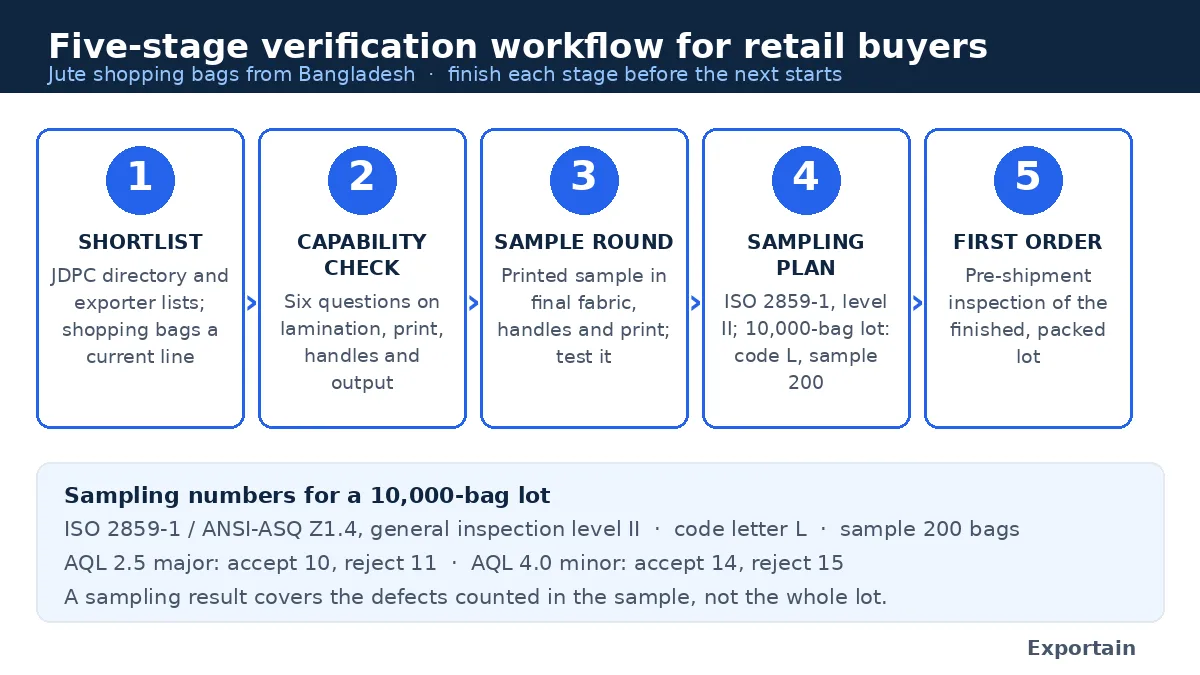
Stage 1 is the shortlist. Open the JDPC directory and the Export Promotion Bureau exporter lists, and keep makers that show shopping bags as a current line. Check whether each maker weaves its own fabric or buys it in.2
Stage 2 is the capability check. Send the six questions above to every maker on the shortlist and score the replies side by side.
Stage 3 is the sample round. Ask the remaining makers for a sample each in the final fabric, and test each as described above. A round with two or three makers costs little and tells you more than any catalogue.
Stage 4 is the sampling plan. Agree it in writing before production, naming the standard, the level, and the acceptance limits for each defect class. Sampling follows ISO 2859-1, also published as ANSI/ASQ Z1.4: lot size and level give a code letter, and the code letter and the acceptance quality limit (AQL) give the sample size and the accept and reject numbers; level II is the default. For a lot of 3,201 to 10,000 bags at level II, the code letter is L and the sample is 200 bags; at AQL 2.5 for major defects the accept number is 10 and the reject number is 11, and at AQL 4.0 for minor defects the accept number is 14 and the reject number is 15.7
Stage 5 is the first order with inspection. Book a pre-shipment inspection of the finished, mostly packed lot, and agree in writing what happens after a failure and who pays for re-inspection. A sampling result covers the defects counted in the sample, not the whole lot.7
HS code and paperwork for a retail shipment
A shopping bag and a packing sack are classified differently. Shipment records show jute bags declared under both headings: 6305.10, the heading for packing sacks and bags, and 4202, which covers handbags and shopping bags, with records showing jute shopping bags at 4202.29.00 and woven jute shopper bags at 4202.22.30.6 The heading follows the use of the bag, so confirm it with your customs broker, and read our HS code guide for jute shopping bags for the classification in full.
The invoice, packing list, certificate of origin, and bill of lading must agree on quantity, description, and HS code, and the invoice must show the export registration certificate number and the HS code. Check them against each other before the container is sealed. Our custom jute bags manufacturer guide sets out the document set.
Worked example: 10,000 printed totes for a grocery chain
A grocery chain in the European Union orders 10,000 laminated jute totes, 40 x 35 x 15 cm, with a one-colour screen print and padded cotton handles. The figures below are example figures, except for the sampling numbers, which follow the standard cited.
The buyer starts with the JDPC directory, picks six makers that show shopping bags as a current line, and sends each the six capability questions.2 Three answer with lamination and print detail and a handle test; the rest answer with a price alone or not at all. The buyer asks the three for a printed sample each.
Two samples arrive. One stands upright, hangs level, and shows print that stays clean along the fold. The other leans, and its print cracks where the bag folds. The buyer keeps the first maker and approves the sample in writing.
Example figures: 10,000 bags at 1.85 dollars is 18,500 dollars; inspection 650 dollars; sea freight 4,200 dollars; total 23,350 dollars, or 2.34 dollars a bag before duty and tax. The sampling plan goes into the order before production: a lot of 10,000 bags at level II gives code letter L and a sample of 200 bags, with major defects judged at AQL 2.5 and minor ones at AQL 4.0.7 At those limits, 10 or fewer major defects accepts the lot and 11 rejects it; 14 or fewer minor defects accepts and 15 rejects.7
Mistakes that cost retail buyers
Ordering unlaminated bags for grocery use. Plain hessian soaks up rain, marks easily, and sags. Specify lamination and test it.
Approving print from a flat swatch. Print is judged on the folded bag a customer opens. Fold the sample by the specified method first.
Accepting a sample in heavier fabric than the bulk order. It proves the construction, not the final bag.
Skipping the handle load test. Handles part at the till, in front of the customer. Hang the rated load and carry the bag first.
Mixing dye lots in one carton. Bags that match under one light and differ under another point to mixed lots. Keep lots apart and check shade bag to bag.
Agreeing the sampling plan after production. Once the goods are packed, a late AQL level is hard to enforce. Write it into the order before cutting starts.
Next steps on Exportain
Start with our jute shopping bags quality control checklist and the HS code guide for jute shopping bags, then read our makers of jute bags in Bangladesh for the checks behind this one. When you are ready, look for Bangladeshi suppliers or post an RFQ with the bag type, fabric weight, print method, handle type, and quantity, and read how to buy to see the steps after quoting.
Sources
- Directive (EU) 2019/904 of the European Parliament and of the Council of 5 June 2019 on the reduction of the impact of certain plastic products on the environment. legislation.gov.uk, (accessed )
- Jute Diversification Promotion Centre weaves success for 1,100 entrepreneurs. Daily Sun, (accessed )
- BB announces export incentives for 43 sectors for Fy26-27. United News of Bangladesh (accessed )
- Jute exports rise 37 per cent as Bangladesh plans to double earnings by 2031. The Financial Express, (accessed )
- Jute Packaging Material & What Jute Bag Is Made Of: Burlap, Laminated & Juco. Ruixing Gifts, (accessed )
- Jute Bags X HSN Code used for Export Import. Volza, (accessed )
- ANSI/ASQ Z1.4 vs ISO 2859-1: Same AQL Tables? What Buyers Should Know. SSTI (accessed )
- supplier verification
- bangladesh suppliers
- sourcing from Bangladesh
- Jute bags
- Jute shopping bags
- Retail packaging
About the author
Sourcing from Bangladesh?
Post a request for quotation and suppliers on Exportain can send you their quotes directly.
Post an RFQ