Custom Jute Bags Manufacturer in Bangladesh: OEM Process From Tech Pack to Bulk
From tech pack to loaded container: how a custom jute bag order moves through a Bangladesh factory, gate by gate.
Short answer
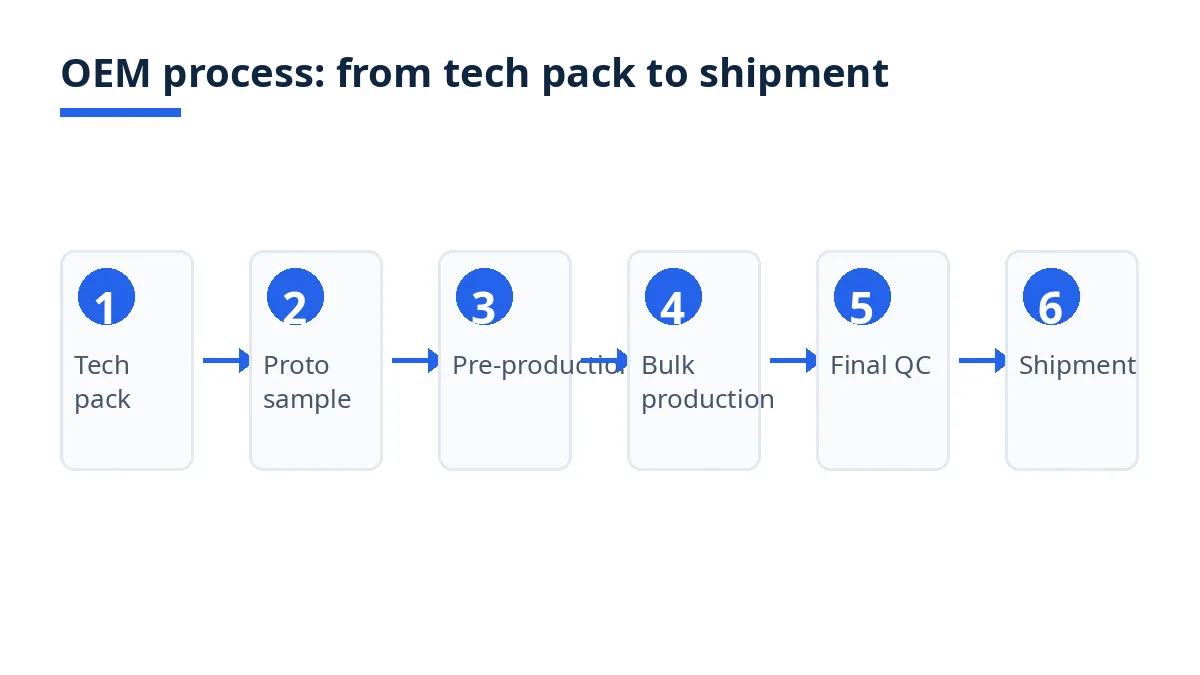
A custom jute bag order in Bangladesh runs from a tech pack to a shipped container through factory gates: the buyer sends a tech pack with flats, bill of materials, measurements and artwork; the factory makes a proto sample, then a pre-production sample in final materials for approval; fabric is sourced and inspected; bulk is cut, stitched and printed with inline checks; final inspection samples the lot under ISO 2859-1 AQL; then the bags are packed and documented for export.
On this page
Key takeaways
The tech pack is the instruction file the factory prices, samples and produces from; anything unwritten is guessed.
Sampling runs proto, then revised sample, then a pre-production sample in final materials that becomes the run reference.
Fabric is inspected before cutting, and finishing such as lamination is agreed before bulk production.
Final inspection uses ISO 2859-1 AQL, usually Level II with AQL 2.5 for major defects and 4.0 for minor defects.
The invoice must carry the ERC number and HS code, and the packing list, invoice and bill of lading must agree.
A custom jute bag order in Bangladesh is made to your design, not taken from a shelf. The factory works from a written specification, builds samples for your approval, sources the fabric, cuts and sews the run, and checks it against a sampling plan before it ships.
What does OEM mean for a jute bag order?
OEM, original equipment manufacturing, means the factory makes a bag to the specification you supply, under your brand and artwork. You own the design and the artwork files; the factory owns the production process. Every step below exists to turn your written specification into a bag that matches it.
A tech pack is the document that carries the specification: the instruction file a factory prices, samples and produces from, and anything not written in it, the factory has to guess.1 For a jute bag it is usually one PDF per style, with one topic per page and a version number on every page, updated after every sample round until the bag is approved.1
What goes into a tech pack for a jute bag?
The pages below are the ones a Bangladesh bag maker needs before it can give a firm quotation or cut a sample.1
Page | What it holds for a jute bag |
|---|---|
Cover | Style name and number, sizes, colourways, brand and contact, version and date, front sketch |
Flat sketches | Front and back drawings with callouts for seams, gusset and handles |
Bill of materials | Jute fabric with GSM and weave, lining, thread, handles, labels, packing |
Measurement spec | Points of measure for the sample size, how each is measured, and a tolerance |
Grading | The same points of measure for every size, or the change per size |
Construction | Seam type, stitch density, seam allowance, handle attachment, reinforcement |
Artwork and print | Each print with file, method, colours, size and position from a fixed point |
Colourways | Every colour version, with the colour of each part and trim |
Labels and packing | Label content and position, hang tags, folding, bale or carton marks |
Costing sheet | Materials, making, trims and packing per unit, by quantity |
Two pages deserve extra care on jute. The measurement spec needs a tolerance on every point, because jute is a coarse natural fibre. The artwork page needs the print size in figures and its distance from a fixed point.1 Colours should travel as a physical swatch or a named reference, not as words alone.1
Version control is part of the pack: every change agreed in a message must be written into the file, the version number raised, and the changed page dated.1
How does sampling work, from proto to pre-production?
Sampling runs in rounds, each with a different job. The usual order is a proto sample, a revised sample, then a pre-production sample that you approve as the reference for the run.1
The proto sample is the first try: did the factory read your tech pack the way you meant it? Check the shape, details, construction and feel of the fabric, and expect the measurements to need work.1 A proto is often made in a substitute fabric, so judge the construction on it and not the final cloth. The revised sample is the corrected version: measure every point against the spec and put your comments into a new version of the tech pack.1
The pre-production sample, known as the PP sample, is made in the final fabric, with the final trims, labels and print, in the way the run will be made. Once you approve it, it becomes the reference the run must match.1 Keep the approved PP sample and the matching tech pack version together, and do not release bulk production until both are signed off.
Where does the factory source material, and what is checked on arrival?
Most jute bag makers in Bangladesh either weave their own fabric or buy it from a mill, and the tech pack should state which. The material chain runs through the same stages: fibre selection, batching, carding, drawing, spinning, weaving, cutting, stitching, printing, inspection and export packing.2
Mill teams first inspect the fibre for length, colour, fineness, strength and cleanliness, and they may blend grades to reach the balance the bag needs.2 Tossa jute is commonly chosen where a stronger and finer yarn is wanted; white jute suits other sacking and general-purpose uses.2 Batching and softening then prepare the dry fibre for machines, with controlled moisture and batching oil; for food-contact sacks the maker uses an approved vegetable-based oil rather than a mineral-oil treatment, agreed before bulk.2 Carding opens the bundles into a sliver, drawing straightens the fibres, and spinning draws the sliver to thickness and adds twist.2
The two main fabrics are hessian, a lighter cloth used for shopping bags and light sacks, and sacking fabric, a heavier cloth used for agricultural commodities and bulk goods.2 B-Twill is a recognised sacking construction, but the specification must still define fabric weight, dimensions, weave density and seam type rather than relying on a product name alone.2
Woven fabric is inspected before cutting for broken yarns, missing picks, uneven weaving, holes, stains, oil marks and width variation.2 Finishing follows the bag type: calendaring, cropping, dyeing, bleaching, lamination for moisture resistance, lining, or a treatment such as flame retardant where specified.2 Agree any special treatment before bulk production, because finishing can change fabric weight, appearance and print adhesion.2
How does bulk production run, gate by gate?
Bulk production is a chain of gates, and each gate is a chance to catch an error while it is still cheap to fix.
Cutting converts inspected fabric into the dimensions the bag needs, following an approved cutting plan based on the finished width, length, gusset, seam allowance, mouth fold and handle position.2 Tote and shopping bags usually need separate front, back, side, bottom, gusset, lining and handle pieces, while industrial sacks may be cut from flat fabric or a tubular construction.2
Stitching joins the panels and creates the bag. Industrial sacks may need side and bottom stitching and reinforced seams, while shopping and tote bags may need boxed or folded gussets, reinforced handle points, a lining or closures.2 Seam construction should match the intended filling weight: a heavy fabric does not guarantee safe load performance when the seam, thread or stitch density is unsuitable.2
Printing normally happens after fabric preparation or after bag construction, depending on the design, method and product type.2 Screen printing is commonly used for logos, commodity markings and simple branded artwork.2 Approve a printed sample before full production, because jute has a textured surface and print sharpness and colour can differ from printing on paper or synthetic fabric.2
Inline inspection runs during the run, not only at the end: a first-piece check at the start of each shift, a stitch check at the handle attachments and the base, and a print check on the first printed pieces. Record the results against the PP sample.
How is quality judged at final inspection?
Final inspection confirms that the bags match the approved specification before packing, checking dimensions, fabric weight, stitching, printing, finishing, cleanliness, quantity and packing details.2 For a bulk order, that check is done on a sample drawn from the whole lot, using the AQL method.
AQL, the acceptable quality limit, is a statistical method defined in ISO 2859-1, also published as ANSI/ASQ Z1.4, that sets how many units from a lot should be inspected and how many defective units are allowed before the lot is rejected.3 The inspector takes the lot size, finds the sample size code letter from the inspection level, then reads the sample size and the accept and reject numbers from the table.3 General Inspection Level II is the default for most consumer product inspections.3
Defects are classed by severity, each with its own limit. The most commonly used levels are 0 to 0.65 for critical defects, 1.0 to 2.5 for major defects and 2.5 to 4.0 for minor defects, with AQL 2.5 the usual value for major defects.3
Lot size in pieces | Code letter, Level II | Sample size | Major defects, AQL 2.5 | Minor defects, AQL 4.0 |
|---|---|---|---|---|
501 to 1,200 | J | 80 | Accept 5, reject 6 | Accept 7, reject 8 |
1,201 to 3,200 | K | 125 | Accept 7, reject 8 | Accept 10, reject 11 |
3,201 to 10,000 | L | 200 | Accept 10, reject 11 | Accept 14, reject 15 |
If the defects found are equal to or fewer than the accept number, the lot passes; if they reach the reject number, the lot fails.3 Agree the level and the AQL values in writing before production starts, and name who inspects. Normal inspection is the default starting level; tightened inspection applies after two of five consecutive lots have been rejected, and reduced inspection after five consecutive lots have been accepted with production stable.3 The order should also state what happens after a failure and who pays for the re-inspection.
What happens between final inspection and the ship leaving Chattogram?
Packing follows the bag type and the buyer's instructions: finished bags may be folded and packed in bundles, cartons, compressed bales or ironbound bales.2 Export preparation includes quantity verification, bale or carton numbering, shipping marks, moisture protection, container cleanliness checks, and preparation of the packing list, commercial invoice and certificate of origin.2
A commercial invoice describes the goods, their value and terms of sale, and serves as the basis for customs valuation; in Bangladesh it must include the Export Registration Certificate (ERC) number and the Harmonised System (HS) code of the goods.4 The packing list gives a full overview of the shipment's packaging, including each package's type, quantity and weight.4 The certificate of origin certifies the country of origin and is required by many countries to determine import duties, and exporters obtain it from their local Chamber of Commerce or another authorised body.4 The bill of lading is the contract with the carrier for sea transport and serves as a document of title.4
Check the documents against each other before the container is sealed: the quantities on the invoice, packing list and bill of lading must agree, and the HS code must match the code you agreed with your customs broker. Our HS code guide for jute bags sets out the classification to confirm before the order ships.
Mistakes that stall an OEM order
The first mistake is sending a sketch and calling it a specification. A factory that receives only a picture has to guess the fabric weight, measurements, stitch type and print position.
The second mistake is treating the proto sample as the approval. A proto made in substitute fabric proves the construction, not the final bag. Only the PP sample is the reference.
The third mistake is letting bulk start before the PP sample is approved. Once cutting begins, the fabric is committed.
The fourth mistake is agreeing the inspection standard after production. An AQL level agreed at the end of the run is hard to enforce, because the goods are already packed.
Next steps on Exportain
With the pack written, the next move is to put it in front of makers. Our guide to finding and checking jute bag makers in Bangladesh explains the checks to run before you enquire, and wholesale jute bags from Bangladesh covers how a production run is bought. Read jute bags MOQ in Bangladesh for how the minimum order is set, and our quality control checklist for jute bags for the inspection points behind the AQL plan above. Then use search Bangladeshi suppliers or post an RFQ, and give the style, fabric, print and quantity in your enquiry.
Sources
- What Is a Tech Pack? How to Make One for Your First Clothing Line [2026]. Tryly (accessed )
- Jute Bag Manufacturing Process: 10 Steps Explained. Jute For Good (accessed )
- Free AQL Calculator, Chart & Sampling Table. Tetra Inspection (accessed )
- Essential export documents for shipping from Bangladesh. DHL (accessed )
About the author
Sourcing from Bangladesh?
Post a request for quotation and suppliers on Exportain can send you their quotes directly.
Post an RFQ