FOB vs DPU: Key Differences, Costs and Which One to Choose
FOB ends on board at Chattogram; DPU ends unloaded at the destination terminal. Here is how the costs, the risk and the import clearance split, with a worked example.
Short answer
Under FOB, the seller delivers when the goods are loaded on board the vessel at the port of shipment, and the buyer pays the freight and clears import. Under DPU, the seller carries the goods to the named place of destination, unloads them there, and then risk passes to the buyer. DPU is the only Incoterms 2020 rule that makes the seller unload. The buyer clears import and pays duty under both rules, so DPU is not duty-paid.
On this page
Key takeaways
FOB delivers on board the vessel at the port of shipment; DPU delivers unloaded at the named place of destination.
DPU is the only Incoterms 2020 rule under which the seller must unload the goods.
The buyer clears import and pays duty and VAT under both rules; DPU is not duty-paid.
Neither rule obliges the seller to buy cargo insurance; each side insures its own stretch of the journey.
A DPU price folds freight, destination handling and unloading into the seller's figure; compare on the landed total.
A buyer who puts an FOB quotation beside a DPU quotation is looking at two very different scopes of service, not two prices for the same job. FOB ends at the load port, the moment the goods are on the ship. DPU ends at the destination, after the goods have been taken off the arriving vehicle and set down at a named place. The gap between the two prices is the whole journey between those points, plus the unloading at the end of it. This comparison starts at the delivery point, then works through the costs, the customs split and the handling charges.
Where does each rule deliver?
Under FOB, delivery happens once the seller has put the goods on the ship the buyer chose, at the agreed load port, after clearing them for export.1 Risk moves to the buyer at that moment, and from there the buyer arranges the sea freight, buys cargo insurance if it wants any, and clears the goods at destination. The rule is written for sea and inland waterway transport, for cargo that goes straight from the quay onto the vessel. For a box dropped at the terminal well ahead of sailing, the delivery point FOB names does not match the handover that actually happened, and the ICC guidance points container cargo toward the any-mode rules instead.1
Under DPU, the seller delivers when the goods have been unloaded from the arriving vehicle and placed at the buyer's disposal at the named place of destination.2 The seller arranges and pays the carriage to that place, completes export formalities, and carries the risk all the way there, including the unloading itself. DPU works for any mode of transport, and it is the only Incoterms 2020 rule under which the seller must unload.1 2 The rule was called DAT, Delivered at Terminal, under Incoterms 2010; the 2020 revision renamed it because delivery was never limited to a terminal, and the named place can be a terminal, a warehouse, a yard or any other point the parties agree.1 2
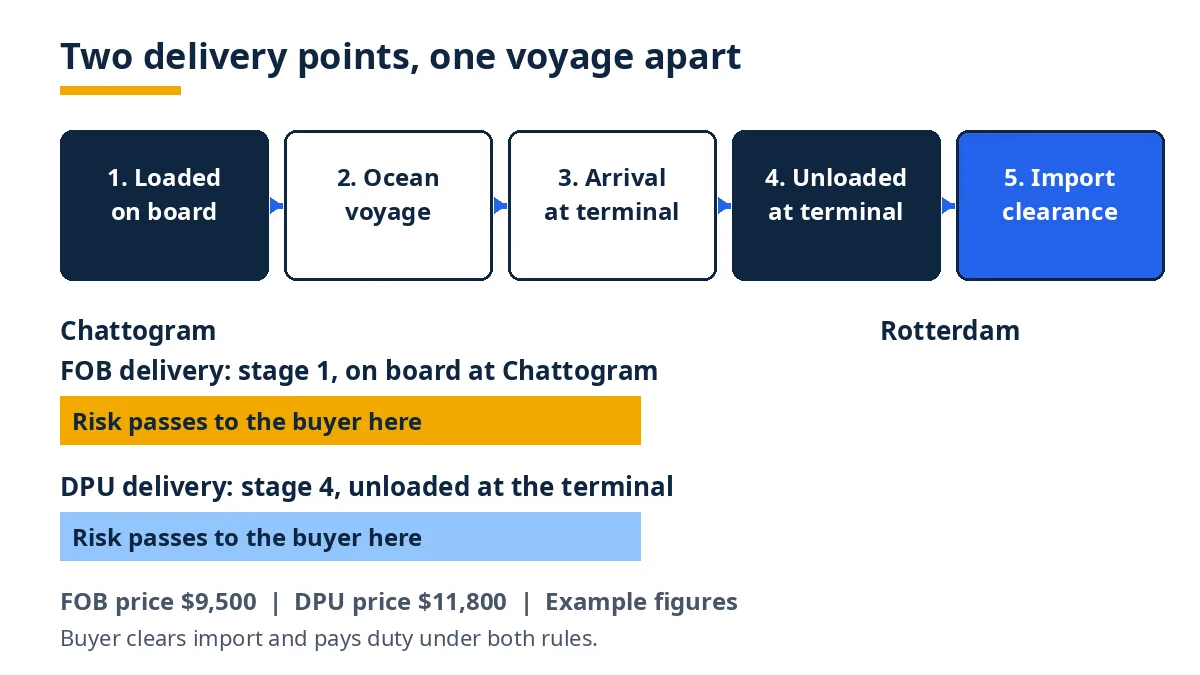
The diagram shows why the two delivery points sit so far apart: FOB hands the goods over at the start of the voyage, in Chattogram, while DPU hands them over at the end of it, unloaded at the destination terminal. A quotation that reads "DPU container terminal, Rotterdam, Incoterms 2020" promises delivery at that terminal, off the vehicle. A vague place defeats the purpose: "DPU Europe" names no terminal and no unloading point, so write the rule, the place, the point and the edition in full. The same precision applies on the FOB side: when risk transfers under FOB decides who carries a loss at sea.
FOB vs DPU: the cost and risk split
Question | FOB | DPU |
|---|---|---|
Transport modes | Sea and inland waterway only | Any mode, single or combined |
Delivery happens when | Goods are loaded on the vessel at the load port | Goods are unloaded at the named place of destination |
Risk passes to the buyer | On board the vessel | After unloading at the destination |
Who books the main carriage | Buyer | Seller |
Who pays the carriage | Buyer | Seller |
Cargo insurance | Buyer arranges its own cover | Neither rule obliges the seller to insure |
Export clearance | Seller | Seller |
Import clearance, duty and VAT | Buyer | Buyer |
Destination terminal handling | Buyer | Seller |
Unloading at the destination | Buyer | Seller |
Onward carriage to the warehouse | Buyer | Buyer |
The table shows a clean split with one line that does not differ at all. The delivery point, the mode, the carriage, the handling and the unloading all move from buyer to seller. The import line does not move: the buyer clears the goods for import and pays the duty and VAT under both rules. The insurance line does not move either. Only CIF and CIP oblige the seller to buy cargo insurance, so under both FOB and DPU the party carrying the risk arranges its own cover for its own stretch.1 An FOB price covers the goods, the packing and the loading, while a DPU price folds the carriage, the destination handling and the unloading into the seller's figure.
Who handles import customs under DPU?
The buyer does, under both rules. DPU leaves import clearance, duty and VAT with the buyer, exactly as FOB does.2 The seller clears the goods for export and handles any transit procedures on the way; the buyer then completes the import formalities, pays the duty and the VAT, and arranges onward carriage from the named place. A buyer that reads DPU as a duty-paid term is confusing it with DDP, the one rule in which the seller clears import and pays the duty.1
That split shapes where the named place should sit. Pick a place where your broker can clear the goods without delay, and agree in writing who presents the documents and who pays the storage if clearance runs slow. A terminal inside the port and an inland depot past customs are different propositions: at the inland depot, the goods must clear import before the seller can complete delivery there, so the buyer's clearance work sits on the path to the seller's delivery.
The duty itself is the same under both rules, because the same goods cross the same border at the same value. The worked example below charges duty on the CIF value, but customs values goods on its own basis in each destination country, so confirm the basis with your broker first.
What about terminal handling and unloading?
Terminal handling is where the two rules diverge on the invoice. Under FOB the seller bears the costs up to loading, and the buyer pays the handling at the destination terminal. Under DPU the seller pays the handling at both ends, because the seller's carriage runs all the way to the named place.3 The fee for lifting the container off the vessel and holding it in the yard sits in the DPU price and on the buyer's account under FOB.
Unloading is the sharper difference, and it is the one only DPU changes. Under every other Incoterms 2020 rule the buyer unloads at destination; under DPU the seller unloads, at the seller's risk and cost.2 3 That matters most where the receiving site has no forklift, crane or labour on the delivery day. The same clause turns into a trap when the seller cannot unload at the place named: a seller with no agent, no equipment and no access at an unfamiliar terminal cannot perform the delivery it promised. Before agreeing DPU, the seller should check that unloading can actually be done at the destination, and if it cannot, DAP is the more appropriate choice.2 The step from the ship's side to the vessel is covered in FAS vs DPU, which shows the same unloading rule against the shortest sea term.
Worked example: one container of cotton towels to a Rotterdam terminal
Example figures. Take 600 cartons of cotton bath towels in one container from Chattogram to a container terminal in Rotterdam, goods worth $9,500. The figures below are illustrative, and they run the two rules over one shipment. The DPU contract names the terminal in full: "DPU container terminal, Rotterdam, Incoterms 2020".
Cost line | Under FOB | Under DPU |
|---|---|---|
Goods, packing, export clearance | $9,500, in the FOB price | $9,500, in the DPU price |
Ocean freight, Chattogram to Rotterdam | $1,900, paid by the buyer | $1,900, paid by the seller |
Cargo insurance | $140, paid by the buyer | $140, paid by the seller |
Destination terminal handling and unloading | $260, paid by the buyer | $260, paid by the seller |
Import duty, 5% of the $11,540 CIF value | $577, paid by the buyer | $577, paid by the buyer |
Onward delivery to the warehouse | $320, paid by the buyer | $320, paid by the buyer |
Total the buyer pays | $12,697 | $12,697 |
Both columns land on $12,697. The DPU invoice reads $11,800, because the freight, the insurance and the destination handling and unloading sit inside the seller's price. The FOB invoice reads $9,500, and the buyer pays the remaining $3,197 to its own freight, insurance, terminal and delivery providers. Every cost appears in each column, only the payer changes, so the totals agree; what differs is who arranges each step and who carries the risk while it happens. Under FOB the buyer carries the risk from the moment the goods are on board, so it insures the voyage itself. Under DPU the seller carries the risk until the towels are unloaded at the Rotterdam terminal, so the seller insures that stretch.
Common mistakes
Reading DPU as duty-paid. DPU leaves import clearance, duty and VAT with the buyer. The duty-paid rule is DDP, which puts the seller in the buyer's customs position.1
Assuming DPU includes insurance. Neither FOB nor DPU obliges the seller to insure the goods. Under DPU the seller carries the risk to the destination, so it usually insures its own stretch, but the rule itself requires no policy, and the buyer should still hold cover from the moment the goods are set down at its disposal.1
Using FOB for a container load. A box is usually dropped at the terminal well ahead of sailing, so it is not on the ship when FOB says delivery happens. Use FCA when the buyer books the transport, or DPU when the seller carries the goods to the destination.1
Agreeing DPU where the seller cannot unload. If the destination has no equipment, no access and no labour on the delivery day, the seller's unloading duty becomes a delay the seller owns. Check the unloading arrangements before signing, and use DAP when the buyer will unload.2
When should you choose DPU?
Choose DPU when the buyer has no freight arrangements at the destination, no unloading equipment or labour, and no forwarder in the destination country. It fits a first order, a small importer, and a buyer that wants one price to a named terminal with the goods set down. The buyer still clears import and pays the duty, so DPU is not hands-free, but it takes the voyage, the handling and the unloading off the buyer's list. DPU for small importers works through the same choice for a first order.
Choose FOB when the buyer imports often, already has a forwarder and an insurer, and wants to choose the carrier, check the freight rate, and run the sailing. It suits bulk and break-bulk cargo that loads directly onto the vessel, and a buyer that consolidates shipments from several suppliers onto one freight account. FOB is the working default for sea shipments out of Bangladesh to Europe; DPU is the option for a buyer that would rather the seller carried the goods to the destination and set them down.
Three questions settle most cases: can the seller actually unload at the place you have named; can you clear import at that place without delay; and does the DPU quotation break out the freight, the handling and the unloading, so you can check each element against your own rates.
Next steps on Exportain
The next comparison up the sea-freight ladder is FOB vs CFR, where the seller takes on the freight while risk still moves on board, and FOB vs CIF covers the version where the seller also buys minimum cover. When you are ready to get prices, search Bangladeshi suppliers to compare quotations side by side. Post an RFQ that states the rule, the place, the point and the edition.
Sources
- Incoterms 2020 Explained: Complete Guide to All 11 Rules. ShipScout, (accessed )
- Incoterms 2020 Explained: Complete Guide (2026 Update). Inecta (accessed )
- DPU Incoterm Explained: Unload Risks & Obligations 2026. FreightAmigo (accessed )
About the author
Sourcing from Bangladesh?
Post a request for quotation and suppliers on Exportain can send you their quotes directly.
Post an RFQ