Private Label Jute Bags Manufacturing in Bangladesh: A Brand Owner's Guide
Private label means a Bangladeshi maker builds a jute bag to your specification alone. Here is how to define it, approve the artwork and print, sample it, label it, and choose the right supplier.
Short answer
A private-label jute bag is made in Bangladesh to one brand owner's specification: its size, fabric weight, handles, print, labels, and packing are all defined by the buyer. The buyer approves the artwork, the print proof, and a pre-production sample in writing, confirms the label wording for each destination market, and agrees the minimum order and the set-up charge before bulk production starts.
On this page
Key takeaways
Private label means the bag is built to your specification alone, from fabric and handles to print, labels, and packing.
State the GSM, size, handles, and finish with tolerances in one dated brief sent to every supplier.
Match the print method to your artwork: screen printing suits one-to-four-colour logos, other methods suit photographic or multi-colour work.
Approve the artwork, the print proof, and the pre-production sample in writing before bulk production starts.
EU labelling rules require fibre composition in the language of the selling country, and the importer is responsible for accuracy.
A private-label jute bag carries your brand and nobody else's. The factory makes it to your specification, prints your artwork, sews in your labels, and packs it as your customers expect. The decisions that matter most happen before production starts: the bag style, the fabric, the print method, the artwork file, the label wording, and the approval that locks them in place.
This guide is for the brand owner placing a first private-label order in Bangladesh.
What does private label mean for a jute bag?
Private label means the supplier manufactures a bag that exists only under your brand. You own the design decisions: the size, the fabric weight, the handle style, the print, the lining, the labels, and the packing. A Bangladeshi maker that runs private-label programmes will prepare printing, labelling, and other order-specific details according to the buyer's instructions.1
That differs from a stock bag, a standard design the supplier already makes. With a stock bag you accept the supplier's size, fabric, and handle, and change only the print. With private label you define the product, so the supplier quotes against your specification instead of its catalogue.
How do you define the bag before you brief a supplier?
A private-label brief starts with the bag itself, not the logo. Five decisions shape everything that follows: style, fabric, size, handles, and finish. Write each one down with a number.
Fabric weight is measured in grams per square metre (GSM). For retail-grade printed jute bags, 250 to 300 g/m2 is the usual range, while 180 to 220 g/m2 suits event or promotional bags.2 State the GSM with a tolerance, such as 260 GSM plus or minus 5 per cent, and ask the supplier to confirm the fabric it will use.
State the handle material, length, attachment, and reinforcement, and the finish: laminated or unlined.
Which print method fits your artwork?
Jute is a hard surface to print on, and the print method should follow your artwork. Jute fibres are five to ten times thicker than cotton fibres, so ink sinks into the gaps between fibres and leaves small unprinted spots.3 Water-based inks spread on contact, so fine lines and small text lose definition, and the natural base colour runs from beige to deep brown and varies between batches, so light inks can shift colour.3
Screen printing is the workhorse for private label: the artwork is transferred onto a mesh screen and ink is pressed through it onto the bag, with one screen per colour. It suits one-to-four-colour logos and solid shapes, with line weight kept at 1 mm or thicker.3 At volume the printing cost can run as low as USD 0.05 to 0.15 per bag, and the method generally needs 500 pieces or more.3
Print method | Suits | Watch for |
|---|---|---|
Screen printing | One-to-four-colour logos at volume | Needs 500 pieces or more; no gradients or photos |
Heat transfer | Multi-colour artwork, gradients, small runs | Weaker wash resistance; can lift on rough jute |
Printed label patch | Photo-quality images, very small text | Visible label edge; extra sewing cost |
Foil stamping | Premium gift bags, metallic logos | Needs a laminated surface; keep the area small |
Embroidery | Clean logos, badge-style marks | No gradients; not for large filled areas |
Laminated gravure | All-over photographic prints | Needs 1,000 pieces or more; bag becomes coated |
How do artwork and print approvals work?
Artwork approval is a written process, not a nod over a photo. Send the artwork as a vector file where possible, with the brand colours named as Pantone codes, and state the print size and the placement in centimetres from a fixed edge of the bag. After sample approval, a buyer guide recommends a locked spec sheet covering GSM, dimensions, handles, Pantone codes, placement, packaging, folding, and labelling.2 Build that sheet before production.
Ask for a print proof before the sample is made: it shows the artwork at actual size on your fabric colour. Approve the proof in writing, naming the file version and the date. A common reprint cause is a logo placed a few centimetres from where the buyer expected it, which a placement measurement in the spec sheet prevents.2 Keep the colour count low: each colour needs its own screen and its own pass.
How do sampling rounds work, and what does each round prove?
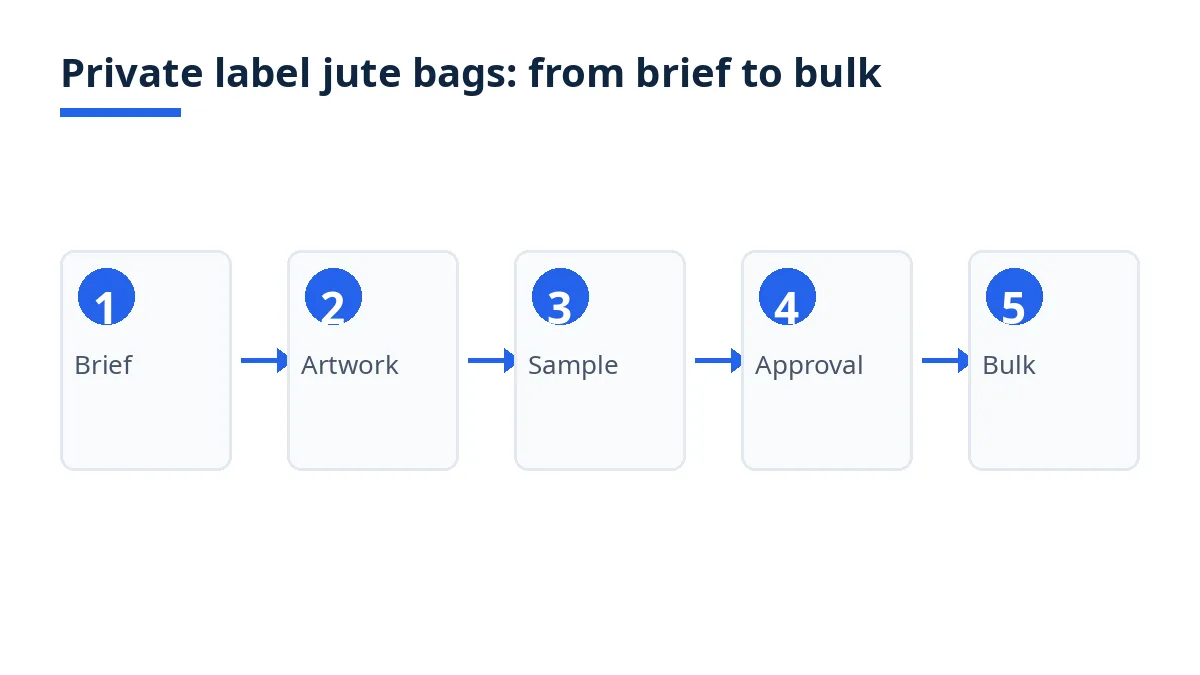
Sampling usually runs in two rounds. The first proves the product: the style, the fabric, the size, the handles, and the print method. The second proves the production run: the exact bag, made on the production line, to the exact specification. Do not let the second round start until the first is approved in writing.
Round one is a prototype, often made by hand, to check the shape, handle length, fabric feel, and print at full size.
Round two is the pre-production (PP) sample, made on the production line, from the production fabric, with the production print method, labels, and packing. Production commonly takes three to six weeks once the PP sample is signed, and sea freight adds another three to five weeks, so the PP approval is the point the clock starts from.2 Sign the PP sample, or approve it in writing with the date and the spec sheet version it matches, and keep it as the reference for the bulk run.
What labels does a private-label bag need?
Labels are part of the product, and they are the part most likely to cause a problem at the destination. State the destination countries in the brief and ask the supplier to confirm the label text for each one before the labels are printed.
For the European Union, Regulation (EU) 1007/2011 requires textile products sold to consumers to carry a durable label with their fibre composition, using only the Annex I fibre names, with percentages by weight in descending order.4 Jute is one of the Annex I names, so a jute-cotton bag is labelled with both fibres and their percentages, and "100%", "pure", or "all" may be used only for a single-fibre product.4 The label must be durable, easily legible, visible, and securely attached, in the official language of the country where the product is sold, and a 3 per cent tolerance applies between the stated composition and a lab analysis.4
Two points surprise brand owners. First, the regulation covers fibre composition only: it does not require care instructions, sizes, or country of origin, although GINETEX care symbols based on ISO 3758 are widely used voluntarily.4 Second, when the manufacturer is outside the EU, the importer is responsible for the label and its accuracy.4
Beyond the EU, the pattern is similar but the details differ: a buyer guide lists the label contents buyers usually need as fibre composition, country of origin, care instructions, and recycling or disposal information.2 Confirm the exact wording with your buyer or a compliance adviser for each destination. Decide the four label elements in the brief: the sewn-in composition and care label, the brand label, the origin marking ("Made in Bangladesh"), and the swing tag.
How do MOQ and price interact with private label?
Private label changes the minimum order because it adds set-up that a stock bag does not need. Screens, plates, dyed fabric lots, woven labels, and print proofs are all made once per design, and their cost has to be recovered across the run.
A printed-bag guide puts the keenest pricing band at 500 to 1,000 pieces, with complex prints or custom shapes needing a higher minimum.2 Treat that range as a starting point, not as a rate. Ask each supplier to state its minimum per design, per size, and per print, and to separate the set-up cost from the unit price. Ask for prices at 500, 1,000, 3,000, and 5,000 units, and watch where the per-bag figure stops falling.2
No guide can set a price for private-label jute bags: each supplier prices your exact bag, fabric, print, quantity, and delivery term. For the full picture on minimums, read our jute bags MOQ guide, and for the wholesale channel, read wholesale jute bags from Bangladesh.
How do you choose a supplier for private label instead of stock bags?
A supplier that is good at stock bags is not always good at private label: stock selling rewards speed, while private label rewards in-house control and clear documentation. Ask each supplier to state, in writing, whether it makes the bags itself, buys them in, or sources them for you, and where the weaving and the printing happen. Our guide to jute bag makers in Bangladesh shows how to check a factory before you enquire.
Four questions separate a private-label supplier from a stock seller: does it print in house, can it make a PP sample on the production line with the labels sewn in, will it work from your locked spec sheet and confirm each line, and will it agree a defect classification before production? A buyer guide suggests classifying defects as critical, major, and minor, and communicating acceptable levels, for example an AQL of 2.5 for major defects and 4.0 for minor ones.2 Score the answers rather than the sales pitch.
Worked example: spreading the set-up across 2,000 bags
Example figures. A brand owner orders 2,000 gusseted retail totes in 260 GSM jute, with a two-colour screen print and a sewn-in composition label. The supplier quotes USD 2.20 per bag and a set-up charge of USD 240 for the two screens and the print proof. The numbers below are illustrative, not a market price.
Order size | Unit price | Set-up | Set-up per bag | Total for goods and set-up |
|---|---|---|---|---|
1,000 bags | USD 2.35 | USD 240 | USD 0.24 | USD 2,590 |
2,000 bags | USD 2.20 | USD 240 | USD 0.12 | USD 4,640 |
3,000 bags | USD 2.05 | USD 240 | USD 0.08 | USD 6,390 |
The set-up per bag falls from USD 0.24 to USD 0.08 as the order grows from 1,000 to 3,000 bags, and on a repeat order in the same design the set-up line disappears, since the screens already exist. Ask your supplier for its own unit prices and set-up charge, then run the same table with real numbers.
Mistakes brand owners make on a first private-label order
The first mistake is approving a photo instead of a physical sample. A photo hides the fabric weight, the handle feel, and the print texture. Approve the PP sample in your hands, against the locked spec sheet.
The second mistake is sending artwork made for a screen and expecting it to print on jute. Thin lines below 1 mm, small text, gradients, and light colours on a dark natural base all lose definition, so change the artwork before the sample.3
The third mistake is leaving the labels until the end: a label error found after the bags are sewn is a rework on every bag.
The fourth mistake is treating the lowest minimum as the right offer: a buyer guide warns that unusually low minimums can be a sign of inexperience.2 Compare the minimum with the GSM, the print method, and the unit price together. The quality control checklist covers what to inspect in the sample and in the bulk run, and the HS code guide for jute bags sets out the classification to confirm with your customs broker.
Next steps on Exportain
Write the brief: bag style, fabric weight, size, handles, finish, artwork, and label wording for each destination. Then browse suppliers on Exportain or send an RFQ with it, and ask each reply whether it makes the bags or trades them, whether it prints in house, its minimum per design, and its set-up charge as a separate line.
Sources
- Premium Jute Enterprise | Jute Products Manufacturer & Supplier in Bangladesh. Premium Jute Enterprise (accessed )
- The Complete Buyer's Guide to Custom Printed Jute Bags for European Markets 2026. Jucofabs (accessed )
- How to Print on Jute Bags. Bene Bags, (accessed )
- EU Textile Labelling Regulation 1007/2011 for India Exports. Clear To Load (accessed )
About the author
Sourcing from Bangladesh?
Post a request for quotation and suppliers on Exportain can send you their quotes directly.
Post an RFQ