How to Import Power Transformers From Bangladesh to Netherlands: Step-by-Step Guide
Duty is 3.70% at the third-country rate, but EBA gives Bangladesh-origin transformers 0% — so the 21% Dutch VAT is the charge that moves the landed cost. Eight steps, Rotterdam to site.
Short answer
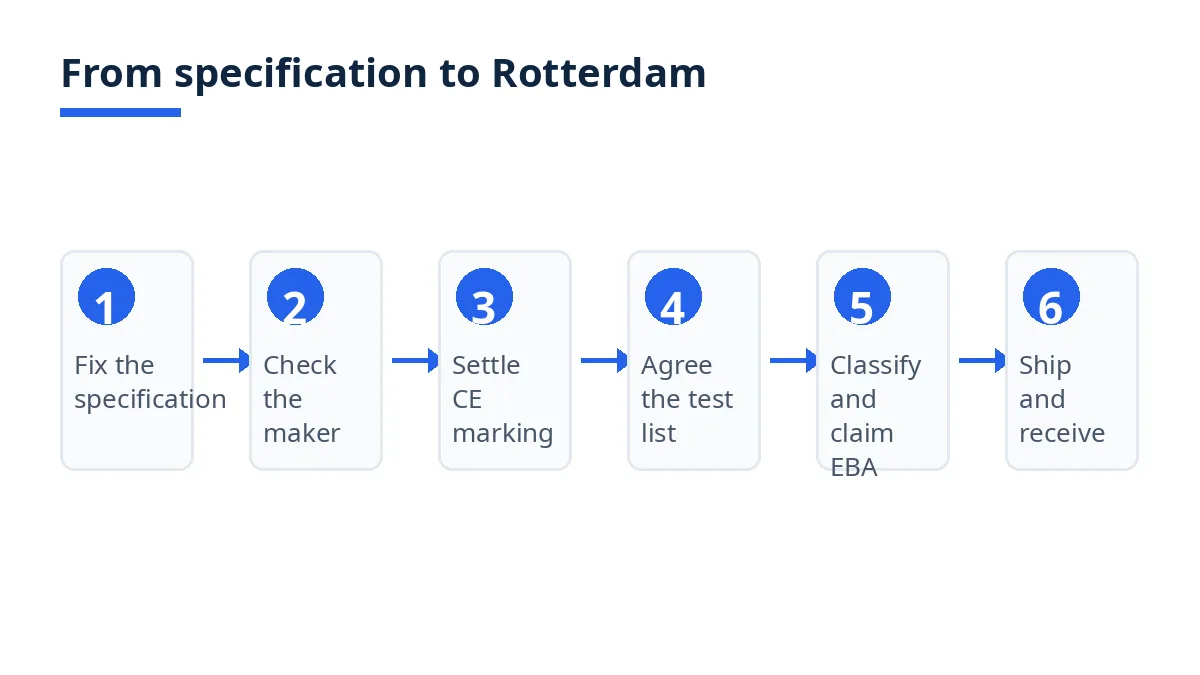
To import a power transformer from Bangladesh to the Netherlands, write the specification first, check the maker, and settle CE marking with an EU declaration of conformity. Agree the IEC 60076 test list, classify the unit under TARIC heading 8504, and claim the Everything But Arms preference at 0% duty instead of the 3.70% third-country rate. Get an EORI number, file the import declaration, and pay 21% import VAT on the customs value, which VAT-registered buyers deduct as input tax.
On this page
Key takeaways
The EU third-country duty on liquid dielectric transformers under heading 8504 is 3.70%; Bangladesh-origin units enter at 0% under Everything But Arms, with a three-year transition after November 2029 graduation.
Dutch import VAT is 21% of the customs value plus duty; VAT-registered buyers deduct it as input tax, and a foreign entrepreneur cannot use the reverse-charge on import.
The Low Voltage Directive covers equipment built for 50 to 1,000 V AC; units above that range need a compliance adviser to confirm which rules apply.
Routine IEC 60076 tests run on every unit; type tests prove the design family, and short-circuit withstand is tested on a sample, never on your unit.
Get an EORI number before the first declaration; one number works across the whole EU.
Rotterdam is where a Bangladesh transformer order is won or lost. The unit is built in Bangladesh, but the file that lets it into the Netherlands is assembled before the vessel sails: rating, CE papers, test reports, tariff code and VAT arithmetic. This guide works through that file in eight steps. See the general transformer import guide for the product with no destination attached.
Step 1: Start from the site, not the catalogue
A transformer is built for one site, so the specification starts with what that site needs. Put each rating on its own line with the values below, send the same sheet to every maker, and ask each to reply against it, with the price split into unit, tests, packing and port transport.
Item | State |
|---|---|
Power | kVA per rating |
Voltages | Primary and secondary, with the frequency the site uses |
Vector group | Connection and phase displacement |
Impedance | Short-circuit impedance and its tolerance |
Taps | Tap range and changer type |
Cooling | Method, such as ONAN or ONAF |
Losses | Loss figures the maker will put in writing |
Fittings and packing | Bushings, oil filling, packing |
Our power transformer price guide breaks down a FOB quotation, and shows why one can look cheaper while leaving out the tests or the packing. Settle the delivery rule too: FOB Chattogram leaves the sea leg and Rotterdam clearance with you; FCA moves the handover to the factory or terminal. Name the place, who books the vessel, and who insures the cargo.
Step 2: Ask the factory to prove it can build your rating
Transformer work needs its own plant: core cutting, winding, drying, oil handling and a high-voltage test bay, which a factory set up for panels or cables does not have. The manufacturer checks cover the wider supplier questions.
Start with the test evidence: recent reports for ratings close to yours, calibration records for the test bay, and the accreditation certificate and scope of the laboratory running the type tests. A maker whose test bay cannot run the tests in Step 4 will send your unit elsewhere or skip them, and you will find out at Rotterdam.
Then the documents: trade licence, export registration and membership papers should carry one name, one address and one bank account. Pay into that account only, and check any change of bank details on a different channel before you send money. Before production, get outline drawings, loss and impedance figures and a draft rating plate, check them against your single-line diagram, sign the pack, and build one fully tested unit of each rating first.
Step 3: Settle CE marking and the declaration of conformity
A transformer placed on the EU market needs its CE position settled before it ships, not at the Rotterdam terminal. The Low Voltage Directive, 2014/35/EU, covers equipment built for 50 to 1,000 volts AC or 75 to 1,500 volts DC.1 A unit whose high-voltage winding sits above 1,000 volts AC falls outside that range, so ask a compliance adviser which rules cover it before treating the CE mark as settled. Name every directive that applies in the order.
Where the directive applies, the manufacturer draws up an EU declaration of conformity and keeps the technical documentation for ten years.1 It names the product, the manufacturer, the directives met and the standards used. Ask for it before you pay the balance, and match its model, rating and serial number with the packing list and rating plate. A test laboratory certificate is not the same document: the declaration is the manufacturer's own signed statement.
As the importer, confirm the assessment is complete and the declaration matches the unit ordered before the unit goes on the market.
Step 4: Write the IEC 60076 test list into the order
The standard that matters is IEC 60076. Part 1 covers service conditions and the rating plate, and it places each test in one of three groups, with tolerances for losses and impedance.2 Name the parts that apply to your unit: a specification citing only "IEC 60076" is incomplete.
Group | When it runs | What it proves | Ask for |
|---|---|---|---|
Routine | On every unit | The unit as built meets its rating | Report by serial number |
Type | One unit per design family | The design meets the standard | Report matching design and rating |
Special | By agreement with the buyer | Extra operating information | Agreed list, priced in the contract |
Every unit goes through the routine list: winding resistance, then ratio and phase displacement, then load loss and impedance voltage at rated current, then no-load loss and current, the applied-voltage and induced-voltage dielectric tests, insulation resistance and the oil checks.2 Type tests cover temperature rise, lightning impulse, partial discharge and noise. Short-circuit withstand under IEC 60076-5 damages the unit it is run on, so it is tested on a sample in a third-party laboratory, never on your delivered transformer.2
IEC 60076-1 allows total losses 15 percent above the stated figure and short-circuit impedance 7.5 percent either side, with more room on the first unit of a new design. Put the tolerance and the remedy into the contract,2 and where the contract allows, hold the balance until the routine reports pass. Arrival checks are in the arrival checklist.
Step 5: Classify the unit and claim the EBA rate
Power transformers sit under heading 8504, and the EU third-country duty on the liquid dielectric lines is 3.70 percent.3
Code | Capacity band | Duty |
|---|---|---|
8504 2100 00 | Oil-immersed, up to 650 kVA | 3.70% |
8504 2210 00 | Oil-immersed, 650 to 1,600 kVA | 3.70% |
8504 2290 00 | Oil-immersed, 1,600 to 10,000 kVA | 3.70% |
8504 2300 00 | Oil-immersed, over 10,000 kVA | 3.70% |
8504 3400 00 | Other types, over 500 kVA | 3.70% |
Those are the third-country figures for heading 8504.3 Most Bangladesh-origin transformers do not pay them: under Everything But Arms, goods from a least developed country enter duty-free and quota-free, except arms and ammunition.4 Bangladesh is scheduled to graduate from that status in November 2029, and a three-year transition then keeps the preference in place.4 5
Claim the preference on the declaration and keep the origin evidence on file: the saving fails at audit without the proof. Classification follows construction and kVA band, so oil-immersed and dry-type units land on different lines. Send the broker the rating plate and get the code back in writing; the digits are walked through in the HS code guide.
Step 6: Get the Dutch importer file ready
Name the importer of record before the vessel sails: that party is legally responsible for the declaration and the import VAT, so agree it in writing. The broker also needs your EORI number: one is required the first time a customs declaration is submitted for you, and a Dutch business filing its own declarations builds its number from NL plus its RSIN.6 The number is free6 and works across the EU,7 so one from another member state needs no Dutch duplicate.
Hand the broker the file in one pass: invoice and packing list, TARIC code, EBA origin evidence, CE declaration, rating plate details and bill of lading once issued. A file in pieces means a late declaration, and a late declaration holds a heavy unit at the terminal.
Step 7: Work out the 21% import VAT before you commit
Dutch import VAT runs at the general tariff of 21 percent, unless an exemption, the reverse-charge mechanism, the 0 percent tariff or the 9 percent tariff applies.8 Customs calculates it on the customs value: the goods plus transport, insurance and similar charges up to the external border of the EU.9 Duty sits inside that base,10 so under EBA at 0 percent the base is the CIF value.
Where the goods are destined for you under the declaration, you pay the VAT to Customs and deduct it as input tax on your return.9 A foreign entrepreneur cannot use the reverse-charge mechanism on imports from outside the EU, so a buyer without Dutch VAT registration pays at the border and recovers it separately.9
Example figures. One 1,000 kVA oil-immersed unit, FOB Chattogram, shipped to Rotterdam. The numbers are illustrative.
Line | EUR |
|---|---|
FOB Chattogram | 16,000 |
Sea freight plus insurance to Rotterdam | 2,600 |
Border value (CIF) | 18,600 |
0 | |
3,906 | |
Terminal, broker, delivery | 1,200 |
Landed cost before VAT recovery | 19,800 |
Cash paid at the border | 23,706 |
Border value EUR 18,600, so VAT at 21 percent is EUR 3,906. With EUR 1,200 for terminal, broker and delivery, the landed cost is EUR 19,800 before VAT recovery, or EUR 23,706 cash. At the 3.70 percent rate the duty would be EUR 688 and the VAT EUR 4,050, so check the EBA claim line by line. Use the table as a worksheet with your own quotations.
Step 8: Ship Chattogram to Rotterdam and receive the unit
Put the export file together in Bangladesh while the unit is still at the factory, not once it has sailed. The exporter files the electronic EXP form in the Online Export Monitoring System, customs issues the Bill of Export, and the exporter has 14 days after sailing to lodge the signed form, the certified Bill of Export and the shipping documents with the authorised dealer bank.11
Document | Check |
|---|---|
Commercial invoice | ERC number and HS code shown |
Packing list | Weights and serial numbers |
Bill of lading | Rotterdam discharge and consignee |
Certificate of origin | Supports the EBA claim |
Insurance certificate | Sea leg cover |
Routine test report | Per serial number |
Check with the forwarder which sailings take a unit of this size, whether it sails filled with oil or drained, and whether terminal and site can lift it as packed. A standard container rarely fits: height, weight and exposed bushings usually mean a flat rack or break-bulk.
At Rotterdam, check the delivery before signing: count the units, read each rating plate against the design pack, and note damage on the delivery note at once. Then run the arrival tests in the arrival checklist before energising. The same Rotterdam file applies to other electrical goods: see the solar panel guide to the Netherlands.
Three ways the Rotterdam file stalls
First, the order goes out under a product name instead of a rating. Without voltages, vector group, impedance, tap range and cooling, the factory is guessing and the broker has nothing to classify.
Second, a test laboratory certificate is filed as if it were the declaration of conformity. The report proves a test result; only the signed declaration carries the CE position.1
Third, the price is compared on the product cost alone. Freight, insurance, terminal and broker fees, delivery and arrival tests all land before duty, and 21 percent VAT is charged on the CIF value plus duty.8 9 10
Next steps on Exportain
Start from the sheet in Step 1, then find Bangladeshi suppliers who already build your ratings, and post an RFQ with the rating sheet, CE file and test list attached. Judge replies on the same delivery rule and test scope, then read how to buy for the steps after ordering. For the United States sequence, see the power transformer guide to the USA.
Sources
- Low Voltage Directive Compliance: Complete Guide. QIMA (accessed )
- IEC 60076 Test Requirements: Routine, Type & Special. Harbin Transformer, (accessed )
- Electrical transformers, static converters (for example, rectifiers) and inductors - Northern Ireland Online Tariff. GOV.UK (accessed )
- EBA (Everything But Arms) | gsphub. GSP Hub (accessed )
- Bangladesh graduation status. United Nations (accessed )
- How to obtain an EORI-number. Dutch Customs (accessed )
- Economic Operators' Registration and Identification System (EORI). Irish Revenue (accessed )
- VAT tariffs. Tax Administration (Belastingdienst) (accessed )
- Import from non-EU countries to the Netherlands. Dutch Tax and Customs Administration (accessed )
- Imports | Practical Guide to VAT 2026. Agencia Tributaria (accessed )
- The EXP form, from number to filing cabinet. Open Trade Bangladesh (accessed )
About the author
Sourcing from Bangladesh?
Post a request for quotation and suppliers on Exportain can send you their quotes directly.
Post an RFQ