Quality Control Checklist for Power Transformers From Bangladesh
A numbered QC checklist for power transformers from Bangladesh: rating plate and documents, dimensions, routine tests per unit, type test evidence, oil and accessories, packing and shipment checks.
Short answer
Use this power transformers quality control checklist to check the rating plate, dimensions, bushings and tank, winding resistance, voltage ratio, impedance and losses, dielectric routine tests, temperature rise, short-circuit and sound evidence, oil, accessories, packing and documents on units from Bangladesh before shipment. Agree guaranteed figures, tolerances and the test plan in the purchase order.

On this page
Key takeaways
Agree the purchase specification, guaranteed losses, tolerances and test plan before inspection, and record measured values per unit rather than pass marks alone.
Check the rating plate, serial number and drawings first, because a plate or drawing error invalidates the test evidence that follows it.
Routine tests are per-unit evidence under IEC 60076-1, while temperature rise, dielectric type tests and short-circuit withstand are design evidence that must name the design supplied.
For an EU destination, agree who supplies the ecodesign conformity evidence under Regulation (EU) No 548/2014 before production starts.
This power transformers quality control checklist gives you a practical way to check each unit before it leaves Bangladesh. A transformer is judged in service: a wrong voltage ratio, a leaking tank or a rating plate that does not match the order shows only after delivery, when correction is slow and costly. IEC 60076-1 sets the general requirements for power transformers and classifies their tests as routine, type and special tests.1 Use it against your purchase specification, not generic limits.
Why this checklist matters
Power transformers concentrate risk in a single heavy unit: the design decides whether the transformer delivers the ordered voltage and losses, the tank and bushings decide whether it survives transport, and the test reports prove the unit supplied is the unit that was tested. A fault hidden at the factory, such as a swapped tapping connection or a weeping weld, is far harder to correct after shipment.
A written checklist removes interpretation. Each point is checked against the specification, approved drawings and named standard, and recorded as pass, fail or not applicable, with measured values kept rather than pass marks alone. Where repeated items are checked by attributes, such as accessories and document packs, agree the sampling plan in advance. ISO 2859-1 specifies an acceptance sampling system for inspection by attributes, indexed in terms of the acceptance quality limit (AQL), applicable to end items, components and raw materials.2 See the AQL acceptance quality limit explainer.
Before you start
Do not begin until the references are complete: the purchase specification naming rated power, voltages, frequency, vector group, impedance, cooling method, guaranteed losses and any guaranteed sound level, the approved drawings, the draft rating plate, and the test plan listing the routine, type and special tests the contract requires. IEC 60076-1 applies to three-phase and single-phase power transformers, with exceptions for certain categories of small and special transformers, so confirm the standard and edition named in the contract cover your unit.1
Check destination-market rules before production starts. For the European Union, Regulation (EU) No 548/2014 sets out ecodesign requirements for placing on the market or putting into service power transformers with a minimum power rating of 1 kVA used in 50 Hz electricity transmission and distribution networks or for industrial applications.3 Agree who supplies the conformity evidence, and record it in the order. Energized testing is factory work: the buyer or inspector witnesses and reviews reports, while hands-on test work stays with the manufacturer's qualified test staff.
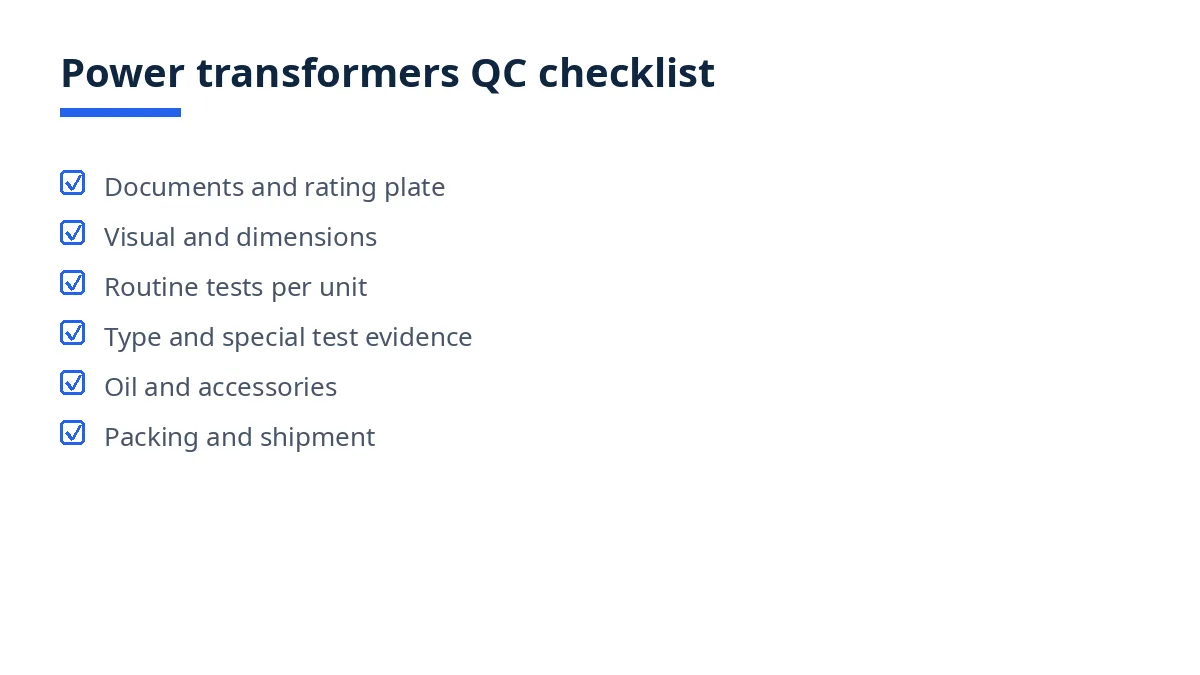
The full checklist (numbered, printable)
Documents, rating plate and identity
Check the serial number on the unit against the purchase order, test reports and packing list.
Read the rating plate against the specification: rated power, voltages, frequency, vector group, impedance and cooling class. IEC 60076-1 covers rating plate information.1
Confirm the drawings used are the approved revision named in the order, including the outline drawing.
Check the test plan against the contract: which tests are routine, which are type tests evidenced from a representative unit, and which special tests were agreed.
For an EU destination, check that the ecodesign evidence required by Regulation (EU) No 548/2014 is in the document pack.3
Agree the accessory and spare-parts list before packing, so each loose item can be checked off.
Visual, dimensions and construction
Measure overall dimensions and mounting dimensions against the outline drawing, recording actual values.
Inspect tank, radiators and conservator where fitted for dents, weld defects and paint damage.
Inspect every bushing for correct type and count, cracks, chipped sheds and damaged terminals, and check terminal markings.
Check that valves, oil level indicator, temperature pockets and other fittings named on the drawing are present.
Check the tap changer: type as ordered, indicator legible, positions marked to match the specification tapping table.
Check earthing terminals, lifting lugs and jacking pads as drawn, and the center of gravity marking where required. IEC 60076-1 covers center of gravity marking.1
Routine electrical tests
Review the winding resistance measurement for every winding, recorded per phase and tapping as the contract requires.1
Review the voltage ratio and phase displacement check at each tapping, and match the vector group result to the rating plate.1
Review the short-circuit impedance and load loss measurement against the guaranteed figures and tolerances in the specification.1
Review the no-load loss and current measurement against the guaranteed figures.1
Review the dielectric routine test results. IEC 60076-3 specifies the insulation requirements and corresponding insulation tests for specific windings and their terminals, and gives the applicable dielectric tests and minimum test levels.4
Where an on-load tap-changer is fitted, review the operation test result.1
For liquid-immersed units, review the leak testing with pressure result, and re-inspect welds and gaskets after the test.1
Review the core and frame insulation check where provided, and confirm every routine report carries this unit's serial number.1
Type and special test evidence
Check the temperature rise evidence. IEC 60076-2 applies to liquid-immersed transformers, identifies them by cooling method, defines temperature rise limits and gives the methods for temperature rise tests.5 The report must name the rating and cooling method it covers.
Check the dielectric type test evidence against IEC 60076-3, including which windings and terminals were covered.4
Check the short-circuit withstand evidence. IEC 60076-5 identifies the requirements for transformers to sustain without damage the effects of overcurrents from external short circuits, and describes the special test and the theoretical evaluation method for the dynamic effects.6
Where a sound level is guaranteed, check the sound evidence. IEC 60076-10 defines sound pressure and sound intensity methods from which sound power levels of transformers and their cooling devices are determined, primarily for factory measurements.7
Confirm each report identifies the design it covers, and record any difference in rating or construction from this order as an open point until closed in writing.
Oil, insulation and accessories
For liquid-immersed units, check oil level after testing and re-inspect tank seams, radiator joints, valves and bushing mountings for leaks.
Review the oil test reports named in the contract, and confirm each names this unit and this oil filling.
Function-check the protective devices fitted under the contract, such as the gas and oil-actuated relay, pressure relief device and temperature indicators.
Operate cooling fans and pumps where fitted, check rotation and controls, and confirm auxiliary supply details.
Check the breather and silica gel charge where fitted, and record the condition at handover.
Packing, preservation and shipment
Confirm the transport condition agreed in the contract, and check every opening is sealed.
Pack loose accessories separately against the list, each package marked with the unit serial number.
Check bushing and radiator protection is fitted so no transit load rests on a bushing or valve.
Check shipment markings: serial number, gross weight, handling marks and the center of gravity marking where required.1
Photograph the unit and packing from all sides before loading, and file photographs by serial number.
Assemble the final document pack: routine reports, type and special test evidence, manuals, drawings and packing list.
Common failures and how to fix them
The most serious failure is a voltage ratio or vector group result that does not match the rating plate, which usually traces to tapping connections or a superseded plate specification. Stop shipment, have the factory correct the connections or plate, and re-run the ratio and phase displacement measurement. Next is impedance or losses outside tolerance: compare measured values with the guaranteed figures, and do not accept a verbal explanation in place of a corrected report.
Dielectric routine test failures point to insulation damage or moisture and are never a packing-stage fix: the unit goes back for investigation. Leaks after pressure testing usually sit at gasket joints or welds: repair, repeat the leak test, and re-inspect the same joints. Rating plate errors are corrected with a new plate checked against the specification. Missing type test linkage, where the report covers a different rating, is closed by evidence for this design or a special test agreed in the contract.
Above the agreed acceptance level, options are re-inspection after correction and retest, documented partial acceptance of a named deviation, or rejection.
Downloadable template / summary table
Copy the checklist into your inspection sheet, add the specification values and tolerances, and record a result and measured value per unit.
Section | Checks | Evidence |
|---|---|---|
Documents and plate | Serial number, rating plate, drawings | Order, plate photo |
Visual and dimensions | Size, tank, bushings, fittings | Measurements, photos |
Routine tests | Resistance, ratio, impedance, losses, dielectric | Reports per unit |
Type and special tests | Temperature rise, short circuit, sound | Reports per design |
Oil and accessories | Oil level, relays, cooling, breather | Reports, function checks |
Packing | Protection, markings, document pack | Packing list, photos |
How Exportain helps
Exportain is a B2B marketplace connecting buyers with Bangladeshi suppliers of power transformers and industrial equipment, so the specification behind this checklist can be agreed at the enquiry stage. Browse suppliers, see the industrial equipment category and use inspection services when you plan the check. Supplier profiles show which document and photo checks have been recorded, not factory inspections. Exportain is not a party to the goods contract and does not inspect goods.
FAQs
When should this checklist be used?
Use it at the factory acceptance stage, when the unit is complete and routine tests are finished, and again before shipment to confirm packing, markings and the document pack. For first orders, also review the type test evidence before production starts.
Who should complete it?
The buyer, a local agent or an independent inspector can complete it, using the purchase specification, approved drawings and test reports. Energized tests are carried out by the manufacturer's test staff and witnessed or reviewed.
What are the most common failures?
A ratio or vector group mismatch, impedance or losses outside tolerance, dielectric routine test failures, oil leaks, rating plate errors and type test reports covering a different design are the failures buyers find most often.
Can a third party do it?
Yes, if you share the specification, guaranteed figures, tolerances and test plan first, and require measured values and serial-numbered reports rather than pass marks alone.
Next steps on Exportain
Before production starts, agree your specification, guaranteed losses, tolerances and test plan, then read the guide to importing power transformers from Bangladesh and the pre-shipment inspection guide, and plan the check with inspection services. You can also post a free RFQ via RFQs and compare quotes.
Sources
- IEC 60076-1:2011 - Power transformers — Part 1: General. International Electrotechnical Commission (accessed )
- ISO 2859-1:1999 - Sampling procedures for inspection by attributes — Part 1: Sampling schemes indexed by acceptance quality limit (AQL) for lot-by-lot inspection. International Organization for Standardization (accessed )
- Commission Regulation (EU) No 548/2014 with regard to small, medium and large power transformers — EUR-Lex summary. European Union, (accessed )
- IEC 60076-3:2013 - Power transformers — Part 3: Insulation levels, dielectric tests and external clearances in air. International Electrotechnical Commission, (accessed )
- IEC 60076-2:2011 - Power transformers — Part 2: Temperature rise for liquid-immersed transformers. International Electrotechnical Commission, (accessed )
- IEC 60076-5:2006 - Power transformers — Part 5: Ability to withstand short circuit. International Electrotechnical Commission (accessed )
- IEC 60076-10:2016 - Power transformers — Part 10: Determination of sound levels. International Electrotechnical Commission, (accessed )
- pre-shipment inspection
- quality control
- aql inspection
- Electrical products
- Bangladesh electrical products
- Power transformers
About the author
Sourcing from Bangladesh?
Post a request for quotation and suppliers on Exportain can send you their quotes directly.
Post an RFQ