Top Jute Rugs and Carpets Manufacturers in Bangladesh: How to Find and Verify Them
A buyer guide to jute rug and carpet makers in Bangladesh: braided, flatweave, tufted and hand-knotted constructions, blends and backing, US and EU compliance, and a five-question shortlist with a worked braided-rug example.
Short answer
Find jute rug and carpet manufacturers in Bangladesh by construction first: braided, flatweave, tufted or hand-knotted. Shortlist makers through the Bangladesh Jute Mills Association and the Jute Diversification Promotion Centre, ask five questions about construction, blend, backing, buyers and price, and confirm the maker in four passes: identity, production line, sample and shipment record.
On this page
Key takeaways
Construction comes first: braided, flatweave, tufted and hand-knotted rugs differ in feel, wear, backing and inspection, so name the construction before discussing price.
Blends and backing decide the label and the risk: write the blend as a percentage, name the backing, and state fibre composition under EU Regulation 1007/2011.
US flammability follows size: 16 CFR 1630 covers large rugs and 16 CFR 1631 covers small rugs, and EN 14041 excludes loose-laid rugs from its scope.
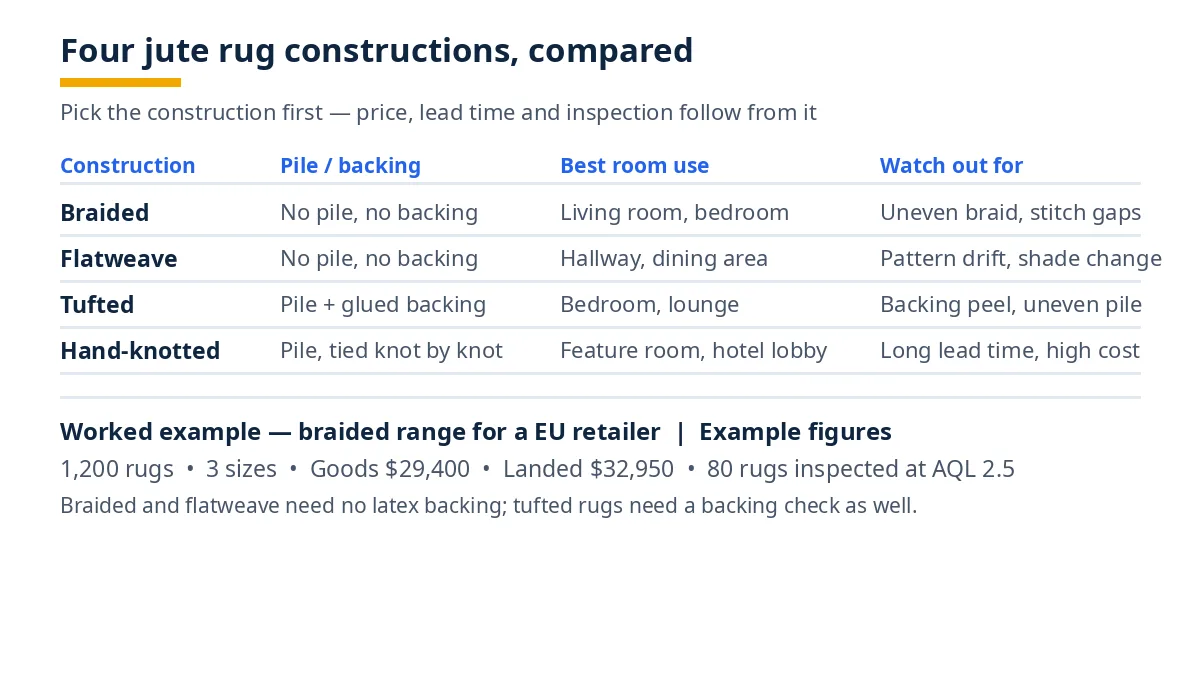
Example figures put a 1,200-rug braided range for a EU retailer at 29,400 dollars in goods and 32,950 dollars landed, with 80 rugs inspected at AQL 2.5.
A home-decor retailer in Rotterdam wants a braided jute rug range for spring: three designs, three sizes, one maker that can repeat the same braid, the same shade and the same size across 1,200 rugs. Every fault in the braid, the dye lot or the backing will sit on a shop floor where customers can see it. This guide shows how to find the makers in Bangladesh who can do that work, and how to confirm them before money moves.
What counts as a jute rug or carpet
A jute rug is a floor covering whose exposed surface is jute fibre, spun into yarn and then braided, woven or tufted into a flat or pile surface. Jute is the bast fibre of the Corchorus plant, defined in the European fibre-name list as fibre from Corchorus olitorius and Corchorus capsularis.1
For buying, the construction matters most: the way the yarn is put together decides how the rug feels, how it wears and what can go wrong with it. A braided rug has no pile. A flatweave has no pile either. A tufted rug has a pile held in by a backing. A hand-knotted rug has a pile tied knot by knot. Ask for the construction first, because the price, the lead time and the inspection all follow from it.
Around 90 per cent of the world's jute fibre comes from Bangladesh and India.2 The Bangladesh Jute Mills Association has 240 member mills, and the country supplies 282 types of jute goods to 118 countries.3 Rugs are made by a different set of workshops than bulk sacking, so a sack maker is not automatically a rug maker.
Braided, flatweave, tufted and hand-knotted: which construction fits which room
Four constructions cover most export orders from Bangladesh.
Construction | How it is made | Best room use | Watch out for |
|---|---|---|---|
Braided | Thick jute yarn is braided into a rope, then stitched in a spiral or in rows | Living rooms, bedrooms, low-traffic retail floors | Uneven braid, stitch gaps, lifting edges |
Flatweave | Warp and weft yarns cross on a loom with no pile and no backing | Hallways, dining areas, layering under other rugs | Pattern drift, loose selvedges, shade change between dye lots |
Tufted | Yarn is punched through a backing cloth with a tufting gun, then a second backing is glued on | Bedrooms, lounges, display areas | Backing peel, uneven pile height, latex smell |
Hand-knotted | Each knot is tied by hand on a loom, then the pile is cut | Feature rooms, high-value retail, hotel lobbies | Long lead time, knot-count variation, high cost per piece |
Braided rugs are the most common Bangladeshi export form, because the braid suits the coarse, firm jute yarn and the work can be done by hand in small workshops as well as in larger units.2 The yarn is braided into a thicker braid to form a rope-like structure, then stitched to form the rug, and the finished piece is often reversible.2 Flatweave rugs are dense and low in profile, which makes them hard-wearing in traffic. Hand-knotted jute rugs are rare, because knotting is slow and jute yarn is coarser than wool.
Fibre, blends and backing: read the label before the price
Pure jute rugs are made entirely from jute fibre and keep a fully natural look, but they stain more easily than blends and shed loose fibre in the first months of use.2 A cotton blend adds softness, makes the rug lighter and easier to handle, and is often reversible.2 A wool blend adds warmth and durability.2 The backing decides whether the rug stays put and keeps its shape. Flatweave and braided rugs usually have no backing at all, which is why they can be flipped. Tufted rugs need one: the pile is held by a backing compound, and a second backing, often cotton or latex, is glued on to lock the tufts in place. Ask what the backing is made of: chemical risk concentrates there in tufted construction, and a certificate that covers only the face yarn does not cover the rug.4
Fibre composition also decides the label. Under EU Regulation 1007/2011, the fibre composition of a textile product must be stated on the label, and for floor coverings and carpets where the backing and the use-surface use different fibres, the composition may be stated for the use-surface alone, with the use-surface named.1
Sizes, shapes and custom orders: what a maker can and cannot change
Standard export sizes cluster around a few rectangles: 120 by 180 cm, 160 by 230 cm and 200 by 290 cm, with runners around 80 by 300 cm and round rugs from 120 to 200 cm across. Braided sizes change by adding braid rows; flatweave is bound by loom width.
A custom shape needs its own pattern, its own approved sample and its own quotation.
Dyeing, finishing and the moisture problem
Jute takes dye unevenly, and the natural shade of the fibre varies from pale beige to rich caramel even before dyeing, so shade variation between rugs is normal within a range and a fault outside it.2 Keep one sealed approved rug as the shade reference, and require rugs of different dye lots to be packed separately.
Jute absorbs water easily, which can lead to mildew and stains.2
Floor-covering compliance: US flammability, EU labelling, and the EN 14041 trap
For the United States, the Consumer Product Safety Commission sets two flammability standards by size. 16 CFR 1630 covers large carpets and rugs, defined as having one dimension greater than 6 feet and a surface area greater than 24 square feet, while 16 CFR 1631 covers small carpets and rugs with no dimension greater than 6 feet and an area not greater than 24 square feet.5 A large rug that fails 1630 cannot be sold. A small rug that fails 1631 may still be sold if it carries a permanent label with the prescribed warning beginning "FLAMMABLE (FAILS U.S. DEPARTMENT OF COMMERCE STANDARD FF 2-70)".5
For the European Union, OEKO-TEX Standard 100 tests the finished rug for harmful substances, covering every component, from the fibre and the dye to the backing and the finishing treatments, and it does not certify organic origin or labour standards.4
Do not ask a rug maker for CE marking under EN 14041. That standard sets essential characteristics for resilient, textile, laminate and modular multilayer floor coverings, but its scope expressly excludes loose-laid mats, runners and rugs from the textile floor covering category.6 Most jute rugs fall under heading 5705, other carpets and other textile floor coverings, at an 8 per cent third-country duty in the UK tariff.7 Our HS code guide for jute rugs and carpets works through the classification in full.
Where to look for rug makers in Bangladesh
There is no published, audited ranking of jute rug manufacturers in Bangladesh, and any list that claims one should be treated with care. Start with the directories that exist. The Bangladesh Jute Mills Association, with 240 member mills, is the industry body for the mill sector, and its member list shows which mills weave and where they sit.3 The country supplies 282 types of jute goods to 118 countries.3 The Export Promotion Bureau lists exporters: jute and jute goods earned 820.16 million dollars in fiscal year 2024-25, down from 855.23 million dollars the year before.8
Most braided and handwoven rugs come from smaller workshops rather than large mills, so sort the long list by construction: which makers braid, which weave flatweave, which tuft, and which only trade.
The shortlist: five questions that sort a rug maker from a reseller
Send the same five questions to every maker on the long list, and score the replies side by side.
Which constructions do you make in your own workshop or mill, and which do you buy in as finished rugs?
For my construction and size, what is the yarn count, the blend percentage and the backing, and will you put all three in the quotation?
Which buyers in my market have you shipped this construction to, and can I contact one of them?
Will you send a sample rug made to my size, construction and shade, and keep one sealed as the reference?
What is the price per rug, how many rugs go in a roll and a carton, and on which Incoterm?
Check the sample unrolled, and keep the rug that passed as the sealed reference.
Confirm the maker in four passes
Verification runs in four passes, each finished before the next starts. The first pass is identity: trade licence, export registration certificate in the exporter's own name, and a bank account in the company name. The second pass is the line: see the braiding tables or looms running your construction on a visit or video call, and ask for production records for the last three runs. The third pass is the sample: a rug made to your size, construction, blend and shade, checked unrolled and kept sealed. The fourth pass is the shipment record: buyer references and shipping papers for a recent order of the same construction to your market.
Exportain's supplier checks are a review of documents and photographs, not a factory inspection.
Worked example: a braided-rug range for a EU home-decor retailer
Example figures. A home-decor retailer in the Netherlands orders a braided-rug range from Bangladesh: three designs, three sizes, 400 rugs of each size, 1,200 rugs in all, FOB Chattogram, in one 40-foot container.
Size | Rugs | Example FOB price per rug | Example goods value |
|---|---|---|---|
120 by 180 cm | 400 | 18.50 dollars | 7,400 dollars |
160 by 230 cm | 400 | 24.00 dollars | 9,600 dollars |
200 by 290 cm | 400 | 31.00 dollars | 12,400 dollars |
Total | 1,200 | — | 29,400 dollars |
The retailer sends the five questions to eight makers that braid.3 Three answer with braid detail, blend percentages and a named reference buyer; the rest answer with a price only or not at all. The retailer asks the three for a sample rug each, made to 160 by 230 cm in the retailer's shade.
Two samples arrive. One lies flat with even braiding; the other curls at two corners and shows a stitch gap. The retailer keeps the first maker and writes the construction, blend, size, shade lot and backing into the purchase order.
The cost build is example figures: goods 29,400 dollars; inspection 650 dollars; freight 2,900 dollars; total landed 32,950 dollars, or 27.46 dollars a rug. The sampling plan follows ISO 2859-1: a lot of 1,200 rugs at General Inspection Level II takes code letter J and a sample of 80 rugs, accepted with 5 or fewer major defects and rejected at 6 at AQL 2.5.9
FAQs
What is the best construction for a first jute rug order?
Braided or flatweave: both are well understood by Bangladeshi makers, need no latex backing, and can be checked unrolled with a tape measure.
Which documents should I ask for with the shipment?
Ask for the bill of lading, the packing list, the certificate of origin and the commercial invoice, plus the test reports for the flammability and chemical tests your market requires and the fibre composition label as it will appear on the rug. Confirm the HS heading with your customs broker before the container is booked.7
Next steps on Exportain
Read the HS code guide for jute rugs and carpets so the shipment carries the right heading, then use the jute rugs quality control checklist to put the inspection in writing. When the shortlist is ready, look for Bangladeshi suppliers and raise an RFQ that names the construction, blend, size, shade and quantity. See our sustainable jute products guide for the wider jute range, and our jute bags manufacturers guide for the contrast between bag and rug makers.
Sources
- Regulation (EU) No 1007/2011 — Annexes: List of textile fibre names and special labelling provisions. legislation.gov.uk, (accessed )
- What Is a Jute Rug? Complete Guide to Natural Fiber Rugs. Base Handicrafts, (accessed )
- BYETS and Bangladesh Jute Mills Association Collaborates to Advance Skills in Jute Diversification. Swisscontact, (accessed )
- GOTS vs OEKO-TEX vs GoodWeave: Rug Certifications. Jaipur Rugs, (accessed )
- Rug Flammability: 16 CFR 1630 vs 1631 for Importers. CargoTrans, (accessed )
- EN 14041:2018 — Essential Characteristics for Floor Coverings. iTeh Standards (accessed )
- Other carpets and other textile floor coverings, whether or not made up — UK Integrated Online Tariff. GOV.UK (accessed )
- Exports of jute and jute goods keep falling. The Financial Express, (accessed )
- AQL Chart 2.5 and 4.0: Sample Size Tables Explained. ClearLoad (accessed )
About the author
Sourcing from Bangladesh?
Post a request for quotation and suppliers on Exportain can send you their quotes directly.
Post an RFQ