Jute Sacks Exporters in Bangladesh: Verified Supplier Checklist
Six checks that test a jute sack exporter in Bangladesh: the sack specification, food-grade lot certificate, ERC pack, export record, the mill behind the firm, and sampling and inspection agreed before production, with a weighted scorecard for three exporters.
Short answer
Check a jute sack exporter in Bangladesh in six steps: write the sack specification first, then ask for the food-grade lot certificate, the ERC in the exporter's own name, two buyer references, the name of the mill behind the sacks, and a written sampling and inspection plan. Score each exporter from 0 to 5 on those six checks, weighted by what matters most, and order only from the exporter that passes every check.
On this page
Key takeaways
A sack exporter is the firm that signs the export papers in its own name: a mill exporter, a trading exporter or a buying house, and the type decides what you check.
Food-grade coffee and cocoa sacks need a lot certificate: unsaponifiable matter below 1,250 mg/kg under IJO 98/01, or MOSH 250 and MOAH 25 mg/kg under the February 2026 specification.
The ERC must be current, issued by CCI&E, and in the same name as the quotation and the bank account.
A 60-bale lot needs 2 bales sampled and 2 sacks tested, and one failed sample rejects the whole lot.
Score each exporter 0 to 5 on six weighted checks: in the worked example the winner scores 4.30 out of 5.
A coffee roaster in Rotterdam needs 24,000 Heavy Cees sacks for green coffee: food-grade VOT, one colour print, FOB Chattogram. Three Bangladeshi exporters reply. One sends an ERC, a mill address and the lot certificate from its last coffee order. One sends a price and a photograph of sacks stacked in a warehouse. One sends nothing for six days, then a price lower than the other two. The sacks are the same grade on paper. The exporters are not the same risk. This checklist sorts them before money moves.
What a jute sack exporter is
A jute sack exporter is the firm that sells the sacks abroad and signs the export papers in its own name. It may weave and stitch the sacks in its own mill, buy finished sacks from mills and ship them under its own name, or act as a buying house that sources on your behalf and never takes title to the goods. The name on the invoice, the letter of credit and the bill of lading is the firm you can hold to the contract, so get its type in writing first.
Exporter type | Who makes the sacks | What to ask for |
|---|---|---|
Mill exporter | Weaves and stitches in its own mill | Mill address, loom count, last three runs of your grade |
Trading exporter | Buys finished sacks from mills it names | The supplying mills by name and address, plus its own shipping papers |
Buying house or agent | Finds mills and follows the order, usually for a fee | The fee payer, and whether the house ever holds the goods |
Do not mark a trading exporter down for being a trader. The risk is a firm that keeps its type vague.
Write the sack specification before you ask for names
State the grade in every enquiry, for example Heavy Cees, 43 by 29 inches, 1,134 grams, 8 by 9 porter and shot, for 100 kg of green coffee.
Grade | Porter and shot | Size and weight | Fill it carries | Sacks in one bale |
|---|---|---|---|---|
Binola | 6 x 7 | 44 x 26.5 in, 907 g | 80-90 kg | 300 |
B-Twill | 6 x 8 | 44 x 26.5 in, 1,020 g | 100 kg | 300 |
A-Twill | 8 x 9 | 44 x 26.5 in, 1,188 g | 100 kg | 300 |
Heavy Cees | 8 x 9 | 43 x 29 in, 1,134 g | 100 kg | 400 |
Porter and shot is the mill's count of weave density in the cloth, and A-Twill is the heavier cloth with a double warp.1 Name the sack weight beside the grade in every enquiry.
At 400 sacks a bale, 24,000 Heavy Cees sacks press into 60 bales and fill one 40-foot container, while B-Twill packs 300 to a bale and 19,500 to a 20-foot container.1 Ask the exporter to state the bale count and the container count beside the price.
One exporter lists a supply ability of 25 forty-foot containers of Heavy Cees a month, or 1,350 bales a month.1 Ask for a sample sack made to your grade first: one exporter sends it for $250, shipping included, within 3 to 7 working days.1
Check the food-grade paperwork first for coffee and cocoa
For coffee, cocoa and shelled nuts, the food-grade question comes before the price. Under IJO Standard 98/01, yarn for sacks holding coffee, cocoa or shelled nuts is batched with food-approved vegetable oil, not mineral oil, and unsaponifiable matter stays below 1,250 mg per kg.2 In force since 1 October 1998 and revised in 2005, it sells such sacks as vegetable-oil-treated, known as VOT.2
European cocoa and coffee buyers are moving past the old standard. The February 2026 specification that the European Coffee Federation and the European Cocoa Association published together caps MOSH at 250 mg/kg and MOAH at 25 mg/kg, and it rejects the IJO 98/01 unsaponifiable-matter proxy as too weak a control on MOAH.3 Every substance used in production must be food-grade, and production must be kept apart from non-compliant material.3
Ask which standard your buyer requires before the price is fixed, and ask for the lot certificate for that standard by name in the order. A certificate for a different lot, or for cloth rather than sacks, does not cover your order.
Bales in the lot | Bales sampled | Sacks taken |
|---|---|---|
Up to 100 | 2 | 1 from each bale |
101 to 150 | 3 | 1 from each bale |
151 to 200 | 4 | 1 from each bale |
Each further 50 bales | 1 more | 1 from each bale |
For 60 bales, the table calls for 2 bales and 2 sacks, handled with clean, grease-free hands and wrapped in foil.3 One failed sample rejects the whole lot.3
Check the registration pack
The Export Registration Certificate, the ERC, comes from the Chief Controller of Imports and Exports (CCI&E) under the Importers, Exporters and Indentors (Registration) Order 2023.4 Renewals run for one to five years, and the exporter should apply at least 60 days before expiry.4
Check four things on the copy: the name matches the quotation and the bank account, the certificate is for export, the expiry date is still ahead, and the ERC number is the one on the firm's invoices. The rest of the pack is a trade licence, an e-TIN, a BIN for VAT, and a bank account with an authorised dealer bank.4 A marketplace badge is not a substitute: Exportain's trust badges rest on a review of documents and photos, not a factory inspection.5
Customs lists the ERC and the BIN among its general export documents.4 The commercial invoice must carry the ERC number and the HS code.4 Our guide to the HS code for jute sacks explains the classification.
Each shipment is declared on an EXP form through an authorised dealer bank, and the money is normally due back within four months of the sailing date.4 For raw jute and jute goods, the terms may run to 360 days against an irrevocable confirmed letter of credit.4 Ask whether the ERC has ever been suspended or cancelled: the 2023 Order allows both.
Check the export record and the mill behind the exporter
Paper proves less than a shipping record. Ask for two buyer references you can reach, and for the shipping papers of a recent jute sack order with the prices and buyer names blanked out. A reference that never answers, or papers that show only sales inside Bangladesh, leave the export history unproven.
In 2025-26, jute sacks and bags earned $132.3 million, up 5.03 per cent on the year before, inside $883.7 million for jute and jute goods as a whole.6
For a mill exporter, ask for the factory address and the order book for that month. For a trading exporter, ask for the name and address of every mill that will make your sacks. Our jute sacks manufacturers guide covers the mill visit in detail.
Agree sampling, lab testing and inspection before production
A final random inspection runs on ANSI/ASQ Z1.4 (ISO 2859-1) AQL sampling, when 100 per cent of the goods are produced and at least 80 per cent are packed.7 It covers quality, quantity, packaging, labelling, shipping marks, transport and drop checks.7
Write into the order: the inspection level, the AQL values for major and minor defects, the inspection firm, and who pays for a re-inspection. One exporter offers SGS, Intertek or Bureau Veritas reports at the buyer's request and expense.1 Our guide to quality control for jute sacks sets out the checks to run on the sample sack and on the packed bales.
For food-grade lots, the laboratory test sits beside the visual inspection. The February 2026 specification samples bales on the table above and tests MOSH and MOAH in the laboratory, and a single failed sample rejects the whole lot.3 Name the laboratory and the test method in the order, and hold the lot until the result arrives.
Payment terms are part of the check too. One exporter wants the full amount by wire transfer before production starts, with a lead time of 7 to 30 working days from payment.1 For a first order, an irrevocable confirmed letter of credit, or a smaller advance with the balance against documents, leaves you a route to refuse a bad lot. Put the inspection result in the payment terms: no release of the balance until the inspection report and the lot certificate arrive.
Score three exporters on one sheet
Score each exporter 0 to 5 on six checks, multiply by the weight, and add the totals. A failed check scores zero and stops the order.
Check | Weight | Exporter A | Exporter B | Exporter C |
|---|---|---|---|---|
Food-grade paperwork | 25 | 5 | 3 | 4 |
Registration pack | 15 | 4 | 5 | 3 |
Export record | 20 | 4 | 5 | 3 |
Mill behind the exporter | 15 | 5 | 3 | 4 |
Sampling and inspection agreed | 15 | 4 | 3 | 5 |
Commercial terms | 10 | 3 | 5 | 4 |
Weighted score out of 5 | 100 | 4.30 | 3.90 | 3.80 |
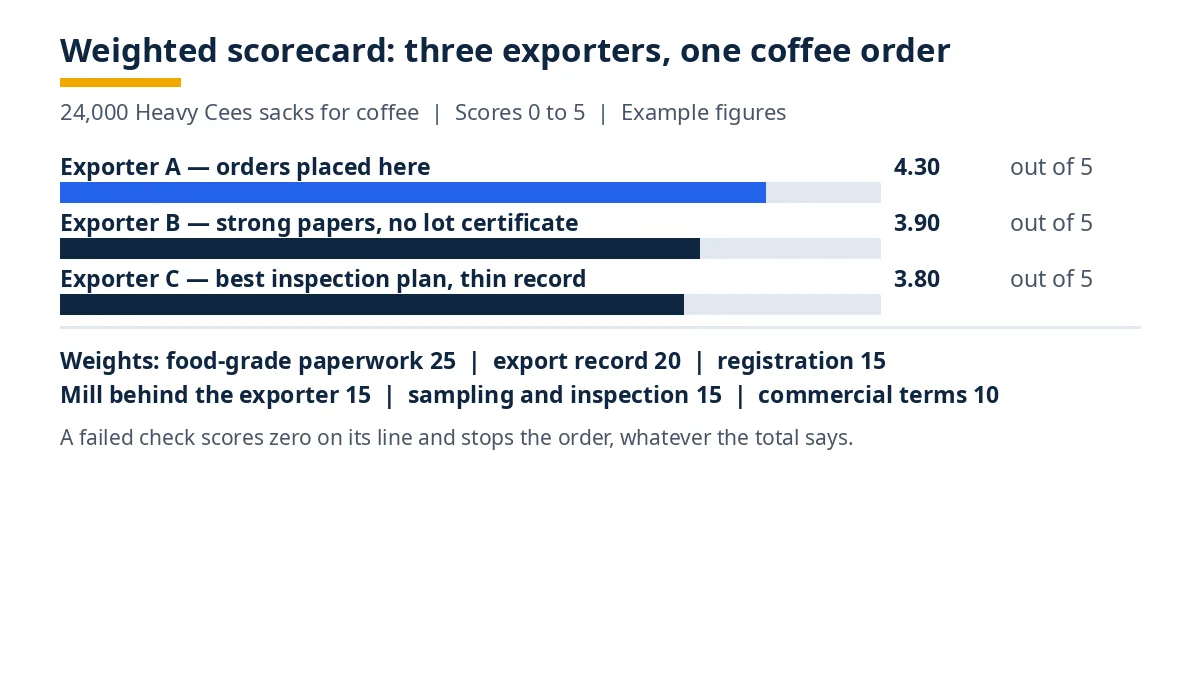
Example figures: the Rotterdam roaster needs 24,000 Heavy Cees sacks, 1,134 grams, food-grade VOT, one-colour print, FOB Chattogram. Exporter A leads at 4.30: it sent the lot certificate for its last coffee order and named its mill, but asks for full advance payment. Exporter B scores 3.90: strong papers and record, yet no lot certificate for the February 2026 limits and no mill named. Exporter C scores 3.80: the fullest inspection plan, but a thin record and an ERC that expires inside the production window. The roaster orders from A by irrevocable confirmed letter of credit, and keeps B as the second source.
At 1,134 grams a sack, the empty sacks weigh about 27.2 tonnes and press into 60 bales of 400.1 The sampling table calls for 2 bales and 2 sacks from a 60-bale lot.3
Seven signs to stop and walk away
Any one of these ends the conversation.
The ERC is in another firm's name, or there is no ERC: the firm cannot sign the export papers.
A lot certificate for a different lot, or for cloth rather than sacks.
An export history that cannot be shown.
The exporter will not name the mill: without a mill name and address, there is nothing to check.
Full advance payment before the sample is approved.
Inspection left open until the bales are packed: once the goods are sealed, the standard is set too late.
Bale and container counts that do not match the grade table.
FAQs
How do I check a jute sack exporter in Bangladesh?
Ask for the ERC in the exporter's own name, the lot certificate for your food-grade standard, two buyer references, the mill behind the sacks, and a written sampling and inspection plan.
What does food-grade mean for a jute sack?
For coffee, cocoa and shelled nuts, it means the yarn was batched with food-approved vegetable oil instead of mineral oil, with unsaponifiable matter below 1,250 mg per kg under IJO 98/01.2 Since February 2026, European cocoa and coffee buyers also cap MOSH at 250 mg/kg and MOAH at 25 mg/kg.3
Next steps on Exportain
Start with the specification, then search Bangladeshi suppliers or raise an RFQ, and ask each reply for four things: its exporter type, its ERC number, the mill behind the sacks, and the lot certificate it will issue.
Sources
- 90 Kg Jute Bag. BACKBD (accessed )
- IJO Standard 98/01: Special Criteria for the Manufacture of Jute Bags used in the Packing of Selected Food Materials. International Jute Study Group (accessed )
- Industry Specification: Jute Bags - Jute Yarns for Use in Cocoa Supply Chains. European Cocoa Association, (accessed )
- Start an Export Business in Bangladesh (2026 Guide). Entrepreneurs.bd (accessed )
- Supplier verification: Earn trust badges buyers can see. Exportain (accessed )
- Jute exports rise 37 per cent as Bangladesh plans to double earnings by 2031. The Financial Express, (accessed )
- Final Random Inspection. SGS (accessed )
- ERC
- supplier verification
- inspection
- import from Bangladesh
- Jute sacks
- Food-grade jute
- Jute sacks exporters
About the author
Sourcing from Bangladesh?
Post a request for quotation and suppliers on Exportain can send you their quotes directly.
Post an RFQ