

HS Code for Jute Sacks: Classification Guide for Importers
Jute packing sacks point to indicative heading 6305, at the jute line 6305.10: made-up sacks of a kind used for packing goods, with new and used sacks split in the EU tariff but not in the US line opened here.
Short answer
A jute packing sack is examined under indicative heading 6305, at the jute line 6305.10, only when it is a made-up sack of a kind used for the packing of goods. The six-digit line does not finish the job: the Northern Ireland (EU) tariff splits that line into used and other lines, while the United States text opened shows a single 6305.10.00 line, so the full national code must be confirmed for the entry date.
On this page
In bulk agricultural trade, the sack is the packing. A jute sack shipped empty to be filled with grain, coffee or a similar bulk good is classified as a sack, not as the goods it will later hold, and not as the jute fibre or yarn it was made from. First establish that the goods are a finished, made-up packing sack, then test packing purpose, and only then read the material line inside heading 6305.
Verify note: every heading and code named here is indicative only. Confirm the six-digit subheading and full national code in the destination tariff for the entry date, and put a doubtful sack to a broker or the binding ruling route.
Quick answer: indicative HS heading (with verify note)
The indicative heading for a jute packing sack is heading 6305, for sacks and bags of a kind used for the packing of goods.1 Inside it, the jute line is 6305.10, for sacks and bags of jute or of other textile bast fibres of heading 5303.1 2 It applies only to a made-up sack of a kind used for the packing of goods. A roll of jute fabric, a mainly cotton sack, and a container made to carry personal effects are each a different question.
Six-digit line | Material split in heading 6305 |
|---|---|
6305.10 | Of jute or of other textile bast fibres of heading 5303 |
6305.20 | Of cotton |
6305.32 | Of man-made materials, flexible intermediate bulk containers |
6305.33 | Of man-made materials, PE/PP strip, other than flexible intermediate bulk containers |
6305.39 | Of man-made textile materials, other |
6305.90 | Of other textile materials |
Each line still needs its national extension, where new and used sacks part company in some tariffs.
How HS codes are structured (2-4-6 digits)
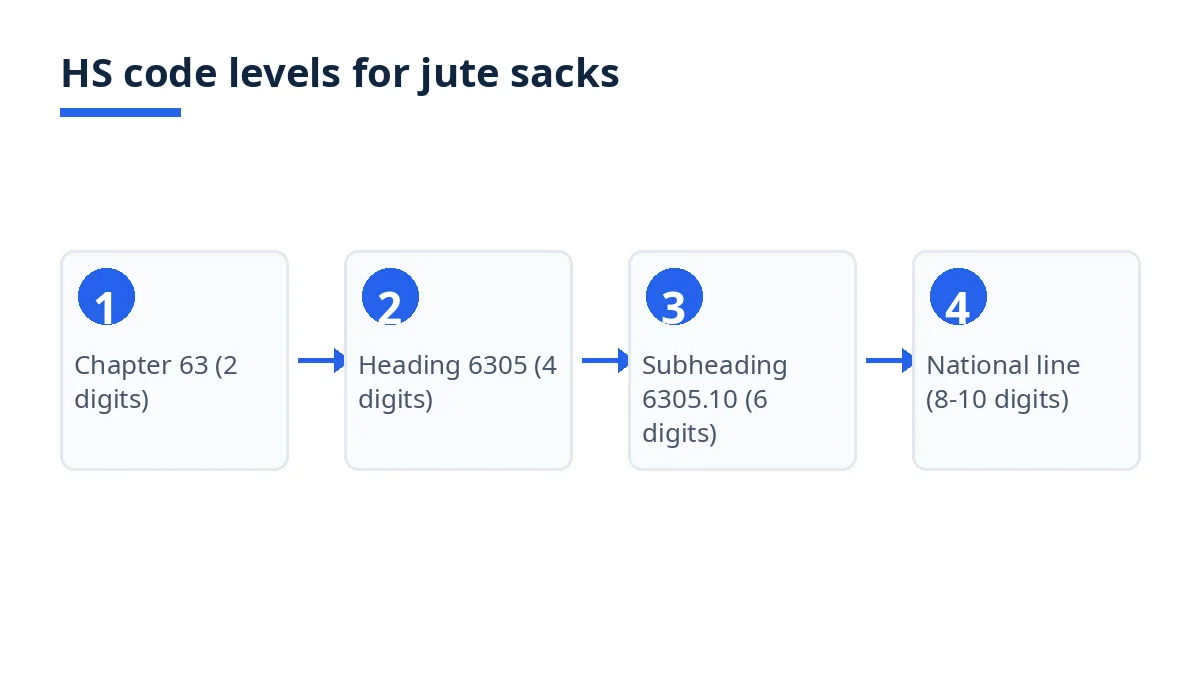
The first two digits are the chapter: chapter 63 covers other made-up textile articles, sets, worn clothing and worn textile articles, and rags.2 The next two digits make the heading, here 6305, and the final two make the subheading, here 6305.10.1 2
Only the first six digits are internationally shared; each destination adds its own digits. The tariff page opened here lists 10-digit codes under 6305.10, split between used and other sacks.1 The United States schedule opened here shows a single 10-digit number, 6305.10.00.3
The diagram below shows the narrowing.
Factors that decide the code for jute sacks
First, test the packing-goods purpose. The explanatory note quoted in a United States customs ruling states that heading 6305 covers textile sacks and bags of a kind normally used for the packing of goods for transport, storage or sale.4 Its examples run from flexible intermediate bulk containers and coal, grain, flour, potato, coffee or similar sacks, to mail bags, small sample bags, and tea sachets.4 The common thread is packing goods for transport, storage or sale, not size or the particular bulk good. The ruling quoted here concerned polyester seat sacks, not jute sacks, and is used only for the note wording; it is not a holding about any jute sack.4
Second, test whether the sack is made up. Sub-Chapter I of chapter 63 applies only to made-up articles, of any textile fabric.1 For Section XI, made up includes an article assembled by sewing, gumming or otherwise, an article hemmed or with rolled edges, an article cut otherwise than into squares or rectangles, and an article knitted or crocheted to shape.1 A sewn, hemmed jute sack passes that test on its face. A length of jute hessian fabric, even if cut into rectangles and intended to become sacks later, does not: it is fabric, not a finished sack.
Third, test the material, and test blends by weight. Heading 6305.10 covers jute and also other textile bast fibres of heading 5303, so a sack of another heading 5303 bast fibre sits on the same six-digit line.1 2 For a mixed-material sack, the Section XI notes provide that products of chapters 56 to 63 with two or more textile materials are regarded as consisting wholly of the material selected under the note for chapters 50 to 55, which turns on predominance by weight.1 A jute-predominant sack therefore stays on the 6305.10 side, while a cotton-predominant sack points toward 6305.20, to be confirmed on the facts.
Fourth, treat coatings and linings as facts to record, not as a new six-digit line. The six-digit splits in heading 6305 turn on material and, for man-made materials, on container type; they contain no separate split for a coated, paper-lined or plastic-lined jute sack.2 A paper-lined sack for flour and a plain sack for grain therefore start from the same six-digit line. That does not settle the national line, so record the coating, lining and weight share.
Fifth, test new against used, because this is where national lines diverge most sharply for jute sacks. In the Northern Ireland (EU) tariff page opened here, 6305.10 splits into used sacks at 6305 1010 00 and other sacks at 6305 1090 00.1 In the United States schedule opened here, the jute line is a single number, 6305.10.00, with no used or other split shown.3 A second-hand sack resold empty for packing therefore stays inside 6305; only the national line under 6305.10 is in question. Do not move it to heading 6309: its notes limit it to clothing, blankets, linen, furnishing articles and footwear or headgear showing appreciable wear in bulk presentation.1 A packing sack is not on that list.
Sixth, state how the sacks travel: empty or filled, folded or baled, new or used, and in what quantity and weight. A filled sack raises a separate question about the contents, for a broker to settle before filing.
Worked sack description | First test | Indicative treatment, with caution |
|---|---|---|
New sewn, hemmed jute sack for grain | Made-up packing sack | 6305.10 area; confirm national line |
Second-hand jute sack, resold empty | Made-up sack, still used for packing goods | 6305.10 area; EU used line; US single 6305.10.00 line |
Paper-lined jute sack for flour | Made-up sack, lining does not change purpose | 6305.10 area; lining recorded |
Jute-blend sack, jute predominates by weight | Material test by predominance | 6305.10 area; weight shares recorded |
Cotton-predominant sack, some jute | Material test by predominance | 6305.20 area, to be confirmed |
Roll of jute hessian, rectangles only, unsewn | Made-up test fails | Not a 6305 sack; a fabric question |
National codes: US HTS, EU CN/TARIC, UK commodity code
In the United States, the schedule text opened here shows the jute line as 6305.10.00.3 That text is an older edition, so treat the number as the structure of the line, not a current-code guarantee: confirm the current line, condition and entry date; no used or other split is shown in that text.
In the European Union, the Combined Nomenclature builds on the six-digit subheading, and TARIC adds further digits. The Northern Ireland (EU) page opened here shows subheading 6305.10, with used sacks at 6305 1010 00 and other sacks at 6305 1090 00.1 That page is dated 1 January 2023 on its face, so use it as the pattern of the EU-side split and read the entry-date line before declaring.
In the United Kingdom, the commodity code is also built on the shared six-digit foundation with national extensions. No Great Britain numeric line is stated here, because the page opened was the Northern Ireland (EU) page, not a Great Britain heading page. For Great Britain, open the UK Integrated Online Tariff for the entry date; do not assume it mirrors the Northern Ireland split digit for digit.
How to confirm the code officially
Start with the destination tariff text, not a supplier invoice or marketplace listing. Open the current chapter 63 text, read the heading wording and notes, and work down to the national line, comparing only subheadings at the same level.
Next, build a classification file for each sack style: material and weight share, finish, coating or lining, dimensions, new or used condition, and empty or filled travel, with the intended bulk good and destination.
Where the answer is still doubtful, seek a binding decision. In the United States, a binding ruling request goes to United States Customs and Border Protection. For Northern Ireland and the European Union, a Binding Tariff Information decision is applied for through the EU Customs Trader Portal, with a separate application for each type of goods, made before all customs procedures have been completed.5 For Great Britain, the equivalent route is an Advance Tariff Ruling, likewise with a separate application per type of goods.6 A binding decision covers only the goods described in it.
Common classification mistakes
The first mistake is quoting the fibre or yarn heading for the sack: heading 5303 covers jute fibres, raw or processed but not spun, and heading 5307 covers jute yarn, but neither is the code for a finished sack.7 The second is treating a roll of fabric as a sack because it will become sacks; until the fabric is made up, there is no sack under 6305.
The third mistake is copying a national line across destinations: the Northern Ireland used line is not a United States line, and vice versa.1 3 The fourth is stopping at 6305 or 6305.10, leaving the national extension undecided. The fifth is treating a coated or lined sack as a different heading on the coating alone. The sixth is treating every jute container as a packing sack: a shopping container or other made-up article is a different question, covered in the companion guide HS Code for Jute Bags: Classification Guide for Importers, and not re-examined here.
Related duties and documents
The HS code does not by itself state what an importer will pay. No rate is stated here. Ask your broker for the treatment for your code, origin and entry date.
Documents that normally travel with a jute sack shipment are the commercial invoice, packing list, bill of lading or airwaybill, and certificate of origin where a preference or buyer requirement calls for one. The invoice description should match the classification file: material and weight share, finish, coating or lining, new or used condition, dimensions, count and weight.
FAQs
What is the HS code for jute sacks?
The indicative heading is 6305, and the jute line inside it is 6305.10, for sacks and bags of jute or of other textile bast fibres of heading 5303.1 2 It applies only to a made-up sack of a kind used for the packing of goods, and the full national code must be confirmed for the entry date.
Is the HS code the same in every country?
Only the first six digits are shared. The Northern Ireland (EU) page splits 6305.10 into used and other 10-digit lines, while the United States text shows a single 6305.10.00 line.1 3
How do I confirm the correct code?
Read the chapter 63 tariff text, apply the heading wording and notes, and test packing purpose, finish, material by weight, coating or lining, and new or used condition.1 4 Then get a broker confirmation in writing, or seek a binding decision: a United States ruling, a Binding Tariff Information decision for Northern Ireland and the EU, or an Advance Tariff Ruling for Great Britain.5 6
What happens if I use the wrong code?
A wrong code can delay clearance, change the entry treatment, and create a mismatch between entry, invoice and any origin claim; it can also put a used-sack shipment on the wrong national line.
Next steps on Exportain
For background, read HS Code: Harmonized System Explained and HS Codes: How to Classify Your Product. When you are ready to source, browse suppliers on Exportain and compare sack material, finish and condition before asking for a quotation. To start sourcing, Post a free RFQ on Exportain.
Sources
- Sacks and bags, of a kind used for the packing of goods - Northern Ireland Online Tariff, heading 6305. GOV.UK (accessed )
- HS, 2012 - Code 6305 Classification Detail. United Nations Statistics Division (accessed )
- Harmonized Tariff Schedule of the United States (2014) (Rev. 1), Chapter 63. United States International Trade Commission (accessed )
- Customs Ruling HQ H295656 - Request for Internal Advice; Tariff Classification of Seat Sacks. U.S. Customs and Border Protection (accessed )
- Apply for a Binding Tariff Information decision. GOV.UK (accessed )
- Apply for an Advance Tariff Ruling. HM Revenue & Customs (GOV.UK), (accessed )
- Chapter 53: Other vegetable textile fibres; paper yarn and woven fabrics of paper yarn (HS 2012). World Customs Organization (accessed )
About the author
Sourcing from Bangladesh?
Post a request for quotation and suppliers on Exportain can send you their quotes directly.
Post an RFQ


