HS codes: how to classify your product before you import
A step-by-step method for finding the HS code of a product you plan to import, with the textile traps to watch for and where to get a legally binding answer.
Short answer
Describe the product precisely: what it is made of, how it is made and what it is used for. Then work down the Harmonized System from section and chapter to the four-digit heading and six-digit subheading, applying the heading texts, legal notes and General Interpretative Rules. Finally, find the full code in your destination country's official tariff. When the choice is unclear, ask a customs broker or apply for an advance ruling.
On this page
Key takeaways
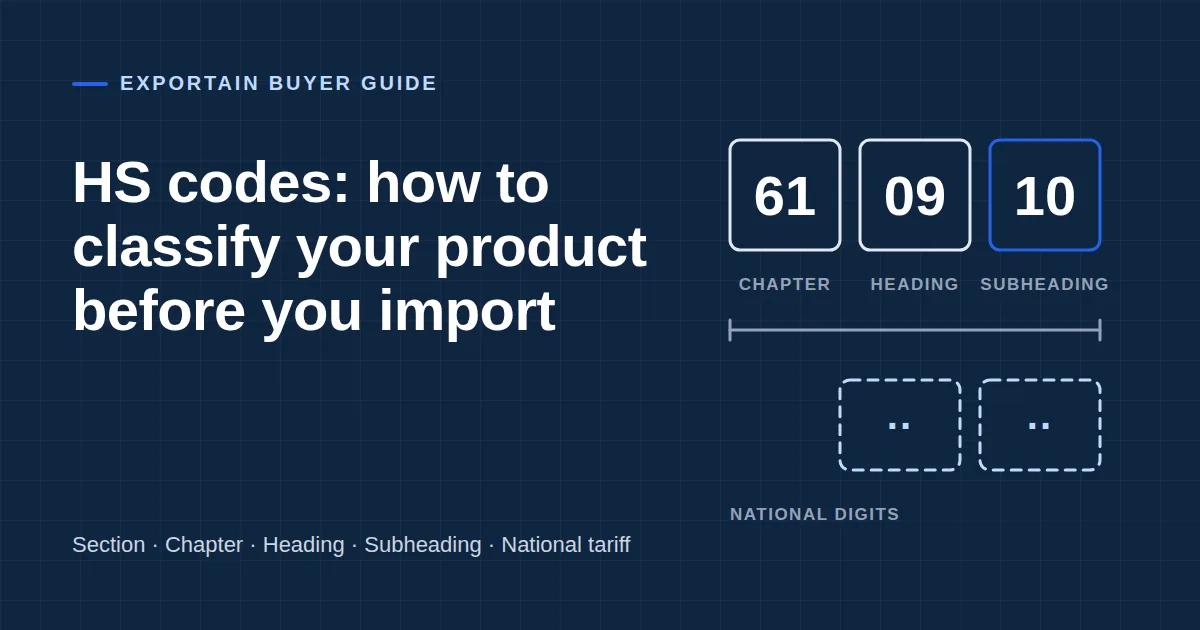
Only the first six digits of an HS code are shared internationally; the digits after that belong to each country's tariff.
Section and chapter titles are for reference only. Classification follows the heading texts and the section and chapter notes.
For garments, knitted versus woven construction and the fiber that predominates by weight decide much of the code.
A supplier's HS code is a useful starting point, not a decision. Your own customs authority's tariff is what counts.
If duty or import controls depend on the answer, ask a customs broker or apply for an advance ruling before you ship.
The short answer
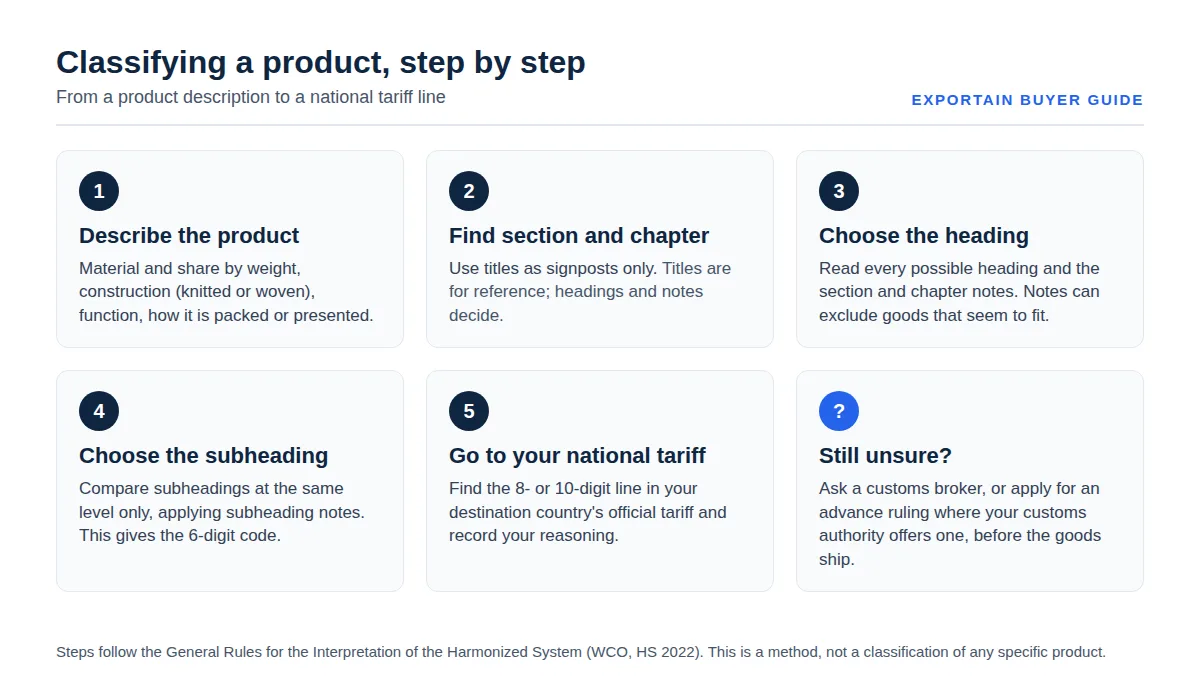
Write a precise description of the product: materials and their share by weight, how it is made, what it does, and how it is packed.
Find the section and chapter that cover it.
Choose the four-digit heading by reading the heading texts and the legal notes.
Choose the six-digit subheading within that heading.
Look up the full national code in your destination country's tariff.
If you are unsure, ask a customs broker or apply for a binding ruling before the goods ship.
This guide walks through each step using a cotton knitted T-shirt as the running example. The example shows how the system works. It is not a classification of your product.
What the Harmonized System is
The Harmonized Commodity Description and Coding System, usually called the Harmonized System or HS, is an international product nomenclature developed by the World Customs Organization (WCO). According to the WCO, it covers more than 5,000 commodity groups, each identified by a six-digit code, and more than 200 countries and economies use it as the basis for their customs tariffs and trade statistics1.
The current version is HS 2022, the seventh edition, which took effect on 1 January 20222. The WCO has announced that HS 2028, the eighth edition, will enter into force on 1 January 20283. When a new edition arrives, some codes change, so a code that was correct for an earlier shipment is worth checking again.
The nomenclature is arranged in 21 sections and in chapters numbered up to 97. Chapter 77 is reserved for possible future use, and chapters 98 and 99 are reserved for special uses by the countries that apply the system4.
Six digits are international; the rest are national
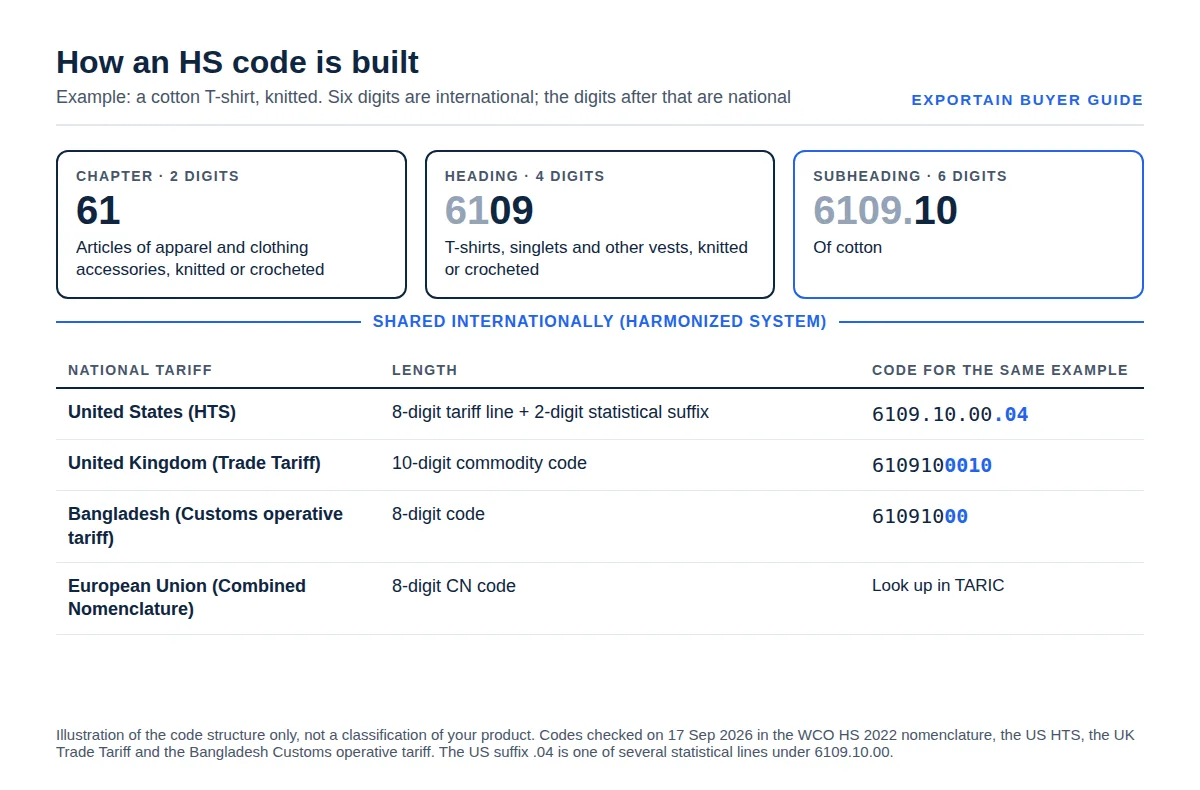
Each country adds its own digits after the first six. The UK government's guidance puts it simply: only the first six digits are used worldwide, and product-specific decisions are particular to each country5. In practice:
Level | Digits | Example: cotton T-shirt, knitted |
|---|---|---|
Section | Roman numeral | Section XI: Textiles and textile articles4 |
Chapter | 2 | 61: Articles of apparel and clothing accessories, knitted or crocheted4 |
Heading | 4 | 61.09: T-shirts, singlets and other vests, knitted or crocheted6 |
Subheading (international) | 6 | 6109.10: Of cotton6 |
European Union (Combined Nomenclature) | 8 | The EU's CN code has 8 digits7 |
United States (HTS) | 8 + 2 | 6109.10.00 is the tariff line; a 2-digit statistical suffix makes the 10-digit reporting number, such as 6109.10.00.048 9 |
United Kingdom (Trade Tariff) | 10 | 6109100010: T-shirts10 |
Bangladesh (Customs operative tariff) | 8 | 61091000: T-shirts, singlets and other vests, of cotton, knitted or crocheted11 |
The last four rows show why a code from your supplier is only a starting point. Bangladesh's tariff and your own country's tariff agree on the first six digits and can differ after that, and the national digits can split one international subheading into several lines with different descriptions. UK guidance makes the same point: if you rely on a commodity code from an overseas supplier, check whether the treatment is the same and how much of the code applies in your country5.
Step by step: classifying a product
1. Describe the product the way customs will read it
Write down the material and its composition by weight, the construction (for textiles: knitted, crocheted, woven or nonwoven), the function, and how the goods are presented, for example as a set or in retail packaging. Vague descriptions produce vague classifications. "Cotton top" could fall under several headings. "Short-sleeved crew-neck T-shirt, 100% cotton single jersey, knitted, no pockets" narrows the search immediately.
2. Find the section and chapter
Browse the section and chapter titles to find the likely area. Use them only as signposts. The first General Interpretative Rule of the HS says that the titles of sections, chapters and sub-chapters are for ease of reference only. For legal purposes, classification is determined by the terms of the headings and any relevant section or chapter notes12.
3. Read the headings and the legal notes
Read every heading that might apply, then read the section and chapter notes. Notes can exclude goods that seem to fit. Chapter 61, for example, applies only to made-up knitted or crocheted articles. One of its notes says heading 61.09 does not cover garments with a drawstring, ribbed waistband or other means of tightening at the bottom6. A top that looks like a T-shirt but has a drawstring hem therefore belongs under a different heading.
If goods could fall under two or more headings, the General Interpretative Rules set the order of preference. The heading with the most specific description is preferred. Mixtures and composite goods that cannot be classified that way go by the material or component that gives them their essential character. If that still does not decide it, the heading that occurs last in numerical order applies12.
4. Choose the subheading
Once the heading is settled, compare the subheadings under it. The sixth General Interpretative Rule says that only subheadings at the same level are comparable, and that subheading notes and the related section and chapter notes also apply12. Under heading 61.09, the choice is between 6109.10 (of cotton) and 6109.90 (of other textile materials)6.
5. Go to the national tariff
Take the six-digit subheading to your own country's official tariff and read the national lines beneath it:
United States: the Harmonized Tariff Schedule of the United States, searchable at hts.usitc.gov8 9
European Union: the Combined Nomenclature and the TARIC database, which integrates the EU tariff with commercial and agricultural measures7 13
United Kingdom: the UK Trade Tariff on GOV.UK10
Bangladesh: the operative tariff on the Bangladesh Customs website, useful when you compare your supplier's code with your own11
6. Record your reasoning
Write down the heading, the notes and the rules you relied on, and share them with your customs broker and your supplier. If the code is questioned later, a written line of reasoning is far easier to review than a number copied from an old invoice.
Why the code matters
The HS code is not a formality. The UK government lists what the commodity code works out: the rate of customs duty and import VAT, other taxes and any preferential rates. The Trade Tariff also shows whether you need a license and whether anti-dumping duties, safeguard measures or tariff quotas apply5. The European Commission notes that classification is also used to apply non-tariff measures, and can decide whether excise duty or a reduced VAT rate applies14. TARIC also records measures such as import and export prohibitions and controls13.
Beyond duty, the WCO lists trade statistics, rules of origin, quota controls and monitoring of controlled goods among the uses of the HS1. And, as UK guidance notes, you use the code on any import declaration5.
Classification traps for textiles and garments
Textile and garment chapters come with detailed legal notes. Three principles are worth knowing before you look at any garment heading.
Knitted or woven. Chapter 61 covers apparel that is knitted or crocheted. Chapter 62 covers apparel that is not knitted or crocheted4. UK guidance explains that garments made from knitted or crocheted fabric fall under Chapter 61, and garments made from woven or nonwoven fabrics fall under Chapter 6215. Two shirts that look alike in a photograph can sit in different chapters if one is knitted and the other woven. Ask your supplier to state the fabric construction on the specification.
Fiber that predominates by weight. Section XI's notes classify goods of Chapters 50 to 55 made of mixed textile materials as if they consisted wholly of the material that predominates by weight over any other single textile material. A subheading note extends that choice to products of Chapters 56 to 63, which include garments16. A 60% cotton and 40% polyester knit and a 40% cotton and 60% polyester knit can therefore land in different subheadings. Get the composition by weight in writing, not just the fabric name.
Garment-specific definitions. Some headings carry their own conditions. Heading 61.09's exclusion for garments tightened at the bottom is one example6. UK guidance adds detail on features such as pockets below the waist, means of tightening at the hem and stitch density, which can move a garment to a different heading15. Read the notes for your garment type before you settle on a heading.
When to ask a customs broker or request a binding ruling
Ask a customs broker when the product combines materials, when it could fit more than one heading, or when the duty rate or an import control changes depending on the answer. A broker who files declarations in your country works with that country's tariff and procedures.
When you need certainty that customs will accept, apply for an advance ruling where your country offers one. The WCO describes advance rulings as legally binding decisions on classification, origin or valuation given before goods are imported or exported17.
United Kingdom: an Advance Tariff Ruling is a legally binding decision on the commodity code for goods imported into or exported from Great Britain. You must apply before all customs procedures are complete, as decisions cannot be made retrospectively, and each type of goods needs a separate application18.
European Union: Binding Tariff Information (BTI) is a legal decision by an EU country's customs authority. It is generally valid for three years throughout the EU and binds all EU customs administrations and the holder. Decisions are published in the EBTI database with confidential information protected19.
United States: U.S. Customs and Border Protection's CROSS (Customs Rulings Online Search System) is a searchable database of CBP customs rulings20.
Published rulings are useful research, but a ruling issued to someone else for their goods is not a decision about yours.
How HS codes appear on Exportain
On an Exportain product listing, the HS code appears next to the category above the product title (for example "HS 6109.10") and again in the Overview table21.
Category pages include a filter labeled "HS code starts with", and some show a box of HS codes for the category. Each code in that box is labeled "HS 2022 heading — not verified by Exportain"22. Treat every code you see on a listing or category page as the supplier's or the catalog's starting point. Exportain has not verified these codes, and it does not clear customs23. The code that counts is the one you or your customs broker confirm in your own country's tariff.
Common mistakes
Copying the supplier's code onto your import declaration. The export code and the import code can differ after the sixth digit.
Classifying from a photo. Fabric construction and fiber composition by weight cannot be confirmed from a picture.
Using titles instead of notes. Chapter titles point the way; the notes decide.
Forgetting edition changes. Recheck codes when a new HS edition or national tariff update takes effect.
Next steps on Exportain
Read the short definition in the glossary entry HS code (Harmonized System code), then use the code you confirm to work out duty in Landed cost: how to calculate the real cost of goods from Bangladesh. When you know what you need, post an RFQ and ask suppliers to state fabric construction and composition by weight in their quotations.
Sources
- What is the Harmonized System (HS)?. World Customs Organization (accessed )
- HS Nomenclature 2022 edition. World Customs Organization (WCO) (accessed )
- HS Nomenclature 2028 edition. World Customs Organization (WCO) (accessed )
- HS Nomenclature 2022 edition: Table of contents. World Customs Organization (WCO) (accessed )
- Finding commodity codes for imports or exports. GOV.UK (HM Revenue & Customs), (accessed )
- HS 2022 Chapter 61: Articles of apparel and clothing accessories, knitted or crocheted. World Customs Organization (WCO) (accessed )
- Combined Nomenclature. European Commission, Directorate-General for Taxation and Customs Union (accessed )
- Harmonized Tariff Schedule of the United States, Revision 19 (2026): General Statistical Notes. hts.usitc.gov (accessed )
- Harmonized Tariff Schedule search: 6109.10. hts.usitc.gov (accessed )
- Commodity code 6109100010: T-shirts. UK Integrated Online Tariff (GOV.UK) (accessed )
- Operative Tariff (search: 6109). Bangladesh Customs, National Board of Revenue (accessed )
- General Rules for the Interpretation of the Harmonized System (HS 2022). World Customs Organization (WCO) (accessed )
- EU Customs Tariff (TARIC). European Commission, Taxation and Customs Union (accessed )
- Tariff classification of goods. European Commission, Directorate-General for Taxation and Customs Union (accessed )
- Classifying textile apparel. HM Revenue & Customs (GOV.UK), (accessed )
- HS 2022 Section XI: Textiles and textile articles (Section Notes and Subheading Notes). World Customs Organization (WCO) (accessed )
- Advance Rulings for classification. World Customs Organization (WCO) (accessed )
- Apply for an Advance Tariff Ruling. HM Revenue & Customs (GOV.UK), (accessed )
- European Binding Tariff Information (EBTI). European Commission, Directorate-General for Taxation and Customs Union (accessed )
- Customs Rulings Online Search System (CROSS). U.S. Customs and Border Protection (accessed )
- 100% Organic Cotton Heavyweight Crewneck T-Shirts (180 GSM) — product listing. Exportain (accessed )
- Apparel & Textiles category page. Exportain (accessed )
- About Exportain. Exportain (accessed )
About the author
Sourcing from Bangladesh?
Post a request for quotation and suppliers on Exportain can send you their quotes directly.
Post an RFQ