How to Import Sandals and Slippers From Bangladesh in 2026: Complete Buyer Guide
Sandals and slippers from Bangladesh turn on the strap, the sole and the joint between them. This guide covers styles, materials, HS codes, duties, chemical rules, inspection and a worked 10,000-pair order to the United States.
Short answer
To import sandals and slippers from Bangladesh, pick one style per order, name the sole and upper materials by grade, and settle the HS code by upper material and construction: most rubber or plastics pairs fall under heading 6402. In the United States, plug-assembled thong sandals enter duty-free and other pairs under 6402.99.31 pay 6 percent, while the EU gives duty-free access under Everything But Arms with proof of origin. Check the strap fixing, flex and chemical file before paying.
On this page
Key takeaways
Most rubber or plastics sandals and slippers classify under HS heading 6402, with the subheading set by construction.
US duty is Free for plug-assembled thong sandals under 6402.20.00 and 6 percent for other pairs under 6402.99.31.
EU entry is duty-free under Everything But Arms with proof of origin.
REACH caps the four phthalates at 0.1 percent in PVC and chromium VI at 3 mg/kg in leather straps.
Inspect to AQL 0 for critical, 2.5 for major and 4.0 for minor defects, with a 25,000-cycle flex test.
A sandal or slipper order is decided by the strap, the sole and the space between them. Open footwear has no lacing or upper to hide a weak joint, so the first place a buyer should look is where the strap meets the sole.
Bangladesh already ships open footwear at scale. Leather footwear earned $691.7 million in FY2025-26, out of $1.23 billion for leather and leather goods.1 Non-leather footwear earned $194.86 million in July to October FY2026-27, up 9.48 percent.2
Which sandal and slipper styles should you order first?
Start with the styles your customers already wear. A thong sandal holds the foot with a Y-shaped strap anchored through the sole by plugs. A slide has a single wide band and no toe post. A two-strap sandal adds a heel strap, a mule leaves the heel open, and a house slipper suits indoor wear.
Style | How it holds the foot | Where it usually fails |
|---|---|---|
Thong sandal | Toe post and straps anchored by plugs | Plug pulls out, toe post tears |
Slide | One wide band across the instep | Band loosens, foot slides forward |
Two-strap sandal | Instep strap plus heel strap | Heel strap or buckle gives way |
Mule | Closed front, open heel | Front upper creases and cracks at the flex point |
House slipper | Soft upper, thin sole | Sole wears through, lining bunches |
Order one style per purchase order. A factory that moulds thong sandals all week will cut a leather-strap sandal with moulding habits, and the strap fixing will show it. Mixed styles also split the size curve and the inspection plan.
What are sandals and slippers made of?
The material decides the weight, feel and chemical file. Most sandals use one of four sole materials, and the upper is often a different material.
Material | Where it is used | What it gives the buyer |
|---|---|---|
EVA | Moulded soles and footbeds | Light and soft underfoot |
PVC | Moulded soles and straps | Low cost, holds colour, firm feel |
Rubber and TPR | Outsoles and grip layers | Grip on wet floors, better abrasion resistance |
Leather | Uppers and straps | Breathable, shapes to the foot, higher price |
Jute | Soles and footbeds | Natural look, light, best for indoor slippers |
Textile | Uppers, linings, slipper vamps | Soft feel, wide print and colour range |
EVA feels light and soft, TPR balances flexibility and grip, and PVC is used where weight, cost and structure need to be considered together.3 Each material has its own processing conditions, shrinkage behaviour and surface finish, so a material should not be selected only because it is familiar or easy to purchase.3
Ask the factory to name the material by grade, not by family. "EVA" alone says nothing about density or hardness, and a soft EVA footbed that feels pleasant in a sample can compress flat after a week of wear. Write the compound, the hardness in Shore A and the colour masterbatch into the specification, and test the exact compound from the bulk lot.
How is a sandal put together?
A sandal has three common builds, and the build decides which joint to test. In a one-piece moulded sandal, the sole and upper leave one mould, so there is no seam or glue line. In a plug-assembled thong sandal, straps are pushed through holes in the sole and locked with plugs. In a cemented or stitched sandal, the upper is glued or sewn to a separate outsole.
The strap connection is the most sensitive part of a moulded sandal, because it is narrow yet carries repeated pulling force.3 A badly placed gate can leave a weak area where the strap joins the sole, and trapped air can leave burn marks.3 Ask where the gate sits and whether the sample was checked after it had rested and cooled, not only when it left the machine.3
For cemented sandals, pull the sole from the upper at the toe and heel, and check the join for gaps and glue overflow. A pull test on a strip 25 mm wide should reach at least 3.5 N/mm for cemented constructions.4 For plug thongs, pull each plug upward and check the plug head seats flat without cracking the hole edge.
How do you size an open shoe?
Size an open shoe by foot length in millimetres, not by the number on the box. Ask the factory for a size chart that gives the finished insole length in millimetres for every size, and measure the sample insoles against it.
Foot length | US women | US men | UK | EU |
|---|---|---|---|---|
24.0 cm | 7 | 6 | 5 | 38 |
25.0 cm | 8 | 7 | 6 | 40 |
26.0 cm | 9 | 8 | 7 | 41 |
Open footwear needs one more measurement that a closed shoe does not: the strap position. A thong post set 5 mm too far forward will rub between the toes, and a slide band set too far back will let the foot slide forward until the toes overhang the sole edge. Ask the factory to mark the strap position on the size chart and wear-test the sample for a full day.
Agree the size curve in pairs per size in writing before the mould is cut.
Which HS code and duty apply to sandals and slippers?
Sandals and slippers have no single code: the heading follows the upper material and the subheading follows the construction. Heading 6402 covers footwear with outer soles and uppers of rubber or plastics: 640220 covers straps or thongs fixed to the sole by plugs, 640291 covers footwear that reaches the ankle, and 640299 covers the rest.5 Leather uppers fall under heading 6403 and textile uppers under 6404, while footwear that fits none of those headings falls under 6405.
The Harmonized System explanatory notes name the sandal and slipper shapes directly under heading 6402: slippers or mules without quarter or counter, sandals of straps across the instep, thong-type sandals with thongs attached to the sole by plugs, and non-waterproof footwear produced in one piece, for example bathing slippers.6 Our guide to how sandals and slippers are classified works through the subheadings by style.
Confirm the duty line in the destination tariff for the entry date. In the United States, the general rate for 6402.20.00, footwear with upper straps or thongs assembled to the sole by plugs, is Free, while sandals of plastics produced in one piece by moulding, 6402.99.27, pay 3 percent, and other footwear under 6402.99.31, including house slippers, pays 6 percent.7
Bangladesh, as a least developed country, qualifies for the EU's Everything But Arms scheme: exports enter the EU with no duty and no quota, apart from arms and ammunition.8 Bangladesh is the scheme's biggest user: 19 billion euros of its exports used the preferences in 2024, a 96 percent utilisation rate.8 A shipment still needs proof of origin to claim the preference.
What chemical rules apply to PVC and rubber sandals?
Under the EU REACH Regulation, the four phthalates DEHP, DBP, BBP and DIBP must not be present in articles at 0.1 percent by weight of the plasticised material, individually or in any combination, and the restriction covers PVC, polyurethane, polymer foams, rubber and surface coatings.9
Leather straps carry a different limit. Under REACH, skin-contact leather must stay below 3 mg/kg of chromium VI, and the same limit appears in footwear inspection standards.4 Ask for the chromium VI report on the bulk leather
How do you check a sandal shipment before paying?
Check sandals as pairs, never one at a time: the left and right of one pair can differ in ways a single-piece check will not catch. Pull pairs at random from sealed cartons and check strap fixing, sole bonding, colour match, size marking and pairing. Our sandals and slippers quality control checklist lists the inspection points in order.
A pre-shipment inspection usually runs when 80 to 100 percent of production is finished and packed.4 For footwear, inspectors work to AQL 0 on critical defects, 2.5 on major defects and 4.0 on minor defects, usually at General Inspection Level II.4
The flex test bends the sole at the ball of the foot, with no cracking after 25,000 cycles.4 The adhesion test pulls the sole from the upper, with a minimum of 3.5 N/mm for cemented constructions.4 The strap pull test tugs each strap and plug in the direction of wear.
What do MOQ, price and seasonal ordering look like?
Sandals and slippers take lower minimum orders than closed shoes. The figures below are example figures for planning, not quotations.
Style | Example FOB per pair | Typical MOQ per style and colour |
|---|---|---|
PVC flip-flop | 1.40 to 2.20 dollars | 3,000 pairs |
EVA slide | 2.20 to 3.40 dollars | 2,000 pairs |
Textile mule | 3.80 to 5.20 dollars | 1,000 pairs |
Jute-sole slipper | 3.00 to 4.50 dollars | 1,000 pairs |
Leather strap sandal | 6.50 to 9.50 dollars | 500 pairs |
Factories usually set the MOQ per style and colour and divide it across the size run, so 2,000 pairs can mean 2,000 pairs in one colour rather than spread across five. Our sandals and slippers MOQ guide explains how to negotiate the split.
Summer sandals are ordered months before the selling season, because the mould, the sample rounds, the bulk run, the inspection and the sea freight all take weeks. Place the order early enough that production, inspection and freight finish before the first week of the selling season.
How do you pack flat pairs for shipment?
Sandals and slippers pack flat, and that is their freight advantage over boxed shoes. Each pair goes into a polybag with a silica gel sachet, then pairs are stacked flat in an export carton marked with style, colour, size range and pair count.
Ask for the carton plan in writing before production, and count the cartons against the packing list at loading.
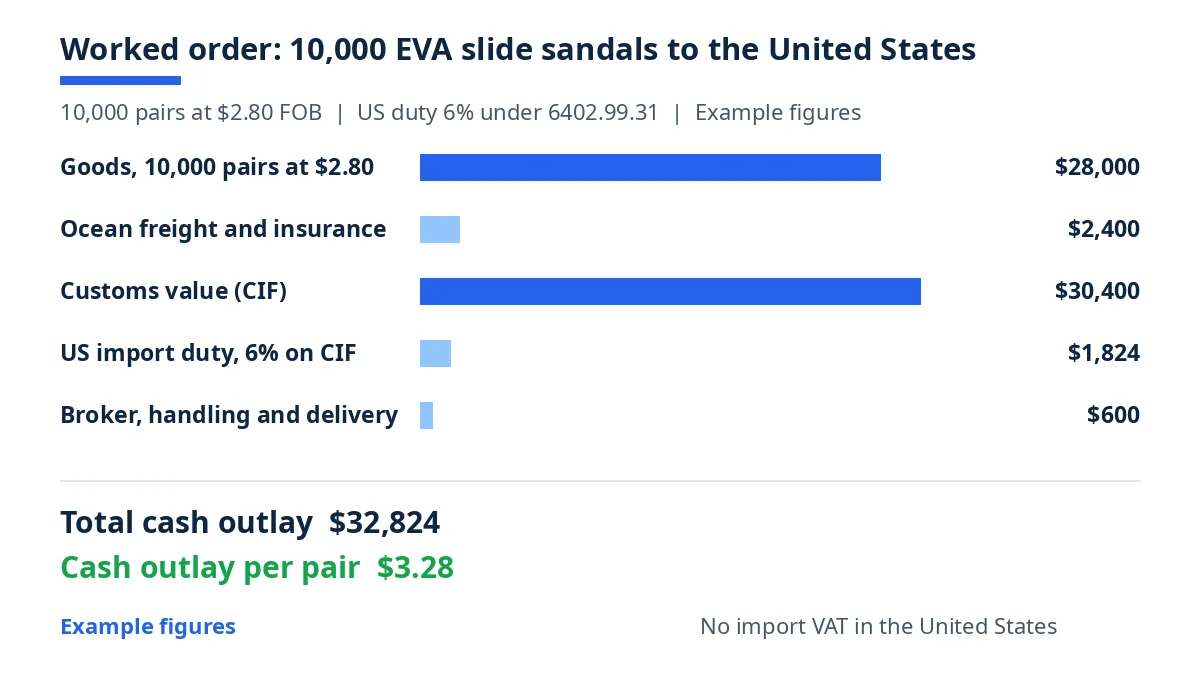
Worked example: 10,000 EVA slides to the United States
A buyer in the United States orders 10,000 pairs of EVA slide sandals at an agreed FOB price of 2.80 dollars per pair. The figures below are example figures.
Cost line | Example figures |
|---|---|
Slides, 10,000 pairs at 2.80 dollars | 28,000 dollars |
Ocean freight and insurance | 2,400 dollars |
Customs value (CIF) | 30,400 dollars |
US import duty, 6 percent on CIF | 1,824 dollars |
Broker, handling and delivery | 600 dollars |
Total cash outlay | 32,824 dollars |
Cash outlay per pair | 3.28 dollars |
The slides classify under 6402.99.31, where the US general duty rate is 6 percent.7 Duty is 6 percent of the 30,400 dollar CIF value, or 1,824 dollars, and the total cash outlay is 32,824 dollars, or 3.28 dollars per pair.
Which mistakes cost sandal buyers the most?
The expensive mistakes in sandal importing are construction mistakes, not price mistakes. Approving a sample in one EVA compound and accepting bulk in another produces a footbed that hardens after a week of wear. Accepting a plug thong without a pull test produces a strap that parts on the first walk. A PVC bulk lot without a phthalate report can leave a shipment unsellable in the EU.9
All of these can be caught at the sample stage. Ask for the sample in the bulk compound, on the bulk mould and in the bulk construction, then wear-test it for a full day before approving bulk.
Next steps on Exportain
Search Bangladeshi suppliers for sandal and slipper makers, then post an RFQ with the style, material, size curve and test reports in the requirement.
Sources
- Leather sector spots 'hope' despite old troubles. bdnews24, (accessed )
- Footwear exports grow as BD expands into new markets. Energy Tribune, (accessed )
- Injection molded sanda: The #1 mistake makers make.. Tan PVC (accessed )
- Footwear Quality Inspection: Sorting & Grading Guide. AQM BD, (accessed )
- Classification Detail: HS Code 6402. United Nations Statistics Division (accessed )
- Explanatory Notes to the Harmonized System: Heading 64.02. World Customs Organization (accessed )
- HS Code 6402 - Tariff Classification of Other footwear with outer soles and uppers of rubber or plastics. Flexport (accessed )
- EU trade relations with Bangladesh. European Commission, (accessed )
- Commission Regulation (EU) 2018/2005 amending Annex XVII to Regulation (EC) No 1907/2006 (REACH) as regards DEHP, DBP, BBP and DIBP. European Commission, (accessed )
About the author
Sourcing from Bangladesh?
Post a request for quotation and suppliers on Exportain can send you their quotes directly.
Post an RFQ