Typical MOQ for Sandals and Slippers in Bangladesh (and How to Negotiate It Down)
A sandals MOQ is a product of three floors: the mould set, the colour batch, and the size curve. This guide shows how to read the figure, work the total, and negotiate each floor without breaking the factory's economics.
Short answer
A sandals and slippers MOQ in Bangladesh is usually a product of three floors, not one factory rule: a mould set cut per size, a material and strap-colour batch run per colour, and a size curve that must add to the colour total. Ask for each floor in writing, multiply the colour floor by the colour count, and negotiate the mould and the batch separately, by sharing a sole unit, cutting colours, or paying tooling as its own line.

On this page
Key takeaways
A sandals MOQ is a product of three floors: the mould set per size, the colour batch per colour, and the size curve inside each colour total.
Example figures: 350 pairs per strap colour across 3 colours means 1,050 pairs, and a 1,260 dollar mould set adds 3.60 dollars per pair at 350 pairs and 1.20 dollars at 1,050 pairs.
Share an existing sole unit, cut colours before sizes, and price tooling as a separate line with ownership and repeat treatment in writing.
No duty rate is stated: the broker confirms the code and duty line for the exact pair and market, and labelling is agreed after materials and batches are fixed.
A buyer sends one enquiry for a slide sandal in three strap colours and receives a single figure: 1,050 pairs. The buyer wanted 600 pairs, and the gap looks like hard bargaining. It usually is not. That figure is the product of three floors: a mould set cut size by size, a colour batch mixed or finished colour by colour, and a size curve that must add up inside each colour total.
This guide is for buyers in the USA, UK, EU, and UAE ordering sandals and slippers from Bangladesh. It treats the minimum as a diagnosis: read the counting basis, find which floor sets the total, work the arithmetic, then decide which lever to pull. Nothing here presents a typical minimum, mould charge, batch size, or lead time as a fact about Bangladeshi factories. Every number showing the arithmetic is labelled "Example figures" and every sum is checked.
Read the figure as a product, not a price
A minimum order quantity sets the smallest order a supplier accepts on standard terms. The number alone says almost nothing, because it can be counted in several ways, and more than one way can apply to the same order. Exportain's MOQ guide lists the counting bases a supplier may use: per order, per style or product, per colour, and per size or size range, sometimes with a minimum order value beside the pair count.1 A figure of 1,050 pairs counted once for the whole order is one order. The same figure counted per colour, across three colours, is 3,150 pairs.
Ask for the basis before asking for a lower figure, and get the answer in writing in the quotation. A listing states its own minimum terms; the quotation you accept is the document that binds both sides.1
Counting basis | What the figure multiplies | Ask in writing |
|---|---|---|
Per order | Nothing; the figure is the whole order | Is there also a floor per style or per colour? |
Per style | Each style must reach the figure alone | Can two styles sharing a sole unit count together? |
Per colour | Each colour of each style must reach the figure alone | Does a stock strap colour replace a custom colour at a lower floor? |
Per size set | Each size group must reach a floor of its own | What is the smallest size breakdown you accept inside a colour total? |
Per order value | The money total must reach a floor, whatever the pair count | Is the value counted on the pair price alone, or with the tooling line? |
Pairs, sizes, and colours are three different units. A size curve is the spread of pairs across the sizes in one colour total. A colour total is the pairs in one colour of one style. An order total is the sum of the colour totals. Place the quoted figure at its level first — colour total, style total, or order total — before comparing it with another supplier's figure.
The mould set: one shape for each size
Most sandals and slippers minimums start with the sole, because the sole is made in a mould cut to a size. Injection moulding forces molten material into a mould cavity, where it cools and hardens into the shape of the cavity.2 A different tread pattern or sole profile needs a different cavity, and a cavity cut for one size does not make the next size. The mould set must cover the size run the buyer wants to sell, size by size, and the cost of cutting it does not fall when the order falls.
Two constructions sit on opposite sides of this floor. In a one-piece moulded pair, or in direct moulding-on, the lasted upper forms the lid of the sole mould and the base of the mould is the cavity in which the sole forms, sealed against the upper at the nip line so the sole material cannot leak out.2 In a cemented pair, the sole unit is made separately and bonded to the upper. The question then changes: is the outsole a stock unit the supplier already buys in, or a custom unit moulded for this style? A stock sole unit can remove the new-mould floor entirely. A custom tread keeps it.
For soles, injection moulding takes PVC and thermoplastic rubber (TR) among the thermoplastics, and polyurethane (PU) where reaction injection moulding is used.2 Name the sole material with the mould question, because a mould made for one material and process does not automatically serve another. Get the cavity count, the sizes each cavity serves, and whether the set is already on the shelf or still to be cut. The last set sits behind the mould set: the last is the form that gives the pair its foot shape. SATRA runs a lasts and fitting service: it checks last dimensions against the market they are meant for, trials new ranges in wear, and helps with sizing systems and conversions.3 Ask for the last measurements per size, the size system, and the width fitting in writing. Finally, settle ownership, storage, and reuse: who owns the set, where it stays, and whether it can serve other buyers. Without that line, the repeat order can carry a second mould charge.
The colour batch: straps, compounds, and shade
The second floor is colour, and it restarts for each colour. In injection moulding, colour is blended into the feedstock ahead of injection.2 Every fresh colour restarts the mixing step, and a short run still needs the full setup. A strap material is likewise dyed, coated, or finished in a run, and each colour of each material can carry its own run.
For sandals, the strap is where this floor shows first. A slide or thong sandal has very little upper, so the strap colour is the colour of the pair as the customer sees it, and the shade must agree across every pair in the colour total. A sample pair approved in one strap colour approves the shade of that colour only. The next colour needs its own batch, its own shade agreement, and its own sample pair. The same holds for a coloured sole compound: a black batch and a tan batch are two batches, even when they fill the same mould set.
Stock colours change the calculation. A strap or compound colour the supplier already holds carries no fresh batch floor for this order, in the same way that working with a stock material can remove a custom minimum from a calculation.1 Ask which strap and sole colours are already held, panel by panel: a strap, a footbed cover, and a sole edge trim do not share a batch merely because they sit on the same pair. Freeze the colour list before the batches are ordered, because a colour added after that point is a new batch, priced as its own batch.
Work the total on paper before you compare quotations
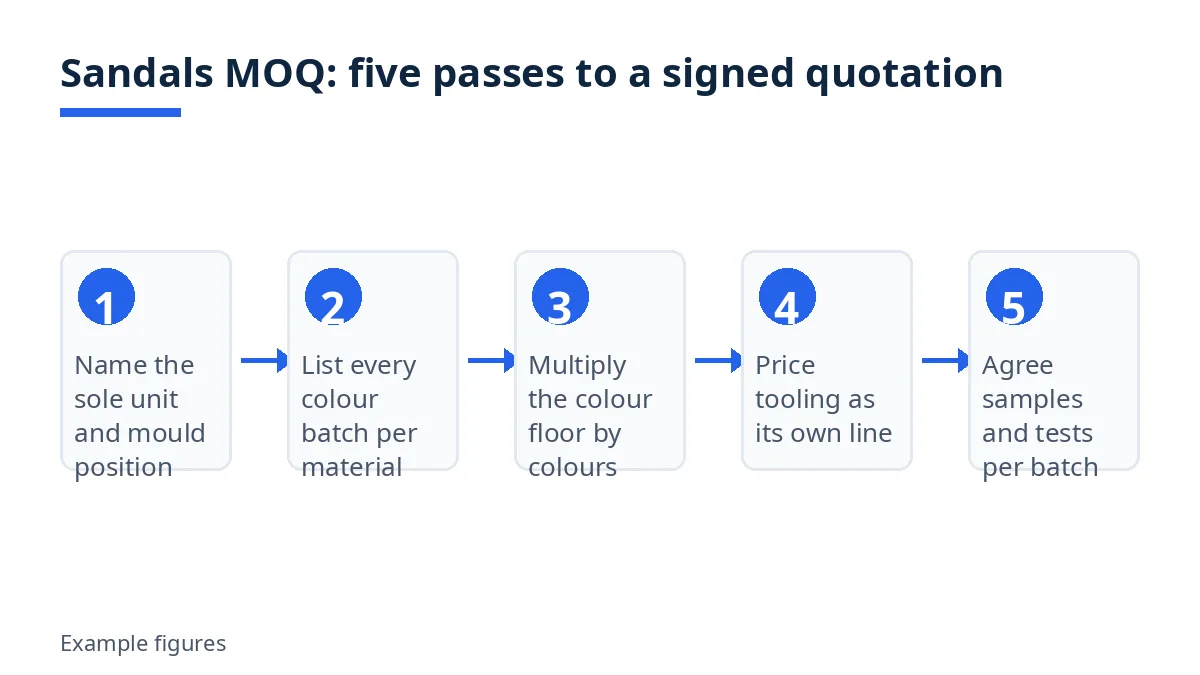
Take the five passes in sequence, with written answers, before ranking quotations. A quotation stating only a pair total, with no mould or batch basis, cannot be ranked against another, because the two totals may rest on different mould sets and batches.
Name the sole unit and the mould position: existing set, shared set, or new set, with the sizes covered.
Name every colour batch the order needs, per material and per colour, including the strap and the sole compound.
Multiply the colour floor by the colour count, and fit the size curve inside each colour total.
Price the tooling as a separate line, and agree ownership, storage, and repeat treatment.
Agree a sample and a test record for every mould set and colour batch in the order.
The diagram shows the five passes in sequence.
The worked example below uses example figures only. A supplier states a floor of 350 pairs per strap colour, for one slide style, across seven sizes. Three strap colours are ordered.
Colour | Example figures | Colour total |
|---|---|---|
Black straps | 350 pairs per colour | 350 pairs |
Tan straps | 350 pairs per colour | 350 pairs |
Navy straps | 350 pairs per colour | 350 pairs |
Order total | 3 colours x 350 pairs | 1,050 pairs |
Inside each 350-pair colour total, the size curve must add to the total. Example figures: EU sizes 38, 39, 40, 41, 42, 43, and 44 at 30, 40, 55, 65, 60, 55, and 45 pairs total 350 pairs (30 + 40 + 55 + 65 + 60 + 55 + 45 = 350). Dropping one colour takes the smallest order from 1,050 pairs to 700 pairs. Adding a fourth colour adds one full batch floor of 350 pairs, not a share of one. Cutting sizes does not cut the colour total; it only redistributes the same 350 pairs and leaves the end sizes untested.
Now add the tooling line. Example figures only: a mould set covering seven sizes at 180 US dollars per size costs 1,260 US dollars (7 x 180 = 1,260). Spread over 350 pairs, the tooling adds 3.60 US dollars per pair (1,260 / 350 = 3.60). Spread over 1,050 pairs, it adds 1.20 US dollars per pair (1,260 / 1,050 = 1.20). Spread over 2,100 pairs, it adds 0.60 US dollars per pair (1,260 / 2,100 = 0.60). The set's cost stays fixed; only its share per pair falls as the order grows.
Test the break from both sides. Example figures only: a below-minimum surcharge of 420 US dollars on a 210-pair run adds 2.00 US dollars per pair (420 / 210 = 2.00), and leaves no extra stock. Ordering up to the 350-pair colour floor at 3.40 US dollars per pair adds 140 pairs at 476 US dollars (140 x 3.40 = 476), and leaves 140 pairs in stock. Example figures only: 980 pairs at 3.60 US dollars per pair cost 3,528 US dollars (980 x 3.60 = 3,528), while 1,050 pairs at 3.40 US dollars per pair cost 3,570 US dollars (1,050 x 3.40 = 3,570). A cheaper unit price can still leave a higher total, so work the break with the tooling line included and the stock position stated.
One paragraph covers the cost lines beyond the pair price. On a free on board (FOB) basis, the quotation should separate the pair price, the tooling line, and any batch surcharge, and the buyer should confirm separately the carriage and cover to the destination, the entry charges and broker fees, and the duty line for the exact pair and market, which the broker confirms from the schedule for that market and date. No duty rate is stated in this guide.
Levers that move the floor, in the order to try them
Negotiate the floor that sets the total, not the headline number. Each lever changes the supplier's costs in a different place, so raise them as questions and expect a trade in return. None of them is assured, and each needs the supplier's written answer before it counts.
Share an existing sole unit first. If a sole shape the supplier already holds fits the style, the new-mould floor falls away and the order is judged on the colour batches alone. Ask which sole units are already held, in which sizes, and whether the tread and profile suit the market.
Cut colours before cutting sizes. Each colour removed takes one full batch floor out of the total, as the worked example shows. Keep the sizes, because the size curve is where fit is proved and where unsold stock collects at the ends. Launch in the colours with sales evidence behind them, and hold the rest for the repeat order.
Take stock strap and compound colours where the market allows it. A stock colour removes the fresh batch floor for that material and the shade risk of a first run. Ask for the stock colour list in writing, with a sample pair in the stock colour, and compare the shade against the customer's requirement before accepting it.
Combine styles that share a sole unit and a strap batch. Two styles on one sole unit, in one strap colour, can meet a batch floor together where neither meets it alone. This works only when the styles genuinely share the mould set and the material runs; two styles sharing a colour name but not a compound or strap material are two batches.
Pay the tooling as its own line, with reuse agreed. A separate tooling charge, with ownership, storage, and repeat-order treatment written down, lets a smaller first order carry the mould cost openly instead of hiding it inside a pair price that assumes a large run. Ask whether a repeat order on the same mould set carries the charge again before the first order is signed.
Offer the surcharge, or phase the order, as a priced choice. Ask what a below-minimum surcharge would be, in dollars and per pair, so the decision is a number rather than a request. For a phased order, record whether the later phase uses the same mould set and batches, and share a realistic forecast for the repeat. A trial order explained honestly, with a forecast the buyer can stand behind, is easier for a supplier to accept than a promise of volume that never arrives.1
One paragraph covers what a lower floor does to price. A smaller order costs more per pair, because the mould set, the batch setups, the line changeovers, and the export paperwork are spread over fewer pairs, and a tier price assumes the tier quantity, so asking for the lowest floor and the lowest tier price together asks the supplier to absorb the same fixed cost twice. Decide which line moves — the floor, the pair price, or the specification — and put the trade in the quotation.
Small-order checks: samples, batches, labels, and the delivery term
Require a sample pair from the production mould set and from each colour batch, and record which mould set and batch each sample pair came from. A trial-cavity or laboratory-batch sample proves the design only; it does not prove the production mould set or batch. Require a fresh sample gate whenever the mould set changes, the compound changes, or a colour is added, and keep one approved pair of each colour as the checking reference for bulk.
Ask for evidence on the batch in this order, not on an earlier batch of the same material. Ask for a test record naming its method, linked to the batch named in the quotation, with the destination market it was checked for. A record from an earlier run or dye lot tells you nothing about the batch in this order. No test result is stated here for any supplier or batch.
Labelling is fixed by the destination market, not by the factory, and must be settled while the colour and material choices are still open. In the European Union, the label addresses three components: the outer sole, the upper, and the lining and sock. A material earns a place on the label only at 80 percent or more of the relevant surface or volume; below that, the label names the two main materials instead.4 The label can use words or pictograms. It must remain visible, attached, and within reach on at least one item of each pair, and the party who first places imported footwear on the EU market answers for its accuracy.4 Settle the label artwork once materials and batches are settled. This guide covers the EU labelling position only; take the USA, UK, and UAE rules from the broker.
Classification follows the materials of the pair. Under the United Kingdom classification guidance, the deciding factors include upper and outer-sole materials, type and purpose, ankle coverage, insole length against a 24 centimetre line, heel height, and intended wearer, with the upper judged by the material covering the greatest external surface area and the outer sole by the material with the greatest contact with the ground.5 A sandal, in the UK guidance, is footwear with a vamp of straps or of material with cut-out sections. For textile uppers on rubber or plastics soles, the guidance gives subheading 6404 19 90.5 Treat every heading as indicative only, confirm the full national code with a broker, and take no duty rate from a heading page.
Name the delivery rule with the same care, and match it to how the cartons will actually be handed over. Only FAS, FOB, CFR, and CIF are confined to sea and inland waterway transport.6 CPT and the D-rules run on any mode of transport. Among them, the split that matters for a sandals carton is who unloads it and who clears it through import customs and pays the duty. Under FAS and FOB, export formalities sit with the seller; the buyer arranges the carrier, pays for the sea leg, and handles import formalities.6 Where the pairs move in containers handed to a carrier at a terminal, the FCA rule fits better than a rule tied to the ship's side: a container can sit in the terminal for days ahead of loading.6 Name the rule, its version year, and the named place or port in every quotation.
Two checks close this section. The Leathergoods and Footwear Manufacturers and Exporters Association of Bangladesh (LFMEAB) describes its role on its president's page as the sector body for the country's leather-goods and footwear makers and exporters.7 A membership claim proves only membership: check it against the association's own listing, then test the maker on the order itself. On Exportain, read each badge for the check behind it. Verification is a document and photograph review by Exportain staff. It involves no factory visit and no search of a government database. Treat a badge as a shortlist aid only: it settles nothing about output, pair quality, or arrival timing.8 A badge shortens a shortlist. It does not settle the mould set, the batches, or the size curve.
Moves that push the floor back up
Adding a colour after the batches are ordered restarts the batch floor for that colour, with a new sample pair and a new shade agreement, usually priced at a premium because the run is set up on its own. Approving a sample pair from a different mould set or batch approves the wrong evidence. Treating a listing figure as the contract figure leaves the counting basis unsettled. Leaving mould ownership unstated leaves the repeat order open to a second tooling charge. Cutting sizes to reach a lower total breaks the size curve instead of lowering the floor: the end sizes go untested, and the curve no longer matches the market.
Diagnostic checklist before you sign
Go through the table row by row before signing. A blank row leaves its figure unsettled, however firm the total sounds.
Line | Record it exactly |
|---|---|
Counting basis | Per order, per style, per colour, or per size set, with the total it produces |
Sole unit and mould set | Sole shape, material, process, sizes covered, existing or new set |
Colour batches | Colour list, material per colour, batch identity per material, stock or fresh run |
Size curve | Pairs per size, adding to the colour total, per colour |
Tooling line | Charge, separate or spread, repeat treatment, ownership, storage, reuse |
Samples and batch tests | Approved pair per mould set and colour, test record by method name per batch |
Labelling and classification | Label artwork agreed, broker-confirmed code, no duty rate taken from a heading page |
Delivery rule | Rule, version year, named place or port, container position, who clears import |
Repeat and phase terms | Forecast, phase treatment of mould set and batches, price validity date |
How do I read a sandals MOQ that arrives as one number?
Place the number at its level before judging it: colour total, style total, or order total. Ask whether it is counted per order, per style, per colour, or per size set, and whether a minimum order value sits beside it, then multiply it out on paper with the colour count and the size curve.1 A figure with no counting basis cannot be compared with another supplier's figure.
Does a mould set I paid for lower the next order?
It can, but only if the repeat treatment was agreed in writing when the tooling was paid for. A separate tooling line with ownership, storage, retention, and reuse settled lets the next order on the same sole unit and size run avoid a second mould charge. Without that written line, the repeat order can carry the charge again.
Does cutting strap colours always lower the MOQ?
It lowers the total where the floor is a colour-batch floor, one full floor per colour removed, as the worked example shows. It does not lower a floor set by the mould set alone, and it does not lower a floor set by a minimum order value, which is a money total rather than a pair count.1 Cut colours first, keep the sizes, and price any late colour as its own batch.
What do I ask before I accept a below-minimum surcharge?
Ask for the surcharge in dollars and per pair, the quantity it covers, and what it leaves behind: no extra stock, or extra pairs held for the repeat. Compare it against ordering up to the floor at the quoted pair price, with the tooling line included and the stock position stated, as the worked example does. Then ask whether it buys a one-off concession or a standing small-order term, with the price validity date, in the quotation.
Next steps on Exportain
Put the sole unit, the mould position, the colour list, and the size curve in a single message to each supplier, so the answer can settle the mould and batch floors rather than restating a total. Shortlist from the Bangladeshi supplier profiles, read what each Exportain badge records before ranking anyone, and use the Exportain MOQ counting guide to frame the counting-basis question in the enquiry.
Sources
- MOQ Meaning (Minimum Order Quantity). Exportain (accessed )
- The development of injection moulding. SATRA (accessed )
- Footwear fit and comfort. SATRA (accessed )
- Footwear labelling. European Commission, EUR-Lex (accessed )
- Classifying footwear for import and export. GOV.UK (accessed )
- FOB & FAS Incoterms® 2020 explained: Key differences. ICC Academy (accessed )
- President's Message - LFMEAB. Leathergoods and Footwear Manufacturers and Exporters Association of Bangladesh (LFMEAB) (accessed )
- How Supplier Verification Works on Exportain. Exportain, (accessed )
About the author
Sourcing from Bangladesh?
Post a request for quotation and suppliers on Exportain can send you their quotes directly.
Post an RFQ