CIP vs DAP: Key Differences, Costs and Which One to Choose
CIP vs DAP for Bangladesh imports: CIP adds seller-bought Clause A cover at 110 percent of the contract price, while DAP delivers to your door with no policy duty. Compare the insurance, risk and buyer totals.
Short answer
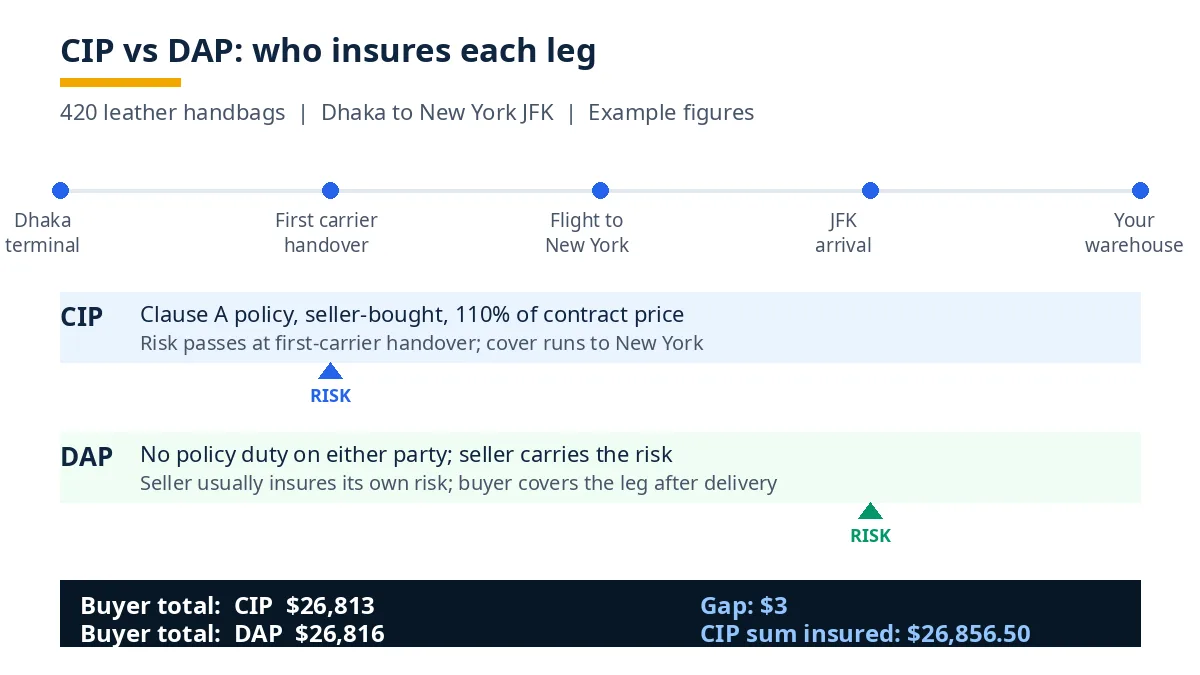
Under CIP, the seller pays carriage to the named destination and must buy Institute Cargo Clauses (A) cover for at least 110 percent of the contract price, while risk passes at handover to the first carrier. Under DAP, the seller carries the risk to the named place and pays the carriage, but neither party must insure the goods. Choose CIP for valuable air freight and first shipments; choose DAP when you hold your own policy.
On this page
Key takeaways
Under CIP the seller must buy Institute Cargo Clauses (A) cover for at least 110 percent of the contract price; under DAP neither party must insure the goods.
Under CIP risk passes at handover to the first carrier, yet the seller's Clause A policy runs to the named destination.
Under DAP the seller carries the transit risk to the named place, and the buyer must arrange its own cover for unloading and onward carriage.
Example figures price 420 leather handbags by air to New York at $26,813 under CIP and $26,816 under DAP, a $3 gap from the premium alone.
A buyer in New York orders 420 leather handbags from a Dhaka supplier. Two quotations come back, one on CIP New York and one on DAP New York. The gap is the insurance question: under CIP the seller must buy cargo cover for the buyer, while under DAP neither party has to buy a policy at all.
The insurance question, answered first
CIP (Carriage and Insurance Paid To) and DAP (Delivered at Place) are two of the eleven Incoterms 2020 rules, in force since 1 January 2020.1 Both rules put the carriage on the seller, paid to the named destination. Under CIP the seller must also buy cargo insurance for the buyer; under DAP the seller carries the risk to the destination, yet the rule asks for no policy from either side.2
Question | CIP | DAP |
|---|---|---|
Seller pays carriage to | Named place of destination | Named place |
Delivery happens | Goods handed to the first carrier | Goods at your disposal |
Risk passes to you | At handover to the first carrier | At the named place |
Seller must buy cargo insurance | Yes, for your benefit | No |
Minimum cover | Institute Cargo Clauses (A) | None set by the rule |
Minimum sum insured | 110 percent or more of the contract price | None set by the rule |
CIP buys you a named policy before the goods move. DAP buys you the seller's risk to your door, with insurance left to trust. See also our CPT vs DAP guide and CIF vs CIP guide.
What CIP promises: Clause A cover bought by the seller
Under CIP the seller must buy insurance that follows Institute Cargo Clauses (A), or similar all-risks wording, covering at least 110 percent of the contract price, unless the contract agrees a lower level.3 The policy must be issued in favour of the buyer, so you can claim on it directly.3
Clause A, the widest of the three standard clause sets, pays for loss or damage from any accidental cause the wording does not exclude.4 Incoterms 2020 raised the CIP minimum from Clause C to Clause A; under the 2010 edition, Clause C was enough.1 A seller quoting from a 2010 template can still hand you a Clause C certificate, so read it before the goods move.
The premium sits inside the seller price, so the seller chooses the insurer and the deductible, not you.
What DAP leaves open: a long risk leg with no policy duty
Under DAP delivery happens when the goods reach the named destination on the arriving vehicle, placed at your disposal and ready to unload.2 The seller bears all costs and risks until that point, including the main carriage and export clearance.2 The buyer then handles import clearance, duty and unloading.2 Neither the seller nor the buyer is contractually required to buy cargo insurance under DAP.5 Only CIP and CIF impose an insurance duty; DAP does not.5 The seller bears the transit risk and normally insures it from its own pocket, but the rule asks for no policy at all.2
Who insures each leg of the journey
Leg of the journey | Under CIP | Under DAP |
|---|---|---|
Factory to the Dhaka cargo terminal | Seller's Clause A policy | Seller's own cover, if it holds any |
Handover to the first carrier | Risk passes to you; policy in force | Risk stays with the seller; no policy duty |
Main carriage by air to New York | Clause A policy, seller-bought for your benefit | Seller's risk; own cover if any |
Arrival at JFK, ready for unloading | Clause A policy to the destination | Risk passes to you at the named place |
Unloading and onward carriage | Your risk; buy your own cover | Your risk; buy your own cover for this leg |
Under CIP the risk passes at handover to the first carrier, yet the insurance runs to the named destination.1 Under DAP the risk travels with the seller's responsibility until the named place.2 See our CIP insurance guide and DAP insurance guide.
Worked example: 420 leather handbags by air to New York
Example figures. A buyer in New York orders 420 leather handbags from a Dhaka supplier, goods worth $21,000, flown from Dhaka to New York JFK and then by road to the buyer's warehouse. Under CIP the seller price already includes the Clause A premium. Under DAP the buyer buys a Clause A policy for the leg from delivery onward. Duty, entry fee and premiums below are illustrative.
Cost line | Under CIP | Under DAP |
|---|---|---|
Goods, packed for export | $21,000 | $21,000 |
Air freight, Dhaka to New York JFK | $3,150, paid by the seller | $3,150, paid by the seller |
Insurance premium, Clause A | $265, inside the seller price | $290, paid by the buyer |
Seller price | $24,415 | $24,150 |
Duty, example 8 percent of the seller price | $1,953, paid by the buyer | $1,932, paid by the buyer |
US entry fee, example fee at 0.3464 percent | $85, paid by the buyer | $84, paid by the buyer |
Unloading and onward carriage | $360, paid by the buyer | $360, paid by the buyer |
Total the buyer pays | $26,813 | $26,816 |
Under CIP, 21,000 plus 3,150 plus 265 is 24,415, and 24,415 plus 1,953 plus 85 plus 360 is 26,813. Under DAP, 21,000 plus 3,150 is 24,150, and 24,150 plus 290 plus 1,932 plus 84 plus 360 is 26,816. The $3 gap is a $25 premium gap less a $21 duty gap and a $1 fee gap. CIP cover must insure at least 110 percent of the contract price: $26,856.50 on $24,415.3
The entry fee uses a real rate: the Merchandise Processing Fee is 0.3464 percent of cargo value for fiscal year 2026, with a $33.58 minimum and a $651.50 maximum per entry.5 At that rate, $24,415 gives $85 and $24,150 gives $84. Without its own policy, the DAP buyer would show $26,526, $287 lower and uninsured.
What Clause A covers that no policy under DAP guarantees
Clause A gives all-risks cover: every accidental cause of loss or damage is paid for unless the wording excludes it.4 For leather handbags flown in, the everyday losses are the ones Clause A pays for and an uninsured DAP leg leaves with you.
Loss to the handbags | Clause A (CIP minimum) | No policy (DAP without own cover) |
|---|---|---|
Handbags water-damaged in a storm at the airport | Covered | No payment |
Handbags stolen from the warehouse | Covered | No payment |
Scuffed and crushed cartons after rough handling | Covered | No payment |
Any other accidental cause the wording does not exclude | Covered | No payment |
Clause A still has gaps. Every clause set excludes deliberate wrongdoing, delay, war and strikes unless added separately, inherent vice, normal leakage and wear, and packing that cannot survive the journey.4
Customs, duty and the US entry: the same bill under both rules
At the border the two terms converge: the seller clears the goods for export, and you, as importer of record, clear them for import and pay the duty and taxes.2 A US import needs a formal entry: the buyer files CBP Form 7501, the Entry Summary, with US Customs and Border Protection, stating the value, origin and classification.5 Under DAP, a clearance delay has a second cost: you must reimburse the seller for additional costs that result from your failure to clear, and risk can pass from the agreed delivery date.5
Bangladesh checks before you sign
The seller clears the goods for export under both rules, with the same export file: commercial invoice, packing list, Shipping Bill and certificate of origin.2 Chattogram declarations run through the ASYCUDA system, and the Export Promotion Bureau handles certificate of origin procedures.6
The certificate is where the two terms part company in practice. Under CIP, ask for the certificate before handover and check three lines on it: the clause set, the sum insured and the destination. Look for the words Institute Cargo Clauses (A), or CL382 — not Clause C, which the 2010 edition asked for.3 It should name the buyer as claimant, show a sum insured of at least 110 percent, and cover the goods to the named destination, not only as far as the airport of discharge.3 Under DAP, ask the seller in writing whether it holds transit cover, and place your own policy for the leg from delivery onward.5
Four mistakes buyers make with CIP and DAP
Reading a DAP price as a landed price. The DAP price covers delivery, not duty, entry fee or unloading.2
Accepting a CIP certificate that names Clause C. Under Incoterms 2020 the CIP minimum is Clause A; a Clause C certificate breaches the rule unless the contract agreed a lower level.3 Check the certificate itself.
Comparing the two quotations on the seller price alone. The CIP price contains the premium and the DAP price does not, so the seller prices differ by design. Compare buyer totals.
Leaving the named place vague. "CIP New York" and "DAP New York" do not settle where carriage ends or where risk passes. Name the warehouse address in full, with the edition: "CIP 120 Greene Street, New York, Incoterms 2020".5
When to insist on CIP, and when DAP is the better buy
Three tests settle most choices. Start with the cover you already hold: a buyer already covered by an open Clause A policy for every shipment may pick DAP. A buyer with no standing policy usually gains more from CIP.3 Next, weigh what a loss would cost. If the goods are theft-prone, water-sensitive or valuable for their weight, insist on CIP.4 Third, who should carry the transit risk. DAP suits a first order from a new supplier; CIP suits a buyer with a broker and an insurer already in place.
Air freight tips the balance toward CIP for most first shipments: the goods change hands several times between Dhaka and New York. A DAP buyer relying on the seller's goodwill has no certificate to claim under, while a CIP buyer holds a Clause A policy in its own favour from the first movement for loading.3
Questions buyers ask about CIP and DAP
Which is cheaper, CIP or DAP?
Neither: the CIP seller price runs higher because the Clause A premium sits inside it, and in the worked example the buyer totals differ by $3.
Which is safer for a first shipment?
CIP, because the seller books the carriage and the Clause A policy is already inside the price. Still check the certificate for the 110 percent sum and the Clause A wording before the goods move.3
Can I switch terms after the purchase order?
Yes, when both sides agree in writing before shipment. Moving from DAP to CIP raises the seller price by the premium. Moving from CIP to DAP means the buyer must already hold its own cover for the leg from delivery onward.5
Does DAP mean the seller pays the duty?
No. Under DAP the buyer clears the goods for import and pays the duties and taxes, while the seller pays the carriage to the named place.2 Only DDP makes the seller pay duty.2
Next steps on Exportain
Get both quotations for the same goods and the same named place, with freight and premium shown as separate lines, then compare what you pay in total. Then find Bangladeshi suppliers and send an RFQ that spells out the term, the place, the edition and the cover you need. The how-to-buy page walks through the steps after you order.
Sources
- Incoterms® 2020. International Chamber of Commerce (ICC) (accessed )
- DAP Delivered at Place: Definition, Costs & Responsibilities. DHL (accessed )
- Cargo Insurance: Institute Cargo Clauses A, B and C Compared, 110% Cover and CIF vs CIP. TriplicateDocs, (accessed )
- Institute Cargo Clauses (A), (B), (C) Explained. VoyageCover (accessed )
- What Are DAP Incoterms? Delivered at Place Explained. LegalClarity (accessed )
- Bangladesh Trade Portal FAQ: Export Registration Certificate (ERC). Bangladesh Trade Portal (accessed )
About the author
Sourcing from Bangladesh?
Post a request for quotation and suppliers on Exportain can send you their quotes directly.
Post an RFQ