CIF vs CIP: Key Differences, Costs and Which One to Choose
CIF vs CIP for buyers importing from Bangladesh: the insurance clause is the real gap — Clause C minimum under CIF against Clause A all-risks under CIP — plus risk points, cost build-up and a worked example pricing woven garments to Jebel Ali.
Short answer
CIF and CIP both make the seller pay the freight and buy cargo insurance for the buyer, but the cover differs. Under CIF the seller must buy Institute Cargo Clauses (C), the narrowest cover, for sea shipments only, with risk passing on board at Chattogram. Under CIP the seller must buy Clause A all-risks cover for any mode, with risk passing at handover to the first carrier. For a container of garments from Bangladesh, CIP usually fits better.
On this page
Key takeaways
Under CIF the seller must buy Clause C minimum cover, and the term works only by sea; under CIP the seller must buy Clause A all-risks cover, and the term works for any mode.
Risk passes on board at Chattogram under CIF and at handover to the first carrier under CIP, while the seller keeps paying carriage under both rules.
Both rules require a sum insured of at least 110 percent of the contract price, but that figure does not fix a narrow Clause C policy.
In the worked example the buyer pays USD 68 more under CIP, while the Clause A cover answers theft, water entry and handling damage that Clause C leaves out.
A buyer in Dubai asks a Dhaka supplier for one container of woven garments on two terms, CIF Jebel Ali and CIP Jebel Ali. The two seller prices come back USD 65 apart, with the CIP price the higher one. That difference is the insurance clause. Under both terms the seller pays the freight and buys cargo insurance for the buyer. Under CIF the seller must buy only Institute Cargo Clauses (C), the narrowest standard cover. Under CIP the seller must buy Institute Cargo Clauses (A), all-risks cover.
The two quotations side by side
CIF stands for Cost, Insurance and Freight. CIP stands for Carriage and Insurance Paid To. Both are Incoterms 2020 rules published by the International Chamber of Commerce, and both put the main carriage and the insurance premium on the seller.1
Point | CIF | CIP |
|---|---|---|
Transport modes | Sea and inland waterway | Any mode, single or combined |
Seller delivers when | Goods are on board the vessel at the port of shipment | Goods are handed to the first carrier |
Risk passes to you | On board the vessel at Chattogram | At handover to the first carrier |
Seller pays carriage to | The named destination port | The named place of destination, which can be inland |
Insurance the seller must buy | Institute Cargo Clauses (C), minimum cover | Institute Cargo Clauses (A), all-risks cover |
Minimum sum insured | At least 110 percent of the contract price | At least 110 percent of the contract price |
Import clearance and duty | You | You |
Our guide to all eleven Incoterms rules places both rules among the eleven.
Why the insurance clause is the real price gap
The insurance difference decides which losses the buyer can claim for, and it changed with Incoterms 2020: before that edition, CIP also required only Clause C. Since 1 January 2020, CIP requires Clause A while CIF still requires only Clause C.2
Clause A is written on an all-risks basis: any accidental loss or damage is covered unless the wording lists it as excluded. Clauses B and C work the other way round: a loss is covered only if its cause appears on the list in the wording, and the Clause C list is the shortest of the three.3 The Lloyd's Market Association and the International Underwriting Association publish all three sets, in editions dated 1 January 2009.3 For a container of woven garments, the gap shows up in the losses that actually happen to cartons, not in the casualties that sink ships.
Loss to the garments | Clause C (CIF minimum) | Clause A (CIP minimum) |
|---|---|---|
Fire or explosion on board | Covered | Covered |
Vessel stranding, grounding, sinking or capsizing | Covered | Covered |
Collision, jettison, general average | Covered | Covered |
Rain or sea water entering the container | Not covered | Covered |
Carton crushed in handling | Not covered | Covered |
Carton missing after pilferage or theft | Not covered | Covered |
Any other accidental cause, not excluded | Not covered | Covered |
Water inside a sealed container, a carton crushed in handling, or shirts missing after pilferage are the losses a garment buyer actually faces, and none of them is a Clause C event. Only Clause A answers all of them, subject to its exclusions.3 4
Clause A is broad rather than boundless. Every one of the three sets excludes the same causes: misconduct by the assured, ordinary wear, packing unfit for the journey, inherent vice, delay, and war or strikes unless separate wordings add them back.3 Shirts sent without moisture protection can sit outside the cover even under Clause A, and cover runs out 60 days after discharge from the overseas vessel at the latest.4
Where risk passes, and why the handover point matters
Risk and cost do not move together under either rule. Under CIF, risk passes to you once the goods are loaded on board the vessel at the port of shipment, while the seller keeps paying freight and insurance to the named destination port. Under CIP, risk passes at handover to the first carrier, and the seller still pays carriage and insurance to the named place.1
A container of garments is usually handed to a carrier at a terminal days before the vessel sails. Under CIP that handover is the delivery point, so the rule matches what actually happened; under CIF the delivery point is on board, so the terminal stage sits outside it.5 Our CFR vs CIP guide makes the same point for the freight-only pair.
Mode is the second reason the handover point matters. CIF applies only to sea and inland waterway transport. It cannot describe an air shipment, a road leg, or a sea-air combination. CIP applies to any mode, including air and multimodal journeys, and its named place can be a port, an airport, a terminal, or your premises inland.5
Name the place with care under both rules. "CIF UAE" and "CIP Dubai" do not fix a port or a destination, so write the term in full: "CIF Jebel Ali, Incoterms 2020" or "CIP Dubai, Incoterms 2020".1
Who pays what: the full cost build-up
The seller pays the goods, the export clearance, the main carriage and the insurance premium under both rules. You pay the destination handling, the import clearance, the duty and tax, and the onward transport under both rules.
Cost line | Under CIF | Under CIP |
|---|---|---|
Goods and export clearance | Seller | Seller |
Main carriage | Seller, ocean freight to the named port | Seller, carriage by any mode to the named place |
Cargo insurance premium | Seller, Clause C minimum | Seller, Clause A |
Destination handling and unloading | You, unless the carriage contract includes it | You, unless the carriage contract includes it |
Import clearance, duty and tax | You | You |
Onward transport to your warehouse | You | You |
Destination handling and unloading sit outside both seller prices unless the carriage contract expressly includes them, so ask in writing who pays them at the destination port. The duty basis is the customs value at destination, which your broker confirms.
What documents change between the two terms
Most of the document set is the same. The Bangladesh export papers do not change with the term: the commercial invoice, the packing list, the certificate of origin, the EXP form certified by the authorised dealer bank, and the Bill of Export.6 Make sure the names, goods, quantities and amounts read the same on every paper.6
Two documents do change. First, the transport document. Under CIF it is a bill of lading for the sea leg. Under CIP it is the document of the mode used: a bill of lading for sea, an air waybill for air, or the carrier document for a multimodal journey.5
Second, the insurance document. Under CIF it should name Institute Cargo Clauses (C), with the sum insured set at 110 percent of the contract price or more. Under CIP it should name Institute Cargo Clauses (A), or the CL382 wording, and the same floor. Get the certificate before the goods move, and check the clause letter, the sum insured, the destination, and the deductible against the contract.4
Where payment is by letter of credit, the bank works from the papers alone: a set that differs from the credit will not be paid. Our documents checklist for CIF shipments works through the full set.
Worked example: woven garments from Chattogram to Jebel Ali
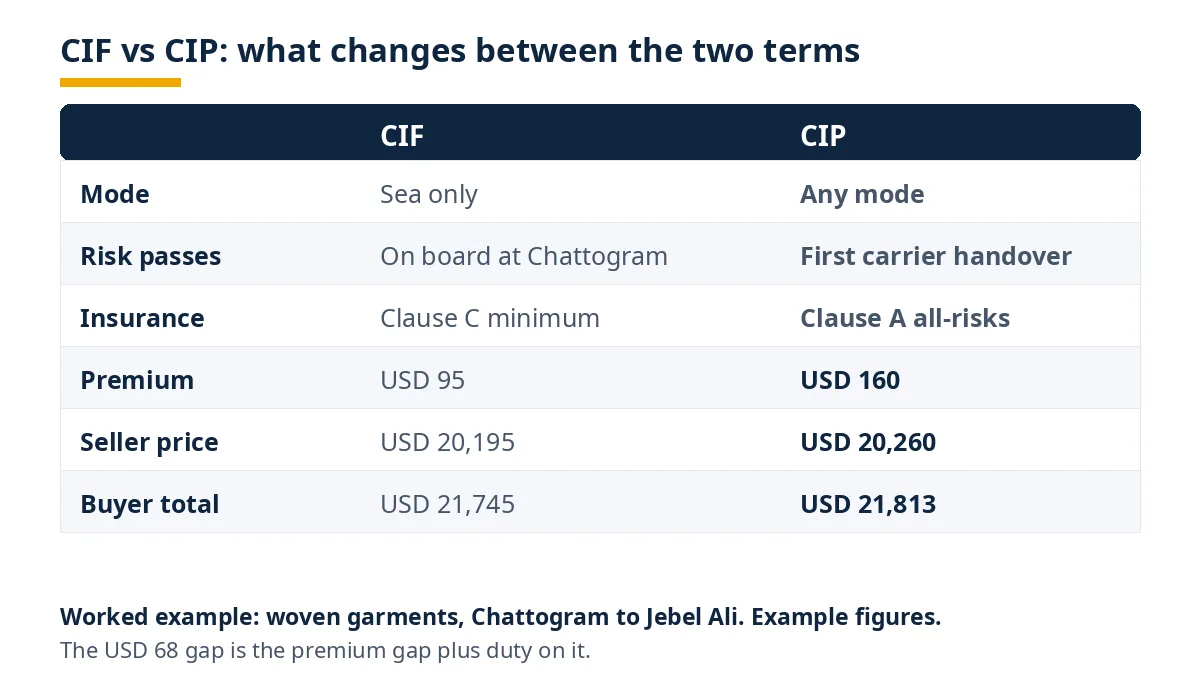
Example figures. A buyer in the United Arab Emirates orders woven garments worth USD 18,000 from a supplier in Chattogram, sent in one 40-foot container to Jebel Ali, then by road to a warehouse in Dubai. The figures below are illustrative only.
Cost line | Under CIF | Under CIP |
|---|---|---|
Goods, packed for export | USD 18,000 (seller) | USD 18,000 (seller) |
Ocean freight to Jebel Ali | USD 2,100 (seller) | USD 2,100 (seller) |
Insurance premium | USD 95, Clause C (seller) | USD 160, Clause A (seller) |
Seller price | USD 20,195 | USD 20,260 |
Duty at an example 5 percent of the CIF or CIP value | USD 1,010 (buyer) | USD 1,013 (buyer) |
Destination handling, clearance and onward road carriage | USD 540 (buyer) | USD 540 (buyer) |
Total the buyer pays | USD 21,745 | USD 21,813 |
Check it. Under CIF: 18,000 plus 2,100 plus 95 is 20,195, the seller price. Duty at 5 percent of 20,195 is 1,009.75, shown as USD 1,010, and 20,195 plus 1,010 plus 540 is 21,745. Under CIP: 18,000 plus 2,100 plus 160 is 20,260, and 20,260 plus 1,013 plus 540 is 21,813. The gap between the two totals is USD 68: USD 65 of premium gap and USD 3 of duty on that premium.
The sum insured also differs in amount: under CIF it must reach USD 22,214.50 on USD 20,195, and under CIP USD 22,286 on USD 20,260.1 The point is what each policy pays for: the Clause C policy pays nothing for a stolen or crushed carton, while the Clause A policy answers both, subject to its exclusions. A buyer who picks CIF to save USD 68 has not saved anything if one carton goes missing.
A decision rule: three questions
Three questions settle most cases, in this order.
First, how does the cargo travel. If any leg is by air, or the journey combines modes, use CIP: CIF cannot describe the journey. If the cargo moves by sea alone, both rules stay open.1
Second, what would hurt if it happened. If the goods are theft-prone, water-sensitive, or easily crushed in handling, use CIP: Clause A covers the losses that Clause C leaves out. If the cargo is bulk or break-bulk loaded directly on board, CIF remains a live option.1
Third, what cover do you already hold. A buyer whose own open policy already covers every shipment on Clause A terms may prefer CIF, since the CIP price would charge again for cover already in place. A buyer holding no open policy usually gains more from CIP.5
For most containerised garment orders out of Bangladesh, the rule that fits is CIP: the handover matches the delivery point, and Clause A answers the losses cartons actually suffer. CIF fits a sea-only bulk or break-bulk order where the buyer already holds its own cover.
FAQs
Which is cheaper, CIF or CIP?
The CIP seller price is usually the higher one, because the Clause A premium costs more than the Clause C premium. In the worked example the buyer pays USD 68 more under CIP on a USD 21,745 order. One stolen or crushed carton can cost more than the premium gap.
Can the CIF cover be upgraded to Clause A?
Yes, by agreement in writing before the goods ship. The seller buys Clause A cover instead of the Clause C minimum, and the buyer pays the extra premium, or the parties split it as agreed.
Can I change the term after ordering?
Yes, if both sides agree in writing before shipment, with the price adjusted to match. Moving from CIF to CIP means the seller takes on Clause A cover in place of Clause C, so the seller price goes up by the premium gap, and delivery moves from loading on board to handover to the first carrier.
Next steps on Exportain
Work the numbers both ways, then search Bangladeshi suppliers and compare a CIF quotation against a CIP quotation for identical goods to the same named place. Post an RFQ naming the rule, the place, the edition and the insurance clause you require, and the how to buy page walks through the steps once you have ordered.
Sources
- CIF vs CIP Incoterms: Key Differences and Usage Guide. FreightAmigo (accessed )
- What Is the Difference Between CIF and CIP Incoterms?. ClimbTheLadder (accessed )
- Institute Cargo Clauses (A), (B), (C) Explained. VoyageCover (accessed )
- Institute Cargo Clauses A B C Compared: Cover and Gaps. Globalior (accessed )
- CIP Incoterm Guide: Risks, Costs & Insurance Explained. FreightAmigo (accessed )
- The papers that move trade. Open Trade Bangladesh (accessed )
About the author
Sourcing from Bangladesh?
Post a request for quotation and suppliers on Exportain can send you their quotes directly.
Post an RFQ