CFR vs CIP: Key Differences, Costs and Which One to Choose
Under CFR the buyer buys its own cargo cover; under CIP the seller buys Clause A cover inside the price. Follow 500 cartons of jute bags from Chattogram to Rotterdam and see which term fits your shipment.
Short answer
CFR and CIP both make the seller pay carriage, but only CIP obliges the seller to insure the goods, at Institute Cargo Clauses (A) level for at least 110 percent of the contract price. Under CFR the buyer arranges its own cover from loading. CFR works only by sea, with risk passing on board the vessel; CIP works for any mode, with risk passing at handover to the first carrier.
On this page
Key takeaways
Under CIP the seller must buy Clause A cargo cover for at least 110 percent of the contract price; under CFR nobody must insure the goods.
Clause A covers water entry, theft and handling damage that Clauses B and C do not name.
CFR works only by sea, with risk passing on board the vessel; CIP works for any mode, with risk passing at handover to the first carrier.
In the worked example the buyer totals differ by $35, the premium gap alone: $13,400 under CFR against $13,365 under CIP.
A buyer in Rotterdam asks a Dhaka supplier for jute bags on two terms, CFR Rotterdam and CIP Rotterdam. The seller prices are close, the sea leg is the same, and the goods are the same 500 cartons. The difference sits in one line of each quotation: under CIP the seller has bought Clause A cargo insurance for the buyer, and under CFR nobody has bought any insurance at all.
The insurance question comes before the price
CFR (Cost and Freight) and CIP (Carriage and Insurance Paid To) look alike: both make the seller pay the main carriage, and both pass the risk of loss to the buyer at origin.1 The split between them is the insurance duty. Under CFR the seller pays the cost and the sea freight to the named destination port, and the rule does not oblige the seller to insure the cargo, so a buyer that wants protection must arrange its own marine insurance.1 Under CIP the seller hands the goods to the first carrier, pays carriage to the named destination, and must also buy cargo insurance for the buyer's benefit, at Institute Cargo Clauses (A) level, for at least 110 percent of the contract price.1
Only two of the eleven Incoterms 2020 rules oblige the seller to insure the goods: CIF and CIP.2 Every other rule, CFR included, leaves insurance to the party that carries the risk, which is the buyer from the delivery point onward. That is why the two quotations cannot be ranked on the seller price alone: the CIP price contains the carriage and the Clause A premium, while the CFR price contains the carriage only, and the buyer still has to buy a policy itself.
Point | CFR | CIP |
|---|---|---|
Who must buy cargo insurance | Nobody; the buyer arranges its own cover | The seller, for the buyer's benefit |
Clause set the seller must buy | None set by the term | Institute Cargo Clauses (A), unless agreed otherwise |
Minimum sum insured | No floor set by the term | 110 percent of the contract price or more |
Transport modes | Sea and inland waterway only | Any mode, including combined transport |
Seller pays carriage to | The named destination port | Any named place of destination |
Risk passes to the buyer | Goods loaded on board the vessel | Goods handed to the first carrier |
What Clause A covers that no policy under CFR has to
Clause A works on an all-risks basis: it pays for loss or damage from any accidental cause unless the wording expressly excludes it.3 Clauses B and C pay only for perils on their list, C the narrowest.3 For jute bags the gap is concrete: jute fibre takes up moisture, so water entering a container can stain and weaken the bags, and a carton dropped in loading, crushed by handling, or missing after pilferage is ordinary transit damage, not a casualty to the vessel. Theft, rain damage, breakage, malicious damage and piracy are covered only by Clause A, while Clauses B and C do not name them.4
Clause A is wide, not unlimited: the exclusions shared by all three sets include wilful misconduct, ordinary leakage and wear, insufficient or unsuitable packing, inherent vice, delay, and war or strikes unless added by separate wordings.3 For jute the packing exclusion carries weight, since bags shipped without moisture protection, or a container stuffed so the load shifts, can fall outside the cover even under Clause A.
Under CFR the buyer must insure from the loading point, since the seller has no duty to buy cover.5 A buyer that buys no policy also faces capped carrier liability: under the Hague-Visby Rules the cap is 666.67 SDR per package or 2 SDR per kilogram, whichever is higher, and under the US Carriage of Goods by Sea Act the limit is 500 dollars per package.6 A buyer with no policy that loses 500 cartons claims against those limits, not against the invoice value.
When a ship's master spends money or sacrifices cargo to save the voyage, every cargo owner shares the cost, so a container can arrive undamaged while its owner still owes a share.6 If the goods are insured, the insurer posts the guarantee and pays the contribution; if not, the buyer must provide the security itself before the line releases the container.6
The premiums in the worked example are assumed figures, not market rates; typical marine cargo insurance runs about 0.2 percent to 0.5 percent of the cargo value.6
One rule is sea-only; the other follows the cargo anywhere
Insurance decides the cover, and transport mode decides whether the term can describe the journey at all. CFR belongs to the four rules written for sea and inland waterway transport only, while CIP belongs to the seven rules that work for any mode, alone or combined.2
A container of jute bags rarely travels by sea alone: truck, terminal, vessel, then road. CFR can describe only the sea leg, and it stops at the port of destination. CIP can describe the whole chain, because its named place can be a port, a terminal, or the buyer's premises.1 ICC guidance points buyers toward the any-mode rules for containers, since a box usually reaches the carrier at a terminal days before the vessel sails.2
CFR still suits bulk and break-bulk cargo loaded directly onto a vessel, where the on-board moment is real.5 Loose jute fibre or baled jute lifted straight onto a vessel at Chattogram fits that pattern; cartons of finished jute bags in a container do not.
Risk passes at two different moments
Both terms sit in the C group, where the seller pays freight to the destination while risk passes at origin.1 Under CFR risk passes when the goods are loaded on board at Chattogram; under CIP it passes at handover to the first carrier, which may be a truck at the factory gate.1
Under CIP the buyer bears the risk from the first handover while the seller keeps paying carriage and insurance, so the policy the seller bought stands behind the buyer for the whole voyage.1 Under CFR the buyer bears the risk from loading, while the seller pays for a voyage it no longer carries the risk of.5 Neither term sets the price, the payment method, or the moment ownership passes.1
Worked example: 500 cartons of jute bags to Rotterdam
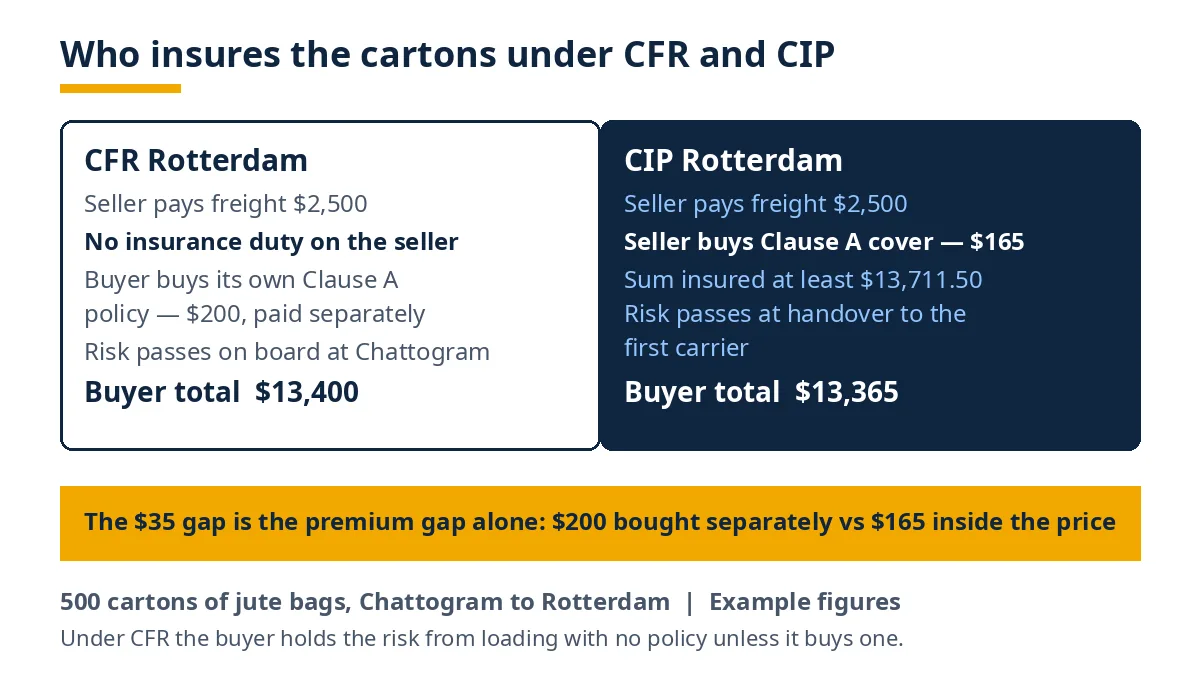
Example figures. A buyer in Rotterdam orders 500 cartons of jute bags, worth $9,800, shipped in one container from Chattogram to Rotterdam with onward road carriage to a warehouse in the Netherlands. The premiums are assumed figures, not market rates. The insurance route is the only difference: under CIP the seller buys Clause A cover inside the seller price, while under CFR the buyer buys a Clause A policy separately.
The diagram below shows who insures the cartons under each term.
Cost line | Under CFR | Under CIP |
|---|---|---|
Goods, packed for export | $9,800 | $9,800 |
Ocean freight to Rotterdam | $2,500 | $2,500 |
Seller price | $12,300 | $12,465 |
Insurance premium, Clause A | $200, paid by the buyer | $165, inside the seller price |
Import duty, 4% of the $12,500 CIF value | $500, paid by the buyer | $500, paid by the buyer |
Onward road carriage | $400, paid by the buyer | $400, paid by the buyer |
Total the buyer pays | $13,400 | $13,365 |
Under CFR: 12,300 + 200 + 500 + 400 = 13,400. Under CIP: 12,465 + 500 + 400 = 13,365. The $35 gap is the premium gap alone: $200 bought separately, against $165 inside the CIP price.
Check two numbers before you sign. CIP requires the sum insured to reach at least 110 percent of the contract price: $13,711.50 on a contract price of $12,465.3 The duty line uses the $12,500 CIF value in both columns; in a live calculation the $35 premium gap would move the duty figure by about $1.40, and customs valuation rules vary by country, so ask a customs broker to confirm the basis.
A buyer that buys no policy under CFR would show $13,200, $200 below the insured CFR total and $165 below the CIP total. That is no saving at all: it is the cost of carrying the full exposure on $9,800 of goods, plus freight and destination charges already spent, with no policy to claim under.
Which term fits which buyer
If the shipment is a container of finished jute bags, CIP fits the journey and CFR does not, because CFR is sea-only and its delivery point sits on board the vessel, while the cartons change hands at a terminal before loading.2 If the cargo is loose jute fibre or baled jute loaded directly onto the vessel, CFR remains a live option, and the buyer buys its own policy.5
Then ask whether the buyer already holds cargo cover. A buyer that already holds an open Clause A policy covering every shipment may lean toward CFR, since a seller-bought CIP policy would duplicate cover already paid for. A buyer without an open policy usually gains more from CIP, since the Clause A policy comes inside the seller price.1 Most containerised jute bag orders from Bangladesh to Europe work best on CIP; CFR stays the choice for a buyer that already holds its own freight and Clause A cover.
Write the term into the contract
Four lines in the purchase order settle the position before anyone books anything.
The term line: "CIP Rotterdam, Incoterms 2020" or "CFR Rotterdam, Incoterms 2020", naming the edition, the destination, and the delivery point.2 Never write a country where a place belongs: "CFR Bangladesh" and "CIP Europe" fix neither.
The insurance line: the clause set, the sum insured, the insurer, and who arranges the policy, with the certificate due before handover. Under CIP, write Clause A and at least 110 percent into the contract in so many words, so a Clause C certificate cannot count as compliance.3 Under CFR, name the policy the buyer will place and the point from which cover starts.
The carriage line: the carrier, the sailing window, the legs covered, and whether unloading and destination handling sit inside the carriage contract.
The papers line: the transport document and, under CIP, the insurance certificate, and how fast damage at discharge must be reported.
Get the certificate before the goods are handed to the first carrier, and read the clause set, the sum insured, the destination, and the deductible. The certificate should name Institute Cargo Clauses (A), not Clause C: under Incoterms 2010, CIP and CIF both required only Clause C as the minimum, and some sellers still quote on that old basis.3 The standard wording stops cover 60 days at the latest after discharge from the overseas vessel, so goods left at the port beyond that period can fall outside the cover.3 A certificate that names a lower clause, a lower sum or a shorter route needs fixing before handover.
See our Incoterms guide for all eleven rules. CFR vs CPT covers the same sea-only rule against the any-mode rule without insurance, FOB vs CIP covers the same Clause A cover where the buyer also arranges freight, and FAS vs CIP covers it against a term with no insurance at all.
Next steps on Exportain
Fix the insurance line in the RFQ before comparing prices: state the term, the edition, the clause set and the sum insured, and ask for the certificate up front. Then search Bangladeshi suppliers and post an RFQ naming the term, the place, the edition and the cover you require. Our how to buy page covers what happens after you order.
Sources
- Incoterms 2020 Explained: Complete Guide (2026 Update). Inecta (accessed )
- Incoterms 2020 Explained: All 11 Rules, Chart & Meaning. Xflowpay (accessed )
- Cargo Insurance: Institute Cargo Clauses A, B and C Compared, 110% Cover and CIF vs CIP. TriplicateDocs, (accessed )
- ICC (A) vs (B) vs (C): Cargo Insurance Clauses Compared. LogiFindex, (accessed )
- CFR Incoterm Risks: Seller Guide to Costs & Freight. FreightAmigo, (accessed )
- Cargo Insurance: Coverage, Costs and When You Need It. Primo Nautic, (accessed )
About the author
Sourcing from Bangladesh?
Post a request for quotation and suppliers on Exportain can send you their quotes directly.
Post an RFQ