FAS vs CIP: Key Differences, Costs and Which One to Choose
Clause A cover bought by the seller, or no cover duty at all: this comparison tests the FAS and CIP insurance gap, the 110% sum insured, and the claim route, with a carton landed-cost example.
Short answer
Under FAS the seller places goods beside the vessel at Chattogram and no party must insure them, so a buyer that wants cover buys its own policy from the alongside point. Under CIP the seller books carriage to the named destination and must buy insurance for the buyer at the Clause A level, for at least 110 percent of the contract price. Risk passes early under CIP, when goods reach the first carrier, so read the certificate before shipment.
On this page
Key takeaways
Under FAS nobody must insure; under CIP the seller must buy Clause A cover for the buyer, for at least 110 percent of the contract price.
Clause A covers theft, water entry and handling drops; Clause C, the CIF minimum, covers major casualty to the vessel only.
Under CIP risk passes when goods reach the first carrier, long before the destination, even though the seller pays carriage and insurance.
The CIP minimum was Clause C under Incoterms 2010 and Clause A under Incoterms 2020, so check the edition named and read the certificate.
Compare buyer totals with the premium line separated; an uninsured FAS total is an exposure, not a saving.
A buyer ordering corrugated cartons from Bangladesh sees two different quotations. One stops beside a ship in Chattogram, with carriage and cover to arrange. The other runs to a named destination with a cargo policy bought by the seller. The figures cannot be ranked until the insurance inside each one is spelled out: cartons lose value when water enters the board, when a stack is crushed, or when a pallet goes missing between legs.
What does the insurance gap change before any price is compared?
Under CIP the seller books carriage to the named destination and must insure the buyer at the Clause A level, for at least 110 percent of the contract price.1 Under FAS the seller places the goods beside the vessel the buyer nominated; the buyer books the vessel, pays for loading, and takes the risk from the alongside point.2 No insurance duty falls on either side under FAS, so a buyer who wants cover must buy it, starting at the alongside point to include the lift onto the ship.
Point of comparison | FAS | CIP |
|---|---|---|
Who must buy insurance | Neither party | Seller, for the buyer |
Clause set required | None | Institute Cargo Clauses (A), unless agreed otherwise |
Minimum sum insured | None set by the term | At least 110 percent of the contract price |
When risk passes | Alongside the vessel | Handed to the first carrier |
Who books main carriage | Buyer | Seller, to the named destination |
Named place | Port of shipment | Place of destination |
Transport modes | Sea and inland waterway only | Any mode, including combined transport |
Import clearance and duty | Buyer | Buyer |
Risk passes early under both terms, and the early transfer is easy to miss under CIP. The seller keeps paying carriage and insurance to the destination, yet the buyer bears the risk from handover to the first carrier.1 That works only when the buyer has read the certificate, checked the clause set and sum insured, and knows the claim steps before the cartons leave Bangladesh. See the Incoterms guide for shipments from Bangladesh. FAS is water-only; CIP covers any mode.1 2
What cover does Clause A buy that Clause C and no cover do not?
Clause A is all-risks cover: it covers loss or damage from any accidental cause during the insured transit, except causes listed as exclusions.3 Clauses B and C cover only named events, and a loss from anything outside the list is uninsured.3 Clause C is the narrowest list, built around major casualty to the carrying vessel or vehicle. It is the minimum CIF requires, so a buyer who has seen a CIF certificate naming Clause C should not assume a CIP certificate names the same wording.4
Cause of loss | Clause A (CIP minimum) | Clause C (CIF minimum) | No policy (FAS) |
|---|---|---|---|
Fire or explosion | Covered | Covered | No payment |
Vessel casualty | Covered | Covered | No payment |
Collision, jettison, general average | Covered | Covered | No payment |
Earthquake, lightning | Covered | Not covered | No payment |
Water entering vessel, container or store | Covered | Not covered | No payment |
Package dropped in loading or discharge | Covered | Not covered | No payment |
Theft, pilferage, non-delivery | Covered | Not covered | No payment |
Deliberate damage by a third party | Covered | Not covered | No payment |
Other accidental cause, not excluded | Covered | Not covered | No payment |
For cartons, the middle rows carry the real exposure. A container that arrives intact can still hold board swollen by water entry, crushed by handling, or short after pilferage. Clause A answers those losses, subject to its exclusions. See the CIF cost, insurance and freight guide.
Clause A still leaves gaps. The exclusions run across all three sets: wilful misconduct, ordinary leakage and wear and tear, insufficient or unsuitable packing, inherent vice, and loss caused by delay.3 War and strikes sit outside all three sets and need separate wordings.3 For cartons the packing exclusion matters most: board without moisture protection, or a container stuffed so the load shifts, can fall under it. Take photographs at stuffing. A high deductible can also leave a typical carton claim unpaid.4
How does the 110 percent sum insured work for a carton shipment?
The 110 percent rule sets a floor. Under CIP the sum insured must reach at least 110 percent of the contract price, in the contract currency, unless the parties agree a different level.4 For the shipment below, a contract price of 28,000 gives a minimum sum insured of 30,800. That margin does not prove freight, duty and onward carriage are inside the insured value, so test 30,800 against the full amount lost if the container never arrived, and agree a higher sum in writing when the floor falls short.
Check the edition the contract names. Under Incoterms 2010 the CIP minimum was Clause C; under Incoterms 2020 it moved to Clause A, and the parties may still agree a different level in writing.4 A certificate naming Clause C on an Incoterms 2020 contract has not met the default position. Also note when cover ends: it attaches when the goods first move for loading and ends at the earliest of unloading at the destination, delivery to another warehouse chosen for storage, or expiry of a fixed period after discharge, 60 days under the 2009 sea wordings.3
Who holds the certificate, and how does a claim move?
Under CIP the policy or certificate must be issued in favor of the buyer, or another party the buyer names, and the seller must hand over the document the buyer needs to claim.1 Ask for it before handover, and read the clause set, sum insured, destination, and any deductible. If it names a lower clause set, a lower sum, or a destination short of the agreed place, fix it before the carrier takes the goods.
A claim under CIP is the buyer's claim, even though the seller bought the policy and booked the carriage. Keep the certificate, transport document, invoice, packing list, and photographs taken at discharge. At discharge, record any visible damage on the receipt, send written notice to insurer and carrier without delay, and hold goods and packing for survey. The buyer must minimize the loss and preserve rights against carriers; a claim against a shipping line can lapse at the one-year mark under the standard sea carriage rules.3
Under FAS the claim route is simpler and the start point is harder. The buyer holds its own certificate and deals with its own insurer, but the policy must start at the alongside point. A policy beginning only when the goods are on board leaves the crane lift, the most exposed step for a pallet of cartons, outside the cover. The FAS price breakdown sets out the same price elements.
Worked example: paper packaging cartons under FAS and CIP
The figures below are Example figures for one container of corrugated cartons from Chattogram to Felixstowe, with onward carriage to a warehouse in the UK. Only the insurance route differs: under CIP the seller buys Clause A cover inside the seller price, while under FAS the buyer buys a Clause A policy separately. The premium difference is an assumption for illustration, not a market rate.
Cost line (Example figures) | FAS Chattogram | CIP Felixstowe |
|---|---|---|
Goods, packed for export | 28,000 | 28,000 |
Inland transport and export clearance | 950 | 950 |
Loading on board | 480 (buyer pays) | 480 (in seller price) |
Ocean freight, Chattogram to Felixstowe | 3,150 (buyer books) | 3,150 (seller books) |
Insurance premium, Clause A at 110 percent | 0 (no policy in price) | 285 (seller buys) |
Seller's price | 28,950 | 32,865 |
Loading, freight and insurance paid separately by buyer | 3,970 (freight 3,150 + loading 480 + policy 340) | 0 |
Destination handling, import clearance, duty, onward transport | 2,240 | 2,240 |
Buyer total | 35,160 | 35,105 |
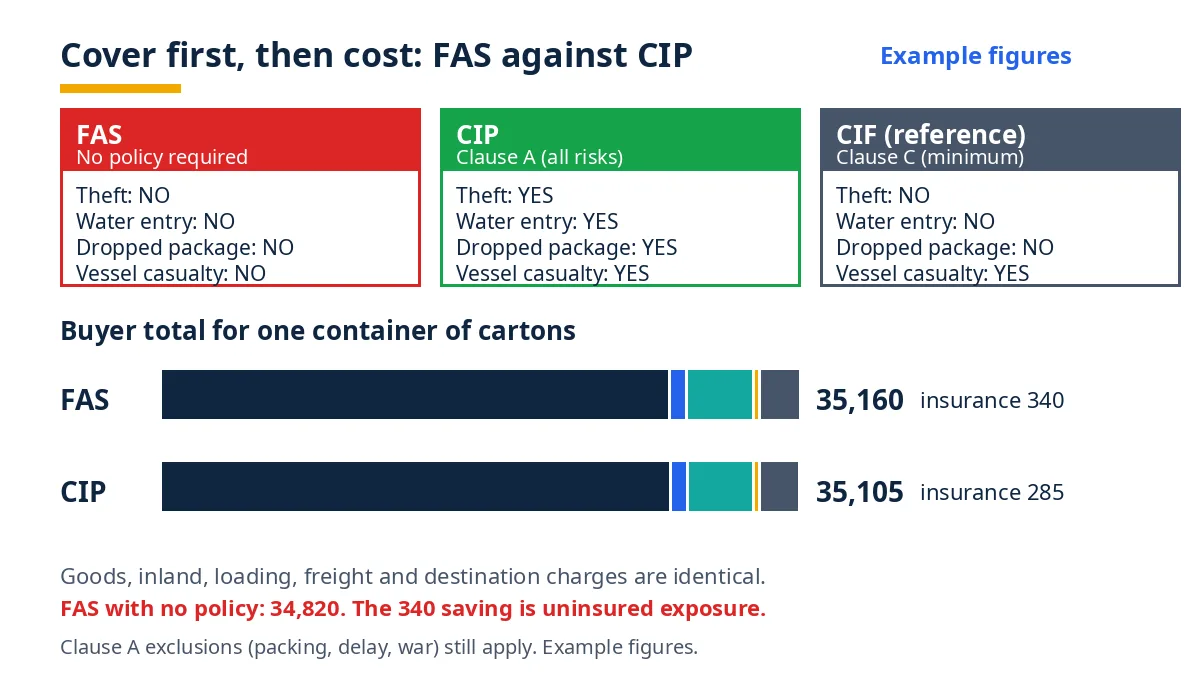
The totals differ by 55, from the premium assumption alone: 340 for a policy the buyer buys alone, against 285 for the policy the seller buys. If the premiums were equal, the totals would be equal.
The uninsured FAS total shows the trap in the other direction. A buyer who buys no policy under FAS would show 34,820, which is 340 below the insured FAS total and 285 below the CIP total. That is not a saving. It is the price of carrying the full 30,800 exposure, plus freight and destination charges already spent, with no policy to claim under if the container is short, wet or crushed.
When does paying for CIP cover beat arranging your own?
Seller-bought CIP cover usually wins when the buyer has no open cargo policy. A buyer who ships occasionally, has no broker, or wants one price containing Clause A cover gets protection without opening a separate policy for one container. It also wins when the certificate is clean: Clause A named, sum insured at least 110 percent, destination matching the contract, and the certificate in hand before handover.
Arranging cover at home usually wins in four situations. First, the buyer already holds an open Clause A policy covering every shipment, so a seller-bought policy would duplicate cover already paid for. Second, the buyer wants control over the insurer, the deductible, or extensions the seller did not buy, such as war and strikes wordings or cover beyond the named destination. Third, the buyer ships regularly and can place cover on better terms than a single-shipment policy bought by the seller. Fourth, the seller's certificate is weak: Clause C on an Incoterms 2020 contract, a sum below 110 percent, a destination short of the agreed place, or a certificate arriving late. In that case, buy a separate policy starting at the delivery point, and settle the duplicate premium with the seller in writing before shipment. The test stays the same: which route leaves the cartons insured at Clause A level, from the first handover to the named destination, with a certificate the buyer has read.
What should the contract name before the cartons move?
Five lines settle the position before payment, in writing in the contract.
The term line: "CIP Felixstowe, Incoterms 2020" or "FAS Chattogram, Incoterms 2020", naming the edition, the destination or shipment port, and the delivery point as precisely as the parties can agree it.
The insurance line: the clause set, the sum insured, the insurer, and who arranges the policy, with the certificate due before handover. Under CIP, name Clause A and at least 110 percent expressly, so a Clause C certificate cannot count as compliance.
The carriage line: the carrier, the sailing or departure window, and which destination charges the carriage price already contains, so handling at Felixstowe is not charged twice.
The packing line: moisture protection, pallet strength, marking, and stuffing photographs, because insufficient packing is excluded under every clause set.3
The papers line: what the seller sends, the transport document and, under CIP, the insurance certificate, and how fast damage at discharge must be reported.
For the insurance documents behind a CIF quotation, which shares the seller-bought policy idea at the lower Clause C level, see CIF insurance documents. Any wider cover, higher sum insured, or extension beyond the named destination must be specified in the sale contract so the seller can arrange it before shipment.1
Questions buyers ask about FAS and CIP
Which is cheaper, FAS or CIP?
Neither term is cheaper as a rule. The seller price is higher under CIP because it contains carriage and the Clause A premium, while the FAS seller price stops alongside the vessel. In the worked example the buyer totals differ by 55, which reflects only the premium assumption used there. Compare buyer totals built from the same goods and clause set, with the premium line separated.
Which is safer for a first-time importer?
CIP is usually safer for a first shipment, because the seller books the carriage and the Clause A policy arrives inside the price, and the buyer need not arrange a vessel, a lift and a policy at Chattogram. A first-time buyer should still read the certificate, confirm the 110 percent sum, and note that risk passes at handover to the first carrier, long before the cartons reach Felixstowe.1 FAS suits a first shipment only when the buyer already has a forwarder and broker handling Bangladesh sailings.
Can the delivery term be changed once the order is placed?
A change is possible only while both sides agree to it and put it in writing before the goods move, with the price, the carriage booking and the insurance position repriced and a new certificate issued where the replacement term calls for one. Moving to FAS means the buyer must already hold its own booking and cover; moving to CIP means the seller needs time to book carriage and place a policy. Once handover has happened, no rewrite of the term can insure a loss already suffered.
Which term do Bangladeshi suppliers prefer?
No published survey records a preference among Bangladeshi suppliers, and this article does not claim one. The practical signal is how a seller quotes: a seller that quotes CIP readily, names Clause A and the sum insured, and sends the certificate before handover is set up to carry that term. Ask for both quotations, with premium and freight lines separated.
Next steps on Exportain
Before you compare quotations, fix the cover in the RFQ: state the term, the edition, the clause set and the sum insured, and ask for the certificate up front. Browse supplier profiles to find carton suppliers, read how buying works, then post an RFQ that names the destination and the Clause A cover you require. Exportain does not take part in goods contracts, book freight, or clear customs, so buyer and seller agree carriage and insurance directly.5
Sources
- CPT & CIP Incoterms 2020 explained: Key differences. ICC Academy (accessed )
- FOB & FAS Incoterms® 2020 explained: Key differences. ICC Academy (accessed )
- Institute Cargo Clauses A B C Compared: Cover and Gaps. Globalior (accessed )
- CIP Incoterms (Carriage and Insurance Paid To) Explained. iContainers (accessed )
- About Exportain. Exportain (accessed )
About the author
Sourcing from Bangladesh?
Post a request for quotation and suppliers on Exportain can send you their quotes directly.
Post an RFQ