How to Import Solar Panels From Bangladesh to Italy: Step-by-Step Guide
Work back from the warehouse-ready date. This Italy guide runs the import as one timeline, from first supplier contact to panels checked in at a distributor warehouse near Milan.
Short answer
To import solar panels from Bangladesh to Italy, work back from the date the panels must be ready in the Italian warehouse. Confirm the exact module papers first, agree the Genoa delivery point and documents in the purchase order, prepare the Italian importer file and origin proof before loading, and clear customs at Genoa before onward delivery to the warehouse.
On this page
Key takeaways
Work back from the warehouse-ready date on a 14-week planning timeline, with one spare week between the Genoa release and the warehouse date.
The module papers must name the exact model, factory, and build: IEC 61215 and IEC 61730 evidence plus the EU declaration of conformity.
Collect the REX statement on origin and the broker's written duty and VAT confirmation before loading, and check which GSP arrangement covers the entry date.
File the complete ENS through ICS2, hold an EORI number for the importer of record, and name the same Genoa terminal in every booking.
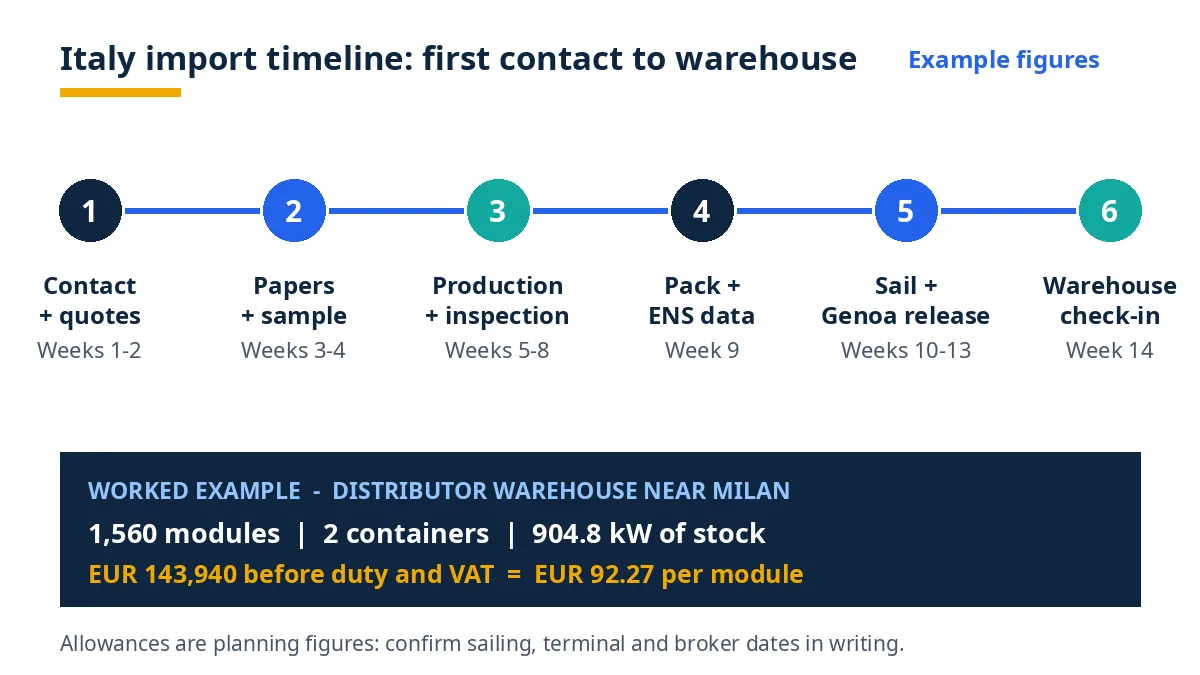
The worked example lands 1,560 modules at EUR 143,940 before duty and VAT, or EUR 92.27 per module, with duty and VAT as separate broker-confirmed lines.
Work back from the date the panels must sit ready in the Italian warehouse, not forward from the date you first write to a supplier. A solar panel import from Bangladesh to Italy runs as one chain: the module papers, the supplier checks, the purchase order, the Italian importer file, the sailing, and the Genoa release all sit on the same timeline, and a late paper at any point moves the warehouse date. This guide follows that chain in the order you should work it, for a buyer importing panels for a distributor warehouse near Milan, and ends with a worked example for two containers.
When does the Italy clock start, and what date do you work back from?
The clock starts with the warehouse-ready date you promise your own customers. Fix that date first, then set each earlier deadline from it, and keep one spare week between the Genoa release and the warehouse-ready date for a customs query, a damaged pallet, or a missed truck slot. Production, sailing schedules, and customs checks do not wait for a supplier paper that arrives late, so a paper promised "during shipment" is a paper that can hold the container at Genoa.
Phase | Work to finish | Planning allowance | Who owns it |
|---|---|---|---|
Weeks 1-2 | Supplier shortlist, quotations on one delivery basis, module papers requested | 2 weeks | Buyer |
Weeks 3-4 | Sample order, sample tests, supplier file, purchase order agreed | 2 weeks | Buyer and supplier |
Weeks 5-8 | Production, in-line checks, pre-shipment inspection | 4 weeks | Supplier, inspector |
Week 9 | Packing, origin statement, advance cargo data sent to the carrier | 1 week | Supplier, carrier |
Weeks 10-13 | Sailing from Chattogram, Genoa arrival, customs release, onward delivery | 4 weeks | Carrier, broker |
Week 14 | Warehouse receiving check, counts, damage record, stock release | 1 week | Buyer |
The allowances in this table are planning figures to confirm with the supplier, the carrier, and the broker for the sailing you will actually use. They are not transit promises. Record the sailing, the expected Genoa arrival, and the free-time expiry at the terminal on the same page as the purchase order. If production slips by a week, the booked sailing may be lost, and the next sailing moves every date after it.
How do you open supplier talks so quotations can be compared?
Open with a written request that every supplier answers in the same form. Name the exact module you want quoted, the wattage class, the cell type, the frame and glass build, and the quantity for the distributor warehouse.
Ask for the same set of papers from every supplier at this stage: the datasheet for the exact model, the design qualification and safety evidence, the EU declaration of conformity, the warranty terms, and the packing list format with pallets per container. Ask how many modules fit on one pallet and in one 40-foot container, and how the supplier protects corners, glass faces, and connectors during loading. For a distributor order, ask whether wattage classes can be mixed in one container and how each pallet is labelled, because warehouse staff need to pick stock without opening sealed pallets to find the right wattage.
Use the supplier listings on Exportain to build the shortlist, and post the same written request as a request for quotation so each reply arrives against the same specification. A shortlist of three suppliers who answered the same questions gives you a real choice; ten suppliers who answered different questions gives you ten prices for ten different offers.
What papers must name the exact module before you agree a price?
No price is final until the papers name the exact module, factory, and build you will receive. IEC 61215-1:2021 sets out design qualification for terrestrial photovoltaic modules for long-term outdoor use, and it warns that test results are not a quantitative prediction of module lifetime.1 IEC 61730-1:2023 sets out construction requirements for safe electrical and mechanical operation, covering electric shock, fire hazards, and injury from mechanical and environmental stresses.2 A certificate for a related model does not cover the module in your order.
The standard treats a change in materials, design, or internal spacing as a matter for fresh evaluation under the IEC 61730 series and IEC TS 62915.2
CE marking is a manufacturer declaration that the product meets the applicable health, safety, and environmental requirements in the relevant European legislation and has gone through the relevant conformity assessment procedure.3 The manufacturer must identify the applicable directive, verify the product meets the requirements, decide whether independent assessment is needed, affix the CE marking, compile the technical file, and draft an EU declaration of conformity.3 Ask for the declaration itself, not only a photograph of a CE mark on a module frame, and check that it names the product, the manufacturer or representative, the directives and standards applied, and the signatory. The technical documentation and the EU declaration of conformity must be kept for 10 years after the product has been placed on the market, or for the period the directive specifies.3 An economic operator in the EU must also be identifiable for market surveillance purposes, so agree early who that operator will be for your consignment.3
How do you test the supplier and the sample without losing weeks?
Test the supplier on documents first, because document checks cost days while a failed container costs weeks. Ask for the business registration, the export history for the same module, and the names of the test laboratory and certification body behind the papers, then check the papers against the model you ordered rather than against the supplier's brochure. Ask which factory will make the modules, whether production is in-house or subcontracted, and who signs the quality records.
Order a sample only after the paper file passes. Test the sample against the datasheet ratings, the dimensions, the connector set, and the labelling, and photograph the sample with its serial number visible. Use the sample to agree the acceptance tests for the full order: flash-test results, insulation checks, visual defect limits, and the serial-number list format. Write those tests into the purchase order so the pre-shipment inspection measures the same points the sample passed.
Book the pre-shipment inspection before production starts, not when the goods are already packed. The inspector should witness loading, count pallets and modules, check pallet labels against the packing list, and record any damage before the container doors close. If the inspection finds a defect, the time to fix it is in Bangladesh, before the container sails, when the supplier can still replace a pallet without a return shipment from Italy.
What do you lock in the purchase order so the shipment cannot drift?
Write the purchase order as the single record every later check refers back to. Name the exact model, the wattage class, the quantity in modules and pallets, the delivery rule and the named Genoa terminal, the price basis, and the payment steps. List every document the supplier must supply, the deadline for each one, and the format: commercial invoice, packing list, bill of lading, origin statement, EU declaration of conformity, test reports, inspection report, and serial-number list. State the packing standard in the same document: pallet size, modules per pallet, corner protection, strapping, and the label on each pallet showing model, wattage, quantity, and pallet number.
Set the wood packaging rule in the order as well. All wood packaging material and dunnage from non-EU countries must be heat treated or fumigated in line with ISPM 15 procedures, officially marked with the ISPM 15 stamp, and debarked.4 The stamp consists of three codes for country, producer, and measure applied, plus the IPPC logo.4 The rule does not apply to wood 6 mm thick or less, or to packaging made entirely from processed wood produced with glue, heat, and pressure, such as plywood or oriented strand board.4
Agree the payment steps against documents and inspection, not against calendar dates alone. A common shape is a deposit on order, a further payment on inspection approval, and the balance against the bill of lading and the agreed document set. State the origin statement the supplier will provide and the form it will take, so the duty position is settled before the vessel loads rather than argued after it berths. For the wider import sequence, see our guide to importing from Bangladesh.
What must be ready in Italy before the vessel loads in Chattogram?
Prepare the Italian importer file while production runs, because the file cannot be assembled in the days between loading and arrival. An Economic Operators Registration and Identification (EORI) number is mandatory for the clearance of customs operations in the EU, including import, and each operator holds a single valid EORI number.5 The number starts with the two-letter country code of the issuing EU country, followed by an identifier of up to 15 alphanumeric characters.5
Appoint the customs broker before loading, and give the broker the full file: the purchase order, the invoice value and currency, the delivery rule, the Genoa terminal, the origin statement, and the module papers. Ask the broker, in writing, to confirm the full customs code for the exact module, the duty position for the entry date, the origin claim to be made, and the import VAT treatment for this consignment. The Everything But Arms arrangement provides duty-free, quota-free access to the EU market for least developed countries for all products except arms and ammunition.6 Do not treat that sentence as a duty rate for your shipment. The arrangement must be claimed for the consignment, the origin must be proved, and a new Generalised Scheme of Preferences regulation signed in June 2026 applies from 1 January 2027.6 Ask the broker to confirm which arrangement covers your entry date and what proof your shipment carries.
Origin proof takes the form of a statement on origin made out by exporters registered in the Registered Exporter (REX) system, typed or printed on the invoice or another commercial document.7 Exporters without a REX number may make out statements on origin only for consignments of originating products worth no more than EUR 6,000 on an ex-works basis.7 The same EC page states a three-year minimum retention period for copies of origin proof and its supporting records, counted from the issue date.7
Give the carrier and the freight forwarder complete and accurate cargo data well before loading. Under the Import Control System 2 (ICS2), economic operators must submit a complete Entry Summary Declaration (ENS) through ICS2 for every consignment moving into or across the EU ahead of arrival, so customs can perform safety and security risk analysis before loading or before arrival.8 Customs may reject an incomplete ENS or issue a referral asking for more information, screening, or a direction not to load, and incomplete data can delay processing and entry.8
How does the Genoa arrival and customs release unfold, in order?
Work the arrival in the same order the port and customs work it: presentation, declaration, checks, release, terminal exit, onward delivery. The vessel berths at the named Genoa terminal, the goods are presented to customs, and the broker lodges the customs declaration for release for free circulation.
PSA SECH, in the heart of the Port of Genoa basin, is equipped to cater for vessels of up to 14,000 TEU and describes itself as a centre for onward distribution towards the major Northern Italian logistic hubs, with direct connections to the rail and motorway network.9 That onward link is why Genoa suits a distributor warehouse near Milan, but the terminal name in your contract must still match the terminal the booked service actually calls at.
Once customs releases the goods, the broker confirms release, the terminal charges are settled, and the haulier collects the containers for the warehouse. At the warehouse, check the container seals against the bill of lading, photograph each seal before opening, and count pallets against the packing list before signing the delivery note. Photograph any crushed corner, cracked glass, or wet carton before moving the pallet, and send the photographs to the supplier and the insurer the same day.
Worked example: two containers for a distributor warehouse near Milan
Example figures. A distributor near Milan orders 1,560 modules at 580 watts each, packed 30 modules to a pallet, 26 pallets in each of two 40-foot containers, for a total of 904.8 kilowatts of stock.
Line | Example figures (EUR) |
|---|---|
Product cost: 1,560 modules at 84.00 per module | 131,040.00 |
Ocean freight, Chattogram to the named Genoa terminal | 7,600.00 |
Cargo insurance | 740.00 |
Subtotal before duty and VAT | 139,380.00 |
Import duty: broker-confirmed figure for this consignment | Your figure |
Customs broker fee | 520.00 |
Genoa terminal and port charges | 1,180.00 |
Inland delivery, Genoa to the Milan-area warehouse | 1,640.00 |
Pre-shipment inspection and sample testing | 980.00 |
Bank and currency costs | 240.00 |
Total before duty and VAT | 143,940.00 |
Landed cost per module before duty and VAT | 92.27 |
Duty and import VAT sit outside the total on purpose. The broker must confirm the duty position for the entry date, including any preference claim and the origin proof, and the accountant must confirm the VAT base and rate for this consignment, before the total is treated as final. For the method behind the table, see our landed cost guide.
What delays Italy imports most often, and how do you prevent each one?
The first delay is a paper that names the wrong module. A datasheet, a test report, or a declaration that describes a related build will not pass a broker check, and the supplier will need days to issue corrected papers while the container waits. Fix it by checking the model, factory, and build on every paper in week two.
The second delay is an origin claim with no proof behind it. A statement on origin that covers a different consignment, a missing REX number, or a value above the unregistered-exporter limit will not support a preference claim, and the duty position will be reassessed at the border. Fix it by collecting the REX number and statement wording before loading.
The third delay is advance cargo data sent late or changed after sending. An incomplete ENS can draw a referral, and a referral answered slowly can hold the cargo. Fix it by sending the forwarder one complete data set before loading and confirming acceptance in writing.
The fourth delay is a terminal mismatch. Freight priced to "Genoa" and haulage booked to a different Genoa terminal will not meet at the gate. Fix it by naming the same terminal in the purchase order, the carrier booking, and the haulage booking.
The fifth delay is a receiving check signed before the count. A delivery note signed "received in good order" before the pallets are counted and photographed will weaken any later claim for shortage or damage. Fix it by counting pallets against the packing list at the dock and writing any exception on the delivery note before signing.
Questions buyers ask before the first Italy order
What is the typical MOQ for solar panels from Bangladesh?
There is no single MOQ for solar panels from Bangladesh, because the minimum depends on the supplier, the module, and the container load. Ask each supplier for its minimum in modules and in pallets, and test whether the minimum fills a container without wasted space. For the distributor example above, 1,560 modules filled two containers at 30 modules per pallet. Agree the MOQ in the purchase order, with the pallet count and container count stated, so a short shipment is visible at loading rather than at Genoa.
How long does shipping take?
Shipping time depends on the sailing schedule, the route, and the time the container spends at Genoa before release, so no single figure in this guide can stand in for your booking. Ask the carrier for the sailing date, the expected Genoa arrival, and the free-time period at the terminal in writing, and ask the broker how long the declaration and any checks should take once the goods are presented. Build the timeline in the first section around those written dates, and keep one spare week before the warehouse-ready date.
What import duty applies?
The duty for your consignment depends on the customs code for the exact module, the value, the origin position, and the arrangement in force on the entry date, so this guide states no duty rate. The Everything But Arms arrangement provides duty-free, quota-free access for least developed countries, but the preference must be claimed and proved for the consignment.6 Ask the broker to confirm the full code, the duty position, and the origin proof in writing before you agree the price, and rebuild the worked example with the broker figure inserted.
How do I verify a supplier?
Verify the supplier on papers that name the exact module, then on a sample, then on an inspection, in that order. Check the datasheet, the design qualification and safety evidence, and the EU declaration of conformity against the model quoted, and check that any change to the build brings fresh evidence.1 2 3 Ask for the factory, the export history for the same module, and the test laboratory behind the papers, and confirm the answers in writing. Order a sample only after the paper file passes, and book the pre-shipment inspection before production starts.
Next steps on Exportain
Start with the warehouse-ready date, read our how to buy guide, then post the same written request to three suppliers through Exportain and compare their answers on one delivery basis to the same Genoa terminal. Use the supplier listings to build the shortlist, send the request through new RFQ, and keep the module papers, the origin statement, and the broker confirmation on the same file as the purchase order. When the first container clears Genoa and the warehouse count matches the packing list, the timeline in this guide becomes the template for the next order.
Sources
- IEC 61215-1:2021 - Terrestrial photovoltaic (PV) modules - Design qualification and type approval - Part 1: Test requirements. International Electrotechnical Commission (accessed )
- IEC 61730-1:2023 - Photovoltaic (PV) module safety qualification - Part 1: Requirements for construction. NEN (accessed )
- Compliance FAQs: CE Marking. National Institute of Standards and Technology, (accessed )
- Requirements for wood packaging & dunnage. European Commission (accessed )
- Economic Operators Registration and Identification number (EORI). European Commission (accessed )
- Generalised Scheme of Preferences. European Commission (accessed )
- Proof of origin. European Commission (accessed )
- Import Control System 2. European Commission (accessed )
- PSA SECH - Autorità di Sistema Portuale Mar Ligure Occidentale. Western Ligurian Sea Port Authority (accessed )
About the author
Sourcing from Bangladesh?
Post a request for quotation and suppliers on Exportain can send you their quotes directly.
Post an RFQ