FAS vs CPT: Key Differences, Costs and Which One to Choose
CPT pays carriage to a named destination but moves risk at the first carrier; FAS stops alongside the vessel and leaves carriage with the buyer. This comparison prices ceramic tableware from Chattogram to Rotterdam and matches each term to its route.
Short answer
Under CPT the seller arranges and pays carriage to a named destination, but risk passes to the buyer when the goods reach the first carrier, and the term works with any mode of transport. Under FAS the seller delivers goods alongside the vessel at the port of shipment, the buyer books and pays carriage, and the term works only by sea or inland waterway. Neither term requires insurance, so compare buyer totals, not seller prices.
On this page
Key takeaways
Under CPT the seller pays carriage to the named destination, risk passes at handover to the first carrier, and the term works with any mode of transport.
Under FAS the seller delivers goods alongside the vessel, the buyer books and pays carriage and loading, and the term works only by sea or inland waterway.
Neither term requires either party to insure; a buyer that wants cover arranges it from the handover or alongside point, while CIP is the separate insured term.
In the worked example both buyer totals are 35,810, so compare totals with the carriage element separated rather than comparing seller prices.
Containerized and multimodal shipments fit CPT; bulk cargo placed beside a vessel fits FAS; name both the delivery point and the destination in a CPT contract.
Two quotations for the same ceramic tableware can look as if they describe different shipments. One names Chattogram and stops there. The other names Rotterdam and carries a higher seller price. The gap is not a difference in the plates, the packing, or the factory. It is a difference in how far the seller's carriage duty runs, and in which kinds of transport the term can cover at all. This comparison follows a containerized order of ceramic tableware from Bangladesh to Rotterdam, and tests where FAS ends and where CPT takes over.
Which term fits the route you actually plan to use?
Use CPT when the route uses more than one mode of transport or moves in a container. Reserve FAS for a sea or inland-waterway movement where the goods can sit beside the vessel. CPT works with sea, road, rail, air, or a combination of modes, while FAS is restricted to sea and inland waterway transport.1 2 That single restriction decides much of the choice before price enters the discussion.
A container is normally handed to a terminal days before the vessel loads, and the seller has no alongside delivery to make at the ship's side.2 The ICC Academy notes that containers delivered to a terminal in this way sit more naturally under a rule built for terminal handover, and CPT reflects a container handed to a terminal days before loading better than a sea-only rule.2 3 DHL makes the same practical point, that sea-only terms suit bulk or break-bulk cargo rather than containers, and that CPT and similar terms suit air or multimodal shipments.4
Question | FAS | CPT |
|---|---|---|
Transport modes | Sea and inland waterway only | Any mode, including combined modes |
Delivery point | Alongside the vessel at the named port of shipment | Handover to the first carrier at the agreed delivery point |
Seller pays carriage to | No onward point; the buyer books from the quay | The named place of destination |
Fit | Bulk or break-bulk cargo placed beside a vessel | Containerized, air, road, rail, or multi-leg shipments |
Place named in the term | Port of shipment | Place of destination, with the delivery point agreed separately |
FAS still has a place, and that place is a vessel-side handover. Bulk cargo, heavy pieces, and project cargo that can be set down beside a named ship fit the term.2 A container of tableware does not, because the physical handover happens at a terminal, not at the ship's side.5
Who books the carriage, and what does that booking control?
Under CPT the seller books the carriage and pays for it to the named destination. Under FAS the buyer books the carriage and pays for it from the port of shipment onward. The seller under CPT contracts the carrier and pays the carriage cost to the named place of destination, while the buyer under FAS appoints the carrier, pays the freight, and pays for loading at the port.1 2
Booking is control as well as cost. The party that books chooses the carrier, the sailing or departure, and the routing, and receives the notices that show whether the plan is holding. Under CPT that party is the seller, so the buyer sees a price to Rotterdam without seeing the carrier choice behind it. Under FAS the buyer keeps the choice, and must also do the work: name the vessel in time, state the place and point of delivery inside the port, and keep the seller informed so the goods can be set down beside the right ship.2 The seller under FAS still owes the buyer the transport information the buyer needs to arrange that carriage, at the buyer's risk and cost.2 Under CPT the seller must tell the buyer in good time that delivery to the carrier has happened, and give the buyer the information needed to receive the goods at the destination.1
A buyer that already moves containers from Chattogram, holds carrier terms, or consolidates tableware with other orders may value the FAS control. A buyer that ships occasionally, or that needs truck, sea, and rail legs joined into one booking, will usually value the CPT booking more.
Where does risk pass when the seller still pays the freight?
Under CPT risk passes when the goods reach the first carrier, long before the named destination. Under FAS risk passes when the goods are placed alongside the vessel. Both terms move risk early, and neither keeps risk with the seller until arrival.
CPT has two places, and reading it as if it had one causes most disputes. The place of delivery is where the seller hands the goods to the carrier, often a warehouse, a forwarder's premises, or an origin terminal in Bangladesh. The place of destination is the place named after the letters CPT, and only the seller's carriage cost runs to that place.1 3 A contract reading "CPT Rotterdam" therefore means the seller pays carriage to Rotterdam while the buyer has carried the risk since handover to the first carrier in Bangladesh.3 With several modes, delivery happens at handover to the first carrier, and the seller still pays carriage to the destination.1 Under FAS, delivery and risk pass together at the alongside point, and the buyer then carries loading, the voyage, and everything after it.5 In both terms the seller handles export clearance and the buyer handles import clearance, duty, and onward transport from the point where the seller's duty ends.1 2
On insurance, one short contrast is enough. Neither FAS nor CPT requires either party to buy cargo cover, so a buyer that wants cover arranges it, with the start point matched to the handover or alongside point.3 5 CIP is the separate term in which the seller must buy cover; under CPT the buyer must not assume a policy is included.
What does each price contain, and what stays outside it?
A CPT seller price contains carriage to the named destination. An FAS seller price stops at the alongside point, with loading, carriage, and terminal handling still to pay. Both prices exclude import clearance, duty, and onward transport beyond the seller's endpoint.
In both terms the seller price contains the goods, packed for export, inland transport to the handover point, and export clearance. Under CPT it also contains the carriage contract to the named destination, including any loading and terminal handling that contract covers. Under FAS those items sit outside the seller price and fall to the buyer.2 3 Ask for the carriage element to be stated separately even under CPT, with its validity period, because a single CPT figure hides the rate inside the goods price.
Two boundary checks prevent double payment. CPT ends at the named place, so cartage, unloading, and storage beyond it belong to the buyer unless the contract says otherwise.3 If discharge or terminal handling at destination already sits inside the carriage contract, that handling is already paid for, so check the contract before settling any invoice from the destination agent.3 Background on the full set of terms is in the Incoterms overview for Bangladesh shipments. The sea-only freight comparison is explained in the CFR price guide.
Worked example: ceramic tableware from Chattogram to Rotterdam
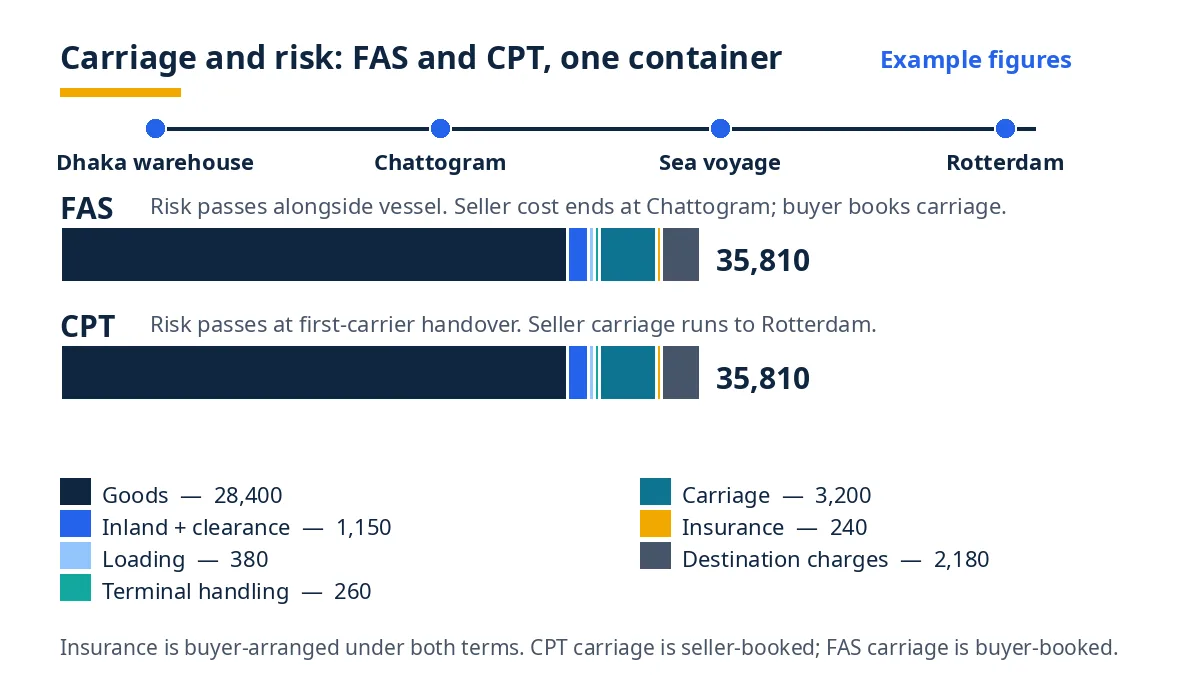
The figures below are Example figures for one container of ceramic tableware, packed in cartons on pallets, shipped from Chattogram to Rotterdam. The same goods, route, and carriage rate are used under both terms, so the comparison isolates the booking and mode difference. The CPT carriage contract is assumed to include origin terminal handling and loading on board. Cargo insurance is buyer-arranged under both terms, starting at the handover or alongside point.
Cost line (Example figures) | FAS Chattogram | CPT Rotterdam |
|---|---|---|
Goods, packed for export | 28,400 | 28,400 |
Inland transport and export clearance | 1,150 | 1,150 |
Loading on board | 380 (buyer pays) | 380 (in seller price) |
Origin terminal handling | 260 (buyer pays) | 260 (in seller price) |
Carriage, Chattogram to Rotterdam | 3,200 (buyer books) | 3,200 (seller books) |
Seller's price | 29,550 | 33,390 |
Loading, terminal handling and carriage paid separately by buyer | 3,840 | 0 |
Cargo insurance, buyer-arranged | 240 | 240 |
Destination handling, import clearance, duty, onward transport | 2,180 | 2,180 |
Buyer total | 35,810 | 35,810 |
The buyer totals match, which is the point. CPT does not make the shipment cheaper, and FAS does not make it cheaper either. CPT moves carriage, loading, and terminal handling into the seller price. FAS moves the same lines into the buyer's separate account, and adds the work of booking them. In a live quotation the carriage rates will differ, because the seller's CPT rate and the buyer's own rate are struck at different times with different carriers. Compare buyer totals on the same sailing window, with the carriage element separated, rather than comparing a seller price under one term with a seller price under the other. The diagram shows the same totals as stacked costs, with the risk point marked for each term.
When does seller-booked carriage help, and when does buyer control win?
Seller-booked carriage helps when the shipment is containerized or multimodal, when the buyer has no carrier relationship in Bangladesh, or when the seller can consolidate the tableware with other cargo on the same route. CPT fits those cases because the seller arranges one carriage contract across the legs, and the buyer receives one price to the named destination, even though risk passed at the first carrier.1 It also helps when an air or rail leg forms part of the route, since FAS cannot cover that leg at all.1 2
Buyer control wins when the buyer charters the vessel, runs its own loading operation, or holds carrier terms that beat a single seller's rate. FAS fits that buyer for bulk sea cargo placed directly beside the vessel, where the buyer wants to choose the carrier and the sailing and to see the freight rate in the open.2 For containerized ceramic tableware, that FAS advantage rarely applies, because the container handover happens at a terminal.5
A first-time importer with no forwarder arrangement in Bangladesh will usually find CPT simpler to run, provided the buyer arranges cargo cover from the first-carrier handover and reads the carriage inclusions before paying. A first-time importer that already works with a forwarder handling Bangladesh shipments may prefer FAS for a bulk sea shipment, where the forwarder books the vessel and the buyer keeps the freight decision. The decision should follow the route and the buyer's booking capacity, not the headline seller price.
What should the contract name before anyone books anything?
Five lines settle the position before booking. First, the term line, with the edition and both places where they matter: "CPT Rotterdam, delivery at the seller's warehouse in Dhaka, Incoterms 2020" names the destination and the delivery point, while "FAS Chattogram, Incoterms 2020" names the port of shipment, and the vessel name and delivery point must be notified in time.1 2 Second, the carriage line: the carrier, the sailing or departure window, the legs covered, and whether unloading and destination terminal handling are inside the carriage contract. Third, the validity line: how long the carriage rate holds, and what happens if a surcharge is applied after booking. Fourth, the insurance line: which party arranges cover, and the point from which cover starts. Fifth, the documents line: the transport document and the seller's notice of delivery, so the buyer can receive the goods and clear import at the destination.1
Put those lines in the purchase order itself, where both sides can find them later. The FAS price breakdown lists the alongside cost lines, and the landed cost guide covers destination charges outside both seller prices.
Questions buyers ask about FAS and CPT
Which term is cheaper for the same shipment?
Neither term is cheaper in itself. The seller price is higher under CPT because it contains carriage, loading, and terminal handling, while the FAS seller price excludes them. In the worked example the buyer totals match at 35,810 once every line is added. A live difference comes from the carriage rate each party can secure, not from the letters in the term.
Which term is safer for a first-time importer?
Neither term keeps risk with the seller until arrival, so neither is safer on risk alone. CPT is simpler to run for a first shipment, because the seller books the carriage to the destination, but the buyer still carries risk from the first carrier and must arrange its own cover.1 3 FAS adds vessel nomination, loading, and carriage booking to the buyer's work, and suits a first shipment only where a forwarder already handles those tasks for the buyer.2
Can the buyer switch terms after the purchase order is signed?
A switch needs the agreement of both parties, recorded in writing before carriage is booked. Changing terms changes who books and pays the carriage, the delivery point, and the price. Do not assume a term can be swapped after the carrier is booked without a price and document change.
Which term do Bangladeshi suppliers prefer?
No general rule answers this. A supplier with carrier terms and regular container sailings may quote CPT readily, while a supplier without that booking capacity may quote FAS and leave carriage to the buyer. Ask each supplier to quote the term that fits the route, state the carriage element separately, and compare buyer totals.
Next steps on Exportain
Decide the route first, then ask for quotations on the term that fits it: CPT for a containerized or multi-leg movement to a named destination, FAS only for a sea movement with a genuine vessel-side handover. Start by looking at supplier profiles, then read the buying guide, then send an RFQ listing the term, the delivery point, the destination, and the carriage inclusions you require. Exportain stays outside the sale contract: it does not arrange carriage or customs clearance, so buyer and seller agree the carriage and risk terms between themselves.6 For the insured alternative to CPT, see CIF cost, insurance and freight.
Sources
- CPT & CIP Incoterms 2020 explained: Key differences. ICC Academy (accessed )
- FOB & FAS Incoterms® 2020 explained: Key differences. ICC Academy (accessed )
- CPT Incoterm: Carriage Paid To, Risk vs Cost. Linbis (accessed )
- Incoterms for Sea Freight: How to Make Them Work for You. DHL, (accessed )
- FAS Incoterms (Free Alongside Ship): Meaning and Use. iContainers (accessed )
- About Exportain. Exportain (accessed )
About the author
Sourcing from Bangladesh?
Post a request for quotation and suppliers on Exportain can send you their quotes directly.
Post an RFQ