

What Does a CFR Price Include? Cost Breakdown With a Real Example
A CFR price covers the goods and the seller costs up to loading on board, plus ocean freight to the destination port, but no insurance. This guide breaks down each included and excluded line, with a labelled example, so you can compare CFR quotes on the same basis.
Short answer
A CFR price covers the goods, export packing, inland transport to the port of shipment, export clearance, loading on board, and ocean freight to the named port of destination. It does not cover cargo insurance, import clearance, import duty, or onward transport. Risk passes to the buyer when the goods are loaded on board, even though the seller pays the freight. CFR is an Incoterms 2020 rule for sea and inland waterway transport only.
On this page
Key takeaways
A CFR price covers the goods, export packing, inland transport, export clearance, loading on board, and ocean freight to the named destination port.
A CFR price does not cover cargo insurance, import clearance, import duty, or onward transport, which the buyer budgets separately.
Risk passes to the buyer when the goods are loaded on board at the port of shipment, even though the seller pays the freight to destination.
In the worked example, example figures total USD 29,000 for 40 tonnes, or USD 725 per tonne, with each included line shown separately.
Exportain verification is a document and photo review, not a factory inspection or a guarantee, and it does not change the cost lines in a CFR quote.
A CFR quote looks reassuring: the seller has paid the ocean freight. The freight bill is settled. The risk of the voyage is not, and no insurance is bought. Under CFR, the buyer carries the risk from loading on board.
Quick answer
A CFR price covers the goods, export packing, inland transport, export clearance, loading on board, and ocean freight to the destination port. Cargo insurance, import clearance, import duty, and onward transport sit outside the price. Risk passes to the buyer at loading, while the seller pays freight. CFR is an Incoterms 2020 rule for sea and inland waterway transport only.
CFR price meaning in plain English
CFR stands for Cost and Freight. Under Incoterms 2020, the seller delivers the goods on board at the port of shipment, cleared for export, and contracts and pays for carriage to the named destination port.1 The price is the on-board cost plus the freight.
CFR has two different points. The place of delivery, where risk passes, is the port of shipment. The place of destination, to which the seller pays freight, is the named port in the buyer's country. Under the C rules, delivery and risk transfer occur at origin, while the seller pays transport to the destination.1
CFR is one of four Incoterms 2020 rules for sea and inland waterway transport only: FAS, FOB, CFR, and CIF.2 Read every CFR quote with its named port and edition: a broad city name may not direct which port freight should be arranged to.3
How it works step by step
Make and pack the goods. The seller produces and packs the goods for export.1
Move the goods to the port. The seller moves the goods to the port of shipment and clears them for export.1
Load the goods on board. On loading, delivery happens and risk passes to the buyer.1 2 The seller must notify the buyer.1
Pay the ocean freight. The seller contracts the carrier and pays freight to the destination port.1
Carry the risk and arrange cover. From loading, the buyer bears the risk. No CFR rule obliges the seller to insure it, so a buyer who wants cover arranges it from loading.2 At destination, the buyer completes the import formalities.1
The diagram below shows that sequence.
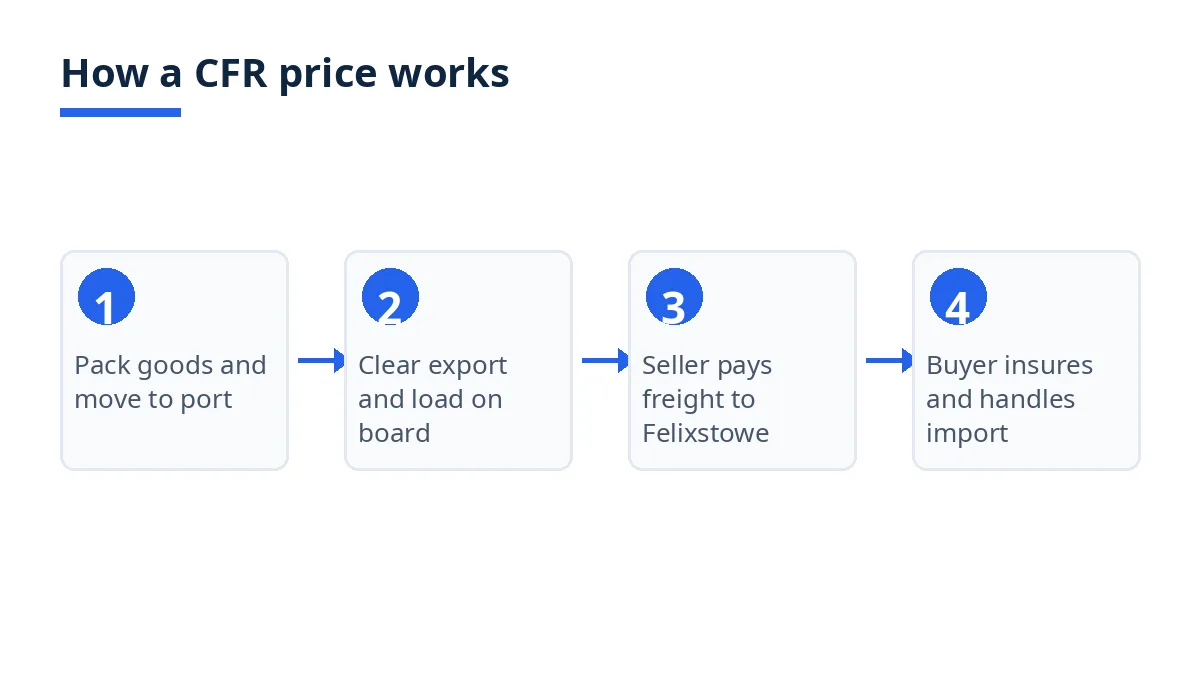
The seller pays unloading at destination only if the carriage contract says so; otherwise the buyer pays.1
Who is responsible for what
Cost line | Paid by | Inside the CFR price |
|---|---|---|
Goods | Seller | Yes |
Export packing and marking | Seller | Yes |
Inland transport to the port | Seller | Yes |
Export clearance | Seller | Yes |
Loading on board | Seller | Yes |
Ocean freight to the destination port | Seller | Yes |
Cargo insurance | Buyer, if wanted | No |
Unloading at the destination port | Buyer, unless the carriage contract says otherwise | No, unless included in the carriage contract |
Import clearance | Buyer | No |
Import duty and taxes | Buyer | No |
Onward transport from the destination port | Buyer | No |
The table follows the C-rule pattern: the seller pays the pre-delivery costs and the costs of getting the goods to their destination, and in CIP and CIF also the insurance premium.2 CFR stops short of insurance.2
Worked example with numbers (Bangladesh shipment)
All figures in this section are example figures only, not market rates.
A buyer orders 40 tonnes of jute yarn in bales from a mill in Narayanganj, on CFR Felixstowe, Incoterms 2020. The goods travel to Chattogram and sail to Felixstowe on a carriage contract the seller pays for.
Included line | Example figures |
|---|---|
Goods: 40 tonnes of jute yarn | USD 24,000 |
Export packing and marking | USD 900 |
Inland transport, Narayanganj to Chattogram | USD 600 |
Export clearance handling | USD 200 |
Port handling and loading | USD 500 |
Ocean freight, Chattogram to Felixstowe | USD 2,800 |
Total CFR price | USD 29,000 |
CFR unit price | USD 725 per tonne |
USD 29,000 divided by 40 tonnes equals USD 725 per tonne. If freight rose by USD 400, the total would be USD 29,400 and the unit price USD 735. Never reuse these figures.
The excluded lines need separate budgets: insurance from loading, unloading at Felixstowe unless the carriage contract includes it, import clearance, duty and taxes, and onward transport. Price them from your own quotes and add them to the CFR total for a landed cost. See the landed cost guide.
CFR vs related terms
CFR sits in the sea-only family with FAS, FOB, and CIF. Its any-mode neighbour is CPT, for seller-paid carriage on any mode.2
Term | Price covers | Buyer still pays |
|---|---|---|
FAS (Free Alongside Ship) | Goods, packing, transport, clearance, alongside vessel | Loading, freight, insurance, import clearance and duty |
FOB (Free On Board) | Goods, packing, transport, clearance, loading on board | Freight, insurance, import clearance and duty |
CFR (Cost and Freight) | FOB lines, plus ocean freight to the destination port | Insurance, import clearance and duty |
CIF (Cost, Insurance and Freight) | CFR lines, plus cargo insurance bought by the seller | Import clearance and duty |
CPT (Carriage Paid To) | Goods, packing, transport, clearance, carriage to the named place | Insurance, import clearance and duty |
Under FAS, the seller delivers alongside the vessel, and the buyer covers loading.4 The passing of risk in FOB and in CFR/CIF is largely the same: on board at the port of shipment.3 The FOB–CFR difference lies in costs and freight.3
CIF differs on one item only: the seller must also obtain cargo insurance for the buyer, while CFR imposes no insurance obligation.2 For the CIF cover level, see the CIF guide. For all rules, see the Incoterms guide.
For air freight or terminal-handed containers, CFR is the wrong shape: the sea-only rules suit bulk or break-bulk cargo, not containers.2 A container fits CPT or CIP better, where risk passes on handover.1
Common mistakes to avoid
Reading CFR as delivery at the destination port. Delivery and risk transfer happen on board at the port of shipment, not at arrival.1
Assuming insurance is included. The seller has no obligation to insure the buyer's risk.2 Arrange cover from loading.
Comparing a CFR headline with an FOB headline. CFR includes freight; FOB does not. Adjust first.
Comparing a CFR headline with a CIF headline as if only freight differed. CIF also includes the seller-bought premium. The gap is insurance.
Accepting "CFR" without a named destination port. Name the port, with the edition, in the quote and contract.3
Using CFR for air freight or terminal-handed containers. CFR is sea-only, and risk still falls only on board.2 Ask for CPT or CIP.
Paying destination unloading twice. Unloading is the seller's cost only if the carriage contract says so.1 Confirm separate charges in writing.
Treating the CFR price as a landed cost. Insurance, clearance, duty, and transport sit outside the price. Add them first.
How Exportain helps
Exportain is a B2B marketplace where buyers can find Bangladeshi suppliers, post requests for quotation, receive quotations, message suppliers, and place orders. Ask several suppliers for the same product, quantity, and destination port, on CFR terms, with the build-up itemized: goods, packing, transport, clearance, loading, and freight as separate lines. Ask each supplier in writing who insures the voyage from loading and what the carriage contract includes at destination.
Exportain verification is a review of documents and photos, not a factory inspection or a guarantee of quality, capacity, or delivery.5 6 A badge does not change the CFR cost lines or insure the voyage. Post a free RFQ on Exportain and ask each supplier to quote CFR Felixstowe, Incoterms 2020, with the lines shown separately.
FAQs
What is CFR?
CFR stands for Cost and Freight. It is an Incoterms 2020 rule for sea and inland waterway transport: the seller delivers the goods on board at the port of shipment and pays ocean freight to the named port of destination.1 Risk passes to the buyer on board at origin; the seller need not insure it.2
How does CFR work in practice?
The seller packs the goods, moves them to the port, clears export, and loads them, then pays for the voyage.1 The buyer bears the risk from loading, arranges insurance if wanted, and handles import clearance, duty, and onward transport.1
Is CFR used for shipments from Bangladesh?
Yes, CFR is used for sea shipments from Bangladeshi ports, including Chattogram. CFR fits bulk and break-bulk cargo loaded directly on board best; for terminal-handed containers, check CPT or CIP.2
What are the common mistakes with CFR?
The common mistakes are reading CFR as delivery at destination, assuming insurance is included, comparing CFR with FOB or CIF headlines unadjusted, accepting "CFR" without a named port, using CFR for air freight or containers, paying unloading twice, and treating the CFR price as a landed cost.
Next steps on Exportain
Post a free RFQ on Exportain with your product, quantity, and destination port, and ask suppliers to itemize the CFR lines. Read how to buy on Exportain before you accept a quotation, and use the Incoterms guide to check CFR against FOB, CIF, and CPT.
Sources
- Incoterms® 2020 C rules vs D rules: Risk transfer explained. ICC Academy (accessed )
- Insider thoughts: Bob Ronai on Incoterms 2020 Rules; What are they about?. International Chamber of Commerce (accessed )
- Incoterms® 2020: CFR vs FOB & the title transfer myth. ICC Academy (accessed )
- FOB & FAS Incoterms® 2020 explained: Key differences. ICC Academy (accessed )
- Trust & Safety Center. Exportain (accessed )
- Supplier verification: Earn trust badges buyers can see. Exportain (accessed )
About the author
Sourcing from Bangladesh?
Post a request for quotation and suppliers on Exportain can send you their quotes directly.
Post an RFQ


