Best Incoterm for Sweaters and Jackets From Bangladesh
FOB, CIF and DDP behave very differently for bulky, moisture-sensitive knitwear outerwear. This guide compares them on landed cost, duty, insurance and air freight, and recommends a term for each order size.
Short answer
For sweaters, jackets and outerwear from Bangladesh, FOB Chattogram suits a repeat buyer with a forwarder, CIF suits a first-time buyer who wants one price to port, and DDP suits a small trial order. The deciding factors are bulky low-density freight, moisture and mould risk under minimum Clause C insurance, and duty, which depends on the HS code and EU preference.

On this page
Key takeaways
FOB suits a repeat buyer with a forwarder; CIF suits a first-time buyer wanting one price to port; DDP suits a small trial order.
CIF insurance is only minimum Clause C cover, which does not cover water entering the container, so agree Clause A cover or buy top-up insurance.
Sweaters fall under HS 6110, where most lines carry 12 percent third-country duty before EU preference.
Puffer jackets price on volumetric weight by air, so check the 6,000 or 5,000 divisor before comparing quotes.
EU duty-free access under Everything But Arms is time-limited, so put the duty assumption in writing on any DDP price.
Sweaters, jackets and outerwear from Bangladesh are bought for a selling season. A wool sweater, a puffer jacket and a lined winter coat take up far more space than their weight suggests, hold moisture, and lose most of their value if they arrive after the cold weather starts. This guide compares FOB, CIF and DDP for that product, then works through duty, moisture and air freight.
Why outerwear changes the Incoterm maths
Bangladesh earned USD 21.15 billion from knitwear in FY2024-25, up 9.73 percent on the year, out of garment exports of USD 39.34 billion.1 A term that leaves you arranging freight gives you control over the sailing date. A term that leaves the seller arranging freight gives you one price and less control over which vessel your cartons board.
A carton of puffer jackets is mostly air. Freight is charged on space as well as weight, so whoever books the freight feels that space charge first. Under FOB you see the freight bill; under CIF and DDP it is folded into the seller price.
Moisture is the third reason. Knitwear fibres and cardboard cartons release water vapour inside a sealed container, and condensation can drip from the steel ceiling onto the top cartons.2 A damp sweater can grow mould, and a mouldy carton is rejected.
FOB, CIF and DDP for a knitwear outerwear shipment
The rules in force today are Incoterms 2020, published by the International Chamber of Commerce and effective from 1 January 2020, with eleven rules that allocate delivery, carriage, insurance and customs clearance between seller and buyer.3 Three cover most outerwear orders from Bangladesh: FOB, CIF and DDP.
Under FOB (Free On Board), the seller puts the goods on the ship you name at the port of shipment, after clearing them for export. Once the goods are on board, the risk is yours. You book and pay for the sea freight, arrange your own insurance, and clear import customs and pay duty at destination. FOB suits a buyer who already has a forwarder, because you control the sailing, routing and insurance level.
Under CIF (Cost, Insurance and Freight), the seller contracts and pays for sea freight to your named destination port and buys marine insurance for your benefit. Risk still passes when the goods are loaded on board at origin, so the seller pays the freight while you carry the risk for most of the voyage.3 CIF suits a buyer who wants one seller-arranged price to the destination port and has no forwarder in Bangladesh. The trade-off is control: you do not choose the vessel, routing or insurer.
Under DDP (Delivered Duty Paid), the seller carries the most obligation of any rule: export clearance, international transport, import clearance at destination and payment of import duties and taxes, bearing the risk until the goods arrive and are ready for unloading.4 DDP suits a first-time buyer or a small order where a single landed price is worth more than freight control. If the seller cannot act as importer of record in your country, the shipment can stall at arrival.
What the duty position does to the choice
For customs, sweaters, pullovers and cardigans sit in HS heading 6110, the heading for jerseys, pullovers, cardigans, waistcoats and similar knitted articles, divided by fibre.5 The third-country duty shown for most 6110 lines is 12 percent, with heavy wool sweaters at 10.5 percent.5 Jackets and coats fall under nearby headings in chapters 61 and 62, so check the line for your exact product.
For the European Union, the duty you actually pay depends on preference, not only on the tariff line. Bangladesh ships to the EU duty-free and quota-free today under the Everything But Arms scheme, and the EU has agreed to continue its trade preferences for another three years, so regular tariffs would come into effect from 2029.6 Ask for the duty assumption in writing before you accept a DDP price that runs past a preference change.
Under every term except DDP, you are the importer of record: you file the import declaration, claim the preference, and pay any duty that applies. Under DDP the seller takes that job, and a seller who has never cleared goods in your country may price the duty from the wrong line or miss the preference entirely. If the DDP price looks lower than your own FOB landed cost, check whether the seller has priced duty at all.
Moisture, mould and insurance: why Clause C is a weak fit for knitwear
A container loaded at 30 degrees Celsius and 80 percent relative humidity holds about 24 grams of water in every cubic metre of air, and cooling that air to 10 degrees leaves only about 9.4 grams in the air, so roughly 1,100 grams of water condenses inside a 40-foot container and lands on the goods below.2 Textiles release water vapour during transit, along with the cardboard cartons and wooden pallets around them.2 The damage is familiar: mould on textiles, cartons that soften and collapse, and labels that peel off.2
That physics is why the insurance level inside CIF deserves a hard look. Under Incoterms 2020, CIF requires the seller to buy only minimum cover under Institute Cargo Clauses (C), while CIP requires the broader Clause A cover.3 Clause C pays only for a short list of major events, among them fire, vessel stranding and sinking, and it leaves out water that gets into the container and cartons dropped while loading.7 Clause A covers all risks except what the clauses exclude.7 Under both rules, insure for 110 percent of the contract price or more.7
For a container of sweaters, that gap is the whole argument. The loss you are most likely to suffer is not a sinking. It is damp cartons, mould on wool, and water staining after condensation inside the container. Clause C does not cover water entering the container.7 If you buy on CIF terms, agree Clause A cover in the contract or buy your own top-up cover from loading.
Packing is part of the same decision. Desiccants pull water vapour out of the air before it can condense, and calcium chloride absorbs up to about 300 percent of its own weight in water, far more than silica gel.2 But desiccants cannot rescue cargo that went into the container wet: if hygroscopic cargo is not already container-dry when loaded, adding desiccant will usually fail.2 Write the packing standard into the contract: dry goods, dry cartons and desiccant sized to the voyage.
Air freight for samples and late-season top-ups
Outerwear buyers use air freight for samples before bulk production, and for a late top-up when the selling season is already open. Both are small, light and bulky, and both are priced on chargeable weight: air freight is billed on whichever is greater, the actual weight or the volumetric weight, and the volumetric weight in kilograms is length by width by height in centimetres divided by 6,000 for general air cargo, or by 5,000 for express courier services.8 Cargo lighter than about 167 kilograms per cubic metre is billed on volume.8
Take a sample shipment of puffer jackets. Example figures: 20 cartons, each 60 by 50 by 50 centimetres and weighing 8 kilograms. The volumetric weight per carton is 150,000 divided by 6,000, which is 25 kilograms. Across 20 cartons the volumetric weight is 500 kilograms against an actual weight of 160 kilograms, so the chargeable weight is 500 kilograms. On an express courier divisor of 5,000 the same cartons price at 600 kilograms in total.
Which term fits each order size
There is no single term for outerwear, because the order size changes who should carry the freight, the risk and the customs work.
Order | Recommended term | Why it fits outerwear |
|---|---|---|
Small trial order, under one pallet | DDP by air or courier | One landed price, seller clears import, no forwarder needed for a first order |
Sample approval, 20 to 50 pieces | CIP by air | Clause A cover for a high-value sample, seller arranges carriage to your door |
Full container, repeat buyer | FOB Chattogram | You control the sailing and the insurance, and you see the freight cost on its own line |
Full container, first-time buyer | CIF named destination port | One seller-arranged price to port, but agree Clause A cover or buy top-up insurance |
Full container, buyer with no import team | DDP named warehouse | Seller carries risk and duty to your door, provided the seller can act as importer |
Worked example: one container priced three ways
Example figures only, for illustration. The same container holds 5,000 wool-blend sweaters. The FOB price is USD 42,000. The CIF price to the destination port is USD 45,600, with freight and minimum insurance inside the price. The DDP price to your warehouse is USD 49,800, with freight, insurance, duty and import clearance inside the price. Ocean freight is USD 2,400, marine insurance is USD 380, and destination handling, duty, broker fees and inland delivery total USD 3,900 under FOB and CIF.
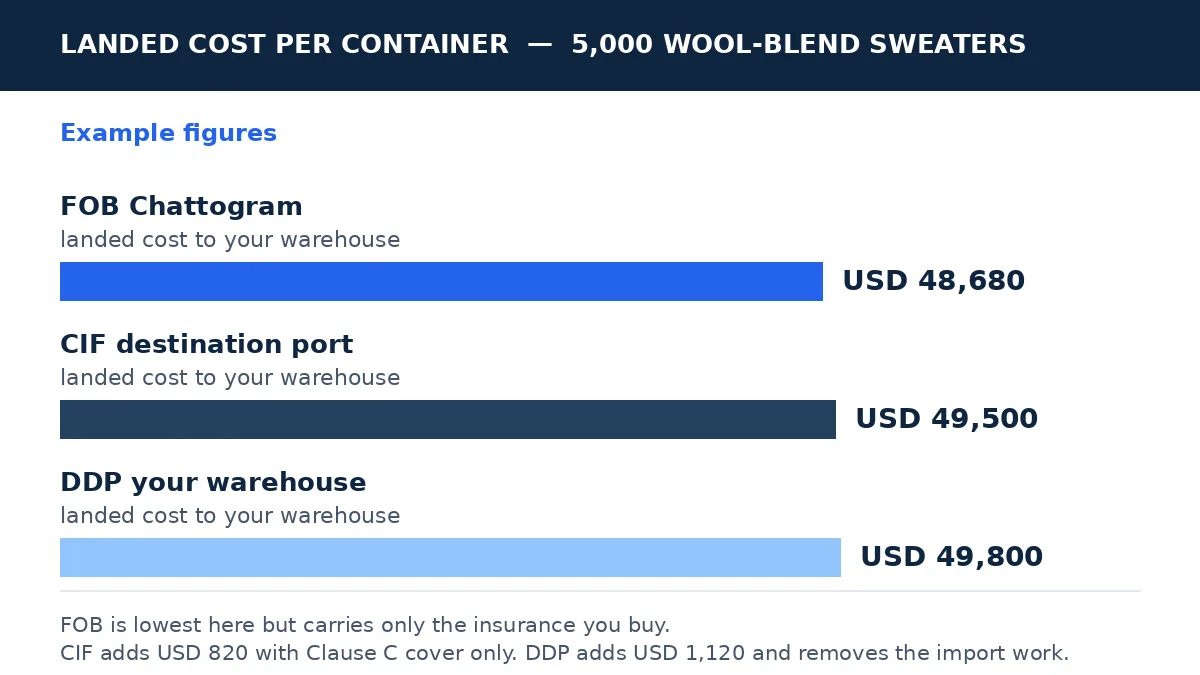
Priced to your warehouse, FOB totals USD 48,680 (42,000 plus 2,400 plus 380 plus 3,900), CIF totals USD 49,500 (45,600 plus 3,900), and DDP totals USD 49,800. FOB is the lowest landed price here, but it carries only the insurance you buy yourself. CIF costs USD 820 more and carries only Clause C cover unless you agree more. DDP costs USD 1,120 more and removes the import work entirely.
Seasonal timing: order the term around the selling window
Outerwear sells in a window, and the term decides who acts when it moves. Under FOB you hold the booking, so you can change the sailing, pay for a faster service, or split the shipment if production runs late. Under CIF and DDP the seller holds the booking, so your contract needs the sailing deadline, the document deadline and the remedy if either is missed. Write the latest sailing date into the contract, not only the shipment date.
Mistakes that cost outerwear buyers money
Buying CIF and assuming the insurance covers damp cartons. Clause C is minimum cover and does not cover water entering the container.7 Agree Clause A cover or buy your own policy.
Treating a CIF price and an FOB price as the same thing. CIF includes freight and minimum insurance. FOB includes neither. Price both to your warehouse first.
Accepting DDP without checking the importer of record. DDP places import clearance and duty on the seller.4 If the seller cannot clear goods in your country, the shipment stalls.
Leaving the duty assumption out of a DDP price. The duty line for HS 6110 is 12 percent on most lines before preference,5 and EU preference under Everything But Arms is time-limited.6
Skipping the packing clause. Desiccants cannot rescue cargo that went into the container wet.2 Dry goods, dry cartons and desiccant belong in the contract under every term.
Checklist before you sign
The term matches the transport mode: sea-only rules only for a sea shipment, any-mode rules for air or a terminal handover.
The named port or place and Incoterms 2020 are written after the three-letter rule.
The insurance level is stated: none under FOB, Clause C under CIF unless you agree Clause A, or Clause A under CIP, at 110 percent.7
The duty line is written: HS code, preference claimed, and who pays duty if the preference changes.
The sailing deadline and the document deadline are written, with the bill of lading and insurance document named.
Next steps on Exportain
Start with the product pages that match your order: read how to import sweaters from Bangladesh and how to import winter coats from Bangladesh. Check the HS code for sweaters for your fibre and style, and compare the sweaters price breakdown first. When you post an RFQ, state the term, the named port and Incoterms 2020, and ask each supplier to price on that term, breaking out freight and insurance where the term includes them. The full Incoterms reference covers all eleven rules. A separate knitwear and T-shirt guide covers lighter knitwear.
Sources
- Exports rose 8% to $48b in FY25 despite economic headwinds. The Daily Star, (accessed )
- Shipping Container Desiccants: Benefits & Sizing. EPGNA (accessed )
- Incoterms® 2020. International Chamber of Commerce (ICC) (accessed )
- DDP Delivered Duty Paid: Definition, Responsibilities. DHL (accessed )
- Jerseys, pullovers, cardigans, waistcoats and similar articles, knitted or crocheted - Northern Ireland Online Tariff (EU tariff), heading 6110. GOV.UK, HM Revenue and Customs (accessed )
- Govt takes twin-track approach to retain EU duty-free access. The Daily Star (accessed )
- Cargo Insurance: Institute Cargo Clauses A, B and C Compared, 110% Cover and CIF vs CIP. TriplicateDocs, (accessed )
- Air Freight Chargeable Weight: Formula & Breakpoints. Globewyn Logisys, (accessed )
About the author
Sourcing from Bangladesh?
Post a request for quotation and suppliers on Exportain can send you their quotes directly.
Post an RFQ