Sweaters Price in Bangladesh: FOB Cost Breakdown for Buyers
An FOB sweater quotation is a sum of cost lines, not one price. This guide breaks down yarn, knitting, finishing, trims, testing, overhead and freight to port, and shows how to read each line before comparing suppliers.
Short answer
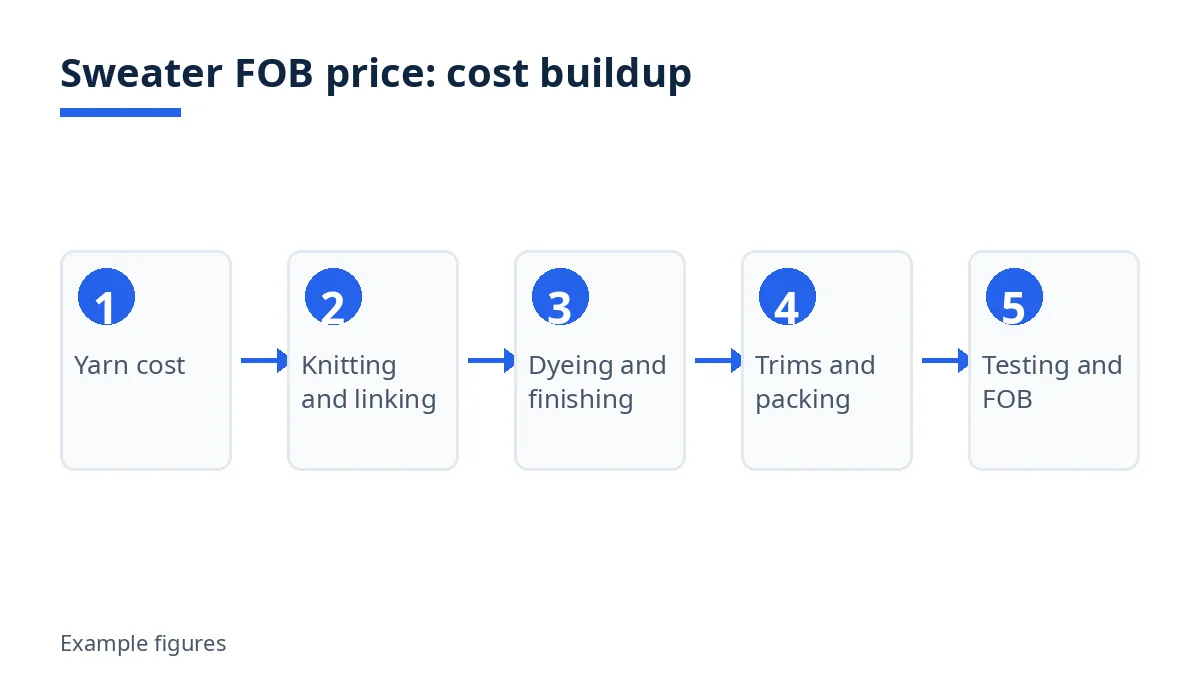
An FOB sweater price from Bangladesh is the sum of seven cost lines up to the vessel: yarn, knitting and linking, dyeing and finishing, trims and packing, testing and inspection, overhead and margin, and inland freight and export handling. Under FOB, the seller delivers the goods on board the vessel nominated by the buyer at the named port, cleared for export. Compare quotations line by line on the same specification, color count, packing, and named port.
On this page
Key takeaways
An FOB sweater price is seven cost lines up to the vessel: yarn, knitting and linking, dyeing and finishing, trims and packing, testing and inspection, overhead and margin, and inland freight and export handling.
Yarn usually moves the total most, while fixed lines such as dye lots and decoration set-up fall as quantity rises.
Compare quotations only on the same specification, color count, packing, named port, and Incoterms rule, line by line.
Exportain verification is a document and photo review, not a factory inspection, and a badge is not a price guarantee.
Search for sweaters price Bangladesh and the results promise a single number. A factory quotation does not work that way. The FOB price is a sum of cost lines, each answering a different question about the sweater specified. This guide reads it line by line: yarn, knitting and linking, dyeing and finishing, trims and packing, testing and inspection, overhead and margin, and freight and handling to the vessel.
FOB stands for Free on Board. Under the Incoterms 2020 rules, FOB means the seller delivers the goods loaded on board the vessel nominated by the buyer at the named port of shipment, and risk transfers to the buyer at that point.1 The seller transports the goods to the port, loads them on board, and completes export formalities.1 The buyer contracts the carrier, pays freight to the destination port, and handles import formalities.1 Everything up to the vessel is inside the price; everything after it is outside it.
The FOB price in one view
An FOB sweater price is built from seven cost lines: yarn, knitting and linking, dyeing and finishing, trims and packing, testing and inspection, overhead and margin, and inland freight and export handling to the port.
Yarn usually moves the total most, because fiber, yarn count, and yarn weight per sweater change with gauge and size.
Fixed lines such as dye lots and set-up fall as quantity rises, while yarn and making stay close to quantity.
Two FOB prices can only be compared on the same sweater, color count, packing, named port, and Incoterms rule.
A quotation that gives one total and no lines cannot be checked. Ask for the lines before you compare prices.
Why this matters for buyers and sellers
For a buyer, the FOB price decides the landed cost that follows it. Ocean freight, insurance, import duty, and destination handling are added after the FOB point, so a low FOB price on a heavier sweater or different fiber can still give a higher landed cost. The quotation, specification, and inspection plan must agree before loading, since the buyer carries the risk once goods are on board.
For a seller, the FOB price must cover inputs bought for one order that cannot be reused. Yarn dyed to your color, labels printed with your brand, and trims matched to your sweater belong to your order alone. A seller who leaves those lines out will recover them later, through a surcharge, a changed specification, or a refused repeat.
Quotations vary because the sector is large. The Bangladesh Knitwear Manufacturers and Exporters Association (BKMEA), established in 1996, represents approximately 2,540 knitwear member factories.2 Knitwear exports reached $5.963 billion in the July to September 2026 quarter, up 6.88 percent year on year, per Export Promotion Bureau (EPB) data.3 That many factories will not produce one shared sweater price.
Step-by-step: reading a sweaters price Bangladesh quotation line by line
Read a quotation the way the factory built it, from yarn inward to the port. Ask for each line in writing, and keep the specification attached.
Start with the specification the price was built on. Confirm fiber, count, gauge, stitch, sizes, color count, decoration, trims, labels, packing. A price without this list is for an unknown sweater.
Read the yarn line first. Check fiber, count, and whether yarn is stocked or dyed for your order. Ask how yarn weight per sweater was set.
Read knitting and linking next. Check gauge and construction: a coarser gauge generally uses more yarn per sweater, and linking, ribbing, and shaping add making time. Ask whether the work is in house or passed on.
Read dyeing, washing, and finishing as one block. Check dye lots, shade approval, and wash and finishing passes. Each color carries its own dye lot, so adding colors adds cost at the same total quantity.
Read trims, labels, and packing as separate lines. Check buttons, zips, cords, labels, tags, polybags, cartons. Ask which items are printed or made for your order.
Read testing and inspection as a cost, not an extra. Check which tests are included, who inspects, and which sampling plan applies. Under ISO 2859-1, the acceptance quality limit (AQL) is the worst tolerable process average for a continuing series of lots submitted for acceptance sampling.4 Put the level and AQL values in the order.
Read the FOB boundary last. Confirm the named port, inland freight, port handling, and export clearance in the price. Under FOB, the seller delivers the goods on board the vessel nominated by the buyer at the named port, cleared for export.1 Confirm currency, validity, and payment terms.
Costs, timelines and documents
What does each FOB cost line cover?
The table below sets out the seven FOB lines, what each covers, what moves it, and the question that tests it. No line is a market price.
Cost line | What it covers | What moves it | Ask the supplier |
|---|---|---|---|
Yarn | Fiber, count and ply, weight per sweater | Fiber, count, gauge, size range, color count | Fiber, count, weight, stocked or dyed |
Knitting and linking | Machine time, linking, ribbing, shaping | Gauge, stitch complexity, construction | Gauge, construction, in-house or subcontracted |
Dyeing, washing and finishing | Dye lots, shade approval, washing, finishing | Color count, shade standard, wash type | Lots per color, shade approval, wash |
Trims, labels and packing | Buttons, zips, cords, labels, tags, cartons | Decoration, label types, carton spec | Itemized trim, label, carton lines |
Testing and inspection | Lab tests, pre-shipment inspection | Test scope, inspection level, AQL values | Tests, inspector, level, AQL values |
Overhead and margin | Overhead, supervision, quality staff, margin | Order size, line time, payment terms | How fixed costs spread at your quantity |
Inland freight and export handling | Transport, port handling, export clearance | Factory location, named port, carton count | Named port, freight and handling included |
Example figures: a quotation of 100 index units for one sweater could read yarn 52, knitting and linking 18, dyeing and finishing 9, trims, labels and packing 8, testing and inspection 3, overhead and margin 6, and inland freight and export handling 4. The split is illustrative only, not a market price. Use it to ask why a line is high or low.
What moves the total most often is a specification change. A coarser gauge raises yarn weight. A second color adds a dye lot and shade approval. An embroidered placement adds set-up. A private label adds a print run. A smaller order spreads fixed lines over fewer sweaters, so the unit price rises even when the yarn line stays the same. When a supplier revises a price, ask which line moved.
What are the typical costs and timelines for a sweater order?
There are no typical FOB costs or timelines across sweaters, because each quotation is built for one specification, color count, and quantity. Sampling depends on yarn, dyeing, and correction rounds; production depends on dye lots, capacity, finishing, trim delivery, and inspection. Ask for each date as a separate line, not one delivery week.
Sweaters sit under HS heading 6110, covering jerseys, pullovers, cardigans, waistcoats, and similar articles, knitted or crocheted, broken down by fiber.5 Confirm the subheading by fiber, since the fiber on the quotation, label, and export documents must match.
Which documents sit behind the FOB price?
The order documents are the specification, itemized quotation, approved sample record, and purchase order, each carrying the same fiber, gauge, colors, sizes, packing, and named port. The export set includes the Bill of Export (Shipping Bill), which must be submitted and approved before goods can be loaded, plus the export contract or purchase order, invoice, packing list, EXP form certified by an authorized dealer, certificate of origin, VAT registration certificate, and TIN certificate, according to the Bangladesh Trade Portal.6 Keep one legal name for the exporter across the set.
Bangladesh-specific rules and tips
Price from the knitwear pool, and check membership claims at the source. Sweaters are knitted garments, so the supplier pool is the knitwear sector, and BKMEA represents approximately 2,540 knitwear member factories.2 Confirm any membership claim against the association record. Membership shows registration only. It does not set a price or prove capacity for your gauge.
State fiber content and labeling from the start. The label must match the sweater, and buyers reselling into the European Union face labeling rules at destination. Under Regulation (EU) No 1007/2011, a textile product shall be labelled or marked with the name and percentage by weight of all constituent fibers in descending order.7 State fiber content, label wording, and position in the specification, and check the first production labels. A later correction is a new print run.
Use one delivery term and one named port for every quotation. Under FOB, the seller delivers the goods on board the vessel nominated by the buyer at the named port, and the buyer contracts the carrier and pays freight to the destination port.1 A quotation naming no port cannot be compared with a clean FOB quotation. Write the rule, named port, and currency on every quotation.
Ask which inputs are bought in for your order. Yarn, dyes, zips, buttons, and some trims may be bought in for your specification, and a bought-in input can set both a cost line and the earliest production date. Record availability per color, and agree in writing what happens if a trim color runs short. Order early enough for sampling and a correction round, since demand rises ahead of cold seasons in destination markets.
Mistakes and red flags
What are the most common mistakes when reading a sweater FOB price?
Comparing totals instead of lines. Two totals can hide different fibers, color counts, packing, or ports. Compare line by line, on the same specification, color count, packing, and named port.
Treating the FOB price as the landed cost. Ocean freight, insurance, import duty, and destination handling sit outside the FOB boundary. Under FOB, the buyer contracts the carrier, pays freight to the destination port, and handles import formalities.1 Build the landed cost separately.
Accepting a price for a changed sweater. A gauge, fiber, color, or decoration change changes the lines. If the specification changes after the quotation, ask for a revised itemized quotation, and keep the change in writing.
Paying for set-up twice. Dye lots, shade approval, decoration set-up, and label print runs are fixed lines. Keep the paid set-up lines from the first order and attach them to the repeat enquiry.
Reading a badge as a price guarantee. A profile badge records a document and photo review. It does not test whether a factory can knit your gauge at the quoted price, and it does not guarantee quality or delivery. See how supplier verification works on Exportain for what each badge covers.8
Leaving the FOB boundary vague. A quotation saying FOB with no named port, currency, or validity period leaves the boundary open. All three belong on the quotation.
Red flags include no itemized lines, a price change with no specification change, a refusal to state gauge or yarn count, and a port that changes between quotation and invoice. Any one is a reason to slow down and ask for the missing line.
Checklist
Every line below should be answered in writing before you accept a quotation.
Specification attached: fiber, yarn count, gauge, stitch, colors, sizes, decoration, trims, labels, packing.
Yarn itemized: fiber, count, weight per sweater, stocked or dyed.
Knitting and linking line stated, with gauge and construction confirmed.
Dye lots and shade approval per color; wash and finishing stated.
Trims, labels, tags, polybags, cartons itemized apart.
Testing scope, inspector, level, AQL values stated.4
Overhead and margin shown, fixed costs spread at your quantity.
Named port, inland freight, port handling, clearance in the FOB price.1
Quotation currency, validity period, and payment terms stated.
Quotations compared on same specification, color count, packing, port, rule.1
HS heading 6110 subheading confirmed by fiber.5
Export set agreed: Bill of Export, invoice, packing list, EXP form, certificate of origin.6
Sample approved in production yarn and trims, washed and measured.
How Exportain helps
On Exportain, browse suppliers and post your specification as a request for quotation (RFQ) on the RFQ board, so each reply quotes the same sweater, color count, packing, and named port. Ask each reply for the itemized FOB lines. The guide to MOQ, or minimum order quantity explains why a smaller order spreads fixed lines over fewer sweaters.
Read badges for what they record. Exportain verification is a document and photo review by staff, not a factory inspection.8 A badge is a starting filter, not a conclusion about price or delivery. Keep the exchange in the RFQ thread, so the specification and lines stay in one place.
FAQs
What should I know first about a sweater FOB price?
An FOB sweater price is a sum of seven lines: yarn, knitting and linking, dyeing and finishing, trims and packing, testing and inspection, overhead and margin, and inland freight and export handling to the port. Under FOB, the seller delivers the goods on board the vessel nominated by the buyer at the named port, cleared for export.1 Sweaters sit under HS heading 6110, broken down by fiber.5
What are the typical costs and timelines for a sweater FOB quotation?
There are no typical FOB costs or timelines a buyer can rely on, because each quotation is built for one specification, color count, and quantity. Ask for each line and date separately, and compare only quotations on the same specification and named port.1
Which documents sit behind the FOB price?
The order documents are the specification, itemized quotation, approved sample record, and purchase order, each carrying the same fiber, gauge, colors, sizes, packing, and named port. The export set includes the Bill of Export, invoice, packing list, EXP form, certificate of origin, VAT registration certificate, and TIN certificate.6 The fiber on the quotation, label, and export documents must match, including the EU rule on fibre names and percentages in descending order.7
What are the most common mistakes when reading a sweater FOB price?
The most common mistakes are comparing totals instead of lines, treating the FOB price as the landed cost, accepting a price after the specification changed, paying fixed set-up lines twice, reading a badge as a price guarantee, and leaving the named port, currency, or validity period off the quotation.1
Next steps on Exportain
Browse suppliers to shortlist knitwear sellers, then post your specification, color count, packing, and named port on the RFQ board and ask each reply for its itemized FOB lines. Before you accept a price, read how supplier verification works on Exportain and the HS code for sweaters guide.
Sources
- FOB & FAS Incoterms® 2020 explained: Key differences. ICC Academy (accessed )
- BKMEA at a Glance. BKMEA (accessed )
- Merchandise exports rise 6.34pc to $13.09b in Q1 FY27: EPB. The Financial Express, (accessed )
- SIST ISO 2859-1:2003 - Sampling procedures for inspection by attributes, Part 1: Sampling schemes indexed by acceptance quality limit (AQL). International Organization for Standardization, (accessed )
- Classification Detail — HS Code 6110. United Nations Statistics Division (accessed )
- Bangladesh Trade Portal FAQ: Export Registration Certificate (ERC). Bangladesh Trade Portal (accessed )
- Regulation (EU) No 1007/2011 on textile fibre names and related labelling and marking of the fibre composition of textile products. European Union, (accessed )
- Supplier verification: Earn trust badges buyers can see. Exportain (accessed )
About the author
Sourcing from Bangladesh?
Post a request for quotation and suppliers on Exportain can send you their quotes directly.
Post an RFQ