Best Incoterm for Importing Leather Goods From Bangladesh
FOB, CIF and DDP behave differently for leather bags, wallets and jackets from Bangladesh. This guide matches each term to small high-value orders, full containers and air-freight samples, with a worked landed-cost example.
Short answer
For most leather goods orders from Bangladesh, FOB suits a full container when you control freight and buy your own all-risks insurance, CIF suits a first sea shipment when you want one price to your port, and DDP suits small high-value orders and samples where a surprise duty bill would hurt. Match the term to the shipment size, the insurance cover and who can clear import.
On this page
Key takeaways
FOB leaves freight and insurance with you and suits full containers of leather goods by sea.
CIF bundles freight and minimum Clause C insurance into one price, but risk still passes at loading in Chattogram.
DDP suits small high-value leather orders, since the seller clears import and pays duty before delivery.
Leather handbags valued over $20 each carry a 9 percent base duty rate in the United States, and Clause C does not cover mould or water damage.
If you buy leather bags, wallets, belts, jackets, gloves or shoes from Bangladesh, the Incoterm on your order decides who pays for freight and insurance, and who carries the loss when a carton arrives damp. Leather goods are small, dense and high in value per carton, and leather reacts badly to moisture. This guide compares FOB, CIF and DDP for leather shipments and matches each to three order sizes.
Why leather goods need their own Incoterm decision
Bangladesh earned $1.14 billion from leather and leather goods exports in 2024-25, up 10.19 percent year on year, according to Export Promotion Bureau figures.1 Most of it travels by sea in cartons.
Leather is hygroscopic: it absorbs moisture from the air. Mould risk stays very low below 65 percent relative humidity, and rises to medium or high once it passes 75 percent; in warm conditions mould can start within 24 to 48 hours.2 Once mould has taken hold on finished leather, the damage is often impossible to remove, and even a small patch of spots can make a bag unsellable.2 Scratches are the second risk: a scuffed grain surface cannot be pressed flat again, so each piece should be wrapped in acid-free tissue.3
The Incoterms rules are eleven three-letter terms from the International Chamber of Commerce that set out who does what, who pays for what, and where risk moves in the delivery of goods, and the current edition, Incoterms 2020, has been in force since 1 January 2020.4 Each rule settles three things for your order: who pays for carriage, who arranges insurance, and the point where risk moves from seller to buyer.4
FOB, CIF and DDP for a leather shipment
FOB and CIF are sea-only terms, while DDP works for any mode of transport, including air.
Term | Who books main carriage | Insurance duty | Risk passes to buyer | Import clearance and duty |
|---|---|---|---|---|
FOB (Free On Board) | Buyer | None on seller | On board vessel at Chattogram | Buyer clears import and pays duty |
CIF (Cost, Insurance and Freight) | Seller, to destination port | Seller, minimum Clause C cover | On board vessel at Chattogram | Buyer clears import and pays duty |
DDP (Delivered Duty Paid) | Seller, to named place | Seller arranges cover | At named destination | Seller clears import and pays duty |
FOB: you control the freight and the insurance
Under FOB, you book the ocean freight and arrange your own insurance from loading onward. That control is why experienced leather buyers choose FOB for full containers: you can pick a direct sailing and buy all-risks cover.
CIF: one price to your port, with risk still moving at loading
Under CIF, the seller pays the freight to your named destination port and buys marine insurance, so the invoice covers goods, freight and insurance in one figure. Risk still passes to you at loading in Chattogram, exactly as under FOB. The insurance the seller must buy under CIF is minimum cover under Institute Cargo Clauses (C), for at least 110 percent of the price in the contract.5 Clause C covers only major casualties such as fire, stranding, sinking and collision, and it does not cover water entering the container, theft, or packages dropped during loading.5
DDP: the seller carries the goods to your door
Under DDP, the seller brings the goods to the named place of destination, cleared for import and ready for unloading, carrying the cost and the risk until that point: export clearance, international transport, import clearance, and any duties, VAT, GST or other taxes the destination country charges.6 Your only job is to unload the goods.6 DDP is the single rule that places import clearance and duty with the seller.6 Before you agree DDP, check whether the seller can act as importer in your country. If not, DAP is the usual substitute: the seller still delivers to your door, but you clear import and pay the duty.
Which term fits your order: three leather scenarios
Each order shape points to a different term.
Order shape | Term to choose | Why it fits leather |
|---|---|---|
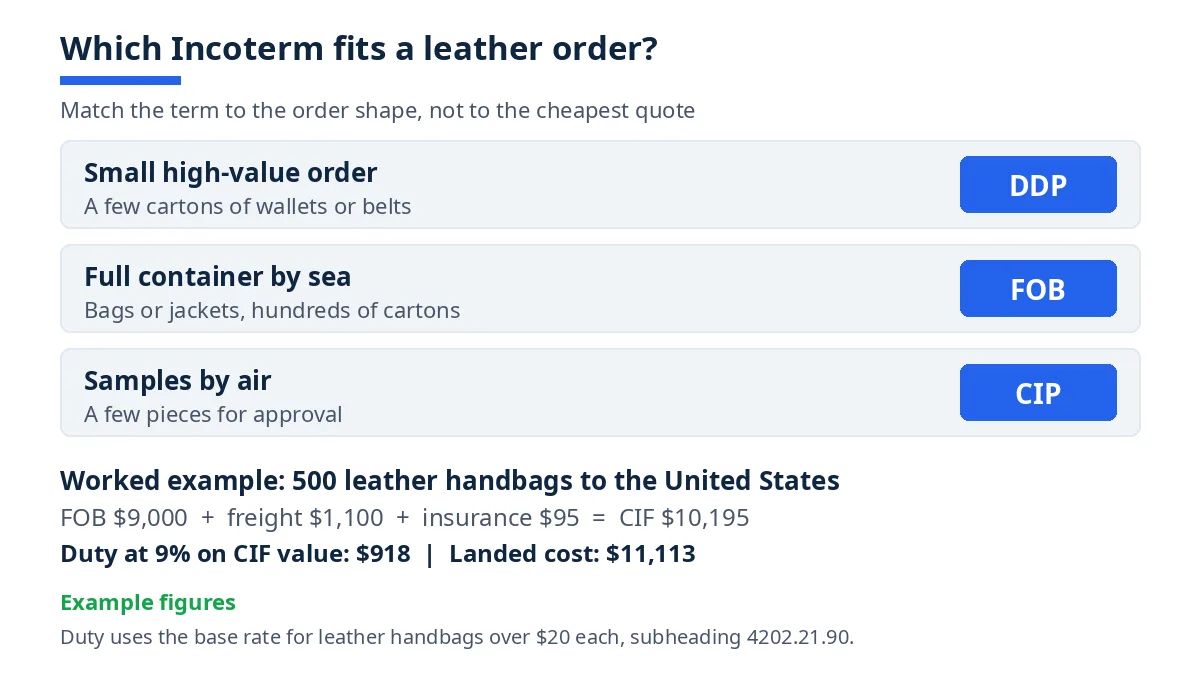
Small high-value order, a few cartons of wallets or belts | DDP | Duty and clearance sit inside the quoted price |
Full container of bags or jackets by sea | FOB | You book the vessel and buy all-risks cover |
Samples by air, a few pieces for approval | CIP or DAP | FOB and CIF are sea-only; CIP adds Clause A cover |
Small high-value order: DDP
A carton of leather wallets can be worth several thousand dollars while weighing under 25 kilograms, so duty outweighs freight. The case for DDP has grown stronger since the low-value exemptions ended: the United States suspended duty-free de minimis treatment for imports valued at or below $800, effective 29 August 2025, and the European Union ended its duty exemption for consignments of 150 euros or less on 1 July 2026.6
Full container: FOB
A 20-foot container of leather handbags holds hundreds of cartons. On an order of that size, your own forwarder rates and insurance outweigh the convenience of a seller-arranged price. Buy your own Clause A all-risks cover.5
Samples by air: CIP or DAP
Samples travel by air, and FOB and CIF cannot be used for air freight. CIP is the air-freight term that includes insurance: the seller must obtain Clause A cover.5 DAP is the alternative when you would rather clear import yourself, for example to reclaim VAT.
Worked example: 500 leather handbags
Example figures.
Cost line | Amount |
|---|---|
500 leather handbags, FOB price $18 each | $9,000 |
Ocean freight, Chattogram to New York | $1,100 |
Marine insurance, Clause A | $95 |
CIF value (goods plus freight plus insurance) | $10,195 |
United States duty at 9 percent base rate on CIF value | $918 |
Landed cost before destination handling | $11,113 |
Duty uses the base most-favoured-nation rate for leather handbags valued over $20 each under subheading 4202.21.90: 9 percent.7 Additional Chapter 99 measures sit on top of that base rate.7
Insurance: what Clause C leaves out of a leather claim
Under Incoterms 2020, only CIF and CIP oblige the seller to insure: CIF requires at least Clause C cover, while CIP requires Clause A cover, in both cases for at least 110 percent of the price in the contract.5 Clause C pays only for named major casualties: fire, stranding, sinking, collision, jettison and general average sacrifice.5 It does not pay for water entering the container, washing overboard, or packages dropped while loading.5 A leather shipment that arrives with mould spots or scratched grain will usually find no cover under Clause C, because the cause is moisture or handling rather than a listed casualty. All three clause levels also exclude loss from insufficient packing and from the inherent nature of the goods.5 The protection is to fix the packing in the contract and to insure on Clause A.5 Cover also ends 60 days after discharge at the final port.5
Duty, customs value and the HS code on leather goods
Duty on leather goods depends on the product, the material of its outer surface, and its value. Handbags, wallets and travel bags fall under heading 4202, and the subheading turns on the container type and the outer-surface material.7 Leather handbags valued over $20 each carry a 9 percent base duty rate in the United States under subheading 4202.21.90, while those valued at $20 or less fall under a different provision at 10 percent.7 The same bag with a man-made textile outer surface can attract 17.6 percent.7 Duty is usually charged on the CIF value, which is goods plus freight plus insurance, so a CIF price and a DDP price produce different duty bases. The duty rate in heading 4202 is only the starting point: additional Chapter 99 duties should be reviewed separately.7 The certificate of origin proves where the goods were made and is issued by a chamber of commerce or, for some trade preferences, by the Export Promotion Bureau.8
Inspection and packing: agree them before the term is signed
No Incoterm inspects your goods or packs them. Both jobs belong in the contract, because the term decides who bears the loss when packing fails. Inspect before shipment, while the goods are still in Bangladesh, opening a sample of cartons to check the grain surface, stitching, zips and buckles, and linings for damp or mould spots. An inspection certificate from an independent checker confirms quantity or quality.8 Packing for leather has four parts: high-density polyethylene vapor barrier bags that create a sealed microclimate around the product,3 silica gel desiccant packs in a quantity calculated from the container volume and the expected humidity load,3 acid-free tissue wrapping and double-wall or triple-wall corrugated boxes,3 and hardware taped down or wrapped in soft foam.3 Desiccants cannot compensate for cargo packed with excessive internal moisture, so goods, cartons and pallets must be dry before loading.2
What to write in the contract and the RFQ
Put these lines in the sales contract and in every request for quotation, so every supplier quotes on the same basis.
The rule code, the named place or port, and Incoterms 2020, for example FOB Chattogram, Incoterms 2020.
The insurance level in words: Clause A all-risks cover for at least 110 percent of the contract price, or Clause C minimum cover where you accept it.
The packing specification: vapor barrier bags, desiccant quantity, acid-free tissue and carton strength.
The inspection point: pre-shipment inspection at the factory, with the right to reject goods that fail the standard.
The document deadlines: bill of lading, insurance certificate, certificate of origin and packing list before the vessel arrives.
Who pays destination charges and storage if clearance is delayed, and who bears the cost of a return under DDP.
The Bill of Export is the exporter's declaration to Customs, and the EXP form is the export declaration that the authorised dealer bank certifies.8 When you send the request for quotation, state the term and the named place in the first paragraph, and ask each supplier to quote with goods, freight and insurance shown as separate lines. Our guide to leather bags prices in Bangladesh shows how FOB prices break down, and the landed cost guide explains how to work out the full cost per unit.
Mistakes that cost leather buyers money
Reading a CIF price as a delivered price. CIF covers freight and minimum insurance to your port, but risk passes at loading and duty remains yours.
Accepting Clause C cover on a high-value leather order. Clause C does not cover water damage, theft or handling damage.
Using FOB or CIF for air-freight samples. Both terms are sea-only, so air samples need an any-mode term such as CIP or DAP.
Agreeing DDP with a seller who cannot clear import. Confirm the seller has a broker or importer of record in your country before you sign.
Skipping pre-shipment inspection because the order is small. Mould found at destination is hard to claim without inspection evidence.
Leaving packing out of the contract. Insufficient packing is an exclusion in every cargo policy.
Comparing quotes on mixed terms. An FOB quote and a DDP quote cover different cost sets, so convert both to the same landed basis first. See the FOB versus CIF comparison and the insurance guide.
Next steps on Exportain
Start with the guide to importing leather bags from Bangladesh and the leather bags quality checklist, then search Bangladeshi suppliers for the product you need. When you post an RFQ, state the Incoterm and the named place and attach your packing specification. Exportain is a B2B export marketplace that connects buyers with Bangladeshi suppliers for quotations and orders, and it is not a party to the contract for goods.
Sources
- Leather, leather-goods exports see 10pc growth. New Age (accessed )
- Mould prevention in container shipping. Absortech (accessed )
- Top 4 Mistakes In Leather Packaging For International Trade. Global Trade Plaza (accessed )
- Incoterms® rules. International Chamber of Commerce (ICC) (accessed )
- Cargo Insurance: Institute Cargo Clauses A, B and C Compared, 110% Cover and CIF vs CIP. TriplicateDocs, (accessed )
- DDP Shipping: Delivered Duty Paid Explained For Sellers. ParcelPath, (accessed )
- HS Chapter 4202 Decoded: Why Backpacks, Handbags, and Travel Bags Have 17 Different Duty Rates. Gaia Dynamics (accessed )
- The papers that move trade. Open Trade Bangladesh (accessed )
About the author
Sourcing from Bangladesh?
Post a request for quotation and suppliers on Exportain can send you their quotes directly.
Post an RFQ