Insurance Under CIF: Who Must Insure the Cargo and for How Much?
Under CIF the seller must insure the cargo, but only to the Incoterms 2020 minimum of Clauses (C) cover for at least 110 percent of the contract price. This guide covers the duty, the documents, and how buyers add protection.
Short answer
Under CIF (Cost, Insurance and Freight, Incoterms 2020), the seller must arrange and pay for cif insurance for the buyer's benefit. The minimum cover is at least 110 percent of the contract price, in the contract currency, with cover at least equivalent to Institute Cargo Clauses (C), running from loading on board to at least the named destination port.
On this page
Key takeaways
Under CIF, the seller must buy cargo insurance and pay the premium; a CIF price includes the goods, the insurance, and the freight to the named destination port.
The minimum cover is at least 110 percent of the contract price, in the contract currency, with cover at least equivalent to Institute Cargo Clauses (C).
Risk passes to the buyer when the goods are placed on board at the shipment port, even though the seller pays for carriage and insurance to destination.
Clauses (C) is named-perils, major-casualty cover; it does not cover theft, shortage, or fresh-water damage, so wider cover must be agreed or bought separately.
Always obtain and check the insurance document after shipment; if it is missing or shows less than 110 percent cover, raise it before a loss occurs.
Under CIF, cif insurance is the seller's obligation, not an optional extra. The seller must arrange and pay for marine cargo insurance on top of the goods and the freight to the named destination port. The harder question is whether that cover is enough for your cargo, because the Incoterms® 2020 minimum is narrow by design.
This guide explains who must insure cargo under CIF, how much cover the rule requires, what the minimum policy does and does not pay for, and how a buyer importing from Bangladesh can add protection before signing.
Why this matters for buyers and sellers
CIF looks simple: one price to a named destination port, with freight and insurance handled by the seller. That simplicity hides a split between risk and cost that surprises both sides when something goes wrong.
For the buyer, risk and insurance are separate under CIF. The seller pays for the main carriage and the insurance, but the buyer bears the risk from the moment the goods are loaded on board. Under CIF, the seller transfers risk to the buyer once the goods are loaded on board the vessel at the named port of shipment, while also arranging and paying for carriage and insurance to the port of destination.1 If cargo is damaged mid-voyage, the loss is normally the buyer's to recover through the insurance the seller arranged. That is why the buyer usually makes the claim, and why the insurance document must let the buyer claim directly.
For the seller, the duty is mandatory. A seller who ships under CIF without arranging the required insurance has not met the rule, even if the goods arrive safely. The seller must price the premium into the quotation, place cover with a reputable insurer, and provide the insurance document. Röhlig Logistics summarises the duty: the seller shall organise and pay for minimum Institute Cargo Clauses (C) level insurance cover, unless otherwise agreed, for the benefit of the buyer.2
CIF can only be used for sea or inland waterway transport, and it works port to port.1 Storage before loading, onward carriage after arrival, and warehousing at destination sit outside the CIF minimum unless agreed otherwise.
For the wider term, read CIF — Cost, Insurance and Freight and Incoterms for shipments from Bangladesh before you agree terms.
Step-by-step: how cif insurance works
Follow these steps in order, before production finishes rather than on sailing day.
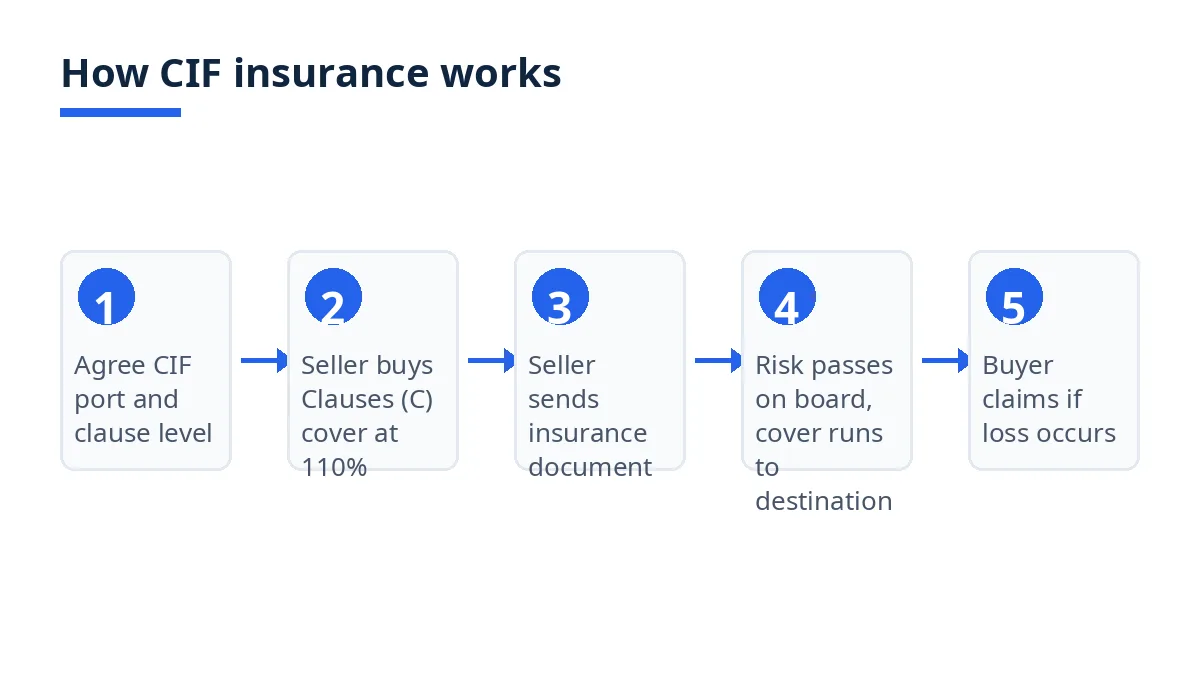
Agree the term properly in the contract. Write CIF followed by the named destination port and the rule version, for example "CIF Rotterdam, Incoterms® 2020". The named port matters because the seller's freight and insurance duties are measured against it. If you want cover wider than the minimum, name it here, for example Institute Cargo Clauses (A) and any war or strikes clauses you require, rather than assuming the seller will provide it.
The seller obtains the insurance. The seller must obtain, at its own cost, cargo insurance that meets the rule. The cover must be at least equivalent to Institute Cargo Clauses (C), placed with underwriters or an insurance company of good repute, for at least 110 percent of the price stated in the contract, in the currency of the contract.2 The buyer, or any other person with an insurable interest in the goods, must be entitled to claim directly from the insurer.
The seller provides the insurance document. The seller must give the buyer the insurance policy or certificate, or other evidence of cover. Röhlig states the same point in plain terms: the seller must provide proof of insurance to the buyer, and the cover extends from the point of delivery to the port of destination.2 Check the insured value, currency, voyage, goods description, and period of cover against the contract at this stage.
Risk passes on loading, and cover continues to destination. When the goods are placed on board the vessel at the shipment port, risk transfers to the buyer.1 The seller's insurance must cover the goods at least as far as the named destination port, so the transit leg where the buyer bears the risk is the leg the policy is designed to protect.
Arrange wider cover deliberately, if you need it. The Incoterms® 2020 rules give parties the option to agree a higher level of insurance cover under CIF.3 Where the buyer wants protection beyond Clauses (C), there are two routes: agree the wider cover with the seller in the sales contract, or arrange supplementary insurance at the buyer's own cost. Do not leave this to assumption. An unspoken expectation is not insured.
Claim promptly if there is loss or damage. The party with an insurable interest, usually the buyer, notifies the insurer or its agent named on the certificate, preserves evidence, notes damage on delivery documents, and submits the insurance document, bill of lading, invoice, packing list, and survey evidence the insurer requires.
How much cover is required under CIF?
The minimum sum insured is 110 percent of the price stated in the contract, in the contract currency.2 Example figures: on a contract price of USD 50,000, the insurance must cover at least USD 55,000. On a contract price of USD 120,000, it must cover at least USD 132,000. A certificate showing only 100 percent of the invoice value does not meet the CIF minimum.
What does Institute Cargo Clauses (C) cover?
Institute Cargo Clauses (C) is named-perils cover. The Clauses (C) wording covers loss or damage reasonably attributable to fire or explosion, a vessel or craft being stranded, grounded, sunk or capsized, overturning or derailment of a land conveyance, collision or contact of a vessel, craft or conveyance with an external object other than water, and discharge of cargo at a port of distress.4 It also covers loss or damage caused by general average sacrifice and jettison.4
That list is short. Theft, pilferage, shortage, breakage, leakage, and rain or fresh-water damage are not on it. Buyers whose goods face those risks in ordinary handling, rather than only in a major casualty, need a wider clause level agreed in writing or a separate top-up policy.
Point | CIF | CIP |
|---|---|---|
Transport | Sea and inland waterway only, port to port1 | Any mode, including multimodal1 |
Risk passes | When goods are loaded on board the vessel1 | When goods are handed to the carrier1 |
Default insurance | Institute Cargo Clauses (C), minimum cover3 | Institute Cargo Clauses (A), higher cover3 |
Minimum sum insured | 110 percent of the contract price2 | 110 percent of the contract price |
The ICC states the contrast directly: under Incoterms® 2020, the CIF rule keeps Institute Cargo Clauses (C) as the default level of coverage, giving parties the option to agree higher cover, while the CIP rule requires a higher level of cover compliant with Institute Cargo Clauses (A) or similar clauses.3
Costs, timelines and documents
What are the typical costs and timelines?
The premium for the CIF minimum cover is the seller's cost, built into the CIF price. The buyer pays it indirectly as part of that price. There is no standard premium in the rules. Insurers price cover on factors such as the insured value, the type of goods, the route, and the level of cover, so a cheaper CIF quote may simply carry the narrowest permitted cover. Broader cover, such as Clauses (A), and war or strikes extensions cost more. Compare quotations on the same clause level, and work the insured value into your landed cost for imports from Bangladesh.
On timing, cover must attach from the point of delivery, when the goods are on board, and run at least to the named destination port.2 Agree the contract wording before production finishes: the insured value depends on the final contract price, and certificate details must match the shipment documents.
Which documents are needed?
A complete CIF insurance file normally contains:
The sales contract stating CIF, the named destination port, and Incoterms® 2020
The insurance policy or certificate showing the insured amount of at least 110 percent, the currency, the voyage, the goods, and the destination claims agent
The bill of lading
The commercial invoice
The packing list
If damage occurs, add the delivery receipt with damage noted, photographs, and any survey report. The insurance document should allow the buyer to claim directly, because the buyer usually bears the transit risk.
Bangladesh-specific rules and tips
Three practical points shape CIF insurance on shipments from Bangladesh.
First, the pre-loading leg needs a separate decision. Goods commonly travel by road from a factory to the port or an inland container depot before loading. Under CIF, the seller's insurance duty is tied to delivery on board, so damage before the goods are on board can fall into a gap unless a separate arrangement covers that leg. Ask in writing who insures the goods before they are on board.
Second, match the term to how the goods actually move. Containerised goods are usually delivered to a terminal rather than brought on board by the seller directly, and Röhlig notes that in that pattern the seller may not be able to fulfil the CIF on-board requirement, so a rule such as CIP is better suited.2 The ICC Academy makes the same point: CIP is the appropriate rule when goods are transported in containers, while CIF is appropriate for bulk goods moved port to port.1
Third, check the paperwork chain. The certificate details should agree with the bill of lading and the invoice, including marks, quantities, and the named destination port. A mismatch in currency, voyage, or destination can slow or block a claim.
Local practice does not replace the rule. The contract term governs: CIF under Incoterms® 2020 means Clauses (C) equivalent cover for at least 110 percent of the contract price, and anything more must be written into the deal.
Mistakes and red flags
Assuming CIF insurance protects against everything. Clauses (C) covers a limited list of major perils: fire and explosion, stranding, grounding, sinking or capsizing, overturning or derailment of a land conveyance, collision with an external object other than water, discharge at a port of distress, general average sacrifice, and jettison.4 Theft, pilferage, shortage, breakage, leakage, and fresh-water damage are not on that list.
Insuring only 100 percent of the invoice value. The minimum is 110 percent of the contract price, in the contract currency.2 A certificate showing only the invoice value is a sign that the cover does not meet the term.
Never seeing the insurance document. A buyer who cannot produce the policy or certificate cannot claim easily. Insist on receiving it as part of the standard document set, and check that it lets you claim directly.
Confusing who pays with who claims. The seller pays the premium. The buyer usually bears the transit risk and makes the claim. Procedures should reflect that split, or the first loss will cause confusion about whose job the claim is.
Leaving the currency or voyage mismatched. The insurance must be in the contract currency and cover the actual voyage to the named destination port. A certificate in a different currency, or for a different destination, is not evidence of cover for your cargo.
Ignoring the gaps before loading and after discharge. The CIF minimum runs from delivery on board to at least the destination port. Storage before loading and onward transport or warehousing after discharge need separate arrangements.
Accepting vague promises in a quotation. Warning signs include no willingness to name the insurer or clause level, a promise of full cover with no clause letter, or refusal to provide the certificate. Pause the shipment until clarified.
Checklist
Before the vessel sails, confirm each point:
The contract states CIF, the named destination port, and Incoterms® 2020.
The seller has arranged insurance with a reputable insurer or underwriter.
The insured value is at least 110 percent of the contract price, in the contract currency.
The clause level is at least Institute Cargo Clauses (C), or the wider cover you agreed in writing.
The buyer can claim directly: the policy or certificate is transferable or otherwise entitles the buyer to claim.
The certificate matches the shipment: goods, marks, quantities, vessel or voyage, and destination port.
Cover attaches from loading on board and runs at least to the destination port.
Any gaps, such as the factory-to-port leg, post-discharge storage, or onward carriage, are insured separately or accepted in writing.
War, strikes, or other extensions you need have been added expressly, not assumed.
You hold the full document set and know the destination claims agent and the notification steps on the certificate.
FAQs
What should I know first about CIF?
Know first that CIF is a sea and inland waterway rule: the seller pays for carriage and insurance to the named destination port, while risk passes to the buyer when the goods are placed on board at the shipment port.1 The seller must insure the cargo, but only to a defined minimum: at least 110 percent of the contract price, with cover at least equivalent to Institute Cargo Clauses (C).2 Anything beyond that minimum must be agreed expressly.
What are the typical costs and timelines?
The premium for the minimum cover is included in the CIF price and paid by the seller. There is no standard premium, because insurers price on the insured value, the goods, the route, and the level of cover. On timing, cover must attach from loading on board and run at least to the destination port, the certificate should be checked with the shipment documents, and any loss must be claimed within the periods the insurance document states.
Which documents are needed?
You need the sales contract stating CIF and the named port, the insurance policy or certificate showing at least 110 percent cover in the contract currency, the bill of lading, the commercial invoice, and the packing list. For a claim, add the delivery receipt with damage noted, photographs, and any survey report. The insurance document must allow the buyer to claim directly.
What are the most common mistakes?
The most common mistakes are assuming the minimum cover protects against every loss, accepting a certificate for less than 110 percent, failing to check the insurance document, confusing who pays with who claims, and ignoring gaps before loading and after discharge.
Next steps on Exportain
Use the checklist in this guide when you discuss a CIF quotation, and confirm who insures the cargo, at what value, and at what clause level before the order is placed. Browse suppliers on Exportain, review how to buy, and post an RFQ stating the named destination port and the insurance clause level you require, so quotations come back on the same basis.
Sources
- CIF & CIP Incoterms 2020 explained: Key differences. ICC Academy, (accessed )
- CIF (Cost Insurance and Freight) | Incoterms 2020. Röhlig Logistics (accessed )
- Incoterms® 2020. International Chamber of Commerce (ICC) (accessed )
- Institute Cargo Clauses (C). MAPFRE (accessed )
About the author
Sourcing from Bangladesh?
Post a request for quotation and suppliers on Exportain can send you their quotes directly.
Post an RFQ