Landed cost: how to calculate the real cost of goods from Bangladesh
The unit price on a quotation is only the start. This guide lists every cost between a Bangladeshi supplier's price and your warehouse, shows where to look up duty, and works through an example.
Short answer
Landed cost is everything you pay to get goods from a Bangladeshi supplier into your warehouse, divided by the units you receive. Start with the product price on its Incoterms® basis, add any freight and insurance it does not include, then import duty on your country's customs value, import taxes you cannot reclaim, broker and port charges, inland delivery, inspection, and bank and currency costs.
On this page
Key takeaways
Start from the quotation's Incoterms® rule: it decides which freight, insurance and export costs are already in the price.
Duty is a rate from your country's tariff, applied to a customs value that each country defines. The UK includes freight and insurance to the UK; the US transaction value excludes them.
Import VAT or similar taxes count as a cost only if you cannot reclaim them.
Use real quotes for freight, insurance, broker and inspection, and confirm the duty rate with a customs broker.
The worked example in this guide uses Example figures, not real rates.
The formula in words
Landed cost per unit is the total of:
the product cost on the quotation's Incoterms® basis
freight and insurance that the price does not already include
import duty
import taxes you cannot reclaim
customs broker, port and terminal charges
inland transport to your warehouse
inspection and testing
bank and currency costs
divided by the number of units you actually receive.
Two words in that list matter. "Actually" means you divide by good units delivered, not units ordered, if you expect shortages or rejects. "Basis" means the quotation's Incoterms® rule decides which lines are already inside the unit price. An FOB price and a DAP price for the same goods start from very different places.
The cost lines, one by one
Cost line | What it covers | Where the figure comes from |
|---|---|---|
Product cost | Unit price times quantity, on the quoted Incoterms® rule | The supplier's quotation |
Origin costs (EXW only) | Collection from the factory, transport to port, export clearance in Bangladesh | Your forwarder's quote |
Main freight | Sea, air or road transport to your country | A forwarder's quote or published rates |
Cargo insurance | Cover for loss or damage in transit | Your insurer or forwarder |
Import duty | The tariff rate applied to the customs value | Your country's tariff, by HS code |
Import taxes | VAT, GST or similar charged at import | Your country's tax authority |
Customs broker | Preparing and filing the import declaration | The broker's quote |
Destination port and terminal charges | Handling and release at the arrival port | Your forwarder or the carrier |
Inland transport | Port or airport to your warehouse | A haulier's quote |
Inspection and testing | Pre-shipment inspection, lab tests | The inspection company's quote |
Bank and currency costs | Transfer fees, letter of credit charges, exchange rate margin | Your bank |
A few lines need more care.
Insurance. If the quote is CIF, the seller already buys insurance, but only the default minimum cover (Institute Cargo Clauses (C)) unless you agree more1. If you want wider cover, add the cost of topping it up.
Destination charges. Freight quoted by the seller can already include handling at the arrival port. ICC's introduction to the 2010 rules warned that carriers or terminal operators may still bill the buyer for those costs, so the buyer pays twice2. Ask your forwarder what the seller's freight covers before you add this line.
Import taxes. In the EU, VAT is charged on imported goods, usually paid by the importer, and calculated on the value of the goods plus import duty and any excise duty; VAT-registered firms can reclaim import VAT3. In the UK, the value for import VAT is the customs value plus transport and insurance costs to the goods' first destination in the UK, plus duty4. If you can reclaim the tax, it affects your cash flow but not your landed cost. If you cannot, add it.
Customs broker. In the UK you can make customs declarations yourself, but the government notes that most businesses importing goods use a transporter or customs agent5. Get a quote and include it.
A worked example (Example figures)
The figures below are Example figures, chosen to show the method. They are not real prices, freight rates, insurance rates or duty rates for any product, route or country.
A buyer orders 5,000 jute shopping bags quoted FOB Chattogram. The buyer's forwarder books the sea freight, and the buyer's country charges duty on a value that includes freight and insurance.
Line | Example figures (USD) |
|---|---|
Product cost: 5,000 bags at 1.20 FOB | 6,000.00 |
Ocean freight | 900.00 |
Cargo insurance at an example rate of 0.5% of the goods value | 30.00 |
Value including freight and insurance | 6,930.00 |
Import duty at an example rate of 10% of 6,930.00 | 693.00 |
Customs broker fee | 150.00 |
Destination port and terminal charges | 250.00 |
Inland delivery to warehouse | 200.00 |
Pre-shipment inspection | 300.00 |
Bank and currency costs | 60.00 |
Landed cost | 8,583.00 |
Landed cost per bag (8,583.00 ÷ 5,000) | 1.72 |
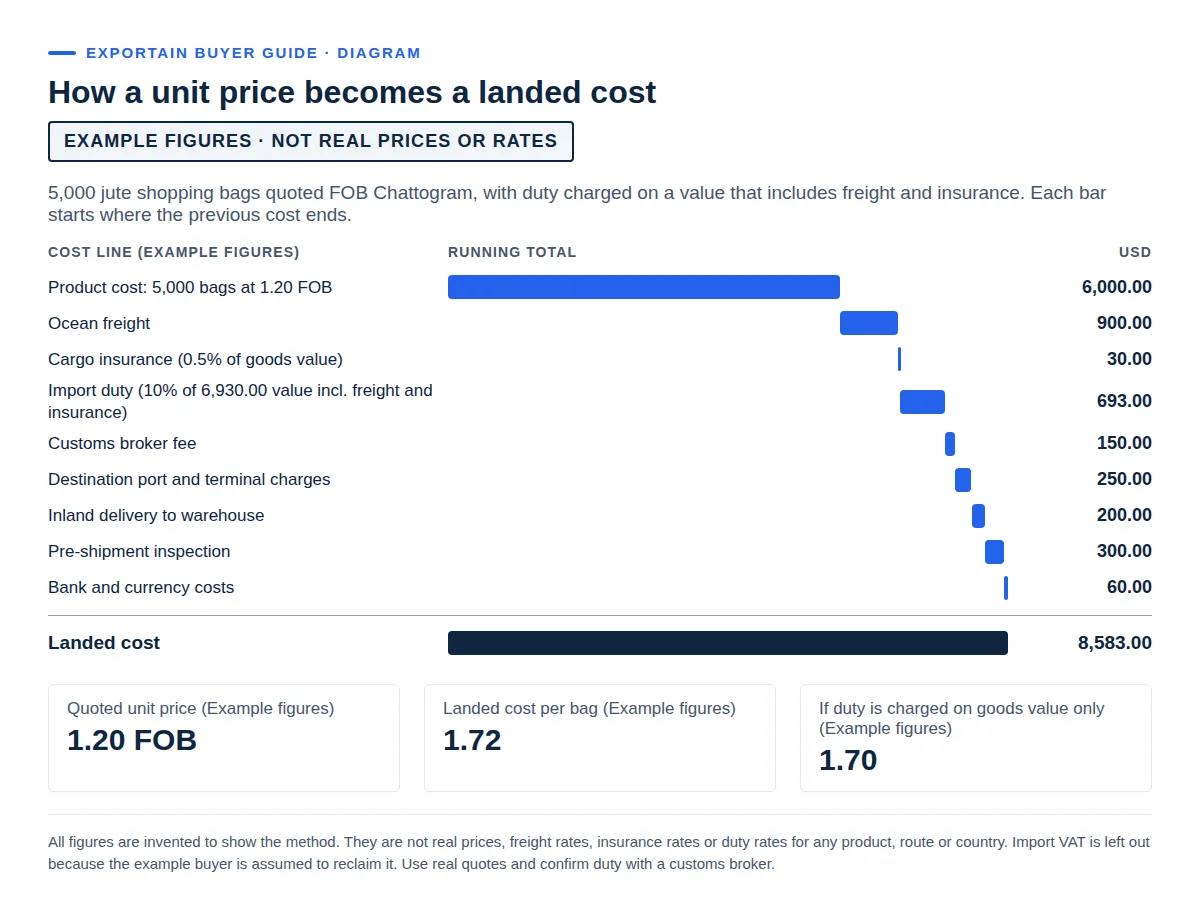
In this example (Example figures), a bag quoted at 1.20 costs about 1.72 by the time it reaches the warehouse. Import VAT is left out because the example buyer is assumed to reclaim it.
Now change one assumption, still using Example figures. If the buyer's country values goods for duty without the international freight and insurance, the duty in this example falls to 10% of 6,000.00, which is 600.00. The landed cost becomes 8,490.00, or about 1.70 per bag. The difference comes only from how the customs value is defined, which is why the next section matters.
Where to find your duty rate
The EU names three factors behind any duty bill: the tariff that applies to the goods, their value and their origin, and the duty is normally a percentage of the customs value6. To find your rate:
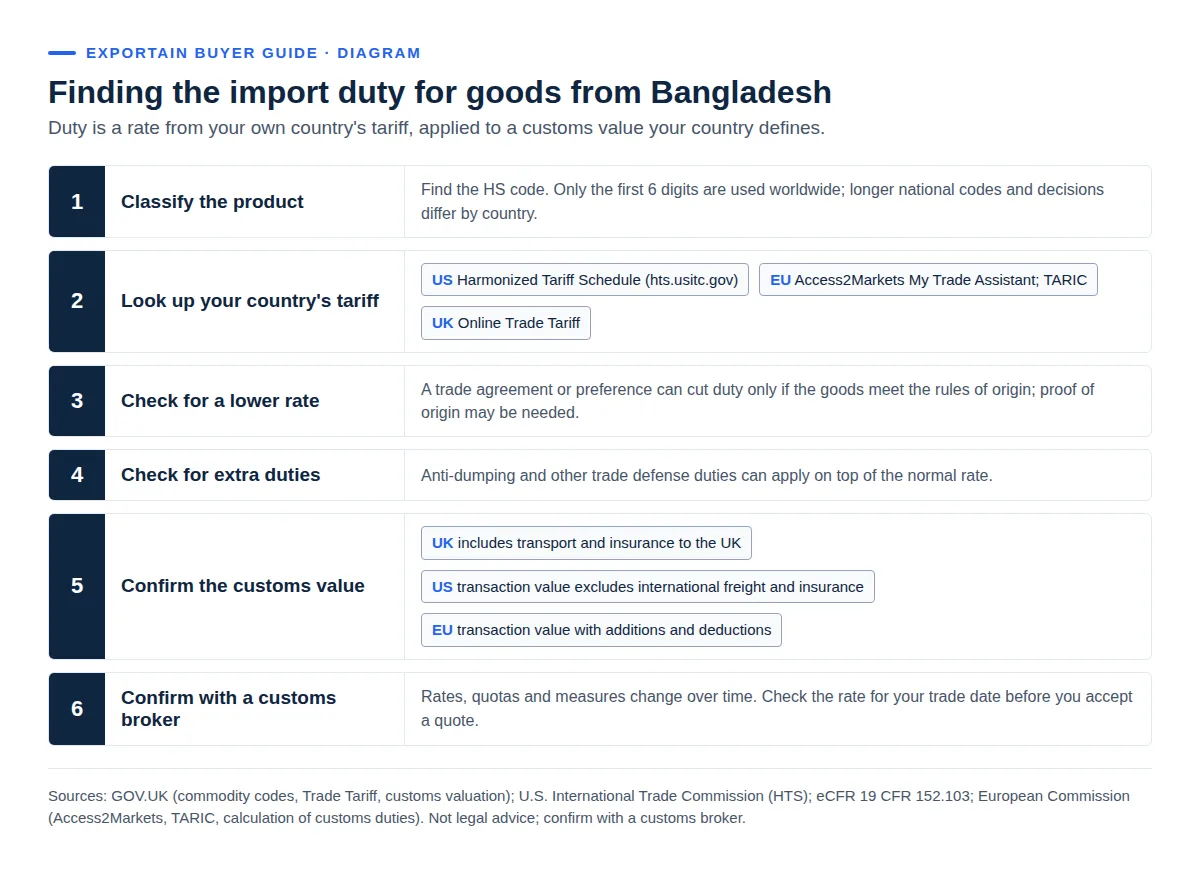
Classify the product. Find its HS code; the HS code guide explains how. Only the first 6 digits are used worldwide; the longer codes and product decisions are particular to each country7. In the UK, the commodity code works out the rate of customs duty, import VAT and any preferential rate7.
Look it up in your own country's tariff.
United States: the Harmonized Tariff Schedule, searchable at hts.usitc.gov, lists each tariff line with general, special and other rate columns8.
European Union: in Access2Markets, open My Trade Assistant, enter the country you import from, the country you import to and the product code, and the results show the applicable duties9. The TARIC database holds the EU's tariff measures, but not national VAT or excise rates10.
United Kingdom: the Online Trade Tariff lets you look up commodity codes, import duties, taxes and controls. You can enter the trade date, because duties and quotas change over time11.
Check for a lower rate. A trade agreement or preference scheme can reduce or remove duty, but only if the goods meet the rules of origin; the supplier may need to provide proof of origin3. In the UK, the Trade Tariff helps you check whether a trade agreement lets you pay less duty7. The International Trade Centre lists a Market Access Map and a Rules of Origin Facilitator among its trade tools12.
Check for extra duties. Anti-dumping or other trade defense duties can apply on top of the normal rate; the EU shows them in My Trade Assistant3, and the UK Trade Tariff helps you check whether anti-dumping duties or tariff quotas cover your goods7.
Confirm the customs value. Countries count freight differently. The UK includes all transport, loading, handling and insurance costs up to the point the goods enter the UK13. U.S. transaction value excludes the international freight and insurance charges14. In the EU, the transaction value is adjusted by the additions and deductions set out in the Union Customs Code6.
Ask a customs broker to confirm. Classification and valuation decide the duty, so have a professional check both before you rely on the figure.
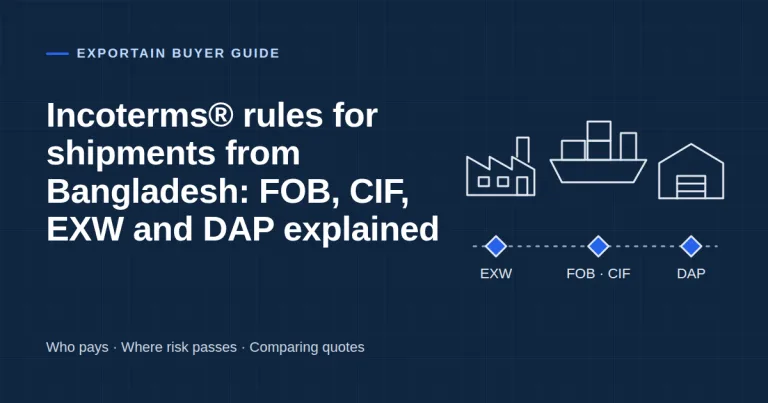
How Incoterms® rules change which lines you pay
Cost line | EXW | FOB | CIF | DAP |
|---|---|---|---|---|
Transport to port and export clearance in Bangladesh | You | In the price | In the price | In the price |
Main freight | You | You | In the price | In the price |
Insurance | Your decision | Your decision | Minimum cover in the price | Seller carries transit risk |
Destination port charges | You | You | Check the freight terms | Check the freight terms |
Unloading and delivery to your warehouse | You | You | You | Unloading is yours |
Import clearance, duty and taxes | You | You | You | You |
Import clearance and duty sit with the buyer under all four of these rules; DDP is the only Incoterms® 2020 rule where the seller pays import duty15. Under DAP the seller does not unload at your named place1. For a fuller comparison, see the guide to Incoterms® rules for shipments from Bangladesh.
Using Exportain's landed-cost estimator
Exportain's landed-cost estimator on the Trade Resources page gives a quick per-unit figure. You enter an FOB unit price, the order quantity, the freight cost, an insurance percentage, a duty rate and port and terminal charges. It applies the insurance percentage to the goods value, adds freight to reach a CIF value, applies the duty rate to that CIF value and adds the port charges. The estimate appears once every field is filled, and the page states that nothing you enter is sent anywhere16.
Treat it as a first pass. It has no separate fields for import taxes, broker fees, inspection or bank costs, so add those yourself. And because it calculates duty on the CIF value, the duty line will come out higher than it should if your country values goods without international freight and insurance, as the United States does14.
For the freight figure, the shipping prices page shows sea, air, courier and road rates that freight providers have published on Exportain, and lets you ask a provider for a quote where no one has priced your route17.
Checklist before you accept a quote
The Incoterms® rule, named place and edition are written in full, for example "FOB Chattogram Incoterms® 2020".
Currency, unit price, quantity and the quote's validity date are clear.
You have a freight quote for the same route, dates and container or cargo size.
You know what insurance cover applies and who holds it.
A customs broker has confirmed the HS code, duty rate and any preference or extra duty.
You know whether you can reclaim import VAT or similar taxes.
Destination port charges are quoted, and you know which ones the seller's freight covers.
Inspection and testing costs are agreed and budgeted.
Payment terms are agreed, with your bank's charges for them.
Next steps on Exportain
Run your quotation through the landed-cost estimator, then add the lines it leaves out. Check published freight rates for your route. When you are ready to collect prices, post an RFQ that states your Incoterms® rule and destination, so every supplier quotes on the same basis. Exportain does not book freight, inspect goods or clear customs, and payment is settled directly between you and the supplier18.
Incoterms® is a trademark of the International Chamber of Commerce.
Sources
- Incoterms® 2020. International Chamber of Commerce (ICC) (accessed )
- The Incoterms® rules 2010 (introduction). International Chamber of Commerce (ICC) (accessed )
- Guide to import goods. European Commission, Access2Markets (accessed )
- Paying VAT on imports from outside the UK to Great Britain and from outside the EU to Northern Ireland. HM Revenue & Customs (GOV.UK) (accessed )
- Import goods into the UK: step by step. GOV.UK (accessed )
- Calculation of customs duties. European Commission, Taxation and Customs Union (accessed )
- Finding commodity codes for imports or exports. GOV.UK (HM Revenue & Customs), (accessed )
- Harmonized Tariff Schedule (HTS search). United States International Trade Commission (USITC) (accessed )
- How can I find the import duty that applies to my product?. European Commission, Access2Markets (accessed )
- EU Customs Tariff (TARIC). European Commission, Taxation and Customs Union (accessed )
- UK Integrated Online Tariff: look up commodity codes, duty and VAT rates. GOV.UK (accessed )
- International Trade Centre (home page, ITC tools). International Trade Centre (ITC) (accessed )
- Customs valuation: Method 1 - transaction value. HM Revenue & Customs (GOV.UK) (accessed )
- 19 CFR 152.103 - Transaction value. Electronic Code of Federal Regulations (eCFR), U.S. Office of the Federal Register (accessed )
- Guidance Note: Using the Incoterms® 2020 Rules to Manage Tariff Risk in International Trade. International Chamber of Commerce (ICC) (accessed )
- Trade resources and tools (landed-cost estimator). Exportain (accessed )
- Shipping prices from Bangladesh. Exportain (accessed )
- About Exportain. Exportain (accessed )
About the author
Sourcing from Bangladesh?
Post a request for quotation and suppliers on Exportain can send you their quotes directly.
Post an RFQ