Incoterms® rules for shipments from Bangladesh: FOB, CIF, EXW and DAP explained
FOB, CIF, EXW and DAP decide who books freight, who clears customs and where the risk passes. Here is how each one works on an order from Bangladesh, and how to compare quotes that use different terms.
Short answer
No single Incoterms® rule is right for every order; pick the one that matches how much of the shipment you can manage. FOB suits buyers with their own forwarder: the seller clears export and loads the vessel. CIF adds freight and minimum insurance to your port, but risk still passes at loading. DAP brings goods to your named place. EXW leaves Bangladeshi export clearance to you.
On this page
Key takeaways
The Incoterms® rule sets who pays for and arranges each leg, and where risk passes. It does not settle price, payment terms or ownership.
FOB and CIF are for sea and inland waterway transport. For containers handed over at a terminal or depot, ask whether FCA fits better.
Under CIF the seller only has to buy minimum insurance cover, and your risk starts when the goods are loaded in Bangladesh.
Under EXW, FOB, CIF and DAP you clear import customs and pay duty. DDP is the only rule where the seller pays.
Compare quotes by pricing every offer to the same point, such as your own warehouse.
Short answer: who pays and who carries the risk
Every quotation from a Bangladeshi supplier names an Incoterms® rule and a place, such as "FOB Chattogram". That short code answers three questions: who arranges and pays for each leg of the journey, who handles customs on each side, and at what point the risk of loss or damage moves from the seller to you.
Here is how the four rules covered in this guide divide the work:
EXW | FOB | CIF | DAP | |
|---|---|---|---|---|
Seller delivers | At its own premises, not loaded | On board the vessel at the named port of shipment | On board the vessel at the port of shipment | At your named place, ready for unloading |
Risk passes to you | When goods are made available at the premises | When goods are on board | When goods are on board | On arrival at the named place |
Main freight booked and paid by | You | You | Seller | Seller |
Export clearance in Bangladesh | You | Seller | Seller | Seller |
Import clearance and duty | You | You | You | You |
Sources for the table: HMRC's summary of the rules1 and ICC's guidance note on tariffs2.
What Incoterms® rules do, and what they leave out
The Incoterms® rules are published by the International Chamber of Commerce (ICC). ICC first published them in 1936, there are eleven of them, and the current edition, Incoterms® 2020, entered into force on 1 January 20203. Each rule allocates tasks, costs and risks between seller and buyer, and each fixes a delivery point; the risk passes at that point4.
Just as important is what the rules do not cover. The U.S. International Trade Administration lists the gaps plainly: an Incoterms® rule does not identify the goods or the price, does not set the method or timing of payment, does not say when ownership passes, does not list the documents you need for import customs, and does not deal with liability for faulty or late goods4. Those points belong in your purchase contract and payment terms. The rules also do not change tariff rates or customs procedures; they only decide who bears those costs2.
Write the term in full. ICC's recommended form is the rule, then the named place, then the edition, for example "FOB Chattogram Incoterms® 2020"5. A bare "FOB" leaves the port and the version open to argument.
EXW, FOB, CIF and DAP side by side
The comparison below follows a sea shipment from a factory in Bangladesh to a buyer's warehouse abroad.
Question | EXW | FOB | CIF | DAP |
|---|---|---|---|---|
Transport modes | Any | Sea and inland waterway only | Sea and inland waterway only | Any |
Loading at the factory | You | Seller | Seller | Seller |
Transport to the port in Bangladesh | You | Seller | Seller | Seller |
Export clearance | You | Seller | Seller | Seller |
Ocean freight | You | You | Seller, to the named destination port | Seller, to the named place |
Cargo insurance | Your decision | Your decision | Seller buys minimum cover for your risk | Seller carries the transit risk |
Unloading at destination | You | You | Check the freight terms | You |
Import clearance, duty and taxes | You | You | You | You |
The transport modes and customs rows come from ICC's guidance note2; the delivery and insurance rows from HMRC's summary1; the FOB and CIF cost rows from the EU's import guide on Access2Markets6; and the DAP unloading point from ICC's Incoterms® 2020 page7.
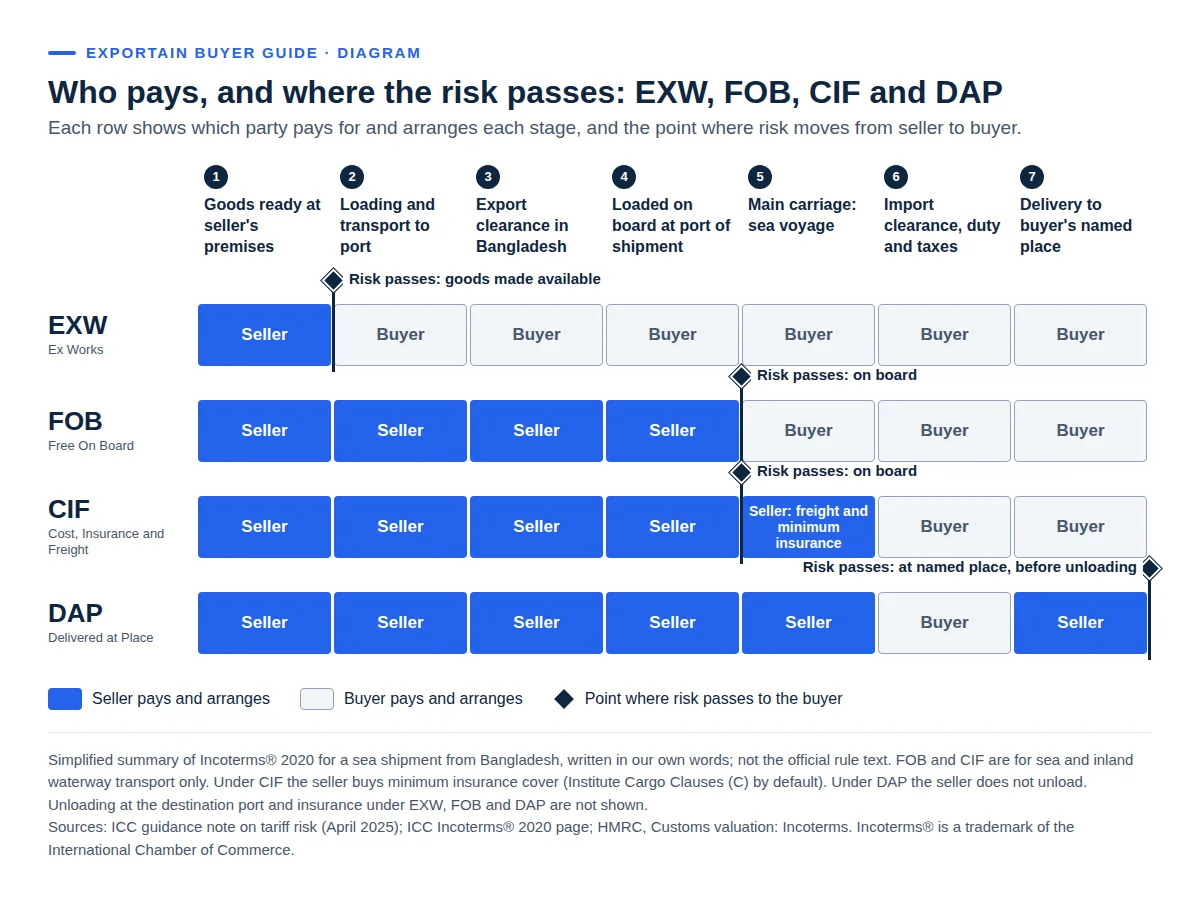
The pattern is simple once you see it. The "F" rule (FOB) ends the seller's job at loading in Bangladesh. The "C" rule (CIF) makes the seller pay for the voyage but still moves the risk to you at loading. The "D" rule (DAP) keeps the seller responsible until the goods reach your named place. EXW puts almost everything on you.
FOB Chattogram: what the price includes
Chattogram port, at the mouth of the Karnaphuli river, is Bangladesh's main seaport. It is run by the Chittagong Port Authority, an autonomous government body8. A quote may instead name Mongla, where the Mongla Port Authority runs the port9. The named port in the quote tells you where the seller's delivery ends.
Under FOB, the seller delivers the goods on board the vessel you nominate at the named port, and the risk passes once they are on board1. The EU's import guide lists what that means for costs: the supplier pays transport to the port of shipment, loading costs and export customs clearance, while you pay onward transport, insurance, unloading and delivery from the arrival port6. Import clearance and duty are yours too2.
In practice, an FOB price suits a buyer who already works with a freight forwarder. You control the booking, the carrier and the insurance, and you can compare the freight cost separately.
One limit matters for container cargo. FOB and CIF are written for sea and inland waterway transport2, with delivery on board the ship. Container cargo can be handed to the carrier at a terminal or depot before it is loaded. ICC introduced the Free Carrier term for exactly that situation, where goods are received at a point on shore such as a container yard rather than at the ship's side10. In the 2020 edition, FCA also lets the parties agree that the buyer will instruct its carrier to issue an on-board bill of lading to the seller, for cases where either party or its bank asks for one7. If your supplier hands over a sealed container before it is loaded, ask your forwarder whether FCA with a named terminal describes the handover better than FOB.
CIF and the insurance question
Under CIF, the seller delivers on board the vessel in Bangladesh, and the risk passes there, just as with FOB. The difference is cost: the seller must contract and pay for freight to the named destination port and for insurance against your risk during the voyage1.
That is why a CIF price looks higher than an FOB price for the same goods. It already contains freight and insurance.
The insurance deserves a close look. ICC's Incoterms® 2020 page explains that CIF keeps Institute Cargo Clauses (C) as the default level of cover, with the option to agree more, while CIP now requires the wider Institute Cargo Clauses (A) or similar7. HMRC puts it the same way: under CIF the seller only has to obtain minimum cover, and a buyer who wants more must agree it with the seller or buy extra cover itself1.
Before you accept a CIF quote, ask for:
the insurance certificate or policy details, including the clauses and the insured amount
the currency of the cover
who to contact to make a claim at destination
Also check destination charges. ICC's introduction to the earlier 2010 edition warned that carriers or terminal operators may bill the buyer for handling costs that the seller already built into its price, so the buyer pays twice11. Ask your forwarder which charges at the destination port are already in the seller's freight.
When DAP makes sense for smaller buyers
Under DAP, the seller delivers when the goods are placed at your disposal on the arriving means of transport, ready for unloading, at the named place, and the seller bears the risks of getting them there1. The seller does not unload7. DAP works for any mode of transport, but import clearance and duty stay with you2. Among the Incoterms® 2020 rules, only DDP makes the seller pay import duty2.
DAP can suit a buyer who places small or occasional orders and does not have a forwarder: the seller arranges the whole journey, and you receive one delivered price. You still need someone to clear the goods through your country's customs. The UK government notes that most businesses that import goods use a transporter or customs agent12.
Two cautions. Freight is folded into a DAP price, so ask the supplier to show it as a separate line. And name the place precisely, down to the warehouse address, because that is where the seller's risk ends.
EXW: the term that leaves the most to you
Under EXW, the seller places the goods at your disposal at its premises or another named place. It does not have to load them onto your truck, and it does not have to clear them for export1. Export clearance in Bangladesh therefore falls on you2.
For a buyer based abroad, that means appointing someone in Bangladesh to collect the goods from the factory, move them to the port and handle export formalities. Before agreeing to EXW, ask your forwarder whether it can do this. If not, FCA at the seller's premises or FOB keeps export clearance with the seller2.
How to compare two quotes on different Incoterms® rules
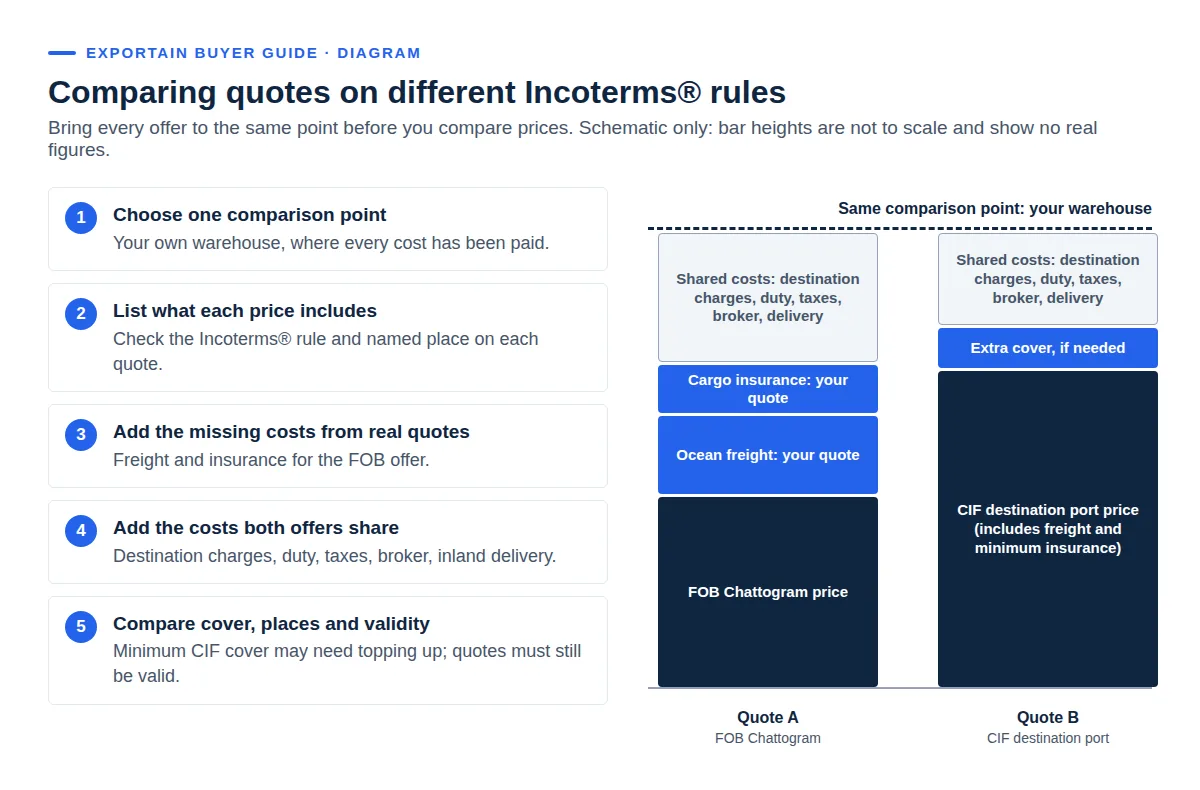
Suppose one supplier quotes FOB Chattogram and another quotes CIF to your port. The unit prices cannot be compared directly. Bring both offers to the same point:
Choose a comparison point. Your own warehouse is the most useful, because that is where every cost has been paid.
List what each price already includes. Use the side-by-side table above.
Add the missing costs from real quotes. For the FOB offer, get ocean freight and insurance quotes. Freight rates that freight providers have published on Exportain's shipping prices page are one starting point, and you can ask a provider for a quote if your route has no published rate13.
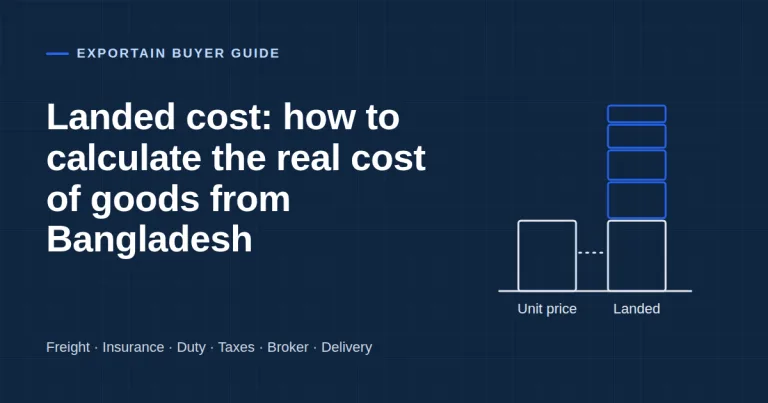
Add the costs both offers share. Destination port charges, import duty and taxes, customs broker fees and inland delivery apply to both.
Compare the cover and the details. A CIF offer with minimum insurance may need extra cover to match the protection you would buy yourself. Check that the named places and currency match, and that both quotes are still valid on the day you decide.
The landed cost guide walks through this calculation line by line, with a worked example.
Common mistakes
Leaving out the place or the edition. "FOB" alone does not say which port or which version of the rules applies.
Using FOB or CIF when containers are handed over inland. The rules place delivery on board the ship; FCA may describe the handover better.
Assuming CIF insurance is full cover. The default is minimum cover.
Treating the Incoterms® rule as the payment term. It does not decide when you pay or when ownership passes.
Agreeing to EXW with no one to clear export in Bangladesh.
Paying destination handling twice. Check what the seller's freight already covers.
Next steps on Exportain
When you post an RFQ, state the Incoterms® rule and the named place you want, so that suppliers quote on the same basis. Every quotation on Exportain records the Incoterms® rule alongside unit price, MOQ, lead time, payment terms and validity14. Exportain does not book freight or clear customs14, so use the published freight rates and your forwarder to price the rest. For the terms themselves, see the glossary entries for FOB, CIF and EXW.
Incoterms® is a trademark of the International Chamber of Commerce. This guide summarizes the rules in our own words and is not the official text; the full rules are available from ICC.
Sources
- Customs valuation: Incoterms. HM Revenue & Customs (GOV.UK) (accessed )
- Guidance Note: Using the Incoterms® 2020 Rules to Manage Tariff Risk in International Trade. International Chamber of Commerce (ICC) (accessed )
- Incoterms® rules. International Chamber of Commerce (ICC) (accessed )
- Know Your Incoterms. International Trade Administration, U.S. Department of Commerce (accessed )
- Incoterms® rules trademark and copyright policy. International Chamber of Commerce (ICC) (accessed )
- Guide to import goods. European Commission, Access2Markets (accessed )
- Incoterms® 2020. International Chamber of Commerce (ICC) (accessed )
- পটভূমি ও কার্যক্রম (Background and activities). Chittagong Port Authority (accessed )
- Mongla Port Authority (home page). Mongla Port Authority (accessed )
- Incoterms® Rules history. International Chamber of Commerce (ICC) (accessed )
- The Incoterms® rules 2010 (introduction). International Chamber of Commerce (ICC) (accessed )
- Import goods into the UK: step by step. GOV.UK (accessed )
- Shipping prices from Bangladesh. Exportain (accessed )
- About Exportain. Exportain (accessed )
About the author
Sourcing from Bangladesh?
Post a request for quotation and suppliers on Exportain can send you their quotes directly.
Post an RFQ