FOB Free On Board: Meaning, Costs, Risks and a Chattogram Example
Definition
FOB (Free On Board) is an Incoterms 2020 rule for sea and inland waterway transport. The seller delivers the goods on board the vessel nominated by the buyer at the named port of shipment, clears them for export and pays the costs up to loading. Risk passes to the buyer once the goods are on board. The buyer then pays ocean freight, decides on insurance and handles import clearance and duty.
By Naim Islam
Published Updated 18 min read
On this page
Key takeaways
Under FOB, the seller delivers the goods on board the vessel nominated by the buyer at the named port of shipment.
Risk passes from seller to buyer the moment the goods are on board at the port of shipment.
The buyer pays ocean freight and import duty under FOB; neither party must insure, so buyers usually arrange their own cover.
For containers handed over at a terminal before loading, FCA usually fits the actual handover better than FOB.
If you are comparing supplier quotes from Bangladesh, FOB is the term that decides where the seller's job ends and yours begins. Under FOB, the seller delivers the goods on board the vessel at the named port of shipment. From that moment, the freight, the voyage risk and the import side belong to the buyer.
This article explains FOB (Free On Board) in full: what an FOB price includes and excludes, exactly when risk transfers, what the seller and the buyer each have to do, how FOB compares with CIF and EXW, when FCA fits better than FOB, and a worked FOB Chattogram example with illustrative figures.
What does FOB mean in shipping?
FOB (Free On Board) is one of the 11 Incoterms® rules published by the International Chamber of Commerce (ICC). The Incoterms® rules are three-letter trade terms for contracts for the sale of goods, and they clarify the tasks, costs and risks involved in delivering goods from seller to buyer.1 The current edition, Incoterms® 2020, entered into force on 1 January 2020.1
The Incoterms® rules do not form a complete contract of sale by themselves. For each rule, they define who arranges and pays for transport and insurance, who clears the goods for export and import, and the point at which the risk of loss or damage passes from seller to buyer. Price, payment terms, title to the goods and remedies for breach still belong in the sales contract or purchase order.
FOB is one of the four rules reserved for sea and inland waterway transport, alongside FAS (Free Alongside Ship), CFR (Cost and Freight) and CIF (Cost, Insurance and Freight). Under FOB, the seller delivers the goods to the buyer, and risk passes from seller to buyer, when the goods are on board the vessel nominated by the buyer at the named port of shipment.2 FOB cannot correctly be used for air, road or rail freight. For those modes, and for most multimodal shipments, FCA (Free Carrier) is the corresponding rule.
The term is always used with a named port of shipment, never a destination port. Correct forms include "FOB Chattogram, Incoterms® 2020". Chattogram, formerly written Chittagong, is Bangladesh's principal seaport. A quote that simply says "FOB Bangladesh" is incomplete: without a named port and the Incoterms® edition, the delivery point is ambiguous, and ambiguity is where disputes start.
Under FOB, the seller is responsible for export clearance only. The buyer must handle import duties and tariffs, import customs clearance and any customs formalities required for goods in transit through third countries.3
One common source of confusion is that "FOB" also appears outside the Incoterms® rules, in older United States domestic trade practice, where it has been used more loosely for the point from which freight charges apply. That domestic usage is not the Incoterms® rule. If you are importing from Bangladesh under an international sales contract, the ICC Incoterms® 2020 meaning in this article is the one that applies, and the edition should always be written into the contract.
When does risk pass under FOB?
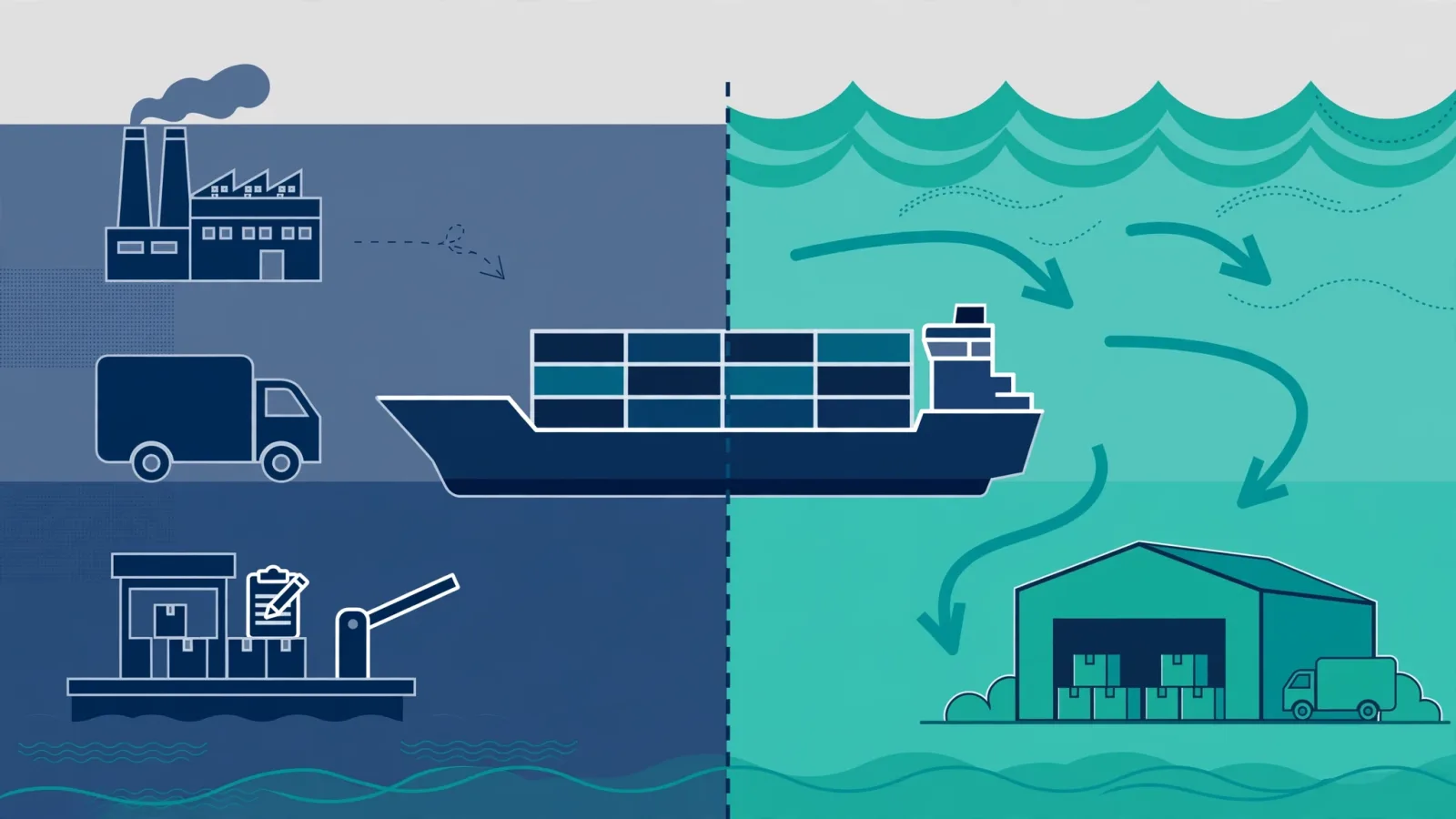
Under Incoterms® 2020, the seller delivers the goods under FOB by placing them on board the vessel nominated by the buyer at the named port of shipment, on the agreed date or within the agreed period. The buyer must nominate the vessel, or the carrier that will nominate it, and must give the seller sufficient notice of the vessel name, the loading point and the delivery time.
Delivery and risk are tied to the same moment. The seller bears all risk of loss of or damage to the goods until they have been delivered on board the vessel. From that moment, the buyer bears all risk.2 That is a clean, visible dividing line, the goods are either on board or they are not, and it is one reason FOB has survived for so long in bulk, break-bulk and conventional cargo trades where the seller physically loads goods onto the ship.
The on-board moment is also evidenced commercially by the bill of lading. When a carrier issues an on-board bill of lading, it confirms that the goods have been loaded. Under a letter of credit, banks typically require exactly that document, so the timing of the on-board notation matters for payment as well as for risk.
What does an FOB price include?
An FOB price is not simply the factory price of the goods. An FOB price is the price of the goods delivered on board at the named port, and a well-constructed FOB Chattogram quotation from a Bangladeshi supplier normally includes the following cost elements:
The goods themselves, packed and marked as required by the contract and suitable for carriage by sea.
Inland transport from the factory or warehouse to the port of shipment, for example trucking garments from a factory in Gazipur or Narayanganj to Chattogram.
Export customs clearance in Bangladesh, including the export declaration and any export duties or charges payable on export. Under FOB, export clearance is the seller's responsibility.3
Costs of checks required for delivery, such as measuring, weighing, counting or quality checks the seller must perform to place the goods on board. A separate pre-shipment inspection ordered by the buyer for the buyer's own purposes is normally the buyer's cost.
Port and terminal handling charges at the port of shipment that fall before or at loading, and the cost of loading the goods on board the vessel.
Providing, at the seller's expense, the usual proof of delivery, typically the transport document the seller receives for goods delivered on board.
An FOB price does not include:
Ocean freight from the port of shipment to the destination port. The buyer contracts and pays for carriage from the delivery point onward.
Marine cargo insurance. Neither party is obliged to insure under FOB. The buyer bears risk from on board, so most buyers arrange their own cover.
Unloading at the destination port, destination terminal handling charges payable by the buyer under its contract of carriage, and onward transport to the buyer's warehouse.
Import customs clearance, import duties, VAT and other taxes in the buyer's country. Under FOB, import clearance is always the buyer's responsibility,3 although the seller must provide reasonable assistance, at the buyer's risk and expense, with documents needed for import or transit.
Costs arising after delivery that the buyer causes. If the buyer fails to nominate a vessel on time or the nominated vessel cannot load, additional costs can fall on the buyer once the goods are identified as the contract goods.
FOB suits a buyer who works with its own freight forwarder. The buyer chooses the carrier, controls the sailing schedule, sees the freight cost as a separate line and decides the level of insurance. To compare an FOB offer fairly with a CIF offer or a delivered price, add the freight, insurance and destination costs to the FOB figure, as set out in the landed cost guide for imports from Bangladesh.
What must the seller and the buyer each do under FOB?
Incoterms® 2020 sets out ten matched obligations for each party under FOB, covering delivery, risk, carriage, insurance, delivery and transport documents, export and import clearance, checking and packaging, allocation of costs, and notices. The practical summary is as follows.
The seller must:
Supply the goods and the commercial invoice in line with the sales contract.
Deliver the goods on board the vessel nominated by the buyer at the named port of shipment, on the agreed date or within the agreed period, in the manner customary at the port.
Bear all risk until delivery on board is complete.
Clear the goods for export from Bangladesh, including any security clearance required for export, and pay export duties and charges.
Provide, at its own expense, the usual proof that the goods have been delivered, in practice the on-board transport document it is able to obtain.
Package and mark the goods appropriately for sea transport, unless the contract specifies otherwise, and pay for checking operations necessary for delivery.
Give the buyer sufficient notice that the goods have been delivered on board, or that the vessel has failed to take the goods, if that occurs.
Assist the buyer, at the buyer's request, risk and expense, with documents or information needed for import clearance, transit and insurance, for example a certificate of origin where the buyer needs one.
The buyer must:
Pay the price as provided in the sales contract.
Nominate the vessel, directly or through its carrier or freight forwarder, and give the seller due notice of the vessel name, loading point and delivery date or period.
Contract for carriage of the goods from the named port of shipment, at its own expense, and bear all risk from the moment of delivery on board.
Decide whether to take out cargo insurance. There is no obligation on either party to insure under FOB.
Clear the goods for import in the destination country, and for transit through third countries where applicable, paying import duties, VAT and clearance charges.
Pay all costs from the moment of delivery, including freight, discharge costs included in its carriage contract, and any additional costs caused by failing to nominate a vessel or by the vessel failing to load, once the goods are identified as the contract goods.
Give the seller appropriate notice of the vessel and loading arrangements, and accept the proof of delivery.
Neither obligation list transfers ownership of the goods. Title passes according to the sales contract and the applicable law, not according to the Incoterms® rule, a distinction that matters if a payment dispute arises after shipment.
How do FOB, CIF and EXW compare?
FOB, CIF and EXW are the three terms Bangladeshi suppliers quote most often to first-time buyers, and they sit at very different points on the responsibility spectrum. EXW places the minimum possible obligation on the seller. CIF places considerably more on the seller than FOB, including arranging freight and minimum insurance to the destination port, while risk under CIF still passes on board at the port of shipment, just as it does under FOB.
Under CIF, the Institute Cargo Clauses (C) level of cover remains the default level of insurance, and the parties can agree a higher level of cover instead.4 Under the C rules as a group, the seller must arrange and pay for transportation to the named destination, but delivery and the transfer of risk occur at the port of shipment, when the goods are loaded on board the vessel.5
Point of comparison | EXW (Ex Works) | FOB (Free On Board) | CIF (Cost, Insurance and Freight) |
|---|---|---|---|
Delivery point | Seller's premises, factory or warehouse | On board the vessel at the named port of shipment | On board the vessel at the named port of shipment |
Risk passes to buyer | When goods are placed at buyer's disposal at seller's premises | When goods are on board the vessel at the port of shipment | When goods are on board the vessel at the port of shipment, not at destination |
Modes of transport | Any mode, including multimodal | Sea and inland waterway only | Sea and inland waterway only |
Export customs clearance | Buyer (seller assists at buyer's risk and expense) | Seller | Seller |
Loading onto vessel | Buyer (loading at seller's premises is also buyer's risk unless agreed otherwise) | Seller | Seller |
Main ocean freight paid by | Buyer | Buyer | Seller (included in the CIF price, to the named destination port) |
Marine insurance obligation | None on either party | None on either party | Seller must obtain at least minimum cover for the buyer's benefit; buyer should consider top-up cover |
Import clearance and duty | Buyer | Buyer | Buyer, CIF does not include import duty |
Suited to | Experienced buyers with their own logistics and export agent in Bangladesh | Buyers with a freight forwarder who want control of freight and insurance | Buyers who prefer the seller to arrange freight and basic insurance to the destination port |
Main caution | Buyer carries almost everything, including Bangladesh export formalities | Wrong fit for containers handed over at a terminal before loading, consider FCA | Buyer bears risk during the voyage despite seller paying freight and insurance; minimum insurance may not cover full loss needs |
Read the CIF row carefully, because CIF is the most misunderstood term in the table. A CIF price sounds as though the seller is responsible all the way to the destination port. It is not. Under CIF the seller pays for carriage and minimum insurance to the named destination port, but delivery is still completed, and risk still passes, when the goods are loaded on board at Chattogram.5 If the goods are damaged mid-voyage, the buyer claims on the insurance the seller procured. The buyer does not reject the goods against the seller. CIF never includes import duty, import VAT or import clearance in the destination country: those remain the buyer's cost under all three terms in this table. See also the full CIF price meaning and the EXW (Ex Works) definition.
EXW sits at the opposite extreme. Under EXW the seller's only duty is to make the goods available, packed, at its premises, and risk transfer occurs when the seller places the goods at the disposal of the buyer at a named place, not loaded on any collecting vehicle.2 The buyer arranges everything from that point, including export clearance in Bangladesh, which a foreign buyer often cannot practically perform itself. Buyers who want minimal seller involvement but workable formalities usually find FCA at the seller's premises, with the seller clearing export, a more realistic minimum-responsibility term than EXW.
Worked example: an FOB Chattogram garment shipment
The following example shows how an FOB price is built and what the buyer budgets on top of it. Example figures: all figures in this example are illustrative only. They are not quotations, market rates or price guidance. Freight rates, port charges and factory prices change frequently, and live quotations from the supplier and freight forwarder are needed for any real order.
Scenario (illustrative): A European buyer orders 20,000 cotton T-shirts from a factory near Dhaka. The parties agree "FOB Chattogram, Incoterms® 2020". The goods travel by truck to Chattogram, are cleared for export by the seller, and are loaded on board the vessel the buyer's forwarder has nominated, bound for Rotterdam.
Illustrative cost build-up, what the seller's FOB price covers (Example figures):
Cost element | Who pays under FOB | Illustrative amount (USD) |
|---|---|---|
20,000 T-shirts, manufactured, packed and cartoned | Seller (in the FOB price) | 56,000 |
Trucking, factory to Chattogram port area | Seller (in the FOB price) | 850 |
Bangladesh export customs clearance and export documentation | Seller (in the FOB price) | 180 |
Port and terminal handling and loading on board at Chattogram | Seller (in the FOB price) | 620 |
FOB Chattogram price invoiced by the seller | Buyer pays the seller this amount | 57,650 |
On these Example figures, the FOB unit price is USD 57,650 divided by 20,000, which is USD 2.88 per T-shirt, rounded. The garment price itself plus roughly USD 1,650 of Bangladesh-side logistics created that number, because the seller absorbed the trucking, export clearance and loading costs to get the goods on board. If the same factory had quoted EXW, its price would have been close to the USD 56,000 goods-only figure, lower on paper, but the buyer would then have paid the trucking, export clearance and loading separately, and carried the risk from the factory gate.
Illustrative costs the buyer pays on top of the FOB price (Example figures):
Cost element | Who pays under FOB | Illustrative amount (USD) |
|---|---|---|
Ocean freight, Chattogram to Rotterdam (buyer's forwarder contract) | Buyer | 2,400 |
Marine cargo insurance (buyer's own policy, optional under FOB but prudent) | Buyer | 290 |
Discharge, destination handling and delivery to buyer's warehouse | Buyer | 1,100 |
Import customs clearance, duty and VAT at destination | Buyer, per destination-country rules | Calculated on the customs value under local rules, not estimated here |
The buyer's landed budget in this illustration is therefore the FOB price of USD 57,650 plus USD 3,790 of freight, insurance and destination costs, which is USD 61,440 before import duty and taxes. That total, not the FOB price alone, is the figure to compare against a CIF Chattogram to Rotterdam quotation. Under CIF, the seller's invoice in an equivalent deal would fold freight and minimum insurance into its price, so it would be higher than the FOB price, while the risk point would be exactly the same: on board at Chattogram.
Two practical lessons fall out of the example. First, always compare like with like: FOB to FOB, or fully landed to fully landed, never an FOB price against a CIF price as if they covered the same scope. Second, under FOB the freight saving or freight increase belongs entirely to the buyer, because the buyer holds the carriage contract. In a volatile freight market, that control is the main reason experienced importers prefer FOB.
When does FOB work well, and when does FCA fit better?
FOB works well when the seller genuinely loads the goods onto the vessel and can supervise that loading: bulk cargo, break-bulk cargo, conventional shipments, and any trade where the seller's delivery on board is a real, observable act. FOB also works well when the buyer has a strong freight forwarder, wants to consolidate shipments from several Bangladeshi suppliers onto one vessel or service, wants freight costs kept separate and auditable, or is buying under a letter of credit that calls for an on-board bill of lading.
FOB is only for sea and inland waterway transport. It does not suit air freight, and it can be a poor fit for the way most containerised cargo actually moves today. A container from a Bangladeshi garment factory is usually handed to the carrier at a container yard, inland container depot or port terminal, sometimes days before the vessel loads. In that case the supplier has given up physical control of the goods, but under FOB the risk would stay with the supplier until the container is actually on board, through a period in which neither party controls the terminal. The ICC Academy notes that for goods in containers, the Incoterms® 2020 rule FCA is typically a better choice, even for maritime transport.2
Under FCA, delivery and risk transfer happen when the goods are handed to the buyer's nominated carrier at the named place, which matches the actual handover. Incoterms® 2020 also revised FCA so the parties can agree that the buyer will instruct the carrier to issue an on-board bill of lading to the seller once the goods have been loaded on board, and for the seller then to tender the document to the buyer, often through the banks.4 That option preserves the letter of credit mechanism that once pushed container traders toward FOB. If goods move in containers handed over before loading, the contract conversation is worth having before the order is placed, not after a loss. Our Incoterms guide for shipments from Bangladesh covers how the rules apply to Bangladesh shipments.
FOB is also the wrong choice if the buyer has no forwarder, no ability to manage freight and no appetite for voyage risk. In that case CIF, with the seller arranging freight and minimum insurance to the destination port, or a delivered term agreed with a capable seller, may be administratively simpler, with the CIF risk warning above kept firmly in mind.
Which documents and notices does an FOB shipment need?
Good FOB shipments run on timely documents and notices. The buyer must give the seller timely notice of the vessel name, loading point and shipment window, usually through the buyer's forwarder's booking note. The seller must notify the buyer when the goods are on board.
The central document is the bill of lading, which functions as a receipt for the goods, evidence of the contract of carriage, and, when negotiable, a document of title that banks and buyers use to control delivery at destination. Supporting documents commonly moving alongside an FOB shipment from Bangladesh include the commercial invoice, packing list, certificate of origin where the buyer claims preferential duty, and inspection or test reports the contract requires. The Incoterms® term and named port should stay consistent across the purchase order, invoice, packing list and booking instructions: inconsistency between documents is a frequent cause of discrepancies under a letter of credit (LC).
What are the most common FOB mistakes?
Writing "FOB" without a named port or edition. "FOB" alone defines nothing. Always write the port, for example "FOB Chattogram, Incoterms® 2020".
Using FOB for air, road or container handovers at a terminal. Use FCA for those situations.
Assuming FOB includes insurance. It does not. If the buyer wants cover for the voyage it bears risk on, the buyer must arrange it.
Assuming the seller pays freight because it loaded the ship. Under FOB, freight from the port of shipment is the buyer's contract and the buyer's cost.
Comparing an FOB quote with a CIF quote without adjusting scope. Add freight, insurance and destination costs first, as the worked example shows.
Letting the shipment window slip without communication. If the buyer's vessel is late or fails, costs and risk consequences can shift to the buyer for identified goods. If the seller is not ready, the seller carries the consequences of a missed shipment under the contract.
Confusing risk with ownership. FOB fixes risk, not title. Payment and title should be dealt with expressly in the sales contract.
Frequently asked questions
What does FOB mean in shipping?
FOB means Free On Board. FOB is an Incoterms® 2020 rule for sea and inland waterway transport under which the seller delivers the goods on board the vessel nominated by the buyer at the named port of shipment, and risk passes to the buyer at that moment.2
What does an FOB price include?
An FOB price includes the goods plus the seller's costs of getting them on board at the named port. Those costs cover inland transport to the port of shipment, export customs clearance in the exporting country, pre-delivery checking, port handling and loading. An FOB price does not include ocean freight, insurance, destination handling, or import duty and taxes.
Who pays freight under FOB?
The buyer pays the ocean freight under FOB. The buyer contracts with the carrier or a freight forwarder for carriage from the named port of shipment to the destination, and bears the risk of the goods from the moment they are loaded on board.
When does risk pass from seller to buyer under FOB?
Risk passes when the goods are delivered on board the vessel at the named port of shipment.2 Before loading, loss or damage is the seller's risk. After the goods are on board, loss or damage is the buyer's risk, which is why buyers commonly arrange their own marine insurance under FOB.
Does FOB include insurance?
No. Under FOB neither the seller nor the buyer is obliged to take out insurance. Because the buyer bears risk from on board the vessel, most buyers arrange marine cargo insurance themselves. This differs from CIF, where the seller must obtain at least minimum insurance cover for the buyer's benefit.5
What is the difference between FOB and CIF?
Under both FOB and CIF, delivery takes place and risk passes on board the vessel at the port of shipment.5 The difference is cost responsibility: under FOB the buyer arranges and pays for freight and any insurance, while under CIF the seller arranges and pays for freight and minimum insurance to the named destination port. Import duty and clearance at destination remain the buyer's under both terms.
Can FOB be used for air freight or container shipments?
FOB is for sea and inland waterway transport only and must not be used for air freight.2 For containers handed to the carrier at a terminal or depot before loading, FCA (Free Carrier) usually fits better than FOB, because delivery and risk transfer at the handover point rather than waiting until the container is on board.
How should FOB be written in a contract?
FOB should be written with its named port of shipment and the Incoterms® edition, for example "FOB Chattogram, Incoterms® 2020". Naming only a country, or omitting the edition, leaves the delivery point and the applicable version of the rule open to dispute.
Next steps on Exportain
On Exportain, buyers can post an RFQ stating the Incoterms® rule and named port they want quoted, for example FOB Chattogram, so Bangladeshi sellers respond on a comparable basis. Buyers can also browse Bangladeshi suppliers by product category, and the guide to importing from Bangladesh covers the wider buying process from first inquiry to delivery.
Incoterms® is a registered trademark of the International Chamber of Commerce. This article summarises the FOB rule in our own words for general information and is not the official ICC text or legal advice. For the authoritative wording, consult Incoterms® 2020 (ICC Publication No. 723E).
Sources
- Incoterms® rules. International Chamber of Commerce (ICC) (accessed )
- Place of delivery & risk transfer in trade contracts. ICC Academy (accessed )
- Should tariffs be part of Incoterms® training?. ICC Academy (accessed )
- Incoterms® 2020. International Chamber of Commerce (ICC) (accessed )
- Incoterms® 2020 C rules vs D rules: Risk transfer explained. ICC Academy (accessed )
Reviewed by Nourin Tabassum
About the author
Sourcing from Bangladesh?
Post a request for quotation and suppliers on Exportain can send you their quotes directly.
Post an RFQ