MOQ explained: minimum order quantities and how to negotiate them
Why suppliers set minimum order quantities, how to read an MOQ per order, style or color, and the questions that can open the door to a smaller first order.
Short answer
MOQ, or minimum order quantity, is the smallest order a supplier will accept for a product. It can apply per order, per style or per color. Suppliers set it so an order covers the fixed costs of materials, trims and production. It can sometimes be lowered: ask about stock fabric, fewer colors or sizes, standard trims, or a higher unit price. Treat each option as a question, not a promise.
On this page
Key takeaways
An MOQ protects the supplier's costs; it is not an arbitrary number, so ask what drives it.
Always confirm whether the minimum applies per order, per style, per color or per size.
Below a price break, a larger order can cost less in total than a smaller one. Check the tiers before you settle on a quantity.
Stock fabric, fewer variants, standard trims and a small-order surcharge are the usual things to ask about.
State your real quantity per style and color in the RFQ so suppliers can answer on MOQ in their first quotation.
The short answer
A minimum order quantity (MOQ) is the smallest quantity a supplier will produce or sell to you on its normal terms. You will see it on product listings, in quotations and in a supplier's terms of sale. It is a starting position, not a law. Suppliers can and do discuss it, but expect a lower quantity to come with a higher unit price, simpler specifications or both.
The rest of this guide explains where MOQs come from, how to read them, how they connect to quantity price tiers, and what to ask when your order is smaller than the supplier's minimum.
Why suppliers set MOQs
A production order carries costs that do not shrink when the quantity does. Someone has to buy the fabric, order the trims, plan the line, check the first pieces and prepare the export paperwork. CBI, a Dutch trade-support center that is part of the Netherlands Enterprise Agency and funded by the Netherlands Ministry of Foreign Affairs1, puts it plainly in its guidance to exporters: a minimum order quantity makes sure an order earns enough margin to cover all the processes involved in producing and exporting it2.
Three cost drivers are worth understanding before you negotiate.
Trims bought from other suppliers. Labels, buttons, hang tags and packaging come from trim suppliers, and those suppliers set minimums of their own. CBI tells apparel exporters to ask each trim supplier for its MOQ and for the surcharge it adds when the quantity needed is below that minimum3. If your 300 pieces need a custom woven label that the label maker only produces in larger runs, that cost lands in your unit price or in the factory's MOQ.
Fabric. CBI advises babywear exporters to work with stock fabric manufacturers because that lets them deliver any MOQ a buyer requests4. The advice tells you how strongly fabric sourcing shapes a factory's minimum: fabric made to your own specification brings its own quantities into the calculation.
Variety within one order. Every extra color, size set or design adds planning, changeovers and checks. CBI's terms-and-conditions guidance recommends that exporters set a minimum number of pieces per product type, because an order made up of small quantities of many different products becomes too complicated to produce efficiently2.
For context on Bangladesh specifically: in its babywear market study (last updated 9 September 2026), CBI's table of competing countries lists scale and experience among Bangladesh's strengths and "relatively high MOQs" among its weaknesses4. That is one agency's view for one product group, written for exporters, but it is a useful reminder to raise quantity early in any conversation.
MOQ per order, per style or per color
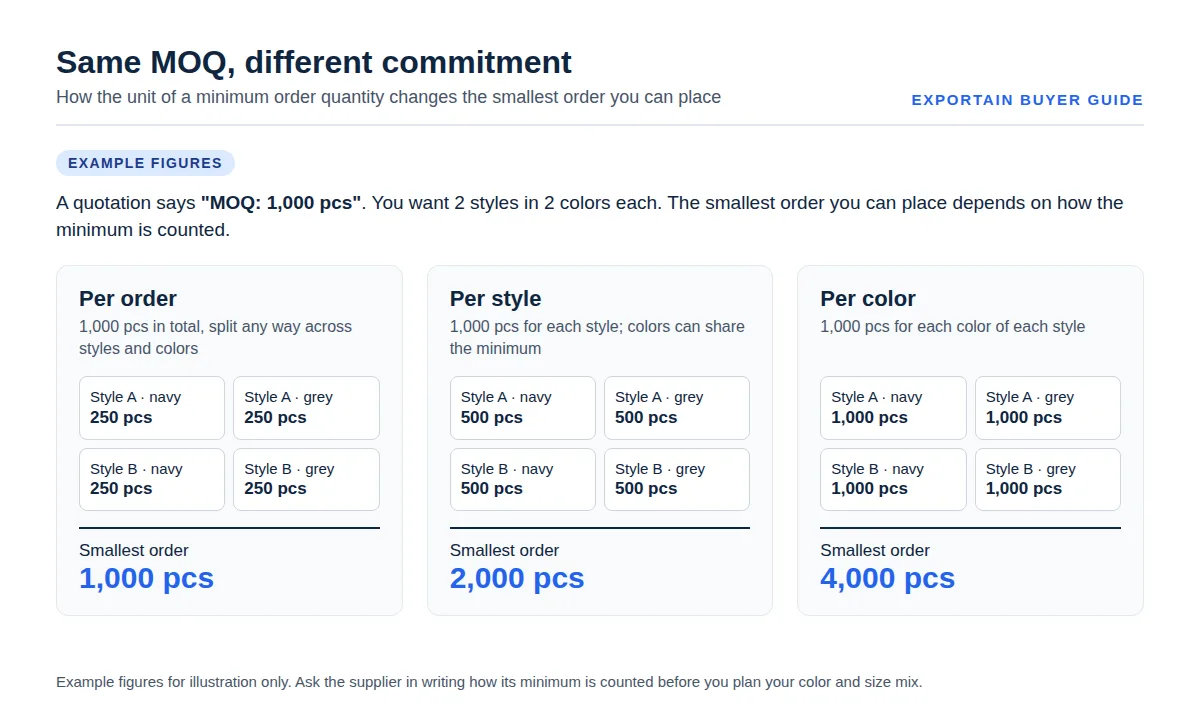
The same number can mean very different things, so read the unit of the minimum as carefully as the number.
How the MOQ is stated | What it means for you | Question to ask |
|---|---|---|
Per order (total pieces or total value) | You can split the minimum across several styles or colors | Is there also a minimum per style or per color? |
Per style or product | Each design must reach the minimum on its own | Can two styles that share a fabric count together? |
Per color | Each color of each style must reach the minimum | Can a color be dropped or replaced with a stock color? |
Per size or size range | Each size group, such as extended sizes, must reach a minimum | What is the minimum size breakdown you accept? |
CBI's example trading terms show two of these side by side: a minimum order shipment value on an FOB basis, and a minimum number of pieces per different product2. A supplier can apply both at once, so "1,000 pieces" may really mean "1,000 pieces per style, and at least a certain order value overall".
If a quotation says only "MOQ: 1,000 pcs", ask in writing how that minimum is counted before you plan your color and size mix.
How price tiers relate to quantity
Tiered pricing means the unit price falls in steps as the quantity rises. CBI lists quantity, together with quality, delivery date and payment terms, among the factors that change an apparel costing5. The same guidance gives a sense of why small orders cost more per piece. It notes there are no standard gross margins for garment manufacturers, and suggests anything from 12% for a big order for a value retailer to 45% for a small order of 100 pieces for a small brand (guidance dated 23 May 2023)5.
How Exportain listings show tiered prices
On an Exportain product page, a listing with tiered pricing shows each tier as a unit price above its quantity range, for example a range of "1,000 – 4,999 pcs" and a final open-ended tier such as "25,000+ pcs". A line underneath states the price basis and the minimum, in the form "Unit price, FOB Chittagong Port. Minimum order 1,000 pcs."6
When you type a quantity into the quantity box, the page highlights the tier that quantity falls into and shows a subtotal at that tier's price, labeled with the Incoterm (for example "Subtotal (FOB)"). Clicking a tier sets the quantity to the start of that tier. If you enter a quantity below the minimum order, the box moves back up to the minimum. A listing without tiers shows "Price on request" and asks you to request a quote with your quantity6. You can browse listings in a category such as RMG & Apparel and sort them by lowest MOQ.
Listed tiers are the supplier's published starting point. The price you actually agree is the one in the accepted quotation.
Watch the price breaks
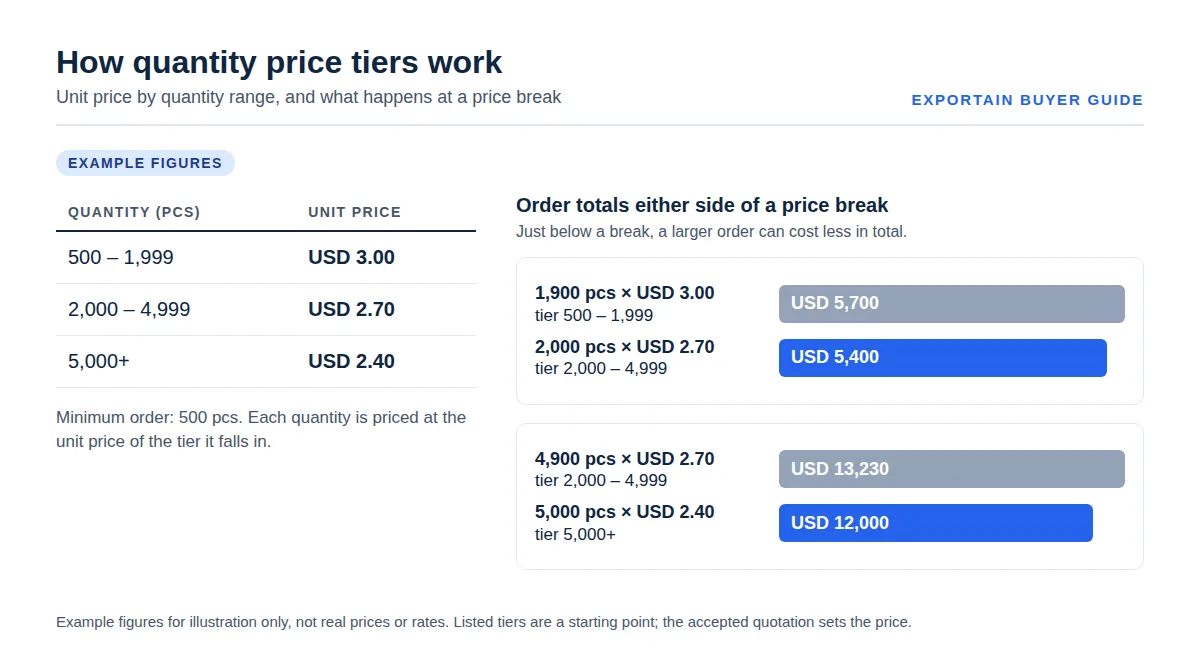
Tiered pricing has a quirk worth checking every time: just below a break, a larger order can cost less in total.
Example figures (not real prices): a supplier lists USD 3.00 per piece for 500–1,999 pieces and USD 2.70 for 2,000–4,999 pieces. An order of 1,900 pieces costs USD 5,700. An order of 2,000 pieces costs USD 5,400. If you can sell or store the extra 100 pieces, ordering at the break costs less in total.
Ways to reach a lower MOQ
None of the options below is guaranteed. Each one changes the supplier's costs, so raise them as questions and expect a trade-off.
Use stock or available fabric. Ask whether the style can be made from fabric the supplier or its mill already carries, instead of a custom color or construction. Stock fabric can take a custom fabric minimum out of the calculation4.
Reduce the number of colors and sizes. Fewer variants means fewer changeovers. If the MOQ is per color, two colors at the full minimum may be easier to agree than five colors below it2.
Accept standard trims and packaging. Custom labels, hang tags, printed polybags and branded cartons each bring their supplier's minimum with them3. Ask which of your trims are driving the minimum.
Offer to pay a small-order surcharge. CBI advises exporters to state in their quotations that an order below the quoted quantity will carry an upcharge5. Asking what that surcharge would be gives you a concrete number to decide on, instead of asking the supplier to absorb the cost.
Explain that it is a trial order, honestly. CBI notes that buyers often want to test a supplier before placing large orders, and that some exporters accept a first order below their normal MOQ for that reason4. It also warns exporters about buyers who keep placing only the difficult orders5. Share a realistic forecast. Do not promise volumes you cannot place.
Ask about small-run capacity. CBI describes factories that set up a sample room or a modular production set-up to handle small orders4. Ask whether the supplier has one.
Ask whether your order can share material or a run. Ask whether your fabric can be ordered together with another order that uses the same fabric, or whether your style can join a run the supplier has already planned. Whether this is possible depends entirely on the supplier and the timing, so ask rather than assume.
Common mistakes
Negotiating the number without the unit. Agreeing "500 pieces" when the supplier meant 500 per color.
Ignoring trims. A low garment MOQ can still come with a surcharge for custom labels or packaging.
Asking for the lowest MOQ and the lowest tier price together. The top-tier price assumes the top-tier quantity.
Treating a listing as a contract. Prices and minimums on a listing are the supplier's published terms. What binds both sides is the quotation you accept.
What to put in an RFQ so suppliers can answer on MOQ
The fastest way to get a useful answer is to give suppliers the numbers they use to work out a minimum. On Exportain's RFQ form, quantity and unit are required fields and the target unit price is optional. The specifications box is where the detail goes7. Include:
the quantity per style, per color and, if you know it, the size breakdown
the fabric composition and weight, and whether a stock fabric in a similar quality is acceptable
which trims and packaging must be custom and which can be standard
your target unit price and currency, if you have a realistic one
the Incoterm and destination, because freight and packing change the costing
whether this is a trial order, and a realistic forecast if there is one
Each quotation a supplier sends through Exportain states unit price, MOQ, lead time, Incoterm, payment terms and validity, and you can counter-offer in the same thread8. Exportain records the quotations but is not a party to the trade: it does not inspect goods, book freight or clear customs, and it holds money for a goods order only when both parties agree to a funds hold9. The negotiation and the final terms are between you and the supplier. For a full checklist, see How to write an RFQ that gets useful quotations.
Next steps on Exportain
Look up the short definition in the glossary entry MOQ (Minimum Order Quantity). When you are ready, post an RFQ with your quantity per style and color, or browse Bangladeshi suppliers and compare their listed tiers.
Sources
- About CBI. CBI, Netherlands Enterprise Agency (accessed )
- Terms & conditions for suppliers of home decoration and home textiles. CBI, (accessed )
- How to calculate the cost price of an apparel item?. CBI, (accessed )
- Entering the European market for babywear. CBI, (accessed )
- 11 tips for doing business with European apparel buyers. CBI, (accessed )
- 100% Organic Cotton Heavyweight Crewneck T-Shirts (180 GSM) — product listing. Exportain (accessed )
- Post an RFQ. Exportain (accessed )
- How to source and buy from Bangladesh. Exportain (accessed )
- About Exportain. Exportain (accessed )
About the author
Sourcing from Bangladesh?
Post a request for quotation and suppliers on Exportain can send you their quotes directly.
Post an RFQ