How to write an RFQ that gets useful quotations
A field-by-field guide to writing a request for quotation that suppliers can price accurately, including how public and private RFQs work on Exportain.
Short answer
An RFQ gets accurate quotes when it states the full product specification (materials, sizes, colors, packaging, labels and required certifications), the quantity and unit, a realistic target price and currency, the Incoterm, destination country and port, the delivery date you need, the payment terms you can offer, and the samples and documents you expect. Add a quotation deadline so suppliers know when to reply.
On this page
Key takeaways
Suppliers can only price what you describe. Put materials, sizes, colors, packaging and labels in writing.
Quantity, delivery date and payment terms all change a supplier's costing, so state them up front.
Name one Incoterm and destination so every quotation is priced on the same basis.
On Exportain, an RFQ is shown in the public directory only if you tick the box, and the public page leaves out your name and company.
Compare quotations on unit price, MOQ, lead time, Incoterm, payment terms and validity, not on price alone.
The short answer: the must-have fields
A request for quotation (RFQ) is your written description of what you want to buy and on what terms. Every question a supplier has to ask before quoting slows the process down, and every assumption a supplier makes can turn into a difference between the quotation and the goods. A good RFQ answers those questions before they are asked.
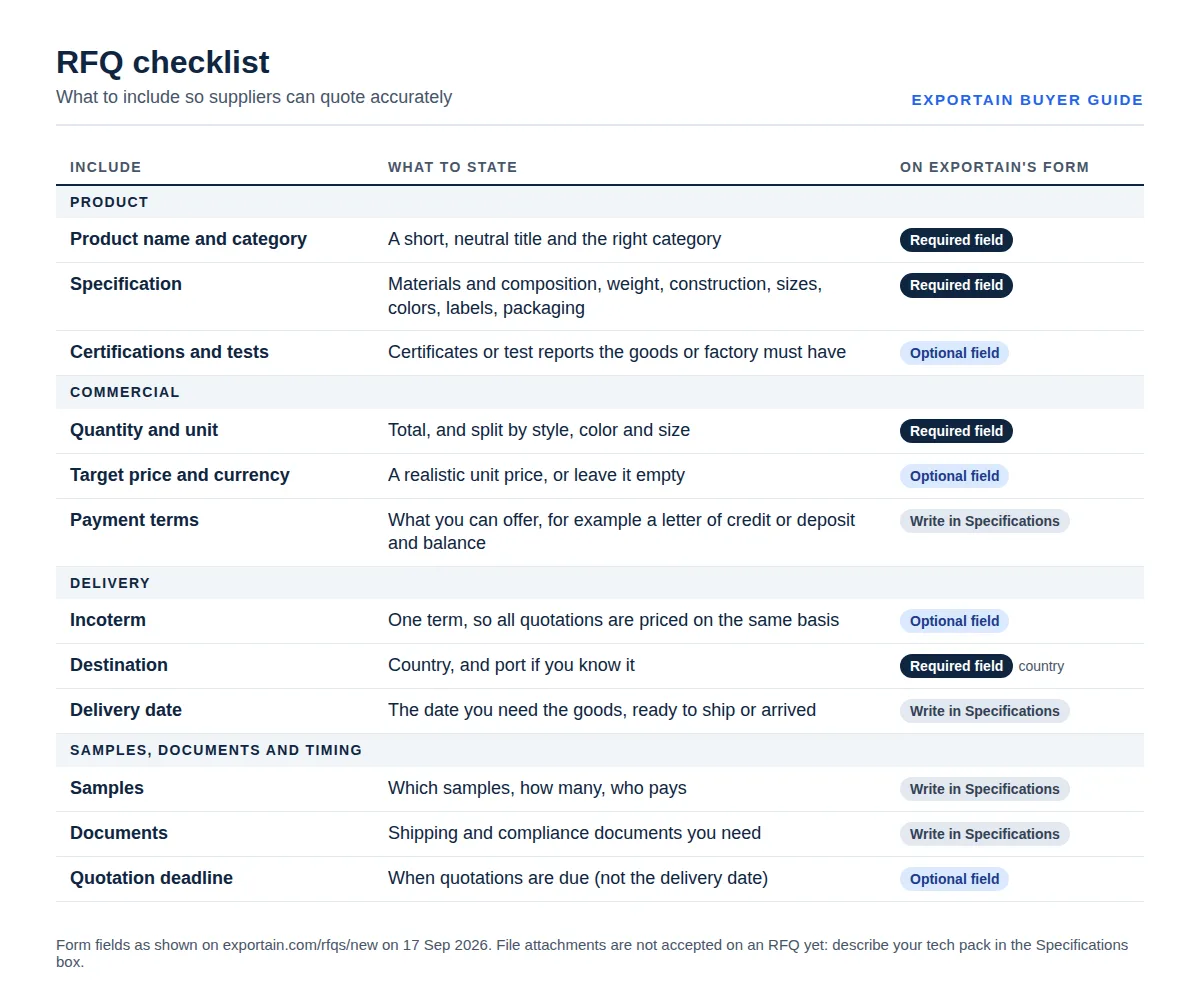
The table below lists what suppliers need and where each item goes on Exportain's RFQ form1.
What suppliers need | Field on Exportain's RFQ form | Required on the form |
|---|---|---|
A short name for the product | What are you sourcing? | Yes |
Product category | Category | Yes |
Full specification | Specifications | Yes |
Quantity and unit | Quantity, Unit | Yes |
Target price | Target unit price, Currency | No |
Where the goods go | Destination country; Destination port | Country yes, port no |
Price basis | Incoterm | No |
Certifications | Required certifications | No |
When quotations are due | Quotation deadline | No |
Delivery date, payment terms, samples, documents | No separate field: write them in Specifications | — |
The form's unit list runs from pieces, pairs, sets and dozens to kilograms, metric tons, meters, square meters, cartons and 20ft or 40ft HQ containers. Currencies offered are USD, EUR, GBP, JPY, CNY, AUD and CAD1. You need to be signed in to a buyer account to post an RFQ.
1. Product specification
Specification is where an RFQ does most of its work. CBI, a center for sustainable production and trade between low- and middle-income countries and Europe that is part of the Netherlands Enterprise Agency2, tells exporters that product details in a quotation should be specific enough to tell products apart, and gives the example that "rattan baskets" is not enough. Its list starts with materials, dimensions, techniques and colors3. What a supplier needs in a quotation is what you need to give in the RFQ.
For garments, CBI's advice to apparel exporters shows how much sits behind one price. A costing sheet should include cut-and-make labor, fabrics, the size breakdown, labels, buttons, badges, embroidery, printing, sewing thread, interlining, padding, hang tags, safety tags, polybag, carton box, export carton and wastage4. The same guidance notes that when a buyer asks only for "100% cotton", the exporter should ask for details such as yarn count, weight and finishing4. Save that round of emails by stating them.
Cover at least:
Materials and composition: fiber content by weight, fabric weight (for example GSM), construction (knitted or woven), finish
Sizes and size breakdown: size range and the quantity per size, or a ratio
Colors: number of colors and quantity per color; reference codes if you use them
Construction details: stitching, prints, embroidery, washes, trims
Labels and branding: main label, care label, hang tags, what is custom and what can be standard
Packaging: how each unit is packed, carton marks, pieces per carton
Certifications and tests: the certificates or test reports the goods or the factory must have
Exportain's form offers preset buttons for OEKO-TEX Standard 100, GOTS, BSCI, Sedex SMETA, ISO 9001:2015, LWG and HACCP / EU Seafood Standard1. If you need something else, name it in the specification. On product listings, certifications that a supplier lists are marked as declared by the seller and not verified by Exportain5, so ask for the documents with the quotation.
File attachments are not accepted on an Exportain RFQ yet. The form asks you to describe the tech pack in the specification, and suppliers can request the files once they respond1. CBI describes the tech pack in an apparel order contract as the document containing the product specifications, visual appearance, quantity and total value6, so summarize its key measurements and materials in the text.
2. Quantity, target price and currency
CBI lists quantity, quality, delivery date and payment terms as the factors, beyond materials and labor, that influence a garment costing4. Start with quantity. State the total quantity and how it splits across styles, colors and sizes. If you are testing a supplier with a smaller first order, say so. CBI advises exporters to tell buyers that an order below the quoted quantity will carry an upcharge4, so a quotation based on 5,000 pieces may not hold for 2,000.
A target price is optional on Exportain's form1. A realistic one helps. It tells suppliers whether the specification and the budget belong together before they spend time costing. A target far below what the specification costs to make leaves a supplier two choices: decline, or quote a cheaper specification you did not ask for. If you do not have a target, leave the field empty rather than guessing.
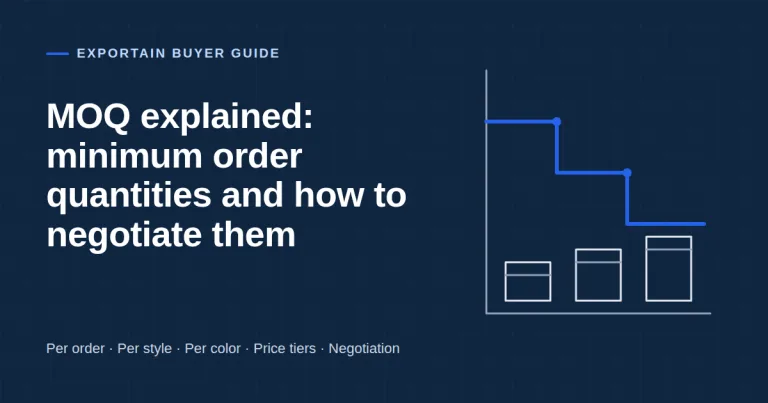
Choose the currency you want to be quoted in, so you are not comparing quotations across exchange rates. For more on quantity and price breaks, see MOQ explained.
3. Incoterm, destination and delivery date
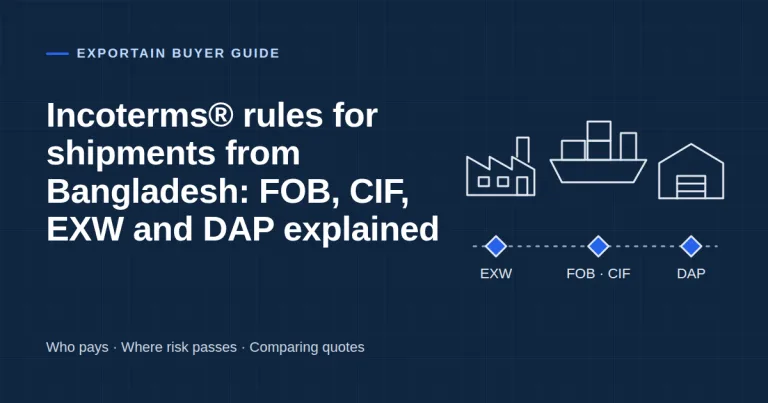
Incoterms® rules are the International Chamber of Commerce's three-letter trade terms that clarify the tasks, costs and risks involved in delivering goods from seller to buyer. The current version, Incoterms® 2020, entered into force on 1 January 20207. The Incoterm tells a supplier what its price must include. CBI reminds exporters that a quotation must specify which costs are included, and that this depends on the Incoterm3.
Exportain's form offers FOB, CIF, CFR, EXW and DDP, or "Other / to be agreed", and you can leave the field as "Not specified"1. Pick one if you can. Quotations on different Incoterms are hard to compare. Incoterms for shipments from Bangladesh explains the difference.
Destination country is required and destination port is optional1. Fill in the port if you know it, especially if you ask for a price that includes carriage to your side, such as CIF.
Note that the form's quotation deadline is the date quotations are due, not your delivery date. Leaving the deadline blank keeps the RFQ open with no closing date1. Write the date you need the goods, and whether that means ready to ship or arrived, in the specification.
4. Payment terms you can offer
Payment terms affect what an order costs the supplier, and CBI lists them among the factors that move a costing4. CBI also lists payment terms first among the trading terms an exporter should set out in a quotation3. State what you can offer: for example a letter of credit, or a bank transfer with a deposit and a balance, and when each part is paid. The pillar guide How to import from Bangladesh compares the common structures.
On Exportain, payment is agreed and settled directly between you and the supplier. Exportain holds money for a goods order only when both parties agree to a funds hold; otherwise payment is settled directly between buyer and supplier8.
5. Samples and documents you expect
Say which samples you need before bulk production, how many, and whether you will pay for them and their courier cost. Samples cost the supplier money: CBI warns apparel exporters that some larger buyers ask for many salesman samples free of charge, and advises including sample costs in the quotation4. Some Exportain listings show whether samples are available and at what price5.
List the documents you need with the shipment and for your own customs clearance, such as the commercial invoice, packing list, transport document, certificate of origin and any test reports. Export documents from Bangladesh covers what each one is. CBI notes that European apparel buyers' supplier manuals cover quality standards, labeling, measurement accuracy, payment and delivery terms, packing, insurance and documentary requirements6. If you have such a manual, summarize the parts that affect price.
6. Public and private RFQs on Exportain
Who sees your RFQ depends on how you post it1.
Posted from the RFQ form: the RFQ is published to the marketplace, and any registered supplier can quote against it. Supplier matching is queued as soon as the RFQ is published1. Suppliers in that category can view it and quote8.
Addressed to one supplier: start from a supplier's profile or listing and tick the box to address the RFQ to that supplier only. An RFQ raised from a listing or addressed to one supplier is never shown publicly on Exportain1.
Shown in the public RFQ directory: only if you tick "Show this RFQ publicly on Exportain without your name or company". The box is not ticked unless you tick it. Suppliers can then find your RFQ in the public RFQ directory and send a quotation1 9.
The public RFQ page shows the RFQ title, category, quantity and unit, destination country, Incoterm, required certifications, quotation deadline and whether it is still accepting quotations. Your name and company are not shown publicly1. Your specification text, target price and destination port are not on the public page either. Suppliers who quote on your RFQ through their Exportain account can see the full requirement, including those details and your company name, so that they can price it.
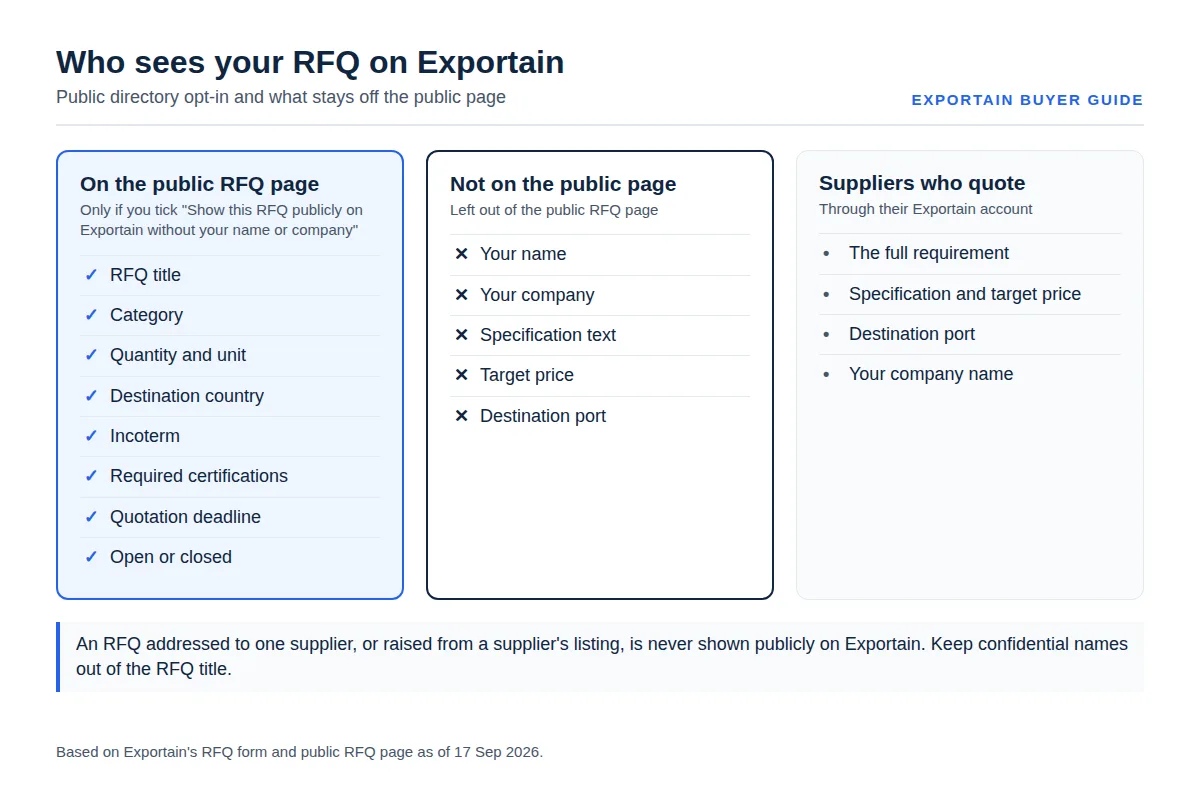
Because the title is public, keep it descriptive and neutral. "Men's cotton knitted T-shirts, 180 GSM" works. A brand name, a retailer's name or a confidential project name does not belong there.
7. Comparing the quotations you receive
On Exportain, every quotation is versioned and states unit price, MOQ, lead time, Incoterm, payment terms and validity. You can counter-offer in the same thread, and accepting a quotation creates an order record with those terms8 and a proforma invoice10. The RFQ, every quotation version and the accepted terms are stored on the platform, and both sides see the same history10.
When you compare:
Put them on the same basis. Convert quotations to one Incoterm and destination before comparing price. Landed cost shows how.
Check the MOQ against your quantity. A low unit price with an MOQ above your order is not a price you can use.
Compare lead time with your delivery date. Ask whether lead time counts from order confirmation, sample approval or deposit.
Read the payment terms. A slightly higher price with terms you can meet may be the better offer.
Check validity. CBI advises exporters to state how long a quotation is valid, because fabric prices and exchange rates move4. Accept, or ask for an extension, before it expires.
Look for what is missing. If one quotation is much lower, check whether it leaves out labels, packaging, testing or samples that your specification asked for.
Exportain is not a party to the trade. It does not inspect goods, book freight or clear customs, and it holds money for a goods order only when both parties agree to a funds hold10. Samples, inspection and payment conditions remain yours to agree in writing with the supplier.
Common mistakes
One-line specifications. "Cotton T-shirts, best price" invites quotations for different products.
Confusing the quotation deadline with the delivery date. They are separate, and only one has a field on the form.
No Incoterm. You receive FOB, CIF and EXW prices and cannot compare them.
Confidential details in the title. The title is visible on a public RFQ.
Comparing unit prices only. MOQ, lead time, payment terms and validity decide whether a price is usable.
Next steps on Exportain
Post an RFQ with the fields above, or check the public RFQ directory for open buying requests. For the full buying process, read How to Buy.
Sources
- Post an RFQ. Exportain (accessed )
- About CBI. CBI, Netherlands Enterprise Agency (accessed )
- 9 tips for doing business with European home decoration and home textile buyers. CBI, (accessed )
- 11 tips for doing business with European apparel buyers. CBI, (accessed )
- 100% Organic Cotton Heavyweight Crewneck T-Shirts (180 GSM) — product listing. Exportain (accessed )
- 10 tips for organising your apparel exports to Europe. CBI, (accessed )
- Incoterms® rules. International Chamber of Commerce (ICC) (accessed )
- How to source and buy from Bangladesh. Exportain (accessed )
- RFQs & Buying Leads from International Buyers. Exportain (accessed )
- About Exportain. Exportain (accessed )
About the author
Sourcing from Bangladesh?
Post a request for quotation and suppliers on Exportain can send you their quotes directly.
Post an RFQ