CPT vs DDP: Key Differences, Costs and Which One to Choose
Under CPT you clear the import and pay the duty and VAT; under DDP the seller does, as importer of record. A worked garment example to the UK shows the two terms match in gross cost but differ by $6,061 net, because the import VAT the seller pays cannot be reclaimed.
Short answer
Under CPT the seller pays the carriage to your named place and you clear the import, pay the duty and import VAT, and carry the risk from the first carrier in Bangladesh. Under DDP the seller also clears the import, pays the duty and import VAT, and acts as importer of record, carrying the risk to your door. For a UK buyer the VAT is the deciding line, because a seller with no UK VAT registration cannot reclaim it.
On this page
Key takeaways
DDP is the only Incoterms 2020 rule that makes the seller clear the import, pay the duty and import VAT, and act as importer of record.
Under CPT the buyer clears the import and carries the risk from the first carrier in Bangladesh, while the seller only pays the carriage.
UK import VAT runs at 20 percent on the goods plus freight, insurance and duty, and only a VAT-registered buyer can reclaim it.
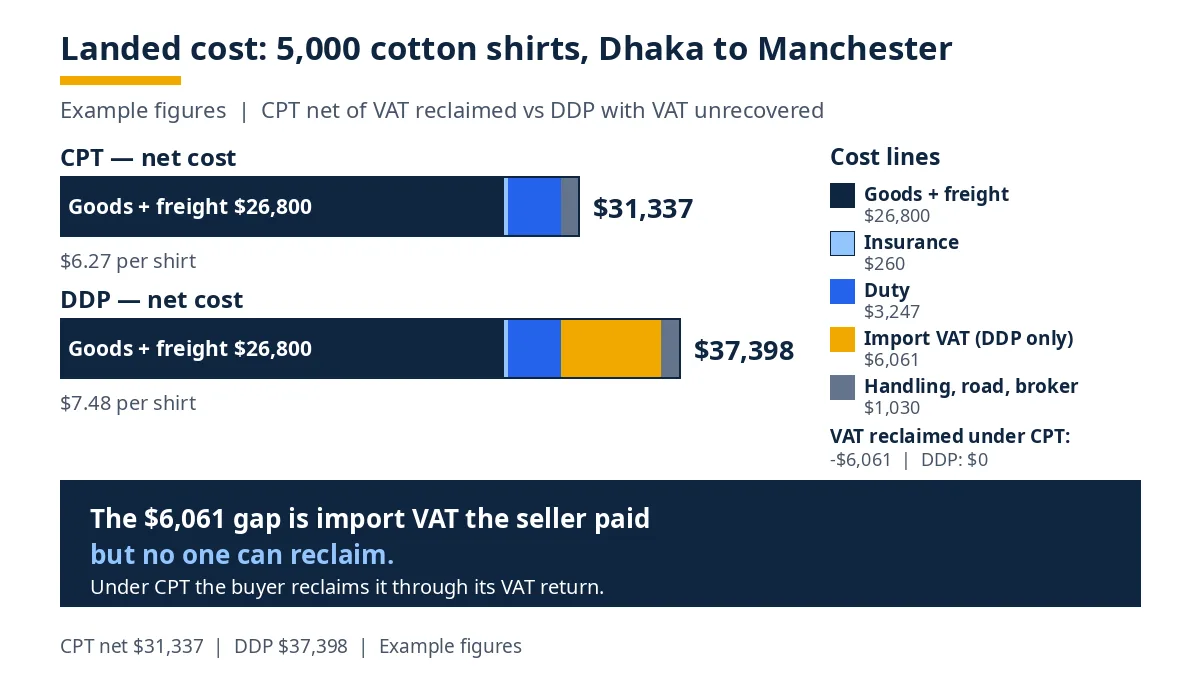
Example figures put 5,000 cotton shirts to Manchester at $31,337 net under CPT and $37,398 under DDP, a $6,061 gap that is import VAT no one can reclaim.
A buyer in Manchester asks a Dhaka supplier for 5,000 men's cotton shirts on two terms: CPT Manchester and DDP Manchester warehouse. The DDP price is higher by more than ten thousand dollars, and the difference is not the freight. The gap is the border, where DDP makes the seller take on the clearance, the duty and the import VAT.
CPT and DDP are two of the eleven Incoterms 2020 rules.1
The duty-paid burden comes first
Under DDP the seller carries the heaviest obligation of any Incoterms rule: export clearance, carriage, risk to the named place, import clearance, duty and import taxes, while the buyer only receives the goods.2 That is the appeal of DDP, and also the risk: the seller takes on work in a country where it has no office or registration.
The party that clears the import is normally named as the importer of record, and stands behind the declaration, the classification, the customs value and the duty and import VAT due.3 If the classification is wrong, the bill can arrive long after delivery, and under DDP it arrives with the seller.3
CPT and DDP at a glance
Question | CPT | DDP |
|---|---|---|
Carriage paid by the seller as far as | The named destination | The named destination |
The seller has delivered when | The first carrier takes the goods in Bangladesh | The goods reach your named place |
You carry the risk from | The first carrier taking the goods | Arrival at your named place |
Cargo insurance the rule demands | None; buy your own policy | None; the seller normally covers its own risk |
Import clearance handled by | You | The seller |
Import duty paid by | You | The seller |
Import VAT paid by | You | The seller |
Importer of record | You | The seller |
Transport modes | Any, alone or combined | Any, alone or combined |
CIF and CIP are the only rules that force the seller to buy cargo cover, so CPT and DDP promise no policy.1 You unload under both rules; DPU is the one rule that puts unloading on the seller. Our CPT vs DAP and CIF vs DDP comparisons cover the same choice from other starting points.
What CPT asks of you
CPT is short for Carriage Paid To. The seller books and pays the carriage to the destination you name, but the risk is yours from the moment the first carrier takes the goods at origin.1 Put both points in the contract: the handover point and the destination. A container damaged at sea is your loss to claim, so buy cover that starts at the first-carrier handover. The border work is yours: you appoint the broker, file the entry, pay the duty and the VAT, and take the goods from the port. That keeps the VAT on your own record, where a VAT-registered buyer can reclaim it.
What DDP asks of the seller
DDP is short for Delivered Duty Paid. The seller brings the goods to the place you name, paying export clearance, carriage, import clearance, duty and taxes, and holds the risk until the goods are at your disposal, still on the vehicle and ready to unload.2 EXW is the mirror image: the buyer takes every responsibility from the seller's door.2 The hard part is the legal standing, not the money: in most countries only a locally registered entity can act as the official importer of record, so a foreign seller with no local office cannot legally file the import entry itself.2 The usual route is an importer-of-record service, a local firm appointed by the seller that files the declaration, pays the duty and the VAT, and carries the compliance exposure.2 Before you accept a DDP quotation, ask who the importer of record will be by name. If the seller cannot name it, the quotation is not a DDP price.
Duty and import VAT: two charges, two treatments
Duty and import VAT are two different charges. Duty is a cost: once paid, it is gone. Import VAT is a tax, and getting it back decides whether DDP is an inconvenience or a margin problem.3
In the United Kingdom, import VAT is charged at the standard rate of 20 percent on most goods, and customs duty is a separate charge that depends on the goods and their origin.4 The VAT is charged on the VAT value, the goods plus shipping and insurance to the UK with any duty added first.4 A VAT-registered buyer can normally reclaim import VAT, with a C79 certificate or a postponed VAT statement as evidence, and postponed VAT accounting lets the buyer declare and reclaim it on the same VAT return, with no cash paid at the border.4 Under DDP the seller pays the import VAT at the border, calculated on the customs value rather than the sale price.3 A Dhaka exporter has no VAT registration in the buyer's country, so the amount stays inside the DDP price as a cost.3
Worked example: 5,000 cotton shirts from Dhaka to Manchester
Example figures. A buyer in Manchester orders 5,000 men's cotton shirts from Dhaka, goods worth $24,000, shipped from Chattogram to Felixstowe and then by road to Manchester. Duty is an example 12 percent, and import VAT is the UK standard rate of 20 percent.4 The customs value is goods plus freight plus insurance, $27,060.
Cost line | Under CPT | Under DDP |
|---|---|---|
Goods, packing and export clearance | $24,000, in the seller price | $24,000, in the seller price |
Ocean freight, Chattogram to Felixstowe | $2,800, in the seller price | $2,800, in the seller price |
Cargo insurance | $260, paid by the buyer | $260, in the seller price |
Seller price | $26,800 | $37,278 |
Import duty, example 12% of the $27,060 customs value | $3,247, paid by the buyer | $3,247, in the seller price |
Import VAT, 20% of the $30,307 VAT value | $6,061, paid by the buyer | $6,061, in the seller price |
Port handling at Felixstowe | $320, paid by the buyer | $320, in the seller price |
Road leg to Manchester | $410, paid by the buyer | $410, in the seller price |
Broker and clearance fees | $180, paid by the buyer | $180, in the seller price |
Unloading at the Manchester warehouse | $120, paid by the buyer | $120, paid by the buyer |
Gross total the buyer pays | $37,398 | $37,398 |
Less import VAT reclaimed | -$6,061, through the buyer's VAT return | $0, the seller holds no UK VAT registration |
Net cost to the buyer | $31,337 | $37,398 |
Duty is 12 percent of the $27,060 customs value, $3,247.20, rounded to $3,247. The VAT value is the customs value plus the duty, $30,307, and 20 percent of that is $6,061.40, rounded to $6,061.4 Both columns land on the same gross total, $37,398, because the same legs are paid either way and only the payer changes.
Under CPT the buyer is VAT-registered, so the $6,061 of import VAT is reclaimed and the net cost is $31,337, or $6.27 per shirt. Under DDP the VAT sits on the seller's record, where no one can reclaim it, so the net cost is $37,398, or $7.48 per shirt.
Where DDP cannot be used
Where the destination's customs rules say only the local buyer may clear the import, DDP is off the table. The ICC names DAP as the rule for those countries.3 The failure is silent until it is expensive: you find out at the border, with the shipment already in transit.3
The European Union adds a second wall: the Union Customs Code states that the declarant shall be established in the customs territory of the Union, and the exceptions are narrow.3 The way through is indirect representation by a customs representative established in the Union.3
When DDP still wins
DDP wins when the buyer has no customs expertise, no broker and no import registration, and wants one price to the door.2 It fits a first or small order, and the marketplace pattern, where a seller ships small parcels direct to consumers.
For consumer sales into the EU there is a third route: the Import One-Stop Shop covers distance sales of low-value goods not exceeding 150 euros, letting the seller charge the customer's VAT at checkout and account for it through a single return.3 It applies to consumers, not to business-to-business sales.3
If you are VAT-registered and you import regularly, CPT usually leaves you better off, because you reclaim the import VAT and you control the clearance. If you are not VAT-registered, or you buy once and want no border work at all, DDP usually leaves you better off. Ask for both quotations, with the duty, VAT and broker lines separated.
The Bangladesh side: export file and the DDP quote
Export clearance sits with the seller under both terms, and the export file is the same either way. Bangladesh Customs issues the shipping bill once the exporter applies, and no cargo loads without it; the same bill supports a duty drawback claim.5 The file behind the bill runs through the exporter's bank: invoice, packing list, the EXP declaration the bank certifies, origin papers, VAT registration and the export registration certificate.5 At Chattogram the declaration goes in through ASYCUDA.5
What changes under DDP is what the seller must arrange after the goods leave Bangladesh: a named importer of record, a broker that will file the entry, and a duty and VAT figure for the HS code. A seller that quotes DDP without those three answers is guessing at the largest lines in the price. Our DDP customs clearance guide covers the destination side, and our landed cost guide shows how to build the full cost picture.
Five questions to settle before you sign
Who is the importer of record, by name, and under what registration. If the seller cannot name it, do not accept a DDP price.
What is the duty rate for the HS code, and what customs value is it charged on. Ask for the duty line on its own.
What happens to the import VAT. Ask whether it is recoverable under the term chosen, and get the answer in writing.
Who insures the cargo, at what clause level and sum insured. Neither rule obliges a policy, so write the cover into the contract.1
What the named place is, in full. Write the warehouse address, not just the city, and name the edition.
Questions buyers ask about CPT and DDP
Is DDP always more expensive than CPT?
Not in gross terms: both cost the buyer $37,398 in the worked example. The difference appears after the VAT return, when a VAT-registered buyer reclaims $6,061 under CPT and nothing under DDP.
Can a Dhaka seller be the importer of record in the UK?
Only through a local arrangement: the seller needs a UK-established importer of record or service to file the entry.2 Ask who files and what the service costs before you accept the price.
Can I reclaim the import VAT under DDP?
No, not as the buyer. The VAT sits on the importer's record, and under DDP the importer is the seller.3 A VAT-registered buyer that wants to reclaim import VAT should take CPT.4
Does CPT cover the goods if they are damaged in transit?
No. Under CPT the risk passes to you at the first carrier in Bangladesh, and neither rule obliges anyone to insure the goods.1
Next steps on Exportain
Get a price on both terms for the same order to the same place, with duty, VAT, broker and insurance shown as separate lines. Then find Bangladeshi suppliers and raise an RFQ with the term, the place and the edition named. Our Incoterms guide sets out every rule in the set.
Sources
- Incoterms® 2020. International Chamber of Commerce (ICC) (accessed )
- DDP Incoterms (Delivered Duty Paid) — Complete Guide. GCE Logistics (accessed )
- DDP vs DAP explained: who pays import VAT and duty. Quaderno (accessed )
- Import VAT and customs duties: What UK businesses need to know. Xero, (accessed )
- Bangladesh Trade Portal FAQ: Export Registration Certificate (ERC). Bangladesh Trade Portal (accessed )
About the author
Sourcing from Bangladesh?
Post a request for quotation and suppliers on Exportain can send you their quotes directly.
Post an RFQ