CPT vs DAP: Key Differences, Costs and Which One to Choose
CPT and DAP both put the freight on the seller, but they part company on risk. Compare the cost split, the risk point, insurance and customs, with a worked cotton-towel example from Chattogram to Dallas.
Short answer
Under CPT the seller pays carriage to your destination, but risk passes to you when the goods are handed to the first carrier in Bangladesh. Under DAP the seller pays the carriage and carries the risk to your named place, ready for unloading. Import clearance, duty and unloading stay with you under both rules, and neither rule obliges anyone to insure. Choose CPT for your own insurance; choose DAP for one delivered price with the seller carrying the risk.
On this page
Key takeaways
CPT and DAP both put the carriage on the seller; the split is risk, not money. Under CPT risk passes at the first carrier in Bangladesh, under DAP at your named place.
Under CPT the seller delivers when the goods reach the first carrier, often a Dhaka or Chattogram terminal, days before the vessel sails.
Import clearance, duty, taxes and unloading stay with the buyer under both rules; DAP is not duty-paid, and only DPU makes the seller unload.
Example figures price the same towel shipment at $23,575 under both terms; the CPT invoice is $220 lower because the insurance sits outside it.
A buyer in Dallas asks a Dhaka supplier for cotton towels on two terms. One quotation reads CPT Dallas, the other reads DAP Dallas warehouse. Both prices include the ocean freight from Chattogram to Houston, and the two invoices sit about two hundred dollars apart. The goods, the vessel and the sailing are the same. The gap is who carries the risk while the cartons cross the ocean, and who insures them if the container is lost.
Quick verdict: CPT vs DAP at a glance
Question | CPT | DAP |
|---|---|---|
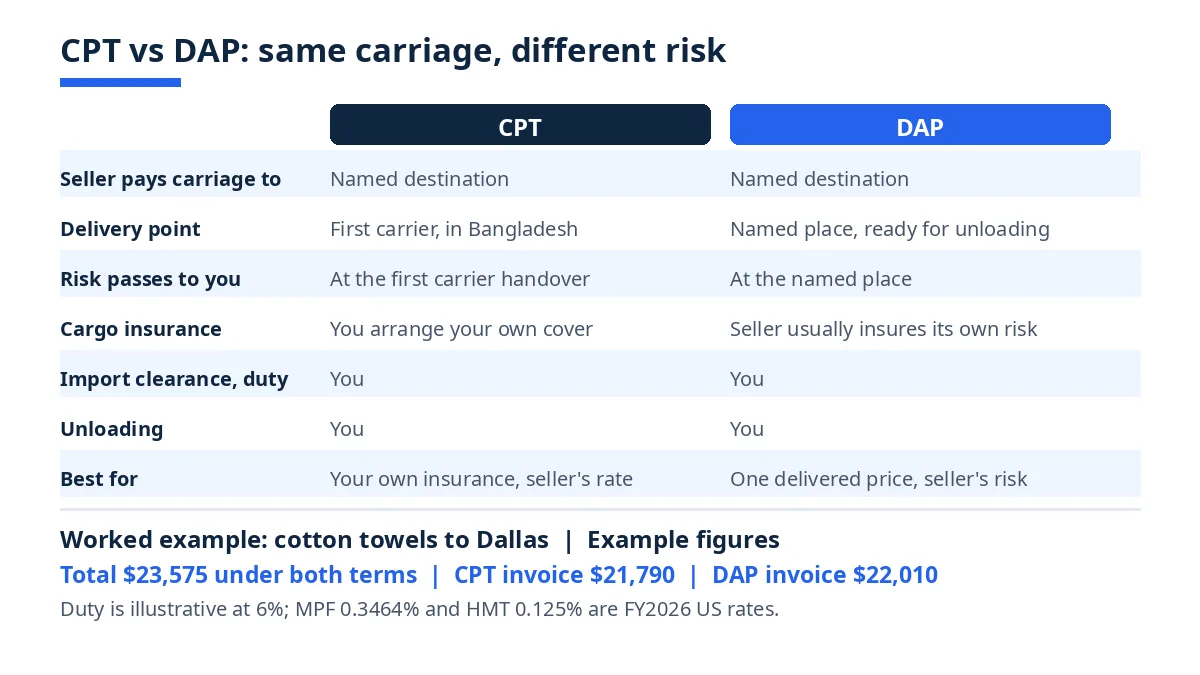
Seller pays carriage to | Named place of destination | Named place, ready for unloading |
Delivery happens | Goods handed to the first carrier, in Bangladesh | Goods at your disposal at the named place |
Risk passes to you | At the first carrier handover | At the named place |
Cargo insurance | No party must insure; you arrange your own cover | No party must insure; the seller usually insures its own risk |
Import clearance, duty, taxes | You | You |
CPT and DAP charge you the same carriage; they differ on risk. If you want the seller's freight rate and your own insurance, CPT fits. If you want the seller to answer for the goods until the truck reaches your warehouse, DAP fits. Both rules come from Incoterms 2020, in force since 1 January 2020.1
What CPT means for a buyer
CPT stands for Carriage Paid To. Under CPT the seller books and pays the carriage to the place named as the destination, while the risk moves to you when the goods are passed to the first carrier at origin, not when they reach the destination.2
CPT has two places. The delivery point is the place where the seller passes the goods to the first carrier and the risk passes, usually at the seller's dock, a forwarder's warehouse or an origin terminal. The named destination is the place written after the letters CPT; the seller's carriage duty runs to there.3 On a Dhaka to Dallas shipment, delivery is likely a terminal in Bangladesh while the destination named in the contract is Dallas. The freight runs to Dallas; the risk stopped at the first carrier, thousands of miles earlier.3
CPT sits in the C group, where the seller pays the freight onward after the risk has already moved to the buyer.2 CPT works for any mode, and it fits containerised cargo handed to a terminal days before the vessel sails.2
What DAP means for a buyer
DAP stands for Delivered at Place. Under DAP the seller delivers the goods to your named place of destination, bearing all costs and risks until the goods arrive, ready for unloading. From that point you take over: import clearance, duties and taxes, and unloading.4
Under DAP the seller arranges and pays for the full chain of transportation, completes export clearance and any transit formalities, and bears the risk for the whole journey.4 Delivery and the transfer of risk happen at the same place: the goods are placed at your disposal on the arriving vehicle at the named place, still loaded and ready for unloading.4
DAP applies to all modes of transport.4 DAP replaced DDU, the older Delivered Duty Unpaid term, in the Incoterms 2010 revision, and it remains the current rule under Incoterms 2020.4 Under DAP the buyer bears all risks during import clearance, and if the buyer fails to clear the goods, the risk passes to the buyer from the agreed delivery date.4 DAP is a delivered price, not a duty-paid one. The rule that hands import clearance and duty to the seller is DDP, not DAP.4 Only DPU makes the seller unload.1
The one real difference: where risk passes
Follow one shipment from Dhaka to Dallas: factory truck, forwarder's terminal, Chattogram, ocean to Houston, road to Dallas. The seller's carriage covers the whole chain under both rules. The risk does not. Under CPT the risk passes at the first step, when the cartons are handed to the first carrier in Bangladesh. Under DAP it passes at the last step, when the truck stands at your Dallas warehouse with the goods still loaded.
On an invoice the two rules look like twins; on a claim they are opposites. The seller pays freight under both, but under DAP it carries the risk to destination, and under CPT you have carried it since origin.3 Name both points in the contract: "CPT Dallas, delivery at the seller's premises, Dhaka".3 On the DAP side, write the full warehouse address into the contract, not just the city.
Worked example: cotton towels from Chattogram to Dallas
Example figures. A buyer in Texas orders 2,400 cartons of cotton bath towels from a supplier in Dhaka, goods worth $18,400, shipped from Chattogram to Houston by sea and then by road to Dallas. The figures are illustrative. The CPT named place is Dallas; the DAP named place is the Dallas warehouse. The carriage sits with the seller under both rules, so what differs between the prices is the insurance, not the freight. Our Incoterms guide lists all eleven rules with their delivery and risk points.
Cost line | Under CPT | Under DAP |
|---|---|---|
Goods, packing, export clearance | $18,400, in the price | $18,400, in the price |
Carriage, Chattogram to Dallas (ocean $2,600, handling $310, road $480) | $3,390, paid by the seller | $3,390, paid by the seller |
Cargo insurance | $220, paid by the buyer | $220, paid by the seller |
Import duty, illustrative 6% of $22,010 | $1,321, paid by the buyer | $1,321, paid by the buyer |
US entry fees, MPF 0.3464% plus HMT 0.125% of $22,010 (MPF $76, HMT $28) | $104, paid by the buyer | $104, paid by the buyer |
Unloading at the Dallas warehouse | $140, paid by the buyer | $140, paid by the buyer |
Total the buyer pays | $23,575 | $23,575 |
Both columns land on $23,575, or $9.82 per carton. The CPT invoice is $21,790 and you pay the other $1,785 yourself; the DAP invoice is $22,010 and you pay the remaining $1,565. The gap is $220, the insurance premium that moves to the seller's side under DAP.
The duty line uses an illustrative 6 percent on a $22,010 value (goods $18,400, carriage $3,390, insurance $220), giving $1,320.60, rounded to $1,321. Customs value rules differ by destination, so confirm the dutiable value with your broker before you settle the term. The two US fees are real: the Merchandise Processing Fee is 0.3464 percent of the cargo's value for fiscal year 2026, and the Harbor Maintenance Tax is 0.125 percent of the cargo value on seaport arrivals.5
Insurance: neither rule obliges a policy
Only two Incoterms rules impose an insurance duty: CIP and CIF. Under CPT and DAP, neither party is contractually required to buy cargo insurance.5 Under CPT the exposure is yours from the first carrier handover, so buy cover that starts at that point, not at the port.5
Under DAP the seller carries the transit risk and usually buys cover at its own expense, although the rule asks for no policy at all.4 If the cargo is worth protecting, put the cover in writing in the contract: which clause level, what sum insured, and who pays the premium. CIP is the upgrade when you want the seller to insure under an any-mode rule: the seller must provide Institute Cargo Clauses (A) cover of at least 110 percent of the contract value.3 Our CIF vs DAP comparison covers the sea-only insured version of this choice, and FOB vs DAP looks at the term where the buyer books and pays the freight.
Customs and import clearance: the buyer clears under both rules
The two rules part company on risk, but they meet again at the border. Under both, the seller files the export clearance and you handle the import entry, the duty and the taxes, as the importer of record.4
For a US import, the buyer files a formal entry with US Customs and Border Protection using CBP Form 7501, the Entry Summary, declaring the value, origin and classification of the goods.5 Ocean shipments carry one more buyer duty: the Importer Security Filing, known as the 10+2, must reach CBP at least 24 hours before the cargo is loaded onto the vessel headed for the United States. and a late or inaccurate filing can trigger liquidated damages of $5,000 per violation.5
Under DAP, if your clearance failure holds the goods up, the risk may pass to you from the agreed delivery date, and you must reimburse the seller for any additional costs.5 Under CPT the risk is already yours, so a clearance delay costs you demurrage and detention directly.
Bangladesh points to settle before you sign
Export clearance sits with the seller under both rules, and the export file is the same either way: invoice, packing list, Shipping Bill and certificate of origin. Declarations at Chattogram go through the ASYCUDA system, and certificate of origin procedures run through the Export Promotion Bureau.6
A container usually reaches the terminal days ahead of the sailing, so it is not on board at the point a sea-only rule names. CPT reflects what actually happens, because delivery is the handover to the carrier at the terminal.3 Our CFR vs CPT comparison covers the sea-only version of that choice. Sea-only rules do not apply to air freight from Dhaka at all, while CPT and DAP both do.2
Mistakes that cost buyers money
Reading "carriage paid" as "risk paid". The freight is paid to Dallas; the risk is yours from the first carrier in Bangladesh. A claim for transit damage goes to your insurer, not to the seller.2
Naming only the destination under CPT. The place named after the letters is where the money stops, not where the risk starts.3
Assuming the DAP price includes duty and unloading. It covers delivery to the named place, not the duty. You clear import, pay the duty and unload them.4
Which term should you choose?
Choose CPT when you hold your own cargo policy and want the seller's freight rate without handing it the transit risk. It fits a regular importer with a broker and an insurer already in place.2
Choose DAP when you order now and then, run no forwarder of your own, and want one seller price to your warehouse. It fits a first order from a new supplier, and a destination away from the port, where the road leg is part of what you are buying.4
FAQs
Which is cheaper, CPT or DAP?
Neither, on the same shipment. The CPT seller price is lower because it leaves the insurance out; the DAP seller price is higher because it contains it. In the worked example above, both cost the buyer $23,575 in total.
Which is safer for first-time importers?
DAP, because the seller carries the transit risk until the truck reaches your named place. You still clear import and pay the duty yourself.4
Can I switch terms after the purchase order?
Only if both sides agree in writing, and only before the goods move. Under CPT the risk moves when the goods reach the first carrier, so a switch agreed after loading cannot move risk that has already passed to you.
Can I use CPT for containerised cargo?
Yes. CPT is the natural fit for containers, because delivery is the handover to the first carrier at the terminal. Sea-only rules name a delivery point on board the vessel, which a container handed to a terminal days before sailing does not match.3
Next steps on Exportain
Pick the term from the risk point: CPT when you want the seller's carriage with your own insurance, and DAP when you want the seller to carry the risk to your warehouse. To get prices on either basis, look up Bangladeshi suppliers and raise an RFQ naming the rule, the place and the edition.
Sources
- Incoterms® 2020. International Chamber of Commerce (ICC) (accessed )
- CPT (Carriage Paid To) Meaning in Incoterms: Risk Transfer and Who Pays. GoFreight, (accessed )
- CPT Incoterm: Carriage Paid To, Risk vs Cost. Linbis (accessed )
- DAP Delivered at Place: Definition, Costs & Responsibilities. DHL (accessed )
- What Are DAP Incoterms? Delivered at Place Explained. LegalClarity (accessed )
- Bangladesh Trade Portal FAQ: Export Registration Certificate (ERC). Bangladesh Trade Portal (accessed )
About the author
Sourcing from Bangladesh?
Post a request for quotation and suppliers on Exportain can send you their quotes directly.
Post an RFQ