FOB vs DAP: Key Differences, Costs and Which One to Choose
FOB stops at the vessel in Chattogram; DAP carries the goods to your warehouse. Here is who pays for each step, where the risk passes, and which rule fits your order.
Short answer
Under FOB, the buyer books and pays the freight, and risk passes once the goods are on board the vessel at Chattogram. Under DAP, the seller pays the carriage to the named place at destination, and risk passes only when the goods arrive there, ready for unloading. Under both rules the buyer clears import, pays duty and unloads. FOB suits regular importers with their own forwarder; DAP suits occasional buyers and inland destinations.
On this page
Key takeaways
Under FOB the buyer pays the freight; under DAP the seller pays the carriage to the named place.
Risk passes on board the vessel under FOB, and at the named place, ready for unloading, under DAP.
The buyer clears import, pays duty and unloads under both rules; DAP is not duty-paid.
FOB suits regular importers with a forwarder; DAP suits occasional buyers and inland destinations.
Two quotations for the same knitwear order can look impossible to compare. One price stops at Chattogram, where the goods go on board a vessel. The other carries the same cartons to a warehouse in Lyon, ready for unloading. The gap is not a markup. It is the freight, the terminal handling, the onward road carriage and the transit risk, all moved from your side of the ledger to the seller's. This article prices that move line by line, so you can compare the two quotations on the same basis.
Who pays for each step of the journey?
Start with money, because that is where the two rules part company first. Under FOB (Free On Board), the seller's price ends at the vessel. Under DAP (Delivered at Place), it runs to the named place at destination. Everything the seller does not pay for, you pay for, so the table below is the real comparison.
Cost line | FOB | DAP |
|---|---|---|
Goods, packing and export clearance | Seller, inside the FOB price | Seller, inside the DAP price |
Inland transport to the port of shipment | Seller, inside the price | Seller, inside the price |
Ocean freight to the destination port | Buyer | Seller |
Destination terminal handling | Buyer | Seller |
Onward carriage to the named place | Buyer | Seller |
Import clearance, duty and taxes | Buyer | Buyer |
Unloading at the named place | Buyer | Buyer |
Cargo insurance for the voyage | Buyer, if it wants cover | Neither party must insure; the seller usually insures the transit at its own cost |
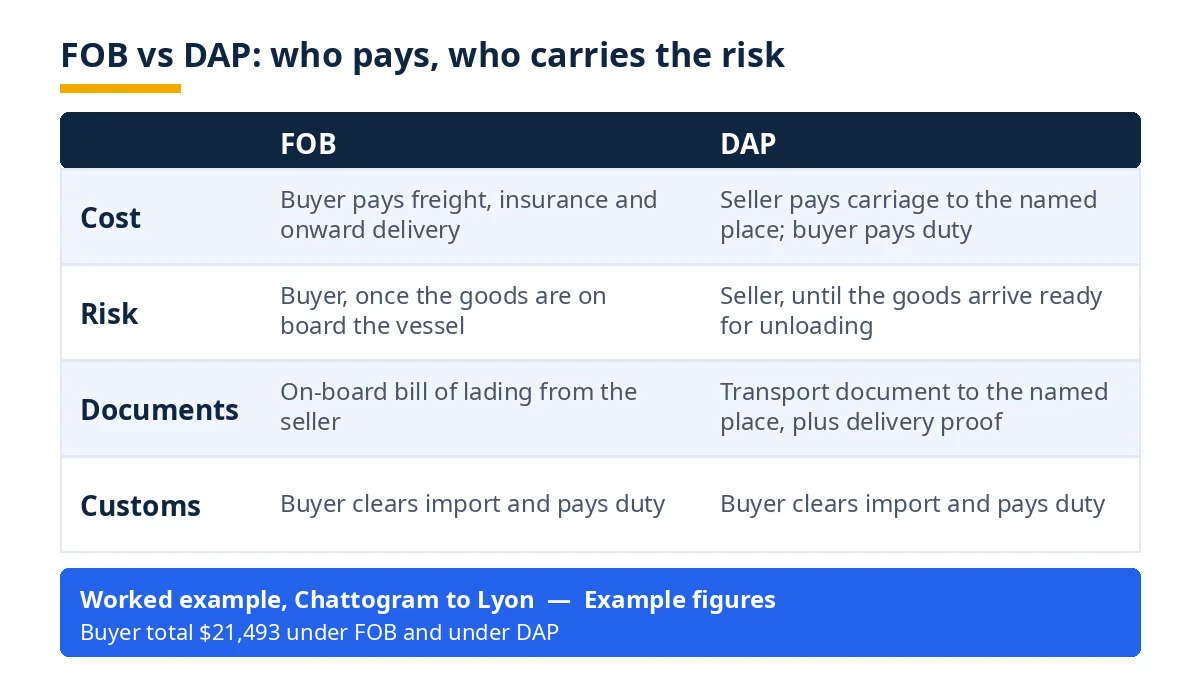
Three lines deserve attention. First, import clearance, duty and taxes stay with you under both rules. DAP is often misread as a door-to-door price with everything included, but the duty is yours and you act as the importer of record.1 The rule that moves the duty to the seller is DDP (Delivered Duty Paid), not DAP.2 Second, unloading stays with you under DAP: the seller delivers the goods on the arriving vehicle, ready for unloading, and you arrange and pay for the unloading.1 Only DPU (Delivered at Place Unloaded) makes the seller unload.3 Third, neither rule obliges anyone to insure. Under FOB you insure the voyage yourself if you want cover; under DAP the seller bears the transit risk, so it usually insures the goods at its own cost, but the rule itself does not require a policy.1 3
A DAP price is therefore always higher than an FOB price for the same goods, and it should be: it contains the freight, the handling and the onward carriage that the FOB price leaves out. Compare the two prices without adding those lines and you are comparing a part price with a nearly full price.
Where does delivery happen, and where does risk pass?
Delivery and risk pass at the same point under both rules, but the points sit at opposite ends of the journey. Under FOB, the seller's job ends and the risk becomes yours once the goods are loaded on board the vessel you nominated at the named port of shipment, export clearance completed.3 Under DAP, the seller delivers and risk passes when the goods reach the named place, still loaded on the arriving vehicle and ready for unloading.1 Between those two points, the risk sits with the seller under DAP and with you under FOB.
The named place needs the most care in a DAP contract. DAP can name almost any place: a port, a terminal, a warehouse, a distribution centre. The seller's duty ends when the goods reach that exact place, ready for unloading, so a vague place leaves both sides arguing about where delivery happened. The seller keeps bearing the risk until the shipment reaches the specific agreed location, even if it has already reached the destination city or port.1 Write the full address into the contract — "DAP 14 Rue des Forges, Lyon, France, Incoterms 2020" — not "DAP Lyon" and never "DAP France".
The two rules also differ in transport mode. FOB works only for sea and inland waterway transport, because its delivery point is a vessel.3 DAP works for any mode of transport, including air, road and rail, alone or combined.1 That makes DAP the natural choice when the journey does not end at a port, as in the Lyon example below, where the goods leave the vessel at Le Havre and continue by road.
One caution carries over from the other sea rules. Containers are usually handed to a terminal days before the vessel sails, so they are not on board at the delivery point FOB names.3 A buyer that books FOB for a container accepts a delivery point that does not match the handover that actually happened. For containerised cargo, the any-mode rules fit the journey better, and DAP is one of them.
Which documents does each rule produce?
The document set follows the delivery point. Under FOB, the key document is the on-board bill of lading, which proves the goods were loaded on the vessel you nominated. Your bank will usually ask for it if you pay by letter of credit, and your insurer if you claim on the voyage. The seller also provides the commercial invoice, the packing list and, where the destination requires it, a certificate of origin.
Under DAP, the seller's transport document runs to the named place rather than to a port, and the delivery proof is the handover record at that place. The seller still provides the commercial invoice, the packing list and any origin certificate, because you need them to clear the goods for import. The seller's documents must be accurate, since an error in the invoice or the packing list can hold the goods at customs even though clearance is your responsibility.1 Ask for the full document set before the goods leave Bangladesh, and check the named place on the transport document against the place written in the contract. Under DAP you hear about a delay from the seller rather than from your own carrier, so the contract should say how and when the seller must tell you.
Worked example: knitwear from Chattogram to a warehouse in Lyon
Example figures. A buyer in France orders 800 cartons of cotton knitwear from a supplier in Chattogram, goods worth $16,500. The DAP named place is the buyer's warehouse in Lyon, reached by road from the port of Le Havre. The figures below are illustrative; they price one shipment under each rule.
Item | Under FOB | Under DAP |
|---|---|---|
Goods, packing, inland transport, export clearance | $16,500, in the FOB price | $16,500, in the DAP price |
Ocean freight, Chattogram to Le Havre | $2,950, paid by the buyer | $2,950, paid by the seller |
Destination terminal handling at Le Havre | $320, paid by the buyer | $320, paid by the seller |
Onward road carriage, Le Havre to Lyon | $410, paid by the buyer | $410, paid by the seller |
Cargo insurance for the voyage | $210, paid by the buyer | $210, paid by the seller |
Import duty, 5% of the $19,660 CIF value | $983, paid by the buyer | $983, paid by the buyer |
Unloading at the Lyon warehouse | $120, paid by the buyer | $120, paid by the buyer |
Total the buyer pays | $21,493 | $21,493 |
Both columns land at $21,493. The DAP invoice is $20,390, because it contains the freight, the terminal handling, the road carriage and the insurance; the FOB invoice is $16,500, and you pay the other $4,993 to your own freight, insurance and customs providers. What changes is not the total but who arranges each leg and who carries the risk while it moves: under FOB the risk is yours from the moment the cartons are on board at Chattogram, under DAP it is the seller's until the truck reaches the Lyon warehouse, ready for unloading.
Two details deserve a second look. The duty line uses a CIF value of $19,660 — goods plus ocean freight plus insurance — at 5 percent; valuation rules differ by destination, so get the basis confirmed by a customs broker before you settle on a term. And the seller pays the $210 premium inside the DAP price because it carries the transit risk, but the rule does not oblige it to insure, so write the cover into the contract if the cargo is worth protecting.1 3
When should you choose DAP?
Choose DAP when you buy occasionally, have no freight forwarder of your own, and want one seller price that carries the goods to your door. It suits a first order from a new supplier, a small order where arranging freight yourself would cost more in time than it saves in money, and a destination inland from the port, where the onward leg is part of the service you are buying. It also suits a buyer whose supplier runs a strong logistics operation and can book better freight than the buyer could. DAP replaced the older term DDU (Delivered Duty Unpaid) in the Incoterms 2010 revision, and it has stayed in place through Incoterms 2020, the current edition, which has been in force since 1 January 2020.1 3
Choose FOB when you import regularly, already have a forwarder working Bangladesh shipments, and want the freight rate visible and the sailing under your control.4 That fits a buyer that consolidates orders from several suppliers onto one freight account, and a buyer whose payment method needs an on-board bill of lading. FOB also suits bulk cargo loaded directly onto the vessel, where the delivery point matches the loading that actually happens.
Neither rule fits if you cannot act as the importer of record at destination — no local entity, no import licence. The goods will arrive at the named place but cannot clear customs, and the seller's risk may pass to you from the agreed delivery date while they sit uncleared.1 In that case ask for DDP, under which the seller clears import and pays the duty, or arrange a local customs broker before you agree the term.2
Mistakes that cost buyers money
Reading DAP as duty-paid. Under DAP you clear import and pay the duty and the taxes. The rule that moves those to the seller is DDP, and it costs more for exactly that reason.1 2
Assuming DAP includes unloading. The seller delivers the goods ready for unloading, and you unload them. Only DPU makes the seller unload.3
Naming a country where a place belongs. "DAP France" does not fix a delivery point. Name the rule, the exact place and the edition, for example "DAP 14 Rue des Forges, Lyon, France, Incoterms 2020".1
Using FOB for a container handed to a terminal. The container is not on board at the delivery point FOB names. Use DAP, or another any-mode rule, for containerised cargo.3
Comparing the two seller prices on their own. The FOB price stops at the vessel and the DAP price runs to your warehouse. Add the freight, handling, onward carriage, insurance, duty and unloading on the same basis before you decide, as in the worked example above.
Forgetting that Incoterms do not set the price, the payment method or when ownership passes. Those need their own contract terms, separate from the delivery rule.3
Next steps on Exportain
The sea-only freight step is covered in FOB vs CFR, and the insured version in FOB vs CIF. To get prices on either basis, browse Bangladeshi suppliers and send an RFQ that names the rule, the place and the edition. How to buy covers the order process from quotation to delivery.
Sources
- DAP Delivered at Place: Definition, Costs & Responsibilities. DHL (accessed )
- DDP vs DDU (DAP) vs FOB: A Guide for US Importers. VoraLane Logistics (accessed )
- FOB vs CIF, CFR or DAP for Food Shipments. Maqboola (accessed )
- DAP Vs FOB Shipping Terms. ShipScience (accessed )
About the author
Sourcing from Bangladesh?
Post a request for quotation and suppliers on Exportain can send you their quotes directly.
Post an RFQ