FOB vs CFR: Key Differences, Costs and Which One to Choose
FOB and CFR differ by exactly one step: who books and pays the freight. Risk passes at the same point either way. Here is how to choose.
Short answer
FOB and CFR differ by one step: who books and pays the freight. Under FOB the buyer arranges and pays for freight; under CFR the seller arranges and pays for it. Everything else is identical: risk passes to the buyer when the goods are on board, the buyer clears import and pays duties, and neither rule requires cargo insurance. FOB suits buyers with their own freight arrangements; CFR suits buyers that want one price including freight.
On this page
Key takeaways
FOB and CFR differ only in who books and pays the ocean freight.
Risk passes to the buyer when the goods are on board, under both rules.
Neither rule requires cargo insurance; the buyer insures unless it buys CIF.
CFR is not a delivered term; it ends at the destination port.
FOB suits buyers with their own freight; CFR suits occasional buyers.
FOB and CFR are the two most quoted sea-freight terms in Bangladesh export, and they differ by exactly one step: who books and pays the ocean freight. Under FOB (Free On Board), the buyer arranges and pays for the freight. Under CFR (Cost and Freight), the seller arranges and pays for the freight. Everything else — where risk passes, who clears import, who insures — is the same. That single difference decides who controls the voyage, who sees the freight cost, and who deals with the carrier when the sailing changes.
What FOB means in practice
Under FOB, the seller puts the goods on board the vessel the buyer has nominated, at the named port of shipment, with export clearance done. Risk passes to the buyer once the goods are on board.1 From that point the buyer pays the ocean freight, buys cargo insurance if it wants any, and handles import clearance, duties and taxes at destination.
FOB gives the buyer control of the voyage. The buyer chooses the carrier, the service and the routing, negotiates the freight rate, and agrees the free time at the destination port with its own carrier. That control is the reason experienced importers prefer FOB: the freight cost is visible on the buyer's own invoice, and the buyer can change carrier or routing without asking the seller. FOB is a sea and inland waterway rule, written for cargo loaded directly onto a vessel. A container is usually handed to a terminal days before the vessel arrives, so it is not on board at the delivery point the rule names; containers should use FCA instead.1
What CFR means in practice
Under CFR, the seller puts the goods on board at the named port of shipment and then pays the freight to the named port of destination. The freight is the only difference from FOB. Risk still passes to the buyer once the goods are on board at the port of shipment, so paying the freight does not extend the seller's risk.1 The buyer still clears import, pays duties and taxes, and still buys its own cargo insurance: CFR carries no insurance obligation, and the seller's freight contract does not insure the buyer's goods.1
CFR is convenient for a buyer that has no freight arrangements of its own. The seller quotes one price that includes the freight to the destination port, and the buyer pays a single invoice. The trade-off is visibility and control: the buyer cannot see what the freight actually cost, cannot choose the carrier or the routing, and has no direct relationship with the carrier if the vessel is delayed or the container is rolled. FOB, CFR and CIF are all sea-only rules, and for containerised cargo the equivalent delivered terms are FCA, CPT and CIP.2
FOB vs CFR at a glance
FOB | CFR | |
|---|---|---|
Full name | Free On Board | Cost and Freight |
Transport mode | Sea and inland waterway only | Sea and inland waterway only |
Seller delivers | On board the vessel at the port of shipment | On board the vessel at the port of shipment |
Risk passes to the buyer | When the goods are on board | When the goods are on board |
Export clearance | Seller | Seller |
Ocean freight | Buyer books and pays | Seller books and pays |
Cargo insurance | Buyer, if it wants cover | Buyer, if it wants cover |
Import clearance, duties and taxes | Buyer | Buyer |
Unloading at destination | Buyer | Buyer |
The table makes the point plainly: the two rules are identical except for the freight line. That is why a FOB price and a CFR price for the same shipment differ by roughly the freight cost, and why comparing them on unit price alone is meaningless. The comparison that matters is the landed cost, and the control each side keeps over the voyage.
The freight decision: control versus convenience
Under FOB the buyer owns the freight relationship. It can consolidate its shipments from several suppliers onto one bill of lading, choose a direct service over a transhipment service, and negotiate destination free time in its own name. When a sailing is cancelled, the buyer hears it from its own carrier and can rebook. That control is worth the most when the buyer imports regularly from several suppliers and wants one freight account for all of them.
Under CFR the seller owns the freight relationship, and the buyer takes the service the seller bought. The seller may choose the cheapest service rather than the fastest, and a transhipment that adds a week to the transit may not be visible in the quotation. The buyer also has no say over destination charges: the carrier's destination handling, the terminal charges and the demurrage terms are all set by the seller's contract, and the buyer pays whatever the carrier charges at the destination port.
There is a middle ground. A buyer that wants FOB control without arranging freight itself can ask its freight forwarder to act as its agent under FOB, so the forwarder books the vessel in the buyer's name and the seller delivers on board. A seller that wants to quote CFR honestly can show the freight rate separately in the quotation, so the buyer can see the freight and compare it with its own rates. Either way, the freight should be visible, not buried in a single price.
Worked example: the same shipment under FOB and CFR
Example figures. A buyer in Rotterdam orders 1,000 cartons of cotton knitwear from a supplier in Chattogram. The goods value is $18,000. The numbers below are illustrative, comparing the two rules on one shipment.
Cost line | FOB: who pays | CFR: who pays |
|---|---|---|
Goods, packing, inland transport, export clearance | Seller, in the $18,000 FOB price | Seller, in the CFR price |
Ocean freight Chattogram to Rotterdam | Buyer, $2,800 | Seller, $2,800 |
Cargo insurance | Buyer, $250 | Buyer, $250 |
Import duty, 4% of the $21,050 CIF value in this example | Buyer, $842 | Buyer, $842 |
Delivery to the buyer's warehouse | Buyer, $500 | Buyer, $500 |
Buyer's total outlay | $18,000 + $4,392 = $22,392 | $20,800 + $1,592 = $22,392 |
The CFR price is $20,800 because it is the $18,000 FOB price plus the $2,800 freight. The buyer's total is the same either way, because the same costs are paid by someone. The difference is the invoice: under FOB the buyer pays $18,000 to the seller and $4,392 to its own freight, insurance and customs providers; under CFR the buyer pays $20,800 to the seller and $1,592 to its own providers. This example charges duty on the CIF value of $21,050, but each importing country sets its own valuation basis, so check the basis with a customs broker before you settle on a rule.1
Common mistakes
The first mistake is reading CFR as a delivered term. CFR ends at the destination port, not at the buyer's door, and the buyer still clears import and pays the duty. The delivered term that includes the destination is DAP, and the term that adds duty to it is DDP, which makes the seller the importer of record.3
The second mistake is assuming the seller's freight contract insures the goods. Under CFR the seller pays for freight and nothing else. If the container is lost or damaged at sea, the loss is the buyer's, and it is recoverable only if the buyer bought a policy. Under CIF the seller buys the insurance, but the minimum cover is Clause C, so a buyer that wants fuller cover should write it into the contract or buy its own policy.1
The third mistake is naming a country instead of a port. "FOB Bangladesh" and "CFR Netherlands" do not fix a delivery point or a destination port. Write the rule, the named port and the edition, for example "FOB Chattogram, Incoterms 2020" or "CFR Rotterdam, Incoterms 2020".2
The fourth mistake is using FOB or CFR for containers. Containers are usually handed to a terminal days before the vessel arrives, so they are not on board at the delivery point the rule names. Use FCA for containers under a buyer-arranged freight, and CPT when the seller pays the freight.2
Which one should you choose?
Choose FOB when you import regularly, have a freight forwarder you trust, and want control of the voyage and visibility of the freight cost. It is the better rule for a buyer that consolidates shipments from several suppliers, because one freight account can cover them all.
Choose CFR when you buy occasionally, have no freight arrangements, and want one price from the seller that includes the freight to your port. Ask the seller to show the freight rate separately in the quotation, so you can check it against the market and compare it with an FOB quotation on landed cost.
For most Bangladesh-to-Europe sea shipments, FOB is the working default, and CFR is the convenience option. Neither is better in the abstract; the right one depends on who has the better freight relationship, and that is usually the side that ships more often.
Next steps on Exportain
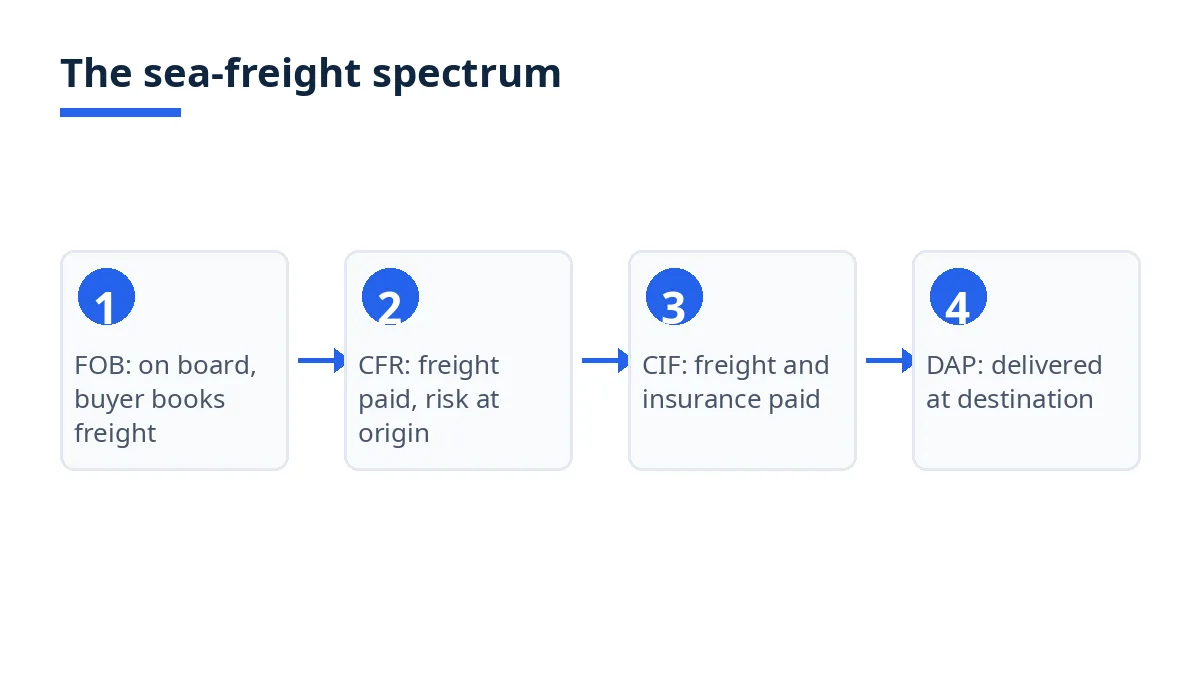
Compare the next step up the ladder: FOB vs CIF adds the seller's insurance to the CFR picture, and FAS vs FOB covers the one step before loading. When you are ready to quote, search Bangladeshi suppliers or post an RFQ — put the rule, the port and the edition in the requirement — and how to buy explains what happens once you have quoted.
Sources
- FOB vs CIF, CFR or DAP for Food Shipments. Maqboola (accessed )
- Incoterms 2020 Explained: All 11 Rules, Chart & Meaning. Xflowpay (accessed )
- DDP Incoterms Explained: Who Pays, Risk Transfer & VAT. LegalClarity (accessed )
About the author
Sourcing from Bangladesh?
Post a request for quotation and suppliers on Exportain can send you their quotes directly.
Post an RFQ