FAS vs FOB: Key Differences, Costs and Which One to Choose
FAS ends alongside the vessel and FOB ends on board. This comparison follows the loading step at Chattogram, prices it, and shows when each term fits bulk and break-bulk cargo.
Short answer
Under FAS the seller delivers goods alongside the vessel at the named port of shipment, and the buyer pays for loading them on board and carries the risk from the alongside point. Under FOB the seller loads the goods on board, and risk passes only then. Both terms leave freight, insurance and import clearance with the buyer, so the choice turns on who can run the loading operation at Chattogram.
On this page
Key takeaways
FAS delivery ends alongside the vessel; FOB delivery ends on board, and the loading cost and risk move with that step.
Both terms leave main carriage, insurance and import clearance with the buyer, and both apply only to sea and inland waterway transport.
The buyer must name the vessel, the berth and the delivery window in time, or risk and costs can shift to the buyer.
A FAS price that looks lower is not cheaper until loading, freight, insurance and destination charges are added to the buyer total.
FAS fits a buyer that controls loading at Chattogram; FOB fits a buyer that does not.
Under FAS the seller's work ends when cargo sits alongside the vessel at the named port of shipment. Under FOB it ends one step later, when the cargo is loaded on board. That step is short in distance and large in consequence, because loading is where heavy cargo is most exposed, and the party that pays for the lift also carries the risk while it happens. This article follows that step for bulk and break-bulk cargo leaving Chattogram.
What changes between the quay and the deck?
Under FAS, the seller completes delivery by setting the goods down beside the ship the buyer named, in the port the contract names for shipment, and the buyer takes the risk from that moment.1 Under FOB, delivery completes when the goods are stowed on board that ship, and the buyer takes the risk at that later moment.1 Both terms apply only to sea and inland waterway transport, both require the seller to clear the goods for export, and both leave the buyer to contract the carrier and pay the port-to-port freight.1 The only part of the journey that moves between the parties is the loading operation, with its cost and its risk.
That difference matters most when cargo cannot be lifted in one routine movement. A pallet that a forklift can place in a hold is a different job from a steel coil or a bale that needs a sling, a spreader and a stevedore gang working to the ship's crane. Under FAS the buyer must be ready to take the cargo from the quay. Under FOB the seller must arrange the lift and remain answerable until the cargo is on board. A buyer who agrees FAS without a loading plan has agreed to run a port operation, not merely to buy goods.
Who pays for the lift, and who carries the risk while it happens?
Under FAS the buyer covers the loading costs at the port and takes the risk from the alongside point onward.1 Under FOB the seller carries the cost and risk of loading, because delivery is not complete until the goods are on board.1 The distinction covers stevedores, slings, waiting time if the vessel is not ready, and damage if a sling slips or a load is set down hard in the hold. Under FAS, damage during the lift is the buyer's loss. Under FOB, it is the seller's loss.
Neither term obliges either party to insure the cargo. FAS does not require the seller or the buyer to obtain cargo insurance, and the buyer normally bears the risk from the alongside point, including loading and the voyage that follows.2 A buyer under FAS therefore needs insurance that starts at the quay, not at the rail. A buyer under FOB needs cover from the moment the cargo is on board. The policy start point must match the delivery point in the sale contract, or the loading step itself may sit outside the cover.
Loading step | FAS | FOB |
|---|---|---|
Delivery point | Alongside the vessel | On board the vessel |
Risk passes | Placed alongside | Loaded on board |
Loading cost | Buyer | Seller |
Loading risk | Buyer, from alongside | Seller, until on board |
Export clearance | Seller | Seller |
Main carriage | Buyer contracts and pays | Buyer contracts and pays |
Insurance obligation | None on either party | None on either party |
Transport mode | Sea and inland waterway only | Sea and inland waterway only |
What must the buyer tell the seller before the vessel arrives?
The buyer must notify the seller in time of the vessel's name and the specific place and point of delivery within the port.1 Under FAS that notice decides where the seller sets the cargo down. Under FOB it decides where the seller loads. If the buyer fails to give the vessel name and loading point in time, and the goods cannot be delivered or loaded as a result, risk and the resulting costs can shift to the buyer from the moment of non-compliance.1
Write the notice as a dated message with the vessel name, the berth within Chattogram, the delivery window, and the buyer's agent at the port. Keep the seller's acknowledgment on file. The contract should also state who pays for storage if the vessel is delayed. Under FOB, the buyer can bear the risk and cost of storage at the port until the vessel arrives when no vessel is available at the agreed time.1 Under FAS, goods left on the quay after an alongside delivery are the buyer's goods, and the buyer pays for their protection and storage.
How does the loading step work for bulk and break-bulk cargo?
Bulk and break-bulk loads are the natural fit for these sea-only rules; containers are not.3 Containerized cargo usually goes to a terminal rather than to the ship's side, and boxes can wait in the terminal for days before transfer to the vessel, which makes the FCA rule a better fit for containers.1 Bulk and break-bulk cargo can be brought to the berth and placed alongside or loaded directly. The ICC Academy lists bulk cargo such as minerals, cement, steel, grains and vehicles as the cargo that fits FAS, and the same cargo types fit FOB.1
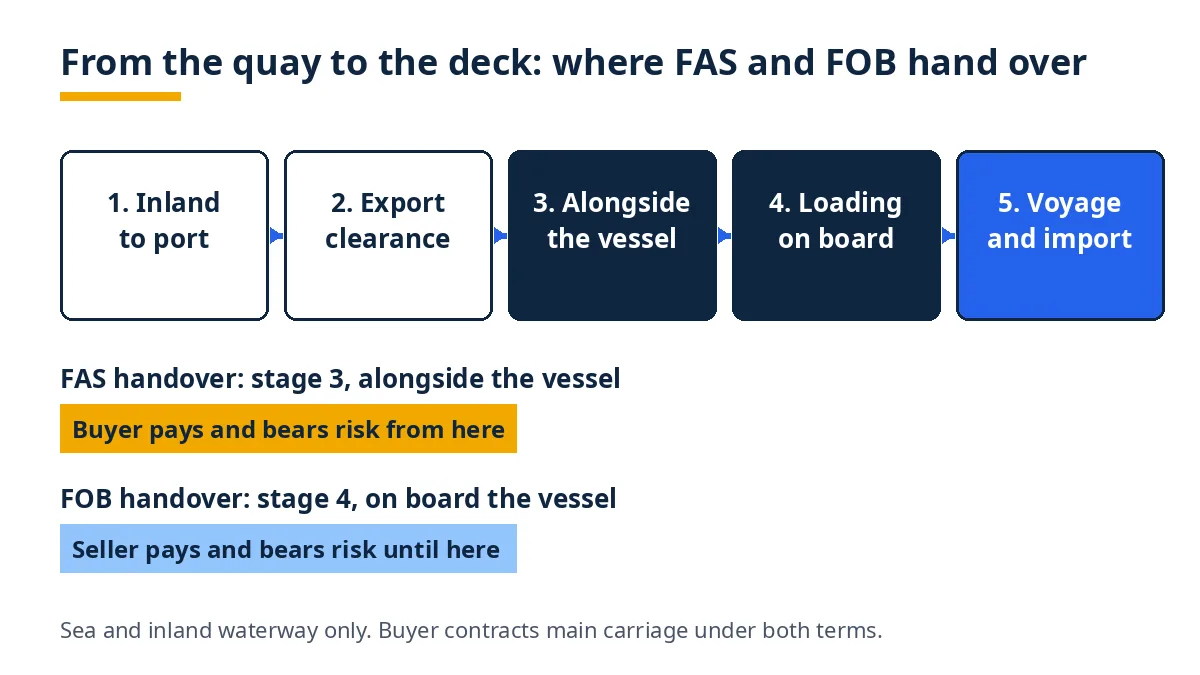
At Chattogram the sequence runs in five stages. First, the seller moves the cargo to the port and completes export clearance. Second, the cargo waits at the berth area under the seller's care. Third, under FAS the seller sets it down alongside the vessel and notifies the buyer; under FOB the seller lifts it on board. Fourth, the buyer under FAS takes over the lift and the voyage, while the buyer under FOB takes over from the on-board point. Fifth, the buyer clears the goods for import and arranges onward transport. The diagram shows the five stages and the handover point under each term.
Worked example: baled jute goods priced under FAS and under FOB
The figures below are Example figures for one shipment of baled jute goods, handled as break-bulk cargo, from a warehouse outside Chattogram to a buyer in Europe. The goods value, freight, insurance and destination charges are the same under both terms, because the buyer contracts the main carriage under both. Only the loading line moves.
Cost line (Example figures) | FAS Chattogram | FOB Chattogram |
|---|---|---|
Goods, packed and marked | 42,000 | 42,000 |
Inland transport and export clearance | 1,850 | 1,850 |
Quay handling to the alongside point | 420 | 420 |
Loading on board | 0 (buyer pays) | 980 |
Seller's price | 44,270 | 45,250 |
Loading paid separately by buyer | 980 | 0 |
Ocean freight, buyer-contracted | 6,400 | 6,400 |
Cargo insurance | 310 | 310 |
Import clearance, duty, onward transport | 2,150 | 2,150 |
Buyer total | 54,110 | 54,110 |
The totals are identical, which is the point. FAS does not make the shipment cheaper. It moves the loading charge out of the seller's price and into the buyer's separate account, and it moves the loading risk with it. A buyer who compares a FAS price of 44,270 with a FOB price of 45,250 and calls FAS cheaper has compared two different baskets. The FAS total assumes the buyer secures the same loading rate of 980 that the seller secured under FOB. If the buyer hires at short notice, the charge can exceed that figure, and the FAS total rises above the FOB total.
When does FAS still make sense for heavy or bulk goods?
FAS makes sense when the buyer controls the loading operation better than the seller does: when the buyer already charters the vessel, employs its own stevedores, or moves the same cargo regularly on the same route with agreed loading rates at Chattogram. It also makes sense when the cargo needs the buyer's own lifting gear or a project team that must supervise the stow. In those cases the seller's loading service adds a margin the buyer does not need.
FAS also suits a buyer who wants the goods at the quay for inspection before loading, while the goods are still accessible. FOB makes sense in the opposite cases: when the seller has the port relationship and the buyer does not, when the cargo is heavy or awkward, and when the buyer has no agent at Chattogram who can attend the berth.
What can go wrong at the loading step?
Four failures recur. The first is a vessel named late or named wrong, so the seller delivers to the wrong berth. The second is cargo delivered to the quay before the vessel arrives. Under FAS the seller must set the cargo down beside the buyer's ship; leaving a shipment at a port while the vessel is still absent does not count as delivery, because there is no ship alongside which to place it. Agree a delivery window that matches the vessel's arrival.
The third failure is a loading plan that nobody wrote down: a heavy piece without a stated weight or a stow plan agreed only verbally. The fourth is insurance that starts at the wrong point.
Name the term, the port and the edition in one line, for example "FAS Chattogram, Incoterms 2020" or "FOB Chattogram, Incoterms 2020". A bare "FAS" or "FOB" without a port is incomplete. Add the nomination deadline, the party that pays for loading, and the insurance start point. For more detail, see what an FAS price includes, when risk transfers under FAS, EXW vs FAS and FCA vs FAS.
Questions buyers ask about FAS and FOB
Does the seller load the goods under FAS?
No. Under FAS the seller places the goods alongside the vessel, and the buyer pays for loading them on board and carries the risk from the alongside point.1 If the contract requires the seller to load, the term should be FOB, or loading should be added as an express extra service with its price and risk stated separately.
Can FAS be used for a container shipment from Chattogram?
FAS can be written for a container shipment, but it fits poorly. Containers are usually delivered to a terminal days before loading, and the ICC Academy notes that FCA is more appropriate in that case.1 A container at a terminal is not alongside the vessel, so the delivery point does not match the physical handover.
Who pays if the vessel is late and the cargo waits at the port?
Under FOB the buyer can bear the risk and cost of storage until the vessel arrives when no vessel is available at the agreed time.1 Under FAS the cargo alongside the vessel is already the buyer's, so waiting costs after delivery fall on the buyer unless the contract says otherwise. Write the storage rule into the contract before the vessel is nominated.
Which term should a first-time buyer choose for a bulk shipment?
A first-time buyer with no loading arrangement at Chattogram should choose FOB for a first bulk shipment. FOB keeps the loading operation and its risk with the seller, who knows the port. FAS suits a later shipment, once the buyer has a stevedore or forwarder arrangement at the port.
Next steps on Exportain
Settle the loading step before comparing prices: name the port, name the vessel procedure, and decide who runs the lift. Browse Bangladeshi suppliers, read how to buy, and post an RFQ stating the term, the port and the cargo weight. Exportain is not a party to the contract for goods and does not book freight or clear customs, so the loading arrangement remains for the buyer and seller to agree in the sale contract.4
Sources
- FOB & FAS Incoterms® 2020 explained: Key differences. ICC Academy (accessed )
- FAS Incoterms (Free Alongside Ship): Meaning and Use. iContainers (accessed )
- Incoterms for Sea Freight: How to Make Them Work for You. DHL, (accessed )
- About Exportain. Exportain (accessed )
About the author
Sourcing from Bangladesh?
Post a request for quotation and suppliers on Exportain can send you their quotes directly.
Post an RFQ