EXW vs FAS: Key Differences, Costs and Which One to Choose
An FAS quote can run 1,190 dollars above an EXW quote for the same steel without the steel costing more. This comparison follows both terms to the quayside, prices one bulk shipment both ways, and shows where cost, risk and export paperwork change hands.
Short answer
Under EXW, the seller makes the goods available at its premises and the buyer handles loading, export clearance, carriage to the port, loading on board, freight and insurance. Under FAS, the seller carries the goods to the named port, clears them for export, and places them alongside the vessel the buyer nominates, where risk passes. The buyer then pays for loading on board, freight and insurance under both terms.
On this page
Key takeaways
EXW ends at the seller's premises, with loading, export clearance and carriage to the port left to the buyer; FAS ends alongside the nominated vessel at the named port, with export clearance done by the seller.
Loading on board is the buyer's cost under FAS, and risk passes at the alongside point, so goods waiting on the quay and the lift itself are at the buyer's risk.
Neither term obliges the seller to insure the goods; the buyer arranges cover, starting at the factory gate under EXW and at the quayside under FAS.
For the same bulk shipment the buyer's total is the same under both terms in the worked example; the term decides who arranges each port-side leg and when risk moves.
An EXW quotation and an FAS quotation for the same steel can differ by more than a thousand dollars without either seller charging more for the steel itself. The difference is the road to the port, the export paperwork, and the short move to a place beside the ship. Under one term the buyer buys all of that work separately. Under the other the seller has already done most of it, leaving the buyer only the lift onto the ship and the sea leg.
Verdict at the quayside: EXW stops at the factory, FAS stops beside the ship
The fastest way to tell the two terms apart is to ask where the seller's job ends. Under EXW it ends at the seller's own premises, before loading. Under FAS it ends at the named port of shipment, with the goods placed alongside the vessel the buyer has nominated. Everything after that point is the buyer's job under both terms: the main voyage, import clearance, and delivery onward from the destination port.
Point of comparison | EXW (Ex Works) | FAS (Free Alongside Ship) |
|---|---|---|
Delivery point | Goods ready for collection at a place the contract names, most often the seller's own site | Goods set down beside the ship the buyer has chosen, in the port named in the contract |
Risk passes | When the goods are ready for loading at the named place | When the goods are set down beside the vessel |
Loading onto the collecting vehicle at the premises | Buyer pays and bears the risk | Not applicable: the seller moves the goods to the port |
Inland carriage to the port | Buyer arranges and pays | Seller arranges and pays |
Export clearance | Buyer | Seller |
Loading on board the vessel | Buyer pays | Buyer pays |
Main carriage and insurance | Buyer contracts and pays; buyer arranges any cover | Buyer contracts and pays; buyer arranges any cover |
Choose FAS when the cargo can genuinely be set down beside a named vessel and the buyer wants control of the sea leg from that point. Choose EXW only when the buyer, or the buyer's agent in Bangladesh, can collect at the factory, complete export clearance, and move the goods to the port.
What EXW and FAS each ask the seller to do
Under EXW, the seller's delivery is complete when the goods are ready for the buyer's vehicle at the agreed place, most often the seller's own premises.1 The buyer pays for the lift onto that vehicle and carries its risk, and export formalities are the buyer's work as well.1 No Incoterms rule asks less of the seller, and the guidance urges traders whose goods cross a border to look at FCA instead, because export duties fall on the buyer and the seller can end up treated as the exporter of record.1
Under FAS, delivery is complete when the cargo is set down beside the ship the buyer has chosen, in the port named in the contract, and risk of loss or damage moves to the buyer at that point.2 Moving the cargo to the port and finishing export formalities sit with the seller.2 The buyer owes the seller timely notice naming the ship and the exact delivery spot inside the port.2
Only FAS, FOB, CFR and CIF are confined to sea and inland waterway transport. The FAS and FOB guidance states that both rules apply only to sea or inland waterway transport, and both ask the seller to bring the cargo to the port named in the contract and finish export formalities, while the buyer books the carrier and pays the port-to-port freight.2 EXW, by contrast, works with any mode, or with modes combined, the buyer booking the onward carriage.1 The two terms also differ in how much of the journey the seller's price can ever contain. An EXW price holds only the goods and their packing.1 An FAS price must also absorb inland carriage to the port, the move to a position alongside the vessel, and export clearance. The worked example below prices that difference at 1,190 dollars on a 24,000-dollar cargo.
The alongside moment: vessel nomination, notice, and a missed sailing
FAS turns on a short window at the port, and the buyer's notice makes that window work. The buyer must give the seller, in good time, the ship's name, the delivery spot inside the port, and the delivery period.2 Late or missing notice can move risk and extra costs to the buyer from the moment of non-compliance, where the vessel has already closed for cargo, under the buyer-obligation articles of the FAS rule.2 Write the ship's name, the berth or quay point, and the delivery dates into the order, and amend them in writing the moment the carrier changes either one.
A missed sailing is where an FAS purchase is won or lost. Once the cargo sits beside the ship and the buyer has been told, delivery is complete and risk has passed, although the cargo still waits on the quay and has not been lifted on board.2 A delayed ship, or late notice that leaves the master closing for cargo early, leaves the cargo waiting at the buyer's risk, with port storage and extra handling on the buyer's account under the same cost articles.2 Three checks close this gap before shipment. First, confirm the carrier's cut-off and the vessel's expected arrival with the forwarder, not only with the seller, and align the delivery period with both. Second, settle in writing who pays each port charge where loading happens, since port practice varies and the lift itself is the buyer's cost under FAS.2 Third, ask for the delivery notice recording the time and place the goods were placed alongside the vessel.
Cost, risk and insurance split, leg by leg
The table below marks who pays for each leg from the factory gate to the destination warehouse.
Task or cost | EXW: who pays | FAS: who pays |
|---|---|---|
Goods and export packing | Seller | Seller |
Lift onto the collecting vehicle at the premises | Buyer, at own risk | Seller, inside the move to the port |
Inland carriage to the named port | Buyer | Seller |
Port handling to a position alongside the vessel | Buyer | Seller |
Export clearance and documents | Buyer | Seller |
Loading on board the vessel | Buyer | Buyer |
Main carriage to the destination port | Buyer | Buyer |
Cargo insurance | Buyer, if cover is wanted | Buyer, if cover is wanted |
Import clearance, duty and onward transport | Buyer | Buyer |
Risk follows the same line as delivery, and the alongside point leaves a visible exposure window. Under EXW, the buyer owns the risk once the cargo is ready for loading, so harm during the factory lift, the road leg, or the wait at the port falls on the buyer.1 Under FAS, the seller carries the risk until the alongside point, and the buyer carries it after, through the quay wait and the lift itself.2 Insurance arranged only from sailing leaves that quay window uncovered, so cover should start no later than the alongside point.
Neither term obliges the seller to insure the goods. Insurance provision is a seller duty in the CIP and CIF rules, and in the F rules the buyer books carriage and bears transport costs after delivery.2 1 Under CIF, the default cover level is Institute Cargo Clauses (C), with the option to agree higher cover.3 Under EXW and FAS alike, a buyer who wants cover arranges it. The difference is only the start date of the risk the buyer insures: under EXW that risk starts at the factory gate, and under FAS it starts at the quayside.
Paperwork follows the same split. Under FAS the seller completes export formalities and the buyer completes import formalities.2 Under EXW the buyer handles export formalities too, which the guidance warns can trouble both sides where the buyer has no base in the seller's country.1
Bulk steel billets to Jebel Ali: one shipment priced both ways
The figures below are illustrations, not quotations. Ask a forwarder and a broker to re-price each leg before you order. One buyer orders 60 tonnes of steel billets from a mill outside Dhaka for shipment to Jebel Ali. The same cargo is priced two ways: EXW at the mill and FAS at Chattogram, Incoterms 2020 in both cases. Steel billets suit the FAS pattern: breakbulk cargo delivered directly alongside a vessel, of the kind the FAS guidance lists alongside minerals, cement, grains and vehicles.2
Price element | EXW at the mill | FAS at Chattogram |
|---|---|---|
Goods and export packing | 24,000 | 24,000 |
Inland carriage, mill to Chattogram | Buyer pays 640 | 640 |
Port handling to alongside the vessel | Buyer pays 260 | 260 |
Export clearance and documents | Buyer pays 290 | 290 |
Loading on board at Chattogram | Buyer pays 380 | Buyer pays 380 |
Ocean freight to Jebel Ali | Buyer pays 4,800 | Buyer pays 4,800 |
Cargo insurance, buyer-arranged | Buyer pays 210 | Buyer pays 210 |
Seller's quoted price | 24,000 | 25,190 |
Buyer-paid legs after the seller's price | 6,580 | 5,390 |
Buyer total to Jebel Ali, before duty | 30,580 | 30,580 |
The chart below stacks each seller price beside the legs the buyer still pays.
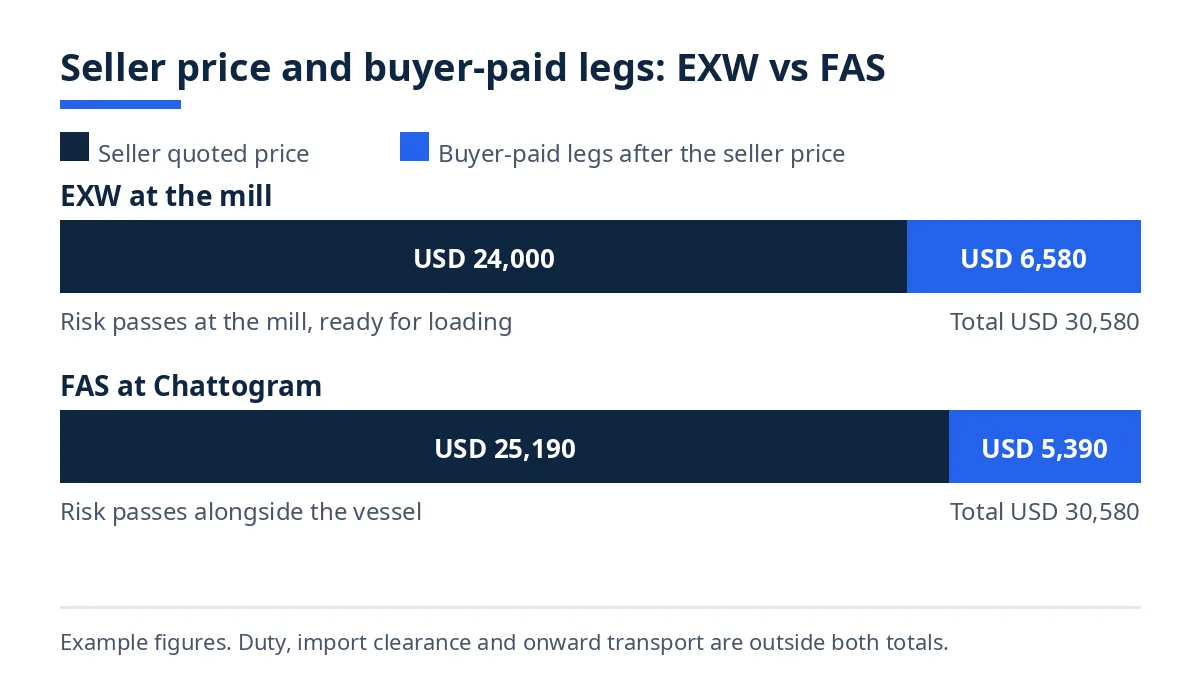
The two columns reach the same end figure because neither the cargo nor the voyage changes. The EXW buyer pays 6,580 after the seller's price; the FAS buyer pays 5,390. In each case 24,000 plus 640 plus 260 plus 290 plus 380 plus 4,800 plus 210 equals 30,580. Per tonne, the FAS price is 419.83 dollars and the full cost before duty is 509.67 dollars.
An FAS quote that looks 1,190 higher than an EXW quote is not 1,190 more expensive: it is 1,190 of port-side work still unbought. A lower total comes only when the buyer's forwarder beats the seller's figures for the inland leg, the port handling and the clearance. Duty at Jebel Ali, import clearance and onward transport sit outside both totals. Confirm the duty position with a broker before pricing, since no duty rate is stated here.
Choosing EXW or FAS for bulk and breakbulk loads
Choose FAS for bulk and breakbulk cargo that can be set down beside a named vessel. The FAS guidance names billets, cement, grain, minerals and vehicles as cargo of this kind.2 The buyer keeps control of the vessel and the sea freight, while the seller carries the cargo to the port and clears it. Choose EXW where the buyer already has the Bangladesh side covered: a forwarder who collects at the mill, completes export clearance, and books the onward carriage. On repeated orders over one route, that control can beat the seller's inland and clearance figures. For sealed containers, choose neither. Containers normally reach a terminal and wait there before loading, and the FAS guidance treats FCA as the better fit there.2
Chattogram quayside checks before you agree FAS
Bangladesh export clearance is the reason the FAS seller's job is heavier than the EXW seller's, and the reason an overseas buyer often cannot perform EXW at all. Under section 131 of the Customs Act, 1969, no consignment may be loaded or stuffed for export until Customs approves its Bill of Export.4 The declaration must list the cargo and its value, who exports it, who buys it overseas, and the carrier moving it.4
Clearance runs on a set of enclosures: the signed invoice and packing list, the origin certificate, the EXP form, the VAT and taxpayer documents, and the letter of credit or, where no letter of credit exists, an approved contract, order or guarantee from the negotiating bank.4 Jute goods and tea need an Export Registration Certificate, and farm produce may need a phytosanitary certificate.4 Under FAS the seller runs this clearance; under EXW the buyer must arrange it. Approval of the declaration comes first; loading follows, and the export counts as complete when the vessel sails.4 Confirm the berth and loading point before the vessel arrives.
Questions buyers ask about EXW and FAS
Is EXW or FAS cheaper for the same bulk shipment?
On the example figures the FAS seller price runs 1,190 dollars higher, yet the buyer spends the same 30,580 dollars before duty under either term. Rank quotes only after adding every buyer-paid leg to each seller price.
Which is safer for first-time importers, EXW or FAS?
A first-time importer faces less work under FAS: the seller takes the cargo to the port, finishes export clearance, and sets it down beside the buyer's chosen ship.2 Under EXW, risk reaches the buyer as soon as the cargo is ready at the seller's premises, and loading and clearance are the buyer's jobs.1 Insurance should still start at the alongside point, since the quay wait and the lift sit at the buyer's risk under FAS.
Can I switch from EXW to FAS after the purchase order is signed?
Before shipment, the parties can record a new term in a written amendment that reissues the quotation and corrects the shipping documents, because the term forms part of the sale contract. The amendment must rework the price, since the seller takes on inland carriage, port handling and export clearance.2 After EXW availability, a later amendment leaves the risk that has already passed where it is.
Which term do Bangladeshi suppliers prefer, EXW or FAS?
Suppliers commonly prefer FAS, because clearance stays with the side holding the paperwork and knowing the Customs routine.4 That preference is not a rule: a mill that lacks an export desk may quote EXW only. Ask each supplier which term it offers, and put the port name and the Incoterms edition in your enquiry.
Next steps on Exportain
Check what a single FAS price already contains before accepting a quayside quote, turn both quotes into one warehouse cost from the full route, and follow the buying steps on Exportain when you ask suppliers to quote.
Sources
- FCA & EXW Incoterms® 2020 explained: Key differences. ICC Academy (accessed )
- FOB & FAS Incoterms® 2020 explained: Key differences. ICC Academy (accessed )
- Incoterms® 2020. International Chamber of Commerce (ICC) (accessed )
- Customs Clearance Procedures for Export. Bangladesh Customs, National Board of Revenue (accessed )
About the author
Sourcing from Bangladesh?
Post a request for quotation and suppliers on Exportain can send you their quotes directly.
Post an RFQ