FAS vs DPU: Key Differences, Costs and Which One to Choose
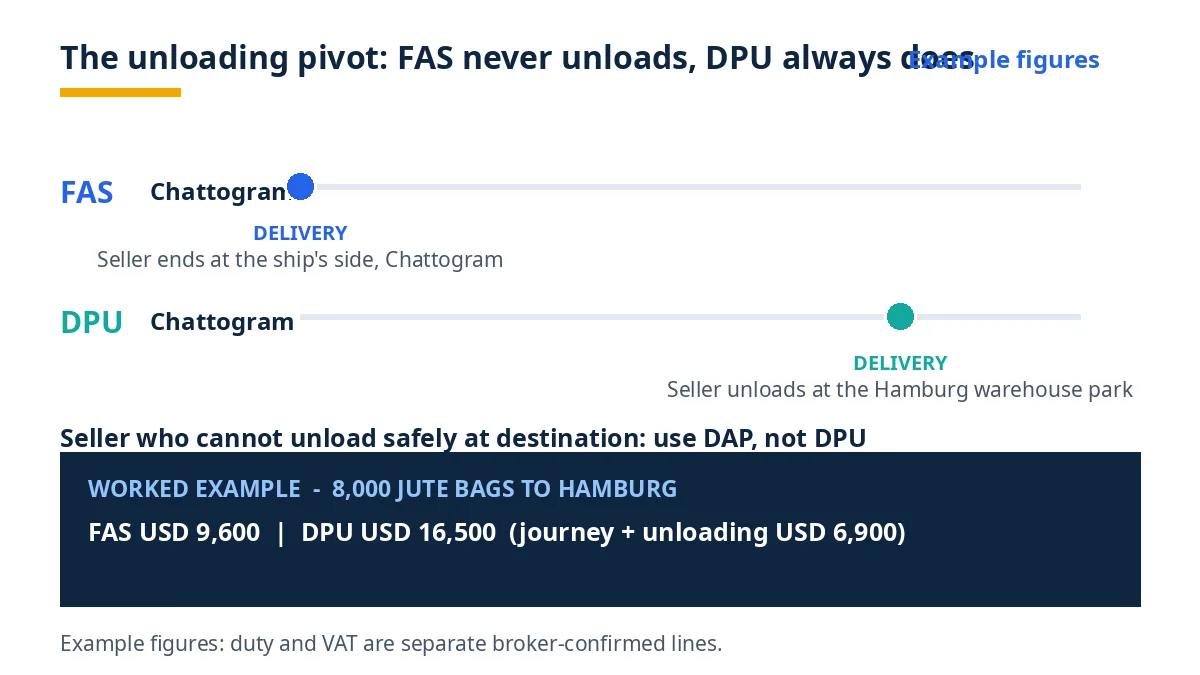
One act separates FAS from DPU: unloading at destination. The seller does it under DPU and never does it under FAS.
Short answer
FAS and DPU differ in one act: unloading. Under FAS, the seller delivers alongside the buyer's vessel at Chattogram, and the buyer pays loading, freight, and import clearance. Under DPU, the seller carries the goods to the named destination, unloads them at the seller's risk and cost, and delivers them unloaded; the buyer then clears import and arranges onward carriage. DPU is the only Incoterm requiring the seller to unload. Choose DPU when the seller can unload at destination.
On this page
Key takeaways
DPU is the only Incoterms rule under which the seller must unload the goods at the named destination.
Under FAS the buyer pays loading at Chattogram, freight, and import clearance; under DPU the seller pays carriage and unloading.
Under both rules the buyer handles import formalities and pays duty and VAT.
A seller who cannot unload safely at the destination should use DAP, not DPU.
Buyers sometimes treat FAS and DPU as two kinds of delivered term. Only one of them delivers anything. DPU carries the goods to a named destination and sets them down unloaded. FAS stops beside the ship at Chattogram, before the journey begins, and leaves loading, carriage, and import to the buyer. A single physical act — unloading at destination — is what divides them, and with it go the risk and the cost of that act.
This comparison explains the difference through one shipment: jute shopping bags from Chattogram to a warehouse park near Hamburg, Germany. The rule names and obligations below follow the ICC Academy's explanations of Incoterms 2020.
What is the unloading rule?
DPU (Delivered at Place Unloaded) requires the seller to deliver the goods at the agreed place and point of destination, unloaded from the arriving mode of transport and made available to the buyer.1 It is the only Incoterms rule that requires the seller to unload. DPU replaced DAT in the 2020 revision, and unlike DAT it allows the parties to designate any place for delivery, not only a terminal.1
FAS (Free Alongside Ship) ends the seller's duty when the consignment sits beside the buyer's nominated vessel at the loading port, and risk moves to the buyer there.2 The buyer pays the loading costs at the port, contracts the carrier, pays the freight, and handles import formalities.2 Under FAS the seller never unloads anything at destination, because the seller's job ends at Chattogram.
The ICC Academy's comparative summary states the difference directly: DPU makes the seller responsible for risk up to the destination including unloading, while DAP holds the seller responsible up to the destination but excludes unloading, and FAS ends much earlier, at the ship's side.1 If your shipment's difficult moment is getting the goods off the truck or out of the container at destination, that summary tells you which rule answers it.
What does the seller do under FAS?
Under FAS, the seller's obligations are short and local. The goods travel to Chattogram, export clearance is completed, and the consignment is placed beside the vessel the buyer has nominated, inside the agreed window, with notice given to the buyer.2 The buyer supplies the vessel name and the exact delivery point inside the port in good time. Miss that notice, and the consequences land on the buyer: where the vessel closes for cargo, risk and the resulting costs move to the buyer from the point of non-compliance.2
From there the buyer pays to load, engages the carrier, pays the freight, and completes import and transit formalities.2 Bulk cargo that can genuinely sit beside a ship — minerals, grain, cement, steel, vehicles — is the natural FAS cargo.2 Baled jute bags in containers are not: they go to a terminal, not to the ship's side. The container warning applies with full force here. Containers handed to a terminal may wait days before loading, and the ICC Academy points buyers in that position toward FCA instead.2 Anyone quoting FAS for containerised jute bags should first confirm the delivery point the forwarder really uses.
What does the seller do under DPU?
Under DPU the seller arranges and pays carriage to the agreed destination, completes export formalities and any transit customs procedures, and delivers the goods unloaded at the named place and point, where risk and cost transfer to the buyer.1 All loading and unloading manoeuvres during transportation up to the agreed delivery point are at the seller's risk and expense.1 The buyer then takes delivery, completes import customs formalities, and arranges any onward transportation beyond the named destination, typically to the buyer's own premises.1
Before agreeing DPU, the seller should carefully assess whether unloading can be ensured at the destination. If it cannot, the ICC Academy advises that DAP is the more appropriate choice.1 That assessment is practical, not legal: does the destination have a forklift, a loading dock, or a crane for the load; is the ground firm and the access clear; who operates the equipment; and what happens if the vehicle cannot be unloaded on the agreed day? A seller who answers those questions with confidence can offer DPU. A seller who cannot should offer DAP, where the buyer unloads at their own risk and cost, and price accordingly. Our FAS vs DAP comparison covers that neighbouring choice in full.
Side by side: FAS against DPU
Question | FAS | DPU |
|---|---|---|
Delivery point | Alongside the vessel at Chattogram | Named destination, goods unloaded |
Risk transfers | At the ship's side | After unloading at the destination |
Unloading at destination | Buyer, at buyer's risk and cost | Seller, at seller's risk and cost |
Main carriage | Buyer contracts and pays | Seller arranges and pays |
Export clearance | Seller | Seller, plus transit procedures |
Import clearance, duty, VAT | Buyer | Buyer |
Onward carriage after delivery | Buyer | Buyer |
Insurance duty | None by the rule | None by the rule |
Modes | Sea and inland waterway only | Any mode, including multimodal |
A DPU figure will always exceed the FAS figure for identical goods, because it absorbs the journey and the unloading. The honest comparison sets the DPU price against the FAS price plus every addition the buyer must fund: loading, freight, insurance, terminal handling, unloading, and import clearance.
Worked example: 8,000 jute bags to Hamburg
The figures below are example figures for 8,000 jute shopping bags from Chattogram to a warehouse park near Hamburg. They compare the two rules on the same goods.
Line | FAS Chattogram | DPU Hamburg warehouse park |
|---|---|---|
Goods, export packing, export clearance | USD 9,600 | USD 9,600 |
Main carriage, terminal handling, and unloading at destination | Buyer pays separately | USD 6,900 |
Delivered price under the rule | USD 9,600 | USD 16,500 |
Import clearance, duty, and VAT | Buyer pays separately | Buyer pays separately |
Onward carriage after delivery | Buyer pays separately | Buyer pays separately |
The DPU figure is 9,600 + 6,900 = USD 16,500. The FAS figure excludes the entire journey, so a buyer comparing the two numbers directly would understate the FAS shipment by USD 6,900 plus the loading cost at Chattogram. Import clearance, duty, and VAT stay on the buyer's side under both rules; for EU entry the buyer needs an EORI number, which is mandatory for customs operations in the EU customs territory and is held as one valid number per person.3
When does FAS win?
FAS suits a buyer who already runs the freight. With annual ocean contracts, consolidated sailings from Chattogram, or a freight partner loading at the port, FAS keeps the seller's price clean and the journey under the buyer's control. It also suits cargo that genuinely goes beside the vessel rather than into a terminal. It fails buyers who have no freight setup and discover loading, storage, and carriage unpriced at the port — and it fails any shipment whose hard part is unloading at the far end, because FAS says nothing about that act at all.
When does DPU win?
DPU wins when the destination unloading is the buyer's problem and the seller can solve it. It suits deliveries to terminals and warehouse parks where the seller's carrier unloads routinely, buyers without unloading equipment at the destination, and shipments where the buyer wants the goods delivered and unloaded before taking responsibility. It also suits any-mode and multimodal routes, since DPU works for all modes.1
DPU loses when the seller cannot ensure unloading: a destination without equipment, access, or labour on the delivery day turns the seller's obligation into a delay the seller owns. It also loses when the buyer wants to control the onward leg from a terminal: under DPU the buyer still arranges onward carriage after delivery, so a buyer who wants door-to-door movement under one rule should consider DAP or DDP instead. The FAS vs FOB comparison covers the nearer origin-port neighbour, and FAS vs CIP covers the case where the seller also insures the journey.
Contract lines to write in either case
Whichever rule you choose, write these five lines into the sales contract:
State the rule, the exact place and point, and the Incoterms 2020 version — for example, "DPU warehouse park, Hamburg, unloading bay 3, Incoterms 2020".
Name who supplies the unloading equipment and crew at destination, and who pays waiting time when unloading runs late.
Settle who insures the journey and for what value: neither rule creates an insurance duty on its own.
Under FAS, fix the deadline by which the buyer confirms the vessel and the delivery point.
List the import-clearance documents the seller owes, with a deadline for each one.
For DPU, add written confirmation that the seller has checked unloading at the named place and can carry it out. That check is the practical heart of the rule.
Next steps on Exportain
Settle the unloading question first, then invite quotations on one rule and one named place so the answers are comparable. Post an RFQ that names the rule and destination, compare Bangladeshi suppliers on that basis, and use how to buy to follow a quotation through to an order.
Sources
- DAP & DPU Incoterms 2020 explained: Key differences. ICC Academy, (accessed )
- FOB & FAS Incoterms® 2020 explained: Key differences. ICC Academy (accessed )
- Economic Operators Registration and Identification number (EORI). European Commission (accessed )
About the author
Sourcing from Bangladesh?
Post a request for quotation and suppliers on Exportain can send you their quotes directly.
Post an RFQ