Custom Kids' Shoes Manufacturer in Bangladesh: OEM Process From Tech Pack to Bulk
From tech pack to bulk: the stage-gate OEM process for custom kids' shoes in Bangladesh, with kids-specific lasts, sizing, and inspection gates.
Short answer
A custom kids' shoes OEM order in Bangladesh runs as a stage-gate process: tech pack, last and mould development, proto sample, salesman samples, size-run approval, bulk production, and final inspection against an agreed quality level. You supply the tech pack with drawings, materials, size curve, and testing requirements; the factory supplies lasts, tooling, and production. Approve each gate in writing before the next starts.
On this page
Key takeaways
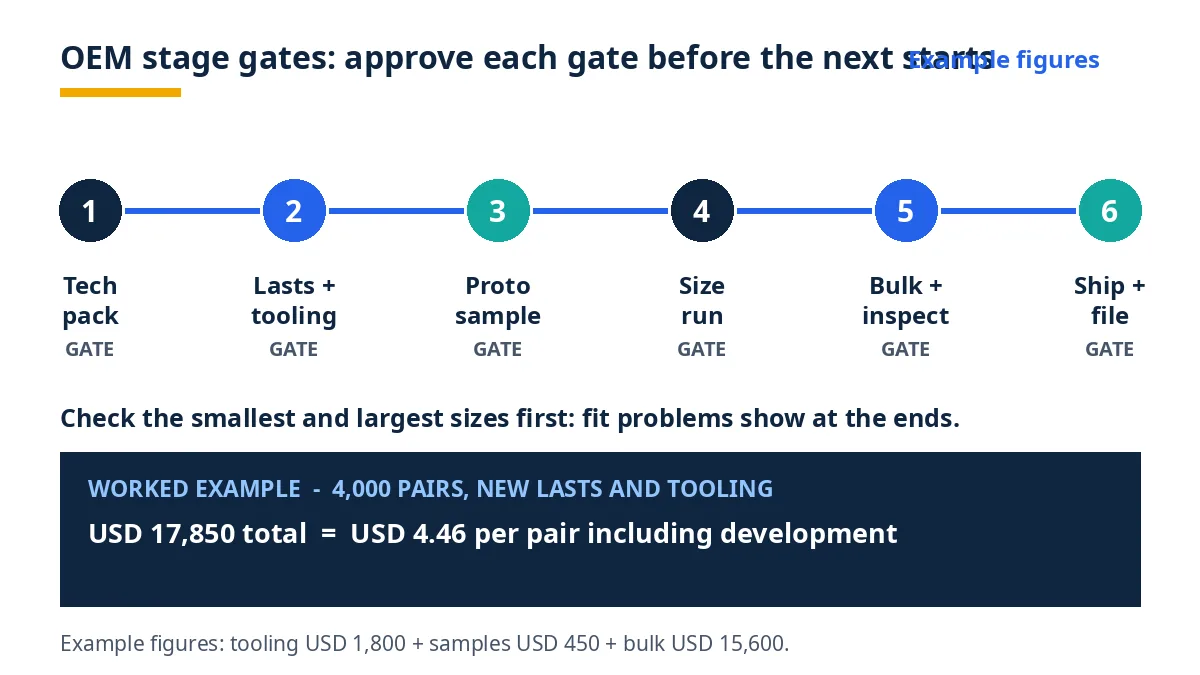
The OEM process has six gates: tech pack, lasts and tooling, proto sample, salesman samples, size run, and bulk with final inspection.
Children's lasts and size curves differ from adult lasts; approve fit on the smallest and largest sizes, not only the middle size.
US children's products need lead testing by a CPSC-accepted laboratory and a Children's Product Certificate.
Development costs (lasts, tooling, samples) are fixed: spread them across the order and state who owns the tooling.
A custom kids' shoe does not start on the production line. It starts in a document: the tech pack. Every decision that matters later — fit, materials, colours, closures, labels, testing — is cheaper to make in the tech pack than on the factory floor, and every decision skipped in the tech pack returns as a sample revision, a tooling charge, or a bulk problem.
This guide follows the OEM (original equipment manufacturing) process for custom children's shoes from Bangladesh, gate by gate, from the tech pack to bulk delivery. It is written for buyers commissioning a shoe that does not exist yet: a new design, a new last, or an existing design changed enough to need new tooling. For buying an existing factory design under your brand, see our guide to private label kids' shoes.
Gate 1: The tech pack
The tech pack is the manufacturing instruction for the shoe. A complete tech pack for children's shoes contains: technical drawings of each view (outside, inside, sole, and heel); the size range and size curve; the last specification and heel height; the material and colour specification for every component (upper, lining, insole, outsole, laces or straps, eyelets, trims, and adhesives); the construction method (cemented, vulcanised, or stitched); stitching and edge details; logo, label, and print artwork and positions; packaging specification; and the target-market testing requirements.
Write the tech pack before requesting quotations, and send the same pack to every factory. Quotations against different packs cannot be compared. State the tolerances you will accept: dimensional tolerances for the last, colour tolerances against the approved swatch, and the defect classes for inspection. If the pack says "good quality leather" without a grade, thickness, and finish, the factory will choose, and you will discover the choice at the sample stage.
Children's shoes add two tech pack lines that adult shoes do not need in the same form. First, closures: small children cannot tie laces reliably, so straps, hook-and-loop fasteners, and elastic closures need their own strength and durability specification, including how many open-and-close cycles they must survive. Second, small parts: products intended for children under 3 must not contain small parts or liberate small parts after use and abuse testing, under the CPSC requirements for children's products.1 Name every detachable trim, charm, and decoration in the pack, and require the factory to confirm each one against the small-parts position for your target age group.
Gate 2: Lasts, moulds, and tooling
The last is the foot-shaped form the shoe is built on. Children's lasts differ from adult lasts in more than size: children's feet grow fast, carry different weight distribution, and need different toe shape, heel grip, and flex points. A factory that scales down an adult last without adjusting the shape will produce a shoe that looks right and fits badly.
Confirm in writing: whether new lasts are needed or existing lasts fit the design; who pays for last and mould development; who owns the lasts and moulds after the order; where they are stored; and whether they can be used for repeat orders without a new charge. Tooling is a fixed cost: it does not change with order size, so it weighs heaviest on small orders and lightest on large ones. State the tooling charge as its own line in the quotation, separate from the unit price, and state the ownership position before the factory cuts the first last.
Gate 3: The proto sample
The proto (prototype) sample proves the design can be made. The factory builds one pair, usually in the middle size, from the tech pack. Check it against the pack line by line: shape and proportions, materials and colours, construction, stitching, closure function, logo and label positions, and weight. Record every deviation in writing with photographs, and approve or reject the proto in writing. Do not approve a proto verbally and discover later that the factory's notes differ from yours.
One proto rarely settles a design. Expect revisions: a second proto after corrections is normal, and a third is common for a new last. Price the sample rounds in the quotation, including who pays for each round and how many rounds are included before extra charges apply. A factory that charges per revision and a factory that includes two revisions quote different totals for the same shoe.
Gate 4: Salesman samples and the size run
Once the proto is approved, the factory produces salesman samples in the full colour range, for selling and for photography, and then a size run: one pair in every size in the range. The size run is the gate most often skipped, and the gate where fit problems appear. Check the ends of the size range first: that is where last scaling, closure reach, and material behaviour show up. Check the full size curve against the tech pack measurements, and confirm the grading between sizes is even.
Approve the size run in writing, size by size, with the measurements recorded. If a size fails, state the correction and require a revised pair in that size before bulk starts. Bulk production from an unapproved size run multiplies the fit problem by the order quantity.
Gate 5: Bulk production, testing, and inspection
Bulk production follows the approved size run. During production, the buyer or the buyer's inspector checks the agreed points: materials against the specification, colour against the approved swatch, construction, labelling, and packing. For the target market, build the testing file alongside production, not after it.
United States testing turns on three numbers and one document. Surface coatings on children's products are limited to 90 ppm of lead, and accessible component parts to 100 ppm of total lead content; a CPSC-accepted third-party laboratory must do the testing, and the importer generates a Children's Product Certificate that travels with the distribution of the product.1 Run the tests on production materials, not sample materials alone: substituting a coating or adhesive mid-run changes the result the certificate relies on. File the reports, the certificate, and the tracking label artwork together, each naming the style, sizes, and materials they cover.
European chemical compliance starts from the scope of the rule, not from an assumption. The REACH entries on phthalates ban toys and childcare articles for children aged 0 to 14 that contain DEHP, DBP, BBP, or DIBP at or above 0.1 percent by weight, singly or combined, and the same bar applies to DINP, DIDP, and DNOP where the article could go into a child's mouth.2 Shoes are neither toys nor childcare articles, so the ban does not reach footwear directly; soft plasticised parts a toddler could mouth, and any toy-like or childcare feature fixed to the shoe, may still fall within it, and plenty of EU buyers impose the 0.1 percent bar on shoe parts as a buying condition anyway.2 Write the bar, the parts it covers, and the evidence you will accept into the specification, and check each destination market separately: Denmark's 0.05 percent ban for toys and childcare articles for under-3s is a national rule that does not extend across the EU.2
Final inspection happens against the agreed acceptable quality level (AQL) and defect classes, agreed in writing before production. State the inspection standard, the sampling plan, who inspects, and what happens to failed lots: rework, re-inspection, or rejection, and who pays for each. Inspect the packed cartons too: size and colour mix per carton, label accuracy, and barcode scanning. A correct shoe in the wrong carton is a retail error discovered by the customer.
Worked example: development cost across a 4,000-pair order
The figures below are example figures for a custom children's shoe: new lasts and tooling, three sample rounds, and 4,000 pairs in bulk. They show how fixed development costs spread across the order.
Cost line | Example figures |
|---|---|
Lasts and tooling (one-off) | USD 1,800 |
Sample rounds, three rounds | USD 450 |
Bulk production, 4,000 pairs at USD 3.90 | USD 15,600 |
Total | USD 17,850 |
Unit cost including development | USD 4.46 per pair |
The arithmetic is 1,800 + 450 + 15,600 = 17,850, and 17,850 divided by 4,000 pairs is USD 4.46 per pair. At 4,000 pairs, development adds USD 0.56 to each pair. The same USD 2,250 spread over a 1,000-pair order would add USD 2.25 per pair. That is why custom OEM suits larger orders and repeat programmes, where tooling is reused: confirm the tooling ownership and storage position so the second order does not pay for the same lasts again.
Custom programmes need a supply base with room for tooling, sampling, and testing routines, and Bangladesh's footwear trade provides it: World Footwear, reporting Export Promotion Bureau data, recorded USD 494.28 million of other-footwear exports and USD 620.17 million of leather footwear exports between July 2024 and May 2025, growth of 30.25 percent and 28.96 percent respectively.3 A deep supply base is not a substitute for the gates. The factories that handle custom work well are the ones whose sample rooms, last libraries, and testing routines you verify before the tech pack leaves your desk.
How long each gate takes
Allow planning time, not just production time. Tech pack preparation and factory feedback, last and tooling development, proto revisions, salesman samples, and the size run all happen before bulk starts, and each gate needs your approval before the next begins. A buyer who compresses the gates to meet a retail date usually compresses the approvals, and the approvals are the quality control. Agree the schedule gate by gate in the purchase order, with approval deadlines on both sides, and hold bulk until the size run is approved in writing. The FOB cost breakdown shows how the unit price is built once production starts, and the typical MOQ guide explains how order size changes the economics of a custom programme.
Next steps on Exportain
Write the tech pack first, send the same pack to every factory, and approve each gate in writing before the next starts. Send the pack with your RFQ, shortlist factories among Bangladeshi suppliers, and follow how to buy to turn a quotation into an order. For the quality checks at the final gate, see the quality control checklist for kids' shoes.
Sources
- Business Guidance FAQ. U.S. Consumer Product Safety Commission (accessed )
- Fact-sheet: Phthalates in toys and childcare articles. Danish Environmental Protection Agency (accessed )
- Bangladesh: leather and non-leather footwear exports on the rise in 2024-2025. World Footwear, (accessed )
About the author
Sourcing from Bangladesh?
Post a request for quotation and suppliers on Exportain can send you their quotes directly.
Post an RFQ