Solar Panels From Bangladesh to Canada: A Buyer's Import Checklist
A buyer's checklist for solar panels from Bangladesh to Canada: the CARM importer file, CSA certification, port choice, and LDCT duty treatment.
Short answer
To import solar panels from Bangladesh to Canada, set up the importer file first: register the business in the CARM Client Portal with a CRA business number and an import-export RM account, delegate authority to your customs broker, and enrol for Release Prior to Payment with financial security. Confirm the modules carry a Canadian certification mark to CSA C22.2 No. 61730, choose Vancouver or Montreal by final destination, and claim LDCT duty-free treatment for qualifying goods.
On this page
Key takeaways
Register the business in the CARM Client Portal before the first shipment; brokers cannot register a client's business.
The first user to register becomes the business account manager; delegate authority to the broker from the portal.
Modules need a Canadian certification mark to CSA C22.2 No. 61730 from an accredited body.
LDCT gives duty-free treatment for virtually all goods from least developed countries, including Bangladesh, subject to origin rules.
Canada's import system rewards buyers who set up the importer file before the first shipment and punishes buyers who discover it at the port. The file is a portal registration, not a form at the border; the certification is a mark on the product, not a promise in a brochure; and the duty treatment is a preference claim with origin rules, not an assumption. This checklist works through all three in the order that avoids delays.
It is written for buyers importing solar panels from Bangladesh into Canada for distribution or projects. Duty, GST, and provincial tax figures are left as broker-confirmed lines throughout, because the applicable treatment depends on classification, origin, and the entry date, and your broker confirms all three in writing.
Checklist item 1: Register the business in the CARM Client Portal
CARM is where Canadian import accounting lives: the CBSA Assessment and Revenue Management system records duties and taxes on commercial imports, and importers manage their accounts through the CARM Client Portal.1 Registration is the importer's own job: importers need to register their business in the CARM portal themselves, and customs brokers cannot register their client's business on their behalf.1
Before registering, have the following ready. A Canada Revenue Agency 9-digit business number (BN9) is mandatory; most new resident businesses can obtain a BN9 during the portal registration process, while non-resident businesses must request their BN9 from the CRA before attempting to register, or the registration will error.1 An import-export program (RM) account is a 6-digit number, for example RM0001, that businesses receive when they enrol in a CBSA commercial program; if you already have an RM number, enter it during registration, and if you do not, you may enrol for a commercial program when you register.1
Each portal user creates their own sign-in credential and user profile. The first user to register the business in the portal automatically becomes the business account manager (BAM), the person who actions employee access requests, and the CBSA recommends assigning a second business account manager as a backup.1 Register early, while the shipment is still at the factory, and keep the BAM's access details with the person who will actually manage the account.
Checklist item 2: Delegate authority to your customs broker
Once registered, delegate authority to your customs broker from inside the portal so the broker can act on your behalf. While registering, importers that use third parties such as a customs broker should review their delegation of authorities.1 The broker requests a business relationship with your account in the portal, and you delegate authority to them there.1 Do not assume a broker who handled your last shipment under the old system can act for you in CARM: delegation in the portal is the mechanism, and it must be in place before the broker lodges entries for you.
Confirm the delegation covers the programmes you need, including Release Prior to Payment if you intend to use it, and confirm the broker's access is active before the vessel sails. A broker locked out of your account at arrival is a release delay, not a broker problem.
Checklist item 3: Enrol for Release Prior to Payment, with financial security
Consider enrolling in Release Prior to Payment and posting the financial security it requires, so release is not held for final accounting.1 Release Prior to Payment allows goods to be released before duties and taxes are finally accounted for and paid, against financial security posted in CARM. Without the enrolment and the security in place, the shipment's release follows the standard accounting and payment sequence, which takes longer.
Ask your broker to confirm the security amount and form for your expected import volumes, post it in CARM before the first shipment, and keep the security current as volumes change. This article states no security amount: the requirement depends on your account and history, and your broker confirms the figure. Record the enrolment and the security posting in the shipment file with the CARM registration itself.
Checklist item 4: Confirm the Canadian certification mark
Solar modules for Canada must carry a Canadian certification mark. The core certification is CSA C22.2 No. 61730-1/-2, equivalent to IEC 61730, and modules must undergo testing by CSA or its accredited institutions, with certificates bearing the CSA mark.2 Some certification bodies offer dual UL and CSA certification from one test programme, reducing duplicate testing for buyers who also sell into the United States.2
Before you agree the purchase order, ask the seller for: the certificate for the exact module model and factory; the certification body's accreditation for Canadian electrical product certification; and the mark as it will appear on the module and the packaging. A certificate naming a different model, or a test report without a Canadian mark, does not establish Canadian market access. Confirm the system voltage rating too: higher-voltage modules have additional interim certification requirements under CSA technical information letters, applied together with CSA C22.2 No. 61730-1/-2, so confirm the rating on the certificate matches the rating on your datasheet.
Checklist item 5: Choose the port by final destination
Two gateways cover most solar imports from Bangladesh. Vancouver suits deliveries to British Columbia, Alberta, and western Canada, with onward rail and road connections inland. Montreal suits deliveries to Quebec, Ontario, and eastern Canada. Name one port in every booking, quotation, and instruction, and keep it identical across all documents.
Port choice also sets the inland leg and the inspection route. Price inland transport from the named port to the final warehouse before comparing supplier quotations, and confirm which provincial electrical safety authority administers permits and inspections where the system will be installed, since Canada has no single national installation permit: each province adopts the Canadian Electrical Code with local amendments and enforces it through its own authority.3 Your project customer or installer confirms the provincial position; the import file does not.
Checklist item 6: Claim LDCT duty-free treatment correctly
Canada's Least Developed Country Tariff (LDCT) provides comprehensive duty-free treatment for virtually all goods imported from least developed countries, covering all imports except over-access, supply-managed dairy, poultry, and egg products.4 The programme has been renewed in legislation to December 31, 2034, and currently applies to 49 least developed countries, including Bangladesh.4 GPT membership is a precondition for LDCT eligibility, and eligibility ultimately rests with the Governor-in-Council on the Minister of Finance's recommendation.4
Two cautions belong in the file. First, the preference is subject to rules of origin: the Department of Finance page points importers to Memorandum D11-4-4, the rules of origin for the General Preferential Tariff and the Least Developed Country Tariff, for the current technical requirements.4 Confirm with your broker that the modules meet the origin rule and what evidence supports the claim. Second, Bangladesh has been identified for prospective UN graduation in 2026, and Canada intends to apply a three-year transition policy allowing graduating beneficiaries to retain full tariff benefits for an additional three years following the formal change in UN status.4 Confirm the treatment in force on your entry date with your broker; do not assume the position from a previous shipment.
GST and any provincial taxes apply separately from duty. Confirm the tax treatment for the exact classification and province with your broker or accountant, and keep the confirmation with the entry documents.
Worked example: 900 modules to a Toronto warehouse
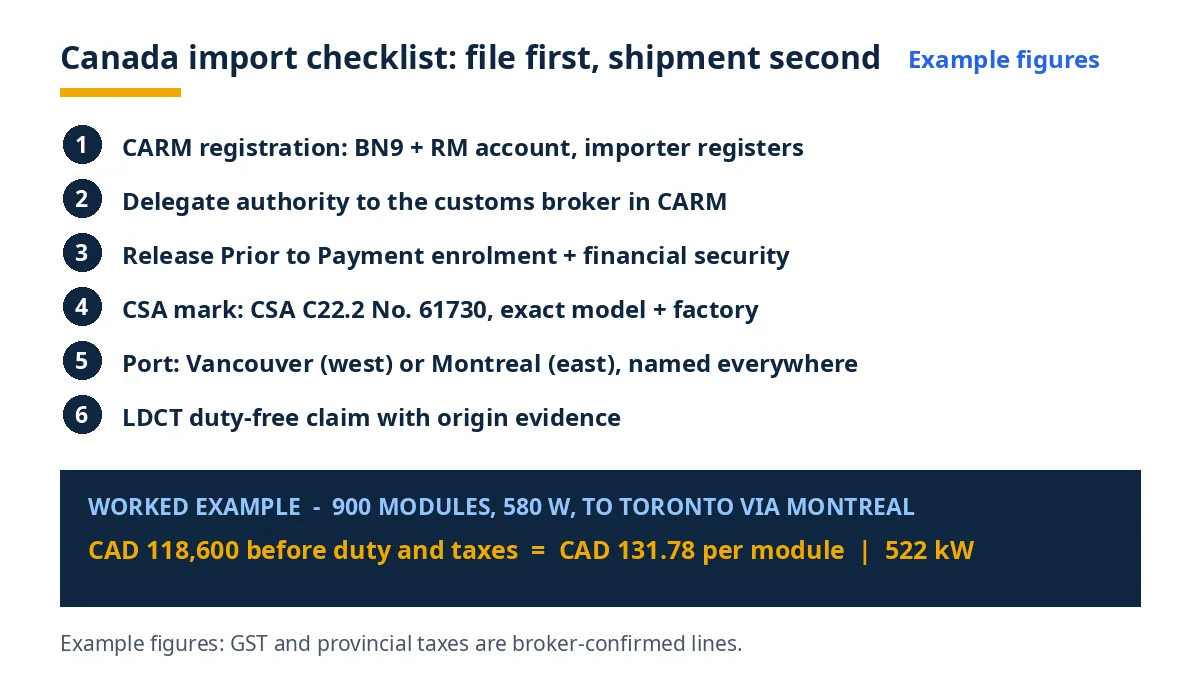
The figures below are example figures for 900 modules at 580 W each, shipped to Montreal and delivered onward to a warehouse near Toronto. Duty is shown as zero under an LDCT claim for qualifying goods; GST and provincial taxes are separate broker-confirmed lines.
Line | Example figures |
|---|---|
Modules, 900 at CAD 118.00 | CAD 106,200 |
Ocean freight and insurance, Chattogram to Montreal, plus inland to Toronto | CAD 12,400 |
Total before duty and taxes | CAD 118,600 |
Cost per module before duty and taxes | CAD 131.78 |
Installed capacity | 522 kW |
Import duty under LDCT claim | CAD 0 for qualifying goods |
GST and provincial taxes | Broker-confirmed lines |
The arithmetic is 106,200 + 12,400 = 118,600, and 118,600 divided by 900 modules is CAD 131.78 per module; 900 modules at 580 W is 522 kW. Replace every figure with a written quote, and keep the duty claim and the tax lines as your broker's written confirmations, not as assumptions in the quotation.
Common file mistakes on the Canada lane
Registering late. CARM registration, RM enrolment, and delegation of authority take time and back-and-forth. A shipment that arrives before the file is ready waits. Start the file when the purchase order is signed.
Letting the broker register the business. Brokers cannot register a client's business in CARM.1 If a broker offers to do it, the offer misunderstands the system, and the registration will not complete.
Accepting a certificate for the wrong model. Canadian certification attaches to a model, a factory, and a rating.2 Match all three to the purchase order before loading.
Assuming the duty claim. LDCT duty-free treatment depends on origin rules and the treatment in force on the entry date.4 Claim it with evidence, and confirm it in writing for each shipment.
For the neighbouring North American lane, see our step-by-step guide to importing solar panels to the United States, and for the European lanes, the guides to Spain, France, and Italy.
Next steps on Exportain
Work the checklist in order: CARM registration, broker delegation, Release Prior to Payment security, certification mark, port, and duty claim. You can post an RFQ naming the module model and the Canadian port, browse Bangladeshi suppliers, and read how to buy for how quotations and orders work on Exportain.
Sources
- Get started with CARM. Canada Border Services Agency (accessed )
- Global PV Module Market Access Certifications and Requirements. DSN, (accessed )
- Canada Solar Regulations 2026: Provincial Net Metering, CSA Code and Incentives Guide. SurgePV (accessed )
- Canada's unilateral tariff preference programs for imports from developing countries. Department of Finance Canada (accessed )
About the author
Sourcing from Bangladesh?
Post a request for quotation and suppliers on Exportain can send you their quotes directly.
Post an RFQ