How to Import Solar Panels From Bangladesh to USA: Step-by-Step Guide
Qualify the module, the supplier and the United States border file in that order. This USA guide gives the nine-step sequence, with a worked landed-cost example and no duty rate stated until a broker confirms it.
Short answer
Importing solar panels from Bangladesh to the United States starts with the module, not the price. Qualify the exact model for UL 61730 safety listing, check the supplier papers and the polysilicon traceability file, set up the importer of record and broker file, file the Importer Security Filing before loading, and have a broker confirm classification and duty in writing. Price from a landed cost with the duty line open.
On this page
Key takeaways
Qualify the exact module for the United States: hold the UL 61730 listing record, the IEC 61215 and IEC 61730 evidence, and the datasheet, all naming the same model and build.
Build the forced-labour diligence file before shipment, tracing polysilicon, wafers and cells by facility, because polysilicon is a high-priority sector under the UFLPA presumption.
File the Importer Security Filing before loading: eight elements no later than 24 hours before lading, with stuffing and consolidator details no later than 24 hours before arrival, and update the filing when a fact changes.
No duty rate is stated in this guide: the broker must confirm the full HTS line, the measures in force on the entry date, origin, and any antidumping or countervailing duty position in writing.
Price on a worked landed cost in dollars with duty as a separate line to be inserted, and compare suppliers line by line on the same delivery basis.
A solar panel order from Bangladesh to the United States is decided by a sequence, and the sequence matters more than any single quotation. The module must suit United States safety and installation rules, the supplier must be able to prove what it is selling, and the border file must be ready before the container is loaded. This guide follows that sequence in nine steps, from module qualification to the installation file, with a worked landed-cost example at the end. It is written for a buyer in the United States who will act as importer, or who will appoint a broker to file on the buyer's behalf.
Step 1: Qualify the module for the United States before you ask for a price
Start with the exact module, not with a wattage class or a price per watt. Ask the supplier to name the model number, the cell type, the frame and glass build, the junction box and connector set, and the factory where that exact build is made. A certificate that names a different model, a different factory, or a different bill of materials does not cover the order, even when the brand name matches. Hold the certificate, the test report behind it, and the datasheet together, and check that all three name the same model. If any one of the three names something else, stop and ask for the matching set before discussing quantity.
Two different questions sit behind the papers. The first is design qualification and durability. IEC 61215-1:2021 sets the tests a terrestrial module design must pass for type approval after long outdoor exposure, and it warns that passing those tests does not predict how many years a module will last.1 The document covers flat-plate designs in crystalline silicon and thin film, and it leaves out short-life uses such as flexible sheets fitted to awnings or tents.1 Read a durability claim in those terms: a laboratory pass shows that a design withstood the test sequence, not that a given module will perform for a stated period in a stated climate.
The second question is safety. IEC 61730-1:2023 sets out how a module must be built so it can operate without exposing people to shock, fire, or mechanical harm from electrical and environmental stress.2 It covers flat-plate crystalline silicon and thin-film designs for long outdoor service, and it caps the modules it covers at 1500 V DC.2 The safety sequence is arranged to share samples with the IEC 61215 sequence, and a change of material, design, or internal spacing sends the module or its part back for fresh assessment under the IEC 61730 series and IEC TS 62915.2 That return-for-assessment rule is the reason a buyer asks about changes: a new backsheet, a new encapsulant, or a new junction box can move the module outside the construction that was assessed.
For the United States, ask separately for the UL 61730 position. UL Solutions states that, when applicable, it tests and certifies to UL 61730-1, the Standard for Photovoltaic (PV) Module Safety Qualification, Part 1: Requirements for Construction, and to UL 61730-2, Part 2: Requirements for Testing, alongside panels and performance testing under the IEC/UL 61215 series.3 Ask for the listing or certification record that names the exact model and configuration, and ask who issued it. An IEC 61730 certificate on its own is not the same record as a UL 61730 listing, and the buyer needs the record that the installer and the authority having jurisdiction will accept for the project. Record the answer per model, and treat a model change as a fresh qualification question.
Paper | What it must name | Ask |
|---|---|---|
Design qualification evidence | The exact model, the IEC 61215 edition, the test sequence | Whether the report covers the ordered build or a related build |
Safety construction evidence | The exact model, the IEC 61730 edition and part | What change would trigger re-evaluation |
United States safety listing | The exact model and configuration, the UL 61730 part | The listing record and the issuing body, checked against the model |
Datasheet | The model, electrical ratings, dimensions, system voltage | Whether the datasheet matches the certificate and the test report |
Step 2: Qualify the supplier on papers that name the exact module
Ask each shortlisted supplier for the same set of answers: the exact module from Step 1, the quantity and delivery rule with named places, the destination in the United States, the sample terms, and the documents that will travel with the shipment. When suppliers answer different questions, their quotations cannot be placed side by side, and the cheapest headline figure in such a set is usually the one that omitted a document. Put every reply into one comparison table, and file each supplier's written answers with its quotation.
Judge each supplier on four tests. First, do the papers describe the exact module and configuration requested, with test evidence the buyer can actually read. Second, does the supplier answer scope questions plainly, including what changes would require fresh assessment and what the supplier will not cover. Third, are quantity, packing, and sample terms given as figures and dates rather than reassurance. Fourth, are the delivery rule, the port of loading, and the handover point all named. A supplier that looks cheap and fails the first two tests will cost the most in the end, because a rejected module or a fresh assessment is paid for after the deposit has gone.
Treat the sample as evidence for the whole file, not only as a check of one module. Approve it in writing against the specification, keep a record of that approval, and insist that production modules match the approved sample in model, marking, and labelling as well as in build. Where a test report is supplied, confirm that the report, the sample, and the production modules all carry the same model and build name. A passing sample followed by bulk modules under a different model name proves nothing about the bulk. On a first order, a small trial quantity that the installer can look at on arrival teaches more than another round of sales material, and its cost belongs in the first order budget.
This guide states no typical minimum order quantity and no typical price. Minimum quantities vary by model, by production run, and by supplier, and a figure copied from another product or another season will mislead the buyer. Ask each supplier to state the minimum in writing for the exact model, including the basis on which the minimum applies, and test that minimum against the project need plus a stated allowance for spares and breakage. Ask separately for the sample price, the sample freight position, and whether the sample cost is credited against a bulk order. Record the answers as numbers, not as promises.
Step 3: Build the forced-labour diligence file before shipment
Solar panels carry a diligence file that must be built before the goods ship, because the input that matters most for that file sits several tiers below the module assembler. The Uyghur Forced Labor Prevention Act establishes a rebuttable presumption that goods mined, produced, or manufactured wholly or in part in the Xinjiang Uyghur Autonomous Region of China, or produced by an entity on the UFLPA Entity List, are prohibited from entering the United States under 19 U.S.C. section 1307.4 The presumption went into effect on June 21, 2022, and the Forced Labor Enforcement Task Force, chaired by the Department of Homeland Security, reported that since implementation through July 2025, Customs and Border Protection had examined more than 16,000 shipments, valued at almost 3.7 billion dollars, under that presumption.4 Goods produced by listed entities are subject to the presumption unless the importer can demonstrate with clear and convincing evidence that the goods were not made with forced labor and meets the other requirements for an exception to the presumption.4
Polysilicon is not a background input in this file. The Task Force identifies silica-based products, including polysilicon, among the high-priority sectors for enforcement, and it states that those sectors involve a higher risk than other sectors of forced labor of Uyghurs and members of other persecuted groups from the Xinjiang Uyghur Autonomous Region.4 The Customs and Border Protection dashboard guide records the same sector list, with silica-based products including polysilicon named among the priority sectors identified in June 2022, and it states that the dashboard covers enforcement data since June 21, 2022.5 The Task Force expanded the Entity List from 20 entities to 144 entities as of the August 2025 update.4 A buyer who cannot trace the polysilicon in the ordered modules has not finished this step, whatever the module price says.
Build the file as a shipment file, not as a company policy file. For each shipment, hold a supply-chain map that names the parties from raw material through finished module, the purchase and payment records that show the chain of custody, and the origin evidence for the polysilicon and the cells. Ask the supplier, in writing, to identify the polysilicon source, the wafer source, the cell maker, and the module assembler, with the facility names and locations for each tier it controls, and to state what it cannot identify. Where a tier is handled by a sub-supplier, ask for the sub-supplier record rather than accepting a general assurance. Keep the file with the order, in the same words as the commercial invoice and the entry file, so that a later question about the shipment can be answered from paper rather than memory. A general statement that a supplier does not use forced labour does not substitute for the tier-by-tier record, and a buyer who discovers a gap at the port has discovered it too late to fix by correspondence.
Step 4: Set up the United States importer file
The importer of record carries the entry duty, even when a broker files the papers. Under 19 U.S.C. section 1484, one of the parties qualifying as importer of record, either in person or by an agent authorized in writing, shall, using reasonable care, make entry by filing the documentation or information necessary for Customs and Border Protection to determine whether the merchandise may be released from custody, and complete the entry by filing the declared value, classification, and rate of duty applicable to the merchandise, with the other information necessary to properly assess duties, collect accurate statistics, and determine whether any other applicable requirement of law is met.6 The required documentation or information is filed either by the owner or purchaser of the merchandise or, when appropriately designated by the owner, purchaser, or consignee, by a person holding a valid customs broker license.6 Appointing a broker does not move the reasonable-care duty off the importer of record, so the buyer reads the entry file before it is filed rather than after the goods arrive.
Settle four items with the broker before the shipment leaves Bangladesh. First, who is the importer of record for this entry, and what importer of record number will appear on the filings. Second, what bond position covers the entry, as the broker confirms it for this shipment. Third, what value basis, classification, and duty position the broker will declare, in writing, for the exact modules. Fourth, what record the buyer will keep, and where the entry papers, the supplier papers, and the diligence file from Step 3 will sit together. Do not let the broker, the forwarder, and the supplier each hold a different version of the module description: one description, in the same words, across the enquiry, the quotation, the sample approval, the commercial invoice, the packing list, and the entry file.
Step 5: File the advance data before loading
Ocean cargo to the United States carries an advance filing that must be sent before the container is loaded, and the timing is fixed by regulation rather than by the sailing schedule. Under 19 CFR section 149.2, for cargo arriving by vessel, with the exception of bulk cargo, the Importer Security Filing Importer or an authorized agent must submit the Importer Security Filing elements in English through a Customs and Border Protection approved electronic interchange system.7 The seller, buyer, importer of record number or foreign trade zone applicant identification number, and consignee number must be submitted no later than 24 hours before the cargo is laden aboard the vessel at the foreign port, and the manufacturer or supplier, ship-to party, country of origin, and commodity Harmonized Tariff Schedule number must also be submitted no later than 24 hours before the cargo is laden aboard the vessel at the foreign port.7 The container stuffing location and the consolidator must be submitted as early as possible, and in no event later than 24 hours prior to arrival in a United States port.7
Two duties follow from that timing. The filing must be updated if, after submission and before the goods enter the limits of a United States port, any submitted information changes or more accurate information becomes available.7 And the party presenting the filing must present it on the basis of what it reasonably believes to be true where it is not reasonably able to verify information received from another party, with Customs and Border Protection taking into consideration how the presenting party acquired the information in accordance with ordinary commercial practices.7 In practice, that means the buyer gives the broker the manufacturer name and address, the country of origin, and the six-digit tariff number from the same order file used everywhere else, early enough for the broker to file before loading, and corrects the filing when a fact changes. A late correction is better than an uncorrected filing, but a filing built from a different module description than the invoice will create questions at both ends of the voyage.
Step 6: Settle classification, duty, and trade remedies with the broker in writing
Classification starts at heading 8541, and the heading is indicative until the broker confirms the full line for the exact product. The broker must confirm the full Harmonized Tariff Schedule of the United States line, the measures in force on the entry date, and every other charge that applies to that line, in writing, before the buyer prices the order. This guide states no duty rate. The rate position for solar modules has moved through safeguard measures and other trade remedies, and a rate copied from another year, another origin, or another product form will mislead the buyer. The broker confirms the figure from the tariff schedule in force on the entry date, and the buyer inserts that confirmed figure into the landed-cost table in the worked example below. A quotation that leaves the duty line blank without saying so is not a quotation the buyer can compare.
One Customs and Border Protection ruling shows why the full line and the product form matter. In ruling NY N338270, on specific solar panels made from silicon wafers at or above 20 micrometers in thickness with a positive/negative junction, the applicable subheading was 8541.43.0010, described as photovoltaic cells assembled in modules or made up into panels, being crystalline silicon photovoltaic cells of a kind described in statistical note 10 to Chapter 85, and the general rate of duty stated in that ruling was Free.8 The same ruling records that Presidential Proclamation 9693 imposed safeguard measures on imports of crystalline silicon photovoltaic cells and certain products incorporating them, later extended by Presidential Proclamation 10339, and that products classified under subheading 8541.43, unless specifically excluded, are subject to the additional duties, with reference to Note 18 to Chapter 99 and subheadings 9903.45.21 through 9903.45.27.8 The ruling is tied to its own facts and merchandise description. Do not read its Free general rate as the total duty position for a different module, a different origin, or a later entry date.
Origin needs the same written treatment, because origin for marking and origin for trade remedies are not decided by the same test in every case. The ruling explains that the substantial transformation test determines origin for sections 201, 232, and 301 trade remedy purposes, and that a substantial transformation occurs when an article emerges from a process with a new name, character, or use different from that possessed by the article prior to processing.8 On the facts of that ruling, cells manufactured in Mexico from Chinese wafers imparted the essence of the finished panel, and the origin for trade remedy purposes was Mexico.8 A Bangladesh order needs the same question answered on its own facts: where were the cells made, where were the wafers made, what process created the junction, and where was the module assembled. Ask the broker to state the origin position for marking and the origin position for trade remedies separately, and to state which facts support each position.
Antidumping and countervailing duties are a further broker check, not an assumption. Ask the broker, in writing, whether any antidumping or countervailing duty order covers the modules, the producer, or the country of origin for this entry, and what deposit or security position applies if one does. The entry statute itself provides for reconciliation of entry elements, including issues relating to the assessment of antidumping and countervailing duties, which shows that those duties sit inside the entry file rather than outside it.6 Record the broker answer with the order. If the answer changes between quotation and entry, rework the landed cost before paying the balance.
Duty file item | Confirm in writing | Before |
|---|---|---|
Full HTS line for the exact module | Broker, from the schedule in force on the entry date | Pricing the order |
General rate and additional duties | Broker, with the Chapter 99 position stated | Pricing the order |
Origin for marking | Broker, on the facts of this shipment | Loading in Chattogram |
Origin for trade remedies | Broker, under the substantial transformation test | Loading in Chattogram |
Antidumping and countervailing duty position | Broker, by producer and country of origin | Pricing the order |
Step 7: Choose the delivery rule and the freight file
The delivery rule fixes three things at once: who books the carriage, who carries the risk at each stage, and who clears the goods at the border. Remember the mode split in this form: the sea/inland-waterway-only rules are FOUR — FAS, FOB, CFR, CIF; CPT is any-mode; DPU is any-mode; DDP is any-mode (seller clears import customs, pays duty); FCA is any-mode. Name the rule together with its named place or point, and make that place exact: a loose port name can let the seller pick a terminal the buyer never intended, leaving the buyer with the inland bill.9
Containerized modules call for the container warning. The Academy summary warns that FOB leaves a gap for boxed goods: the buyer's risk starts only once the goods are aboard, yet a container may wait in the terminal first, so FCA usually fits container loads better, even on a sea leg.9 Anyone buying containerized modules on FOB should ask the forwarder who carries the risk while the box sits in the terminal, and write the answer into the contract. With a C rule, carriage to the named destination is the seller's bill, while the risk moves to the buyer sooner: when the carrier takes the goods under CPT or CIP, or when they are loaded aboard under CFR or CIF. CIP and CIF add seller insurance; CPT and CFR do not.9 DAP, DPU, and DDP all end at the named destination: DAP leaves the goods ready to unload, DPU has the seller do the unloading, and DDP adds import clearance by the seller.9 On a first United States order, DAP to a named warehouse often gives the simplest handover, with the seller arranging the move while the buyer retains the entry file and the duty position. DDP can fit a buyer who wants the seller to run import clearance, but the seller then acts as importer of record for that entry, and the buyer should confirm the seller is set up for that role before agreeing the rule.
No transit time appears in this guide. Sailing dates, transshipment, terminal congestion, and the onward road or rail service each shift the arrival date, and a figure borrowed from another route or another season will mislead the installer. Get the sailing date, the expected arrival at the named United States terminal, and the onward service for the week of shipment from the carrier or forwarder, then set the site date from those three facts plus a buffer for inspection and examination. Write the buffer down as a number of days, and tell the installer it exists, so a short delay does not turn into a project delay.
Step 8: Ship, receive, and inspect in the United States
Packing decides whether modules arrive in the condition the papers describe. State the packing in the order: pallets or crates, the number of modules per pallet, the stacking and strapping terms, the corner and edge protection, and the marks on each pallet. State who owns the pallets, whether pallets return, and what a damaged pallet costs in time as well as money. Agree the unloading sequence with the receiver before loading, and put the sequence on the packing list, because restacking heavy pallets at the warehouse is slow and easy to damage.
On arrival, check the shipment against the file before signing for it in full. Count pallets and modules against the packing list, check the model and marking on the pallets against the approved sample and the certificate, and photograph any damage before the pallets are moved. Note damage on the delivery record at the time of delivery, keep the damaged packing until the carrier and the insurer have seen it, and tell the broker and the insurer on the same day. A damage note written a week later, after pallets have been restacked, is difficult to settle from paper. Keep the inspection record with the order file, and insist that production modules match the approved sample in model, marking, and labelling as well as in build. Where a module fails the receiving check, record the failure by pallet and model, and do not mix failed and passed modules in the same installation batch.
Step 9: Plan the installation file before the modules arrive
The border file settles whether modules may enter the United States. It does not settle whether they may be installed on a particular building. The installer, the electrical inspector, and the utility serving the site own that answer, and the buyer should have it in hand before ordering, rather than chasing it when the truck arrives. Put the same written questions to all three: what do they require for these exact modules, this exact site, and this exact system design. File their answers with the order.
Electrical installation in the United States is governed in large part by the National Electrical Code, and a summary of the 2023 edition states that Article 690 covers solar installations, except large-scale ones, which are covered in Article 691.10 The same summary states that components of the photovoltaic system, including inverters, photovoltaic modules, alternating current modules, direct current combiners, direct current to direct current converters, rapid shutdown equipment, and charge controllers, must be listed or evaluated for the application and have a field label applied.10 That listing point is why Step 1 asks for the UL 61730 record: the module that arrives must be the module the listing covers, in the configuration the listing covers. Ask the installer to confirm, in writing, that the listed status covers the ordered configuration and the intended application, including the system voltage and the mounting arrangement.
Grid connection is a separate permission. Where a photovoltaic system operates in parallel with the electric utility as permitted by Article 705, a permanent plaque, label, or directory must be installed at the service disconnect location, and photovoltaic systems connected in parallel with the electric utility must have the interconnection made per Article 705.10 The utility process itself varies by state and by utility territory, so the buyer checks the serving utility's process for the site rather than assuming a national timetable. As one state example, Massachusetts describes interconnection as the process of connecting a distributed generation system to the electric grid, states that the system owner must obtain written approval from the local utility in the form of an Interconnection Service Agreement and subsequent Authorization to Connect before connecting, and states that the process is necessary to protect the reliability and safety of the electric grid.11 Ask the serving utility what application, study, agreement, and authorization steps apply to the site, what equipment and metering terms apply, and whether the system may operate before the authorization is issued. Do not energize a grid-parallel system on the strength of the delivery date alone.
Worked example: landed cost per module, with the duty line open
Every figure in the table below is illustrative: treat each one as an example, and keep the duty line empty until the broker confirms the full HTS line, the measures in force, and every other charge in writing. The basis is FOB Chattogram, Incoterms 2020, for 1,200 modules of one model, with the broker-confirmed duty figure added once it arrives. Build the table again from real quotations and the broker figures before pricing, and file the rebuilt table with the order.
Line | Example figures (USD) |
|---|---|
Product cost: 1,200 modules at 85.00 per module, FOB Chattogram | 102,000.00 |
Ocean freight, Chattogram to the named United States terminal | 4,800.00 |
Cargo insurance | 620.00 |
Subtotal before duty | 107,420.00 |
Import duty and additional duties: customs value x broker-confirmed rates | Your figure |
Customs broker fee | 450.00 |
Destination port and terminal charges | 780.00 |
Inland delivery to the United States warehouse | 1,150.00 |
Inspection and testing | 900.00 |
Bank and currency costs | 210.00 |
Total landed cost | 110,910.00 + your duty figure |
Landed cost per module before duty | 92.43 |
The arithmetic is: 102,000.00 + 4,800.00 + 620.00 = 107,420.00; 107,420.00 + 450.00 + 780.00 + 1,150.00 + 900.00 + 210.00 = 110,910.00; 110,910.00 / 1,200 = 92.43 per module. Before duty, the per-module figure already sits about 9% above the quoted 85.00, with freight and shipment charges accounting for the gap. Divide the confirmed duty figure by 1,200 and add it for the final landed cost per module, and price from that number. Pricing from 85.00 would absorb freight, inspection, broker and delivery charges, plus duty, inside the margin. Rank suppliers against this table, line by line, on one delivery basis, and set aside any comparison that mixes delivery rules or leaves the duty line empty without saying so.
The order to follow: nine steps, no step skipped
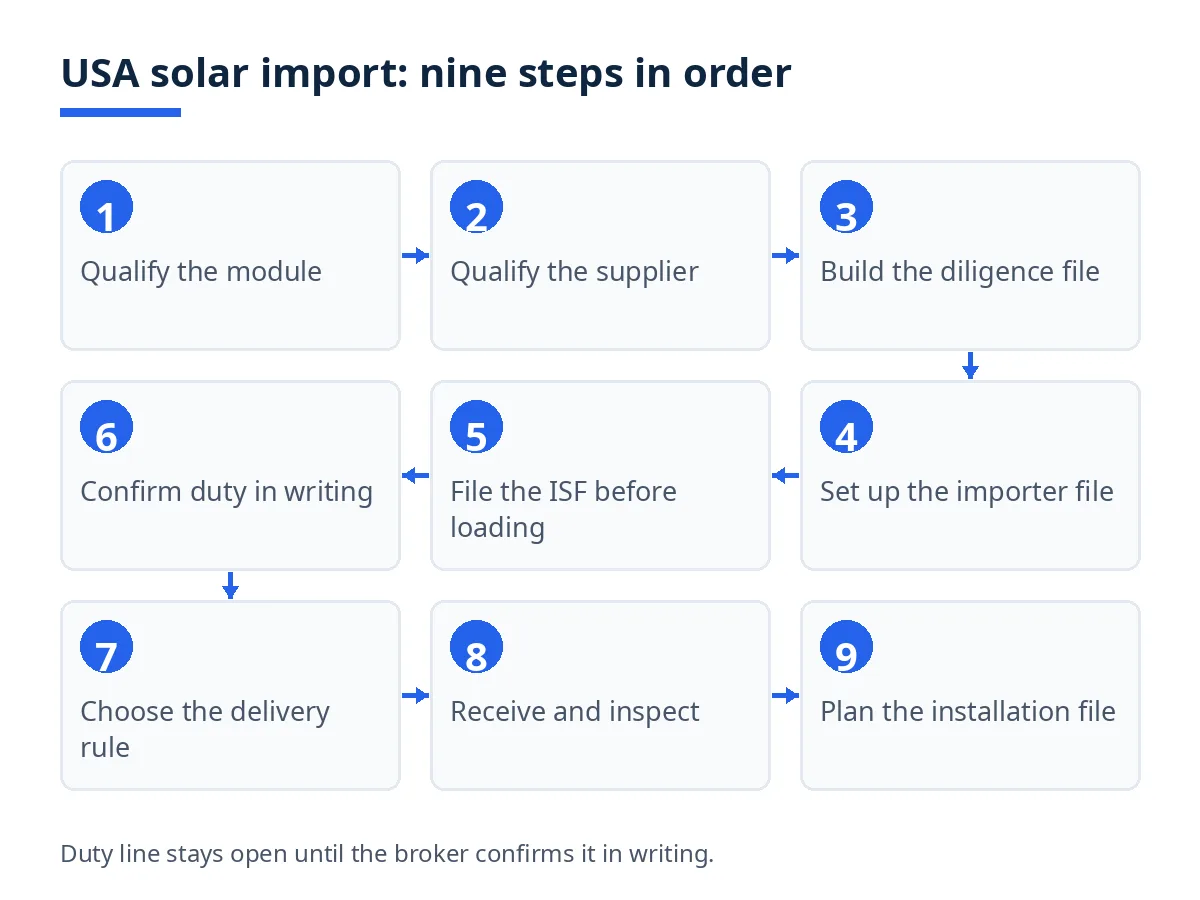
Work the nine steps in the order given, and record any change when a later step forces an earlier one open again. First, qualify the exact module for the United States, checking the UL 61730 record against the model. Second, qualify the supplier on papers naming that module, with a sample approved in writing. Third, build the forced-labour diligence file, including polysilicon traceability, before shipment. Fourth, set up the importer of record and broker file, using one module description everywhere. Fifth, file the Importer Security Filing before loading, and update it when a fact changes. Sixth, settle classification, duty, origin, and trade remedies with the broker in writing, keeping the duty line open until the answer arrives. Seventh, choose the delivery rule with named places, and confirm who carries the risk during terminal handling. Eighth, ship, receive, and inspect against the file, pallet by pallet. Ninth, plan the installation file with the installer, the inspector, and the utility before the modules arrive. Followed in that order, most difficulties show up as questions on paper, where they cost little, instead of as trouble at the port, where they cost far more.
What import duty does a USA buyer pay on solar panels from Bangladesh?
No rate appears in this guide. The amount turns on the full HTS line for the exact module, the measures in force on the entry date, the origin positions, and any antidumping or countervailing duty order that covers the producer or the country of origin. In one ruling on specific panels, the general rate stated was Free, while additional safeguard duties applied under Chapter 99 unless specifically excluded.8 Have the broker confirm, in writing, the full line, the general rate, the additional duties, the origin positions, and every other charge, and insert the confirmed figures into the landed-cost table before pricing.
What does UFLPA diligence require for solar panels from Bangladesh?
The diligence file must trace the module below the assembler, to the cells, the wafers, and the polysilicon source, with facility names and locations and the purchase and payment records that show the chain of custody. The presumption covers goods mined, produced, or manufactured wholly or in part in the Xinjiang Uyghur Autonomous Region or by an entity on the UFLPA Entity List, and it is rebutted only with clear and convincing evidence that the goods were not made with forced labor, together with the other requirements for an exception.4 Polysilicon is a high-priority sector for enforcement, so a file that stops at the module assembler is incomplete.4
Does an IEC certificate alone qualify a solar panel for installation in the United States?
No. An IEC 61730 certificate addresses construction safety under that standard, and an IEC 61215 qualification addresses design qualification, but the installation file needs the record the installer and the authority having jurisdiction will accept for the exact model and configuration. UL Solutions tests and certifies to UL 61730-1 and UL 61730-2, alongside the IEC/UL 61215 series.3 Separately, the summary of the 2023 National Electrical Code states that photovoltaic system components, including modules, must be listed or evaluated for the application and have a field label applied.10 Ask for the listing record that names the exact model, and ask the installer to confirm it covers the intended application.
When must the Importer Security Filing be sent for a solar shipment from Bangladesh?
The seller, buyer, importer of record number, consignee number, manufacturer or supplier, ship-to party, country of origin, and commodity tariff number must be submitted no later than 24 hours before the cargo is laden aboard the vessel at the foreign port, and the container stuffing location and consolidator must be submitted as early as possible and no later than 24 hours before arrival in a United States port.7 Update the filing if any submitted information changes or more accurate information becomes available before the goods enter the limits of a United States port.7
Next steps on Exportain
Read the general guide to importing from Bangladesh for the full import sequence behind this USA guide, compare suppliers in the Exportain supplier directory, and rework your figures with the landed-cost approach for Bangladesh imports before accepting a quotation. For the ordering route, see how buying works on Exportain.
Post a free RFQ on Exportain and get quotes from Bangladeshi suppliers
Sources
- IEC 61215-1:2021 - Terrestrial photovoltaic (PV) modules - Design qualification and type approval - Part 1: Test requirements. International Electrotechnical Commission (accessed )
- IEC 61730-1:2023 - Photovoltaic (PV) module safety qualification - Part 1: Requirements for construction. NEN (accessed )
- Testing and Certification Support for Solar Energy. UL Solutions (accessed )
- 2025 Updates to the Strategy to Prevent the Importation of Goods Mined, Produced, or Manufactured with Forced Labor in the People's Republic of China. U.S. Department of Homeland Security, (accessed )
- Uyghur Forced Labor Prevention Act (UFLPA) Enforcement Statistics Dashboard Guide. U.S. Customs and Border Protection (accessed )
- 19 U.S.C. 1484 - Entry of merchandise. U.S. Government Publishing Office (accessed )
- 19 CFR 149.2 - Importer security filing, requirement, time of transmission. Cornell Law Institute (accessed )
- Customs Ruling NY N338270 - The tariff classification and country of origin of solar panels. U.S. Customs and Border Protection (accessed )
- Place of delivery & risk transfer in trade contracts. ICC Academy (accessed )
- Solar, Part I, based on the 2023 NEC. Mike Holt Enterprises (accessed )
- Utility Interconnection in Massachusetts. Commonwealth of Massachusetts (accessed )
About the author
Sourcing from Bangladesh?
Post a request for quotation and suppliers on Exportain can send you their quotes directly.
Post an RFQ