FCA vs DDP: Key Differences, Costs and Which One to Choose
One load of handloom throws, priced from Tangail to a Naas warehouse under FCA and under DDP, shows the maximum-obligation bargain plainly: FCA ends at the carrier handover, DDP ends cleared at the door, and the duty estimate decides which price can be trusted.
Short answer
FCA hands goods to the carrier the buyer names at an agreed place, and the buyer books carriage, clears import, and pays duty from that handover. DDP keeps carriage, risk, and import clearance with the seller until the goods stand at a named destination ready for unloading, with duty and import tax already paid. DDP works only where the seller can clear import directly or through an agent. Neither term obliges the seller to insure the buyer.
On this page
Key takeaways
FCA delivers at handover to the carrier the buyer named, and the buyer books carriage, clears import, and pays duty from there; DDP delivers at the named destination ready for unloading, cleared, with duty and import tax paid by the seller.
DDP is closed where the destination country requires the local importer to file the entry: the seller must be registered locally or appoint a qualified agent, and the buyer must confirm the route with a broker or counsel before signing.
A DDP price hides an estimated duty line built on classification, value, and origin; ask for the estimate broken out, broker-confirmed, with the reassessment position in writing, and check import VAT recoverability, which follows the importer of record.
In the worked example the FCA buyer total is 12,448 dollars and the DDP buyer total is 12,500 dollars before import VAT, a 52 gap set by freight and clearance rates less the transit premium the FCA buyer pays.
A homeware retailer in Naas, County Kildare, orders handloom cotton throws from a maker in Tangail. Two quotations arrive for the same throws. One ends when the buyer's carrier collects them in Tangail, and every later step, including the Irish import entry, sits with the buyer. The other ends when the throws stand at the retailer's warehouse in Naas, cleared for import with the duty already paid, and the buyer only lifts them off the truck. The gap between the two prices is not a freight margin. It is the price of the seller taking on the whole border crossing, and it is worth paying only if the seller can actually complete that crossing.
FCA and DDP sit at opposite ends of the seller's obligation. FCA stops early: the seller hands the goods to the carrier the buyer names and finishes the export file. DDP runs to the far end: the seller carries the goods, the risk, and the import file to the named destination and pays the duty and taxes. This comparison works through the one question that decides between them for a Bangladesh import, whether the seller can lawfully stand as the importing party in the destination country, and then prices a single load both ways with the duty shown as its own line inside the DDP figure.
The split in one table
Point of comparison | FCA (Free Carrier) | DDP (Delivered Duty Paid) |
|---|---|---|
Seller's delivery point | Goods given to the carrier or person the buyer named, at the agreed spot | Goods at the buyer's disposal at the named destination, ready for unloading |
When risk moves to the buyer | At the handover to the buyer's carrier | At the named destination, when the goods stand ready for unloading |
Main carriage booked by | The buyer, once the handover is done | The seller, all the way to the named destination |
Carriage paid by | The buyer, leg by leg after the handover | The seller, through to the named destination |
Export clearance | Seller | Seller |
Import entry and duty | Buyer files the entry and pays duty and import tax | Seller files the entry and pays duty and import tax |
Who stands as importer of record | The buyer, or the buyer's broker acting for the buyer | The seller, directly or through its agent, where the destination country allows it |
Unloading at the destination | Buyer, under its own arrangements | Buyer, at its own risk, as part of taking delivery |
Policy bought for the buyer | None owed | None owed; the seller carries the transit risk itself |
What the buyer still arranges | Carriage, cover, import entry, duty, unloading, onward movement | Unloading, plus the information the seller needs to clear import |
Modes the rule covers | Any mode, single or mixed | Any mode, single or mixed |
The table shows why the two prices cannot be ranked side by side. An FCA price buys goods, packing, loading at the seller's premises where delivery happens there, and export clearance. A DDP price buys all of that plus carriage, the import entry, duty, and import tax, and the risk of the whole journey. Comparing the two headlines compares two different bundles, and the duty line buried inside the DDP bundle is the part most often misread.
What FCA hands over, and what DDP takes on
Under FCA, the seller's work is short and ends at a named point. The seller places the goods in the hands of the carrier or person the buyer nominated, at the place and point the parties agreed, and the risk passes at that moment; the seller also finishes the export file in either delivery variant.1 Delivery at the seller's own premises means the seller loads the collecting vehicle itself. Delivery at any other agreed spot, a port container terminal for instance, means the seller presents the goods to the carrier or the named person still loaded on the vehicle that carried them in, ready to come off.1 After that handover, transport booking and the import file become the buyer's work.1 What the FCA figure pays for is the goods with their packing, the loading job where the handover happens on the seller's own ground, and the export file. Every movement past the handover point is bought and paid for by the buyer.1
Under DDP, the seller's work runs the full length of the sale. The seller delivers the goods and transfers the risk when the goods stand at the buyer's disposal at the agreed point in the designated destination, ready for unloading from the arriving vehicle, and the delivery location is typically the buyer's premises.2 DDP requires the seller to handle and pay for all export, transit, and import clearance formalities, while the buyer is responsible for unloading the goods at the agreed delivery point as part of its obligation to take delivery, bearing the associated risks and typically the costs.2 The seller must arrange and pay for transportation by road, rail, air, sea, or inland waterway, or a combination of modes, and must notify the buyer in good time of the goods' arrival so the buyer can receive them.2 The seller takes on maximum responsibility for risks and costs, and the buyer's sole obligation is to unload the goods from the final mode of transport at the agreed destination.2
The sea and inland-waterway-only rules are four — FAS, FOB, CFR, CIF; CPT is any-mode; DPU is any-mode; DDP is any-mode (seller clears import customs, pays duty); FCA is any-mode.3 Both rules in this pair therefore cover a load that travels by truck, vessel, and truck again, and the choice turns on who clears import rather than on the modes used. The count is seven any-mode rules against four sea-only rules, and only DAP, DPU, and DDP leave the risk on the seller for the main carriage to the destination.3 FCA puts the risk on the buyer from the handover, even where the seller is still paying for part of the journey under a different rule, so paying for carriage and carrying the risk must always be read as two separate questions.3
Neither rule puts a buyer policy on the seller. Under DDP the seller is not obligated to arrange insurance for the buyer, although the seller assumes the risk and responsibility of delivering the goods to the agreed destination.2 The seller may take cover for its own interest, since a loss before delivery falls on the seller, and the buyer should not assume a policy exists in its favour. Under FCA the position is the same: no policy is owed, and the buyer's cover must run from the carrier handover. The difference is the length of the buyer's exposure. An FCA buyer insures the whole journey from Tangail. A DDP buyer needs cover only for the unloading lift and any movement after delivery, and should ask the insurer in plain terms whether harm during the lift itself is answered, because that lift is the buyer's risk from the time the goods stand ready to come off the vehicle.
The importer-of-record gate: the question that closes DDP
DDP is open only where the seller can complete import clearance in the destination country, directly or through an agent it appoints. The ICC guidance reflected in the DAP and DDP comparison is that DDP should be used only where the seller can, directly or indirectly, obtain import clearance in the destination country.4 Some import customs authorities impose legal restrictions or regulations that require the local importer, here the buyer, to carry out the import clearance itself, and in such cases DDP cannot be used and DAP would be the appropriate rule.2 The seller is ultimately responsible for the import clearance process and any associated challenges, and if the seller does not want to manage import clearance, or is prevented by local rules in the destination country from doing so, then DAP is the more suitable rule.2 Before a buyer accepts a DDP quotation from a Bangladeshi seller, the buyer should put three questions to that seller: the route by which the entry will be filed, the identity of the filing party, and the fallback if the destination authority turns a foreign declarant away.
The importer of record is the party the customs authority holds answerable for the entry. That party is legally responsible for the accuracy of customs declarations, proper classification of the goods, payment of duties and taxes, compliance with local import regulations, and post-entry audits and recordkeeping.5 In most countries the seller must either be registered locally to act as importer of record or appoint a qualified third-party importer-of-record provider.5 Foreign companies often cannot legally act as importer of record without local tax registration, a corporate presence, or specific import licences, and failure to meet the requirements can result in shipment delays, penalties, seizure of goods, or retroactive tax assessments.5 That is the gate in practice: a seller with no registration, no local agent, and no licence in the destination country cannot open it by writing DDP on a quotation.
The buyer is not a bystander even under DDP. Under article B7 of the Incoterms 2020 rules, the buyer must assist the seller in obtaining any documents or information required by the import customs authorities, although the seller remains ultimately responsible for the clearance process.2 A seller that asks for nothing before shipment, no product descriptions, no classification help, no end-use statement, has usually not started the clearance work at all. The buyer should also note that the gate is destination-specific. Nothing in this article settles whether a Bangladeshi seller can act as importer of record in any particular country, because the answer turns on that country's registration, licensing, and declarant rules. Confirm the position with the broker or counsel who will handle the destination entry, for the actual destination, before the term is agreed. A DDP quotation that cannot name the party who will file the entry, and the basis on which that party may file it, is an unfinished quotation, not a delivered price.
Where the gate is closed, the fallback is not a weaker version of DDP. It is DAP, under which the buyer clears import and pays duty while the seller still delivers at the named destination, or DPU where the buyer also needs the seller to unload.2 4 DPU is the only rule that requires the seller to unload, and it differs from DAP on that single point.4 A contract that keeps the letters DDP while the buyer in fact files the entry and pays the duty is not DDP at all, whatever the heading says, and the cost argument that follows will be about a bargain neither side actually made.
Inside a DDP price: the duty line and the tax check
A DDP quotation usually arrives as one number. Inside that number sit at least five distinct costs: carriage, the export file, the import entry, duty, and import tax. The duty element is an estimate, and the seller absorbs the estimation risk once the price is fixed. Duty is charged on the basis of the goods' classification, their country of origin, the trade agreements that apply, and the customs value declared, and misclassification can lead to penalties or retroactive reassessments.5 If the destination authority classifies the throws under a different heading, or values them above the declared figure, the duty payable rises, and under a fixed DDP price the seller pays the difference. Under FCA the same reclassification lands on the buyer, who pays the revised duty on top of the price already agreed. The estimation risk is therefore not a footnote. It is the main financial difference between the two terms after freight, and the buyer should read a DDP price as a price that has already absorbed it.
Reading the quotation means pulling the duty element back out into the open. Ask the seller to state the duty as a separate estimated line, with the classification heading used, the customs value basis, and the origin claimed, and to confirm in writing that the estimate came from a broker or agent who handles entries in the destination country. Ask what happens if the authority reassesses: whether the seller stands behind the estimate, whether any shortfall is recharged, and whether the buyer must supply documents after arrival. Ask for the import clearance charge as its own line too, since a DDP price that folds the broker's charge into freight hides the cost of the entry itself. A seller that cannot produce a duty estimate with a heading and a basis has not priced the duty. It has guessed it, and the guess will be corrected at the border, at one side's expense.
The tax check runs beside the duty line and must be settled with a tax adviser, not assumed from the quotation. Under DDP the seller pays import VAT in the destination country, and VAT recovery is not always automatic, while the obligations may require local tax registration.5 Import VAT is normally recoverable by the importer of record, and under DDP the importer of record is the seller, a foreign entity that frequently cannot register for, or reclaim, VAT in the destination country, so that irrecoverable VAT is priced into the goods and the buyer pays it as unrecoverable cost rather than reclaiming it as input tax.4 A DDP price can therefore be worse value than a DAP price plus the buyer's own recoverable import VAT, even though it looks simpler.4 No rate is stated in this article, because no rate is common to the destinations a Bangladesh shipment may reach, and the treatment turns on the destination country's rules and on who stands as importer of record. The buyer-side check is three questions, put to the broker and the tax adviser before signing: does the DDP price include import VAT, who is the importer of record for the entry, and can the buyer recover the VAT the seller pays. Where the buyer can reclaim VAT and the seller cannot, DAP with the buyer as importer of record is usually the better commercial outcome.4
Two further seller-side risks belong in the quotation conversation, as questions rather than as conclusions. Repeated DDP shipments may in some jurisdictions trigger tax presence or a permanent establishment, and trade regulations, tariffs, and customs requirements can change rapidly, with the seller bearing responsibility for staying compliant.5 A seller quoting DDP for the first time into a new destination should be able to say how it tracks regulatory change there and who advises it. If the answer is that no one does, the buyer is looking at a seller that has priced the freight and not the border.
One load, two prices: handloom throws from Tangail to Naas
All amounts in this section are worked illustrations for one consignment only, built to show how the arithmetic behaves. They are not quotations, and a forwarder and a broker should re-price each leg before a real order. A retailer in Naas orders one consignment of handloom cotton throws and cushion covers, packed in bales, from a maker in Tangail, for the retailer's warehouse in Naas, County Kildare. The bales move by road to Chattogram, by sea to Dublin, and by road to the warehouse. Under FCA, the handover point is the maker's premises at Tangail, where the carrier the buyer named collects the bales. Under DDP, the named place of destination is the Naas warehouse, the seller engages the road haul, the ocean sailing, and the last road leg itself, and the seller's agent files the Irish import entry and pays the duty. The same bales carry two seller prices, because the DDP price already contains the carriage, the entry, and the duty that the FCA price leaves for the buyer to settle, and because each side buys its ocean and inland transport at its own rates.
Cost element | FCA at the Tangail premises | DDP at the Naas warehouse |
|---|---|---|
Goods and export packing | 8,640 | 8,640 |
Loading at the maker's premises | 70 | 70 |
Export papers | 185 | 185 |
Inland carriage, Tangail to Chattogram | Buyer pays 295 | 295 |
Port handling at Chattogram | Buyer pays 140 | 140 |
Loading on board at Chattogram | Buyer pays 110 | 110 |
Ocean freight, Chattogram to Dublin | Buyer pays 1,760 | 1,890 |
Inland carriage, Dublin port to Naas | Buyer pays 240 | 265 |
Transit premium, whole journey | Buyer pays 118 | No transit premium: seller carries the risk |
Import clearance charge | Buyer pays 175 | 190 |
Duty, estimated line (broker figure) | Buyer pays 620 | 620, inside the seller's price |
Unloading at the Naas warehouse | Buyer pays 95 | Buyer pays 95 |
Seller's quoted price | 8,895 | 12,405 |
Buyer-paid legs after the price | 3,553 | 95 |
Buyer total, before import VAT | 12,448 | 12,500 |
The diagram that follows places the two seller figures alongside what each buyer must still pay, with the duty estimate flagged inside the DDP figure.
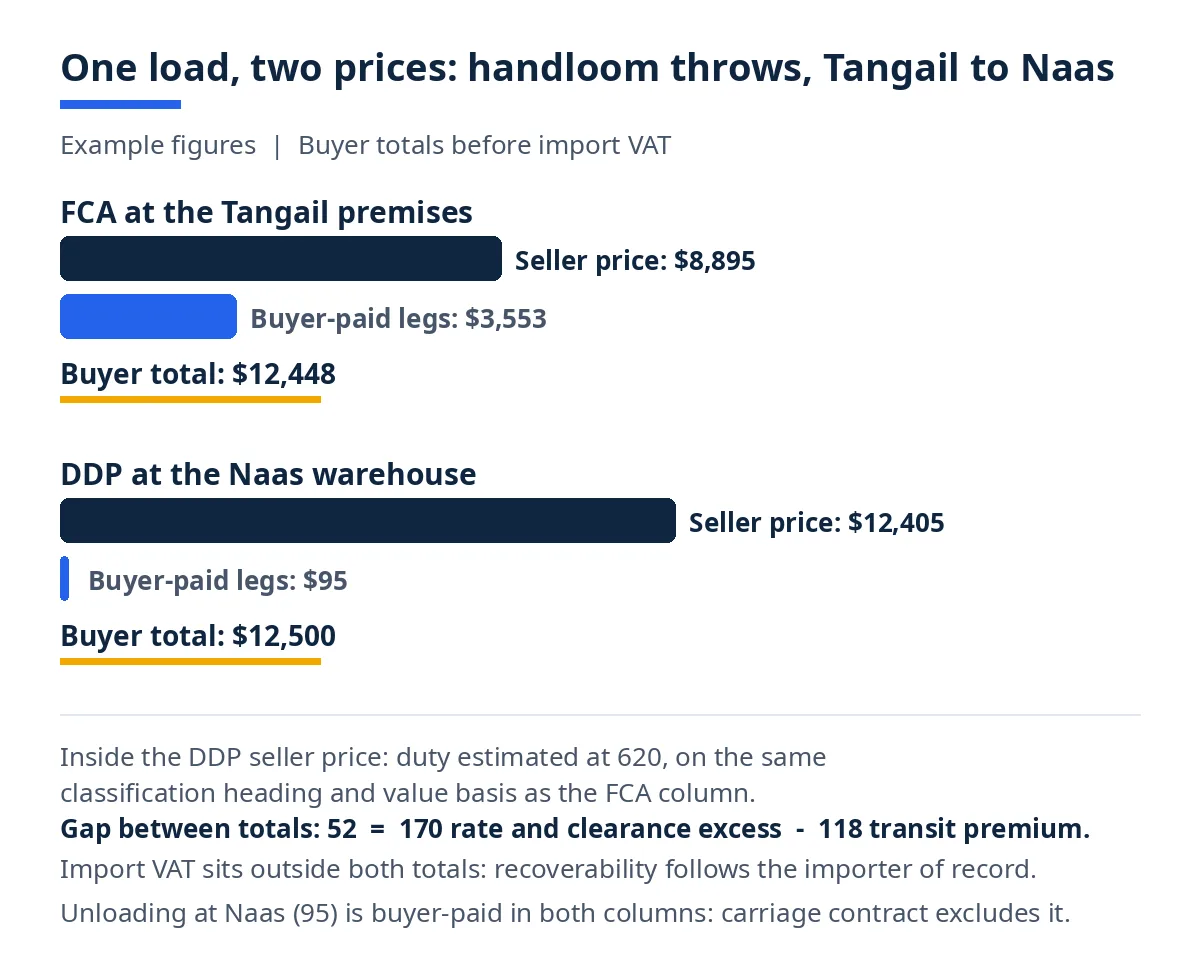
The buyer totals sit 52 apart, with DDP the higher total on these figures: 12,500 against 12,448. The seller prices sit 3,510 apart, which is the carriage, entry, and duty the DDP seller has already bought: 295 plus 140 plus 110 plus 1,890 plus 265 plus 190 plus 620. Booking those same seven elements itself costs the buyer 3,340, which is 170 less: the ocean rate the buyer holds sits 130 under the seller's, the inland rate the buyer holds sits 25 under, and the clearance charge the buyer pays sits 15 under the seller's. That 170 rate advantage is partly given back, because the FCA buyer pays a 118 transit premium for whole-journey cover that the DDP buyer does not pay, the seller carrying the risk itself. The net gap is 170 less 118, which is 52. Move any single rate and the ranking may reverse, so the test must use buyer totals with each side's rates shown, never the seller headlines alone.
Import VAT sits outside both totals, on purpose. The VAT figure depends on the destination country's rules and on who stands as importer of record, and it must be settled with the broker and the tax adviser under the three-question check in the previous section before either total is judged. In both columns the 95 for unloading falls on the buyer, because the working assumption here is a carriage contract that leaves the lift out. Under DDP the seller must keep the buyer informed on the unloading position to avoid double payment, since the transportation contract may or may not include the cost of unloading.2 Where a real carriage contract does include the lift, shift the 95 into the DDP seller's price and total both columns again. Confirm the unloading position in writing, column by column: the 95 matches in both columns here only because the stated assumption matches.
The duty line deserves a final reading before the totals are used. The 620 in each column is the same broker estimate, built on the same classification heading, value basis, and origin claim, so the comparison isolates the freight and cover difference rather than hiding a duty difference inside it. In a real order the two 620 figures would not stay equal. Under DDP the seller pays whatever duty the authority assesses, and a reassessment above the estimate comes out of the seller's margin. Under FCA the buyer pays the assessed figure, and a reassessment above the estimate comes out of the buyer's pocket. The worked example therefore understates the DDP seller's exposure and overstates the comfort of the FCA total, and any buyer ranking the two terms should add a contingency to the FCA column for a duty reassessment, sized by the broker, before treating the 52 gap as the real difference.
When DDP earns its price, and when it strands the load
DDP earns its price where the buyer has no broker, no importer presence, and no appetite for the border at all. A retailer ordering a single consignment, with no customs broker retained in the destination country and no registration that would let it file an entry, buys one seller answerable for the journey through to the warehouse door, with the duty already inside the price and the clearance already done.2 The seller sets the timetable, and the buyer gives up carrier choice and entry control in return for one party answerable for the whole movement. That exchange favours DDP where the seller runs regular shipments to the destination, holds an agent or registration there, and can name the importer of record before the bales leave Tangail. A DDP price from such a seller is a delivered, cleared price, and the buyer can plan stock against it.
DDP turns into a trap where the seller cannot clear and the load still travels. The goods reach the destination country, the entry cannot be filed in the seller's name, and the load waits in customs control while the seller looks for an agent, a registration, or a licence it should have held before shipment. If goods are delayed at customs because of documentation errors or inspections, the seller must absorb storage fees, demurrage charges, and port handling costs.5 Those charges fall on the seller, but the buyer's position is worse: the goods are not delivered, the delivery obligation is not discharged, and the stock the order was meant to fill is not in the warehouse. The trap is sharpest for a buyer that chose DDP precisely because it has no broker of its own, since that buyer has no one to step in and file the entry when the seller's route fails. A DDP order without a named importer of record, a named agent, and a written fallback is a load travelling toward a border it may not cross.
FCA pays where the buyer already owns the border machinery. A buyer holding its own broker, its own carrier contracts, and a VAT registration that permits recovery of import tax holds the booking, picks the sailing, and shoulders the risk from the Tangail handover under wording it selected. The advantage in the worked example traces to the buyer's lower freight and clearance rates, not to any difference in the bales, and a buyer whose own rates undercut the seller's by more than the DDP convenience is worth pockets that advantage on each repeat order. FCA also suits a buyer that wants collection at a spot of its own choosing, with the load grouped alongside other Bangladesh orders on a single booking, which a seller-run DDP movement cannot provide.
Situation | Term that fits |
|---|---|
Buyer has no broker and no importer presence in the destination country, and the seller names its agent and importer of record before shipment | DDP |
Buyer keeps its own carrier rates and wants to pick the sailing itself | FCA |
Buyer groups orders from several makers onto one shared booking | FCA |
Buyer can reclaim import VAT and the seller cannot | FCA, or DAP with the buyer as importer of record |
Seller cannot name the party who will file the import entry | Neither DDP as written; DAP, with the buyer clearing |
Seller's agent is named but the destination authority may refuse a foreign declarant | Confirm with broker or counsel first; DAP if the refusal is likely |
Buyer wants the entry filed and the duty paid by the seller too | Neither alone; DPU, only if the seller can unload at the named place |
Buyer wants risk and delivery carried through to its own warehouse door | DDP at the warehouse address, with the clearance route proven before shipment |
No crew or lifting gear waiting at the destination | Neither alone; arrange the lift before arrival, or ask for DPU |
A buyer that cannot clear import quickly should not choose FCA on price alone, and a buyer that cannot prove the seller's clearance route should not choose DDP on convenience alone. The decision is a capability test on both sides, not a price comparison, and the price comparison only ranks the terms once both sides have passed it.
Bangladesh ordering checks: the clearance proof pack before the truck moves
Draft the term for the reader who must act on it, not for the file. For DDP, spell out the destination completely: warehouse name and street address, the bay where the truck stops, and the hours it may arrive, with the edition written next to the term. For FCA, describe the agreed place with equal completeness — the premises address, the exact spot for collection, and the permitted hours — and put the carrier's contact route and planned arrival time in the seller's hands well before the truck is due, so the handover is expected rather than improvised. A quotation reading only "FCA Bangladesh" or "DDP Ireland" gives a carrier, a warehouse team, or a broker nothing to work from. Putting a country where a place belongs is a costly error, because each rule needs a named place and precision protects the buyer.3 Keep the place spelled the same way across the packing list, the transport document, the invoice, and the quotation, so the broker's papers and the carrier's instruction agree with each other.
Before the truck leaves Tangail, ask the seller for the clearance proof pack, in writing, and keep it with the order. The pack names the party who will file the import entry and the basis on which that party may file it, whether local registration, an appointed agent, or a third-party importer-of-record provider. It states the duty as a separate estimated line with the classification heading, the customs value basis, and the origin claimed, and confirms the estimate came from a broker or agent handling entries in the destination country. It states the import VAT treatment: whether the price includes import VAT, who stands as importer of record, and whether the buyer can recover the VAT paid. It states the unloading position under the carriage contract, and the arrival-notice route, with the warning period and the channel the seller will use. A seller that answers all five points has a clearance route. A seller that answers none of them has a quotation heading.
Work through the remaining order mechanics on the same pass. Verify the seller's export papers against the bales as packed, and confirm the term and the place match across all the papers.2 1 Reserve the unloading crew and gear for the delivery window at the Naas warehouse before the vessel sails, since the lift stays the buyer's job under DDP and the lift risk sits with the buyer once the goods stand ready to come off.2 Fix the arrival-notice bargain in advance: the warning period the seller owes, and the route it travels by, since the seller must give timely word of arrival so the buyer can receive the load.2 For FCA, fix the opposite notice in advance: how the buyer passes the carrier's particulars and the collection window to the seller, so the handover occurs at the agreed spot and the carrier's receipt fixes the risk moment rather than a dispute doing so. If the term must change after the order is placed, put the change in writing while the bales are still with the seller, agree a fresh price, and rewrite each document so every one of them carries the new term, since a handover already completed cannot be reversed, and a credit still written with the old term needs its own amendment through the bank.
Questions buyers ask about FCA and DDP
Can a Bangladeshi seller act as importer of record in the destination country, or must a local party file the entry?
It depends on the destination country's rules, and no general answer covers every destination. In most countries the seller must either be registered locally to act as importer of record or appoint a qualified third-party provider, and foreign companies often cannot act without local tax registration, a corporate presence, or specific import licences.5 Some authorities require the local importer to carry out the clearance itself, in which case DDP cannot be used and DAP is the appropriate rule.2 Ask the seller to name the filing party and its basis for filing, and have the broker or counsel for the actual destination confirm the position before the term is agreed. A seller that can clear directly, or indirectly through its agent, passes the gate. A seller that cannot name the filing party has not passed it.
A DDP quotation shows one price and no duty line. How does the buyer check what duty sits inside it?
Ask for the duty as a separate estimated line, with the classification heading, the customs value basis, and the origin claimed, confirmed by a broker or agent who handles entries in the destination country. Duty turns on classification, origin, trade agreements, and customs valuation, and misclassification can lead to penalties or retroactive reassessments.5 Ask whether the seller stands behind the estimate if the authority reassesses, and whether any shortfall is recharged. In the worked example above, the 620 estimate is shown inside the DDP price and as a buyer-paid line under FCA, on the same heading and basis, so the 52 gap between the totals reflects freight and cover only. A DDP quotation that will not break out the duty line cannot be compared with an FCA quotation at all, because the buyer cannot tell how much of the price is goods, how much is carriage, and how much is the border.
If the seller cannot clear import after the goods arrive, who bears the wait and the storage?
The seller bears the storage, demurrage, and port handling charges that follow a customs delay caused by documentation errors or inspections.5 The buyer bears the wait: the goods are not delivered, the delivery obligation is not discharged, and the stock is not in the warehouse. The seller also bears the compliance exposure, since the seller is ultimately responsible for the import clearance process and any associated challenges.2 The practical protection is written before shipment: the named filing party, the agent's details, the fallback term if clearance is refused, and the point at which the buyer may step in with its own broker. A buyer with no broker of its own should treat a DDP quotation without those four items as an unproven clearance route, whatever the price says.
Does DDP remove the buyer's VAT check, or change it?
It changes the check; it does not remove it. Under DDP the seller pays import VAT, and recovery is not always automatic.5 Import VAT is normally recoverable by the importer of record, and under DDP the importer of record is the seller, which frequently cannot register for or reclaim VAT in the destination country, so the irrecoverable VAT is priced into the goods and the buyer pays it as unrecoverable cost.4 Before signing, ask whether the DDP price includes import VAT, who stands as importer of record, and whether the buyer can recover the VAT the seller pays, and put the answers to the broker and the tax adviser. Where the buyer can reclaim VAT and the seller cannot, DAP with the buyer as importer of record is usually the better commercial outcome, and the DDP price, however clean it looks, costs more than the DAP total once the lost recovery is counted.4 No rate is given here, because the treatment turns on the destination country's rules.
Next steps on Exportain
Place the pair inside the eleven-rule chart that sets the D rules beside the sea-only rules for Bangladesh shipments, then weigh the seller-bought cover question against the CIF comparison that prices a seller-bought policy against buyer-bought cover. When the term, the named place, and the clearance route are settled, ask suppliers to quote on them through the buying walkthrough for placing a request for quotation once the term is fixed.
Sources
- FCA & EXW Incoterms® 2020 explained: Key differences. ICC Academy (accessed )
- DAP & DDP Incoterms 2020 explained: Key differences. ICC Academy (accessed )
- Incoterms 2020 Explained: All 11 Rules. Blue Ocean Academy (accessed )
- Incoterms® 2020: DAP, DPU and DDP. Eastwest Medico, (accessed )
- DDP Shipping (Delivered Duty Paid) Explained. TecEx (accessed )
About the author
Sourcing from Bangladesh?
Post a request for quotation and suppliers on Exportain can send you their quotes directly.
Post an RFQ