Custom Safety Shoes Manufacturer in Bangladesh: OEM Process From Tech Pack to Bulk
A custom safety shoe is built to the buyer's tech pack in seven approval gates: last and tooling, samples, certification file and sealed sample. This guide follows each gate, with the standards, costs and documents a buyer needs before bulk.
Short answer
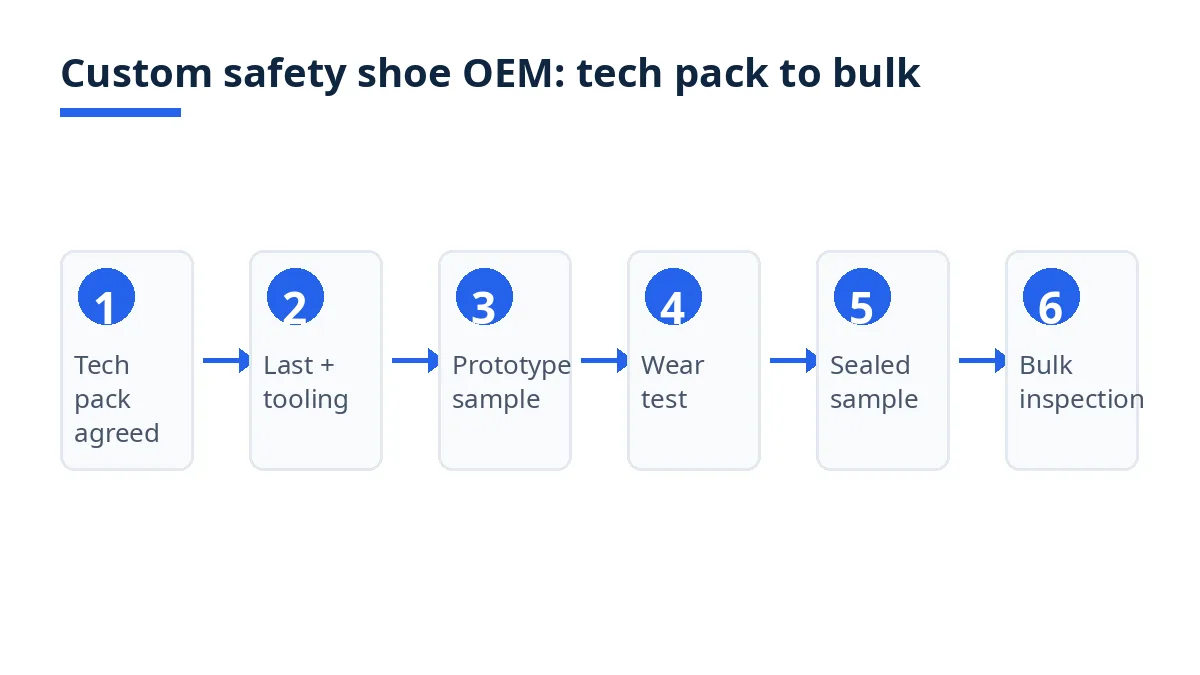
A custom safety shoe from Bangladesh is built in seven gates: a complete tech pack, a last and pattern set, prototype and fit samples, wear testing and revision, a certified confirmation sample, a signed sealed pre-production sample, and bulk production inspected against that sample. The buyer approves each gate in writing before the next one starts. The protection code on the label must match the test report and the certificate, and all three must name the same model and factory.
On this page
Key takeaways
Custom means built to the buyer's tech pack: the last, the materials, the protection code and the label are all fixed in writing before the first sample is cut.
Approve each gate in writing - tech pack, last and pattern, fit sample, wear test, certification sample, sealed pre-production sample - and keep a signed copy of every approval.
The test report, the certificate and the datasheet must name the same model, the same factory and the same protection code; a mismatch voids the paper the order rests on.
Plan two to three sample rounds at two to four weeks each, with sole tooling running in parallel, and confirm the factory's own schedule and minimum order quantity in writing before paying a deposit.
For the EU, Category III safety footwear needs EU type-examination and a technical file kept for ten years; for the US, the ASTM F2413 markings on the label are the buyer's first check.
A custom safety shoe is not a catalogue shoe with a logo added. It is a shoe built to the buyer's own design, fit and protection specification, and the factory builds it from a document the buyer controls: the tech pack. This guide follows that build from the tech pack to bulk shipment in seven approval gates, and shows what the buyer signs at each one. It is written for buyers in the United States, the United Kingdom, the European Union and the UAE who are placing a first custom order with a manufacturer in Bangladesh, and who want the papers, the samples and the inspection to agree before the bulk run starts.
Custom, OEM, and private label: three different builds
Three words are often used as if they meant the same thing. They describe three different builds, and the build decides who owns the design, who pays for the tooling, and whose name sits on the certificate file.
Build | Who supplies the design | What the buyer owns |
|---|---|---|
Custom / OEM | The buyer, in a tech pack | The design, the last and the tooling made for it |
ODM | The factory, adapted to the buyer's brief | The brand on the shoe, not the design itself |
Private label | The factory, from an existing model | The brand and the label, on a shoe the factory already makes |
In a custom build, the buyer fixes the shape, the materials, the protection code and the markings, and the factory's job is to reproduce that specification at volume. In an ODM build, the buyer starts from a shoe the factory already knows how to make and changes colours, materials or details. In a private label build, the shoe already exists and the work is branding, labelling and re-certification. The price, the calendar and the paperwork differ between the three, so the first question to settle with any factory is which build is on the table. This guide covers the custom build only: the buyer's design, the buyer's tech pack, and the gates that turn the pack into bulk shoes.
The tech pack: the document the factory builds from
The tech pack is the single document the factory builds from, and every later argument about a sample or a bulk delivery comes back to what it does or does not say. A complete pack for a custom safety shoe fixes eight things before any material is cut: the views and drawings of the shoe; the last, the fit and the size range; every material, named by specification rather than by description; the protection code and the edition of the standard it is tested to; the construction method; the markings and labels; the packaging; and the size curve across the order. Where a pack says "good quality leather" instead of naming the leather, its thickness, its finish and its test requirement, the factory has to guess, and the guess becomes a sample round.
Version control is part of the document, not an extra. Number each version, date it, and record every change in writing after it is issued. When a material is substituted — a different outsole compound, a different lining, a different toe cap supplier — the substitution is written into the pack as a new version, and the sample that follows is judged against that version. A development house that runs more than a thousand new designs a year through this process reports that most extra sample rounds trace back to gaps in the specification rather than to errors on the production line, and that a complete tech pack is what keeps the round count down.1 Treat a verbal specification as no specification: if it is not in the pack, the factory cannot be held to it, and the buyer cannot inspect against it.
Step-by-step: how a custom safety shoe is built
The build runs through seven gates. The buyer approves each gate in writing before the next one opens, and the approval is kept on file with the version of the tech pack it refers to.
Gate 1: Tech pack review and material confirmation. The factory reads the pack against what it can actually build and confirms, in writing, that each named material is available at the stated specification, or names the substitute it proposes. Price position is settled here, because it decides the construction and the material grade, and changing it after tooling is made is expensive.1 Nothing is cut until the material list is agreed.
Gate 2: Last, pattern and tooling. The last is the foot-shaped form the shoe is built around, and it decides the fit. A dedicated last gives a fit no other brand can buy; a proven stock last is faster and cheaper where fit is not the differentiator.1 The pattern is the flattened form of the last, trialled in cardboard and cheap material before real upper stock is cut.1 Sole tooling runs in parallel with the first upper rounds rather than after them: a custom sole mould takes about 25 to 36 days end to end, so the sole shape should be signed off early, because a late sole sign-off is one of the two things that stretch the calendar most.1
Gate 3: Prototype and first sample. The first physical shoe exists to be criticised, not approved. Its job is to expose what the drawing could not show: how the upper sits on the last, where the toe cap presses, how the sole unit joins.1 Judge it against the tech pack version in force, and record every change as a measurement.
Gate 4: Fit testing and wear test. Fit feedback is recorded in dimensions, not adjectives. "Five millimetres more instep height" can be built; "a bit loose over the arch" cannot, and vague fit comments are the most common cause of a repeated round.1 Wear-test the sample for the period the factory and the buyer agree, and check the grading on real pairs across the size range, not on a table: European sizes step by about 6.67 mm, and United States, United Kingdom and Japanese systems do not convert cleanly between each other.1
Gate 5: Confirmation sample and certification samples. Once fit and construction are settled, the factory produces the confirmation sample — the shoe the buyer will sell — and the samples that go to the laboratory for the protection tests. The protection code is locked at this gate: the toe cap, the puncture-resistant insert, the outsole compound and the upper material in the certification samples must be the materials that go into bulk.
Gate 6: Sealed pre-production sample. A sample signed by both sides becomes the standard every inspection is measured against. Without one, there is nothing objective to inspect against.1 The sealed sample carries the agreed tech pack version, the agreed materials and the agreed markings, and it is kept where the inspector can reach it — not in a drawer at the buyer's office.
Gate 7: Bulk production and inspection. Bulk runs against the sealed sample, with checks during production and a final random inspection before packing. Agree the sampling plan in writing before bulk starts: the inspection level, the acceptable quality limit for each defect class, and who inspects. The inspector compares bulk shoes with the sealed sample pair by pair — appearance, measurements, markings, packaging — and the buyer holds the right to reject a lot that fails the agreed plan.
The protection file: standards, testing, and the exact model
A safety shoe is sold on its protection code, and the code is only as good as the papers behind it. Three systems cover the markets in this guide, and the buyer should know which one the order is built to before the first sample.
For the European Union and the United Kingdom, the standard is EN ISO 20345, and the current edition is 2022. The toe cap is tested to 200 joules of impact and 15 kN of compression, and the codes build on each other: SB is the basic safety shoe, S1 adds a closed heel, antistatic properties and heel energy absorption, S1P adds a puncture-resistant insert, S2 adds an upper that resists water penetration and absorption, and S3 adds the insert and a cleated outsole.2 3 The 2022 edition changed the insert codes — P is a metal insert, PL marks a non-metallic insert proven with the wider 4.5 mm nail and PS marks a non-metallic insert proven with the narrower 3 mm nail — and added S6 and S7 for whole-footwear water resistance, plus SR for extra slip resistance, replacing the old SRA, SRB and SRC marks.2 Older stock may still carry 2011 labels such as S3 SRC, and the codes mean slightly different things between editions, so the buyer checks which edition is printed on the label and writes that edition into the tech pack.2
For the United States, the standard is ASTM F2413. The markings on the label carry the result: I/75 means the toe cap withstood a 75 foot-pound impact, C/75 means it withstood 2,500 pounds of compression, Mt is metatarsal protection, EH is electrical hazard protection rated to 18,000 volts, and PR is puncture resistance.4 The label also states the standard, the gender, the size and the manufacturer's identification, and the buyer reads the label against the test report rather than taking the code on trust.4
For the European Union, safety footwear is personal protective equipment under Regulation (EU) 2016/425, and most safety footwear sits in Category III, the category for risks that may cause very serious consequences such as falling objects and punctures. Category III products need EU type-examination by a notified body and ongoing production control, the manufacturer draws up an EU declaration of conformity, and the technical file is kept for ten years after the product is placed on the market.5 An importer that markets the footwear under its own name or trademark takes on the manufacturer's duties, including the technical file and the declaration.5 Ask who holds the type-examination certificate, which notified body issued it, and whether the certificate covers the exact model in the order.
Two further rules cut across all three systems. First, leather that comes into contact with the skin must stay under the REACH restriction on chromium VI compounds: less than 3 mg/kg in the leather, measured under EN ISO 17075 parts 1 and 2.6 Ask for the test report on the production leather, not on a reference hide. Second, the certificate, the test report and the datasheet must name the same model, the same factory and the same protection code. When the papers name a different model, factory or build, they describe a different shoe from the one in the order, even when the brand name matches. For the Great Britain market, the label carries a UKCA mark rather than a CE mark.2
Costs, timelines, and documents
No rate is stated in this guide, because the price of a custom safety shoe is set by the specification, and a figure quoted without one is not comparable between factories. Six drivers decide the unit price: the tooling — the last, the patterns and the sole mould — and how that cost is spread across the order volume; the materials, above all the protection set of toe cap, insert and outsole compound; the testing and certification fees for the target market; the size range and the grading work; the packaging and labelling; and the freight to the named place. Ask each factory for the same itemised quotation — unit price, tooling charges shown separately, minimum order quantity, lead time, delivery term with the named place, payment terms and validity — and compare the quotations line by line on the same delivery basis. A headline figure that omits tooling or testing is not cheaper; it is incomplete.
The calendar follows the gates. A new shoe typically goes through two to three sample rounds, each lasting two to four weeks, with the custom sole mould running in parallel at about 25 to 36 days.1 Bulk production after development sign-off is quoted by one development house at 30 to 60 days for its own production, but that is one company's schedule, not a Bangladesh figure: confirm the factory's own bulk lead time in writing, with the start date defined as the day the sealed sample is signed, not the day the order is placed.1 Certification testing sits outside the factory's control, so ask which laboratory will test the samples, how long its queue is, and whether the certificate is issued before or after bulk starts. Never pay a bulk deposit before the sealed sample is signed.
The documents that travel with the order are agreed before bulk, not requested after shipment: the versioned tech pack and the signed gate approvals; the material specifications and the test reports; the EU type-examination certificate and the declaration of conformity for European orders, or the ASTM test evidence for United States orders; the commercial invoice; the packing list; the certificate of origin; and the bill of lading. Confirm the import duty position with a customs broker before pricing the order: duty is not stated here, and the broker confirms the classification and the rate in force on the entry date in writing.
Bangladesh-specific rules and tips
Bangladesh is a large footwear producer, and the scale of the sector is the buyer's leverage and the buyer's risk at once. Export Promotion Bureau figures reported by LightCastle Partners put the leather and footwear sector at 1.67 billion dollars of exports in the 2024–25 financial year, with footwear at 1.19 billion dollars, about 72 percent of the sector total.7 Around 423 million pairs were produced in 2024, about 85 million pairs were exported, and the average export value was about 15 dollars a pair.7 Roughly 90 export-oriented factories carry most of the export volume.7 The practical meaning for a custom order is that capacity exists, but it is concentrated: the factories that can run a certified custom safety shoe to a European or American specification are a subset of the sector, and the buyer qualifies that subset on papers and samples, not on headcount claims.
Three Bangladesh-specific points belong in the negotiation. First, the input chain: 80 to 90 percent of the synthetic materials used in footwear are imported, so a change of synthetic material mid-order can mean a new import cycle and a new test report, and the tech pack should name the material source as well as the material.7 Second, the compliance file: access to European buyers increasingly runs through Leather Working Group certification, REACH and ZDHC conformance, and factories that hold those credentials should be asked to show them for the tannery and the production site in the order.7 Third, the tariff horizon: LightCastle reports that graduation from least-developed-country status exposes Bangladesh to tariffs of roughly 10 to 17 percent in the European Union and 12 to 18 percent in the United Kingdom, so the duty line in any landed-cost calculation is confirmed with the broker rather than assumed from today's preference.7 Book laboratory slots early where the testing is done overseas, and plan a factory visit at the fit-sample gate and again at the sealed-sample gate: both visits are cheaper than a bulk run built on an unresolved fit.
Mistakes and red flags
The mistakes that cost money on a custom safety shoe order are process mistakes, and all of them are visible before bulk if the buyer looks for them. Approving a sample from photographs alone, without the shoe in hand, hides fit and weight. Accepting a verbal approval at any gate leaves nothing to inspect against. Allowing a material substitution without a new test report breaks the protection file. Accepting a certificate that names another model, another factory or another protection code means the order has no valid papers. Checking the grading on one size only leaves the ends of the size range unproven. Signing the sole shape late, after the mould is cut, stretches the calendar by the full mould cycle.1 And agreeing the packaging after bulk starts invites a last-minute carton change that the inspection plan never covered. A factory that will not put the tech pack version, the material list and the gate approvals in writing is not a factory to place a custom order with, whatever the unit price.
Custom safety shoe checklist: the file that travels with the order
Keep one file for the order, and carry it to every gate. The tech pack, version-numbered and dated, with every material named by specification. The material confirmations, including any substitution agreed in writing. The last and pattern approval, with the fit measurements recorded in millimetres. The fit-sample and wear-test reports, with changes written as dimensions. The certification samples' identity, and the test reports that name the exact model and factory. The type-examination certificate and the declaration of conformity, or the ASTM test evidence, for the target market. The sealed pre-production sample, signed by both sides, with the inspection plan and the agreed quality limits attached. The itemised quotation, the purchase order, the delivery term with the named place, and the shipping documents. If any item in the file is missing at the gate where it belongs, the gate does not open.
How Exportain helps
Exportain is a business-to-business marketplace that connects international buyers with suppliers in Bangladesh, and the custom shoe process runs through its request-for-quotation route: the buyer posts the requirement with the tech pack attached, suppliers reply with quotations that state the unit price, the minimum order quantity, the delivery term with the named place, the lead time, the payment terms and the validity period, and the buyer compares the replies on the same basis. Supplier profiles carry verification badges based on document and photo review, which is a check of the supplier's papers rather than a factory inspection, and freight rates from forwarding companies are available alongside the quotations.8 Exportain is not a party to the contract for the goods, so the tech pack, the gate approvals and the protection file remain the buyer's own record, and the buyer keeps them. Post a free request for quotation at https://exportain.com/rfqs with the tech pack attached, and start the conversation at the document, not at the price.
Questions buyers ask about custom safety shoe OEM in Bangladesh
What must the tech pack fix before the first sample is cut?
The drawings, the last and size range, every material named by specification, the protection code with the edition of the standard, the construction, the markings and the packaging. A pack that leaves any of those open buys an extra sample round, because the factory has to guess and the guess has to be corrected.1
How long does a custom safety shoe take from tech pack to bulk shipment?
Plan for two to three sample rounds at two to four weeks each, with sole tooling running in parallel at about 25 to 36 days, and then the factory's own bulk lead time from the day the sealed sample is signed.1 Certification testing sits outside that calendar, so the laboratory queue is asked about at the first gate, not discovered at the last.
Which documents must name the exact shoe model?
The certificate, the test report and the datasheet, all three, with the same model, the same factory and the same protection code. For European orders the EU type-examination certificate and the declaration of conformity join that set, and the technical file is kept for ten years.5 A mismatch anywhere in the set means the papers describe a different shoe.
What mistakes most often delay a custom safety shoe order?
An incomplete tech pack, fit feedback given in adjectives instead of millimetres, a material substitution without a fresh test report, and a sole shape signed off after the mould is cut.1 Each one adds a sample round or a mould cycle, and each one is preventable at the gate where it first appears.
Next steps on Exportain
Start with the document, not the price: write the tech pack, attach it to a free request for quotation, and compare the replies line by line on the same delivery basis. Read the safety shoes MOQ guide before fixing quantities, browse suppliers with the protection code and the size range already decided, and post the requirement through requests for quotation so the first conversation is about the shoe, not about a headline figure.
Sources
- Footwear Development Services. DOING INT'L CORP. LIMITED (accessed )
- Work Boots by Safety Rating S1-S7 | EN ISO 20345. Tuffshop (accessed )
- What is the EN ISO 20345 Standard for Safety Footwear. Oxwork (accessed )
- ASTM F2413-18 Protective Footwear Standard. Workplacepub (accessed )
- Applying the CE PPE Regulation (EU) 2016/425. easyCE (accessed )
- Chromium VI in leather. SATRA (accessed )
- Leather & Footwear as The Next Export Frontier of Bangladesh. LightCastle Partners (accessed )
- About Exportain. Exportain (accessed )
About the author
Sourcing from Bangladesh?
Post a request for quotation and suppliers on Exportain can send you their quotes directly.
Post an RFQ