Private Label Safety Shoes Manufacturing in Bangladesh: A Brand Owner's Guide
A private label changes who answers for a safety shoe: brand ownership, the declaration and certificate for the branded model, labelling, and the file to hold. This guide separates a brand-only change from a model change.
Short answer
Private label safety shoes from Bangladesh put the buyer's brand on a factory-made model, and in the EU that can make the buyer the manufacturer under the PPE Regulation, with the duties in Article 8. Settle whether the change is brand-only or a model change with the notified body, secure the extension or addition naming your brand and model, approve all labelling and instructions, and hold the declaration, certificate, and test evidence in one file per model.
On this page
Key takeaways
In the EU, placing PPE on the market under your own name or trade mark can make you the manufacturer under Article 12, carrying the Article 8 duties.
A brand-only change is not the same as a model change: material, component, or construction changes must go to the notified body for additional approval.
One pair carries two labelling regimes: material labelling for the upper, lining and sole, and PPE marking with CE, class codes, and instructions.
Own the mark, license it to the factory in writing with a no-reuse clause, and keep one file per branded model for 10 years.
A private label order asks a factory to make a shoe that carries your name instead of its own. The shoe may already exist in the factory catalogue, the last and the sole may stay exactly as they are, and still the order is a different kind of purchase from buying the factory brand. Your name on the tongue changes who answers for the shoe in the market where it is sold, which papers must name your model, and what the factory may do with your artwork after your order ships. This guide is written for buyers who will sell safety shoes under their own brand in the USA, the UK, the EU, and the UAE, sourcing from Bangladesh. By the end, you will know how to separate a brand-only change from a model change, what to settle with the notified body before bulk, which labels and documents carry your brand, and what file to hold for each branded model.
What a private label changes, and what it leaves alone
A private label, also called an own brand, means the buyer supplies the brand identity and the factory applies it to shoes the factory makes. The factory keeps making the shoe. The buyer owns the customer relationship, the packaging story, and, where the brand is registered, the trade mark. Nothing in that arrangement, on its own, changes the physical shoe. The toe cap, the insert, the upper, and the sole can remain the same components, made on the same line, to the same specification. What changes is the set of names, marks, and papers that travel with the shoe, and the person those papers point to when a market authority asks who placed the shoe on the market.
Three parts of the order stay with the factory whatever brand goes on the shoe: control of the production line and component suppliers, the production knowledge behind the sample that passed testing, and the same production controls for bulk that its own brand needed. A new name does not relax any of that.
Three parts move to the buyer, or to the buyer and the factory jointly, the moment the buyer's name goes on the shoe. The buyer takes on the brand risk: if the shoe fails in the market, the complaint names the brand the wearer can see. The buyer takes on the paper risk in the EU, where the Regulation treats a person who places protective equipment on the market under their own name or trade mark as the manufacturer, with the manufacturer's duties attached.1 And the buyer takes on the artwork risk: every logo placement, colour, size marking, and carton print must be approved before bulk, because a label applied in bulk cannot be recalled from a carton as cheaply as a file can be corrected on screen.
The distinction that runs through this guide is between the shoe and the brand. Test evidence, certificates, and declarations describe a model: a defined combination of components, materials, and construction, examined against a standard. A brand describes who sells that model. Keep the two questions apart in every discussion with the factory and the notified body: when only the brand changes, how are the existing papers extended or replaced so they name the right model under the right brand, and when the model changes as well, what new testing is needed?
Whose name on the shoe decides whose duties follow
In the European Union, the PPE Regulation assigns duties by role, and the role follows the name under which the product reaches the market. An importer or distributor who places PPE on the market under their own name or trade mark, or who modifies PPE already placed on the market in a way that may affect compliance, is considered a manufacturer for the purposes of the Regulation and carries the obligations of the manufacturer set out in Article 8.1 The recitals state the same rule in one sentence: any economic operator who places PPE on the market under their own name or trade mark, or modifies a product so that compliance may be affected, should be considered the manufacturer and should assume the manufacturer's obligations.1 For a private label buyer importing into the EU, that is the central fact. Putting your brand on the shoe can make you the manufacturer in the eyes of the Regulation, even though the factory in Bangladesh physically made it.
The manufacturer's obligations in Article 8 are the list you are accepting, directly or through the arrangements you make with the factory. The manufacturer must ensure the PPE is designed and manufactured to the applicable essential health and safety requirements, draw up the technical documentation, carry out the applicable conformity assessment procedure, draw up the EU declaration of conformity, and affix the CE marking.1 The manufacturer must retain the technical documentation and the declaration for a decade after the PPE reaches the market.1 The manufacturer must put procedures in place so series production stays in conformity, and must take design changes, characteristic changes, and changes in the harmonised standards or other technical specifications into account.1 The PPE must bear a type, batch, or serial number or another element allowing its identification, or carry that information on the packaging or an accompanying document where the size or nature of the shoe does not allow it on the shoe itself.1 The manufacturer must indicate, on the PPE, their name, registered trade name, or registered trade mark and the postal address at which they can be contacted, or, where that is not possible, on the packaging or in an accompanying document, with a single point of contact and details in a language easily understood by end-users and market surveillance authorities.1
An importer who is not treated as the manufacturer has a shorter but real list. Importers must place only compliant PPE on the market, and before placing it they must ensure the conformity assessment procedure has been carried out, the manufacturer has drawn up the technical documentation, the PPE bears the CE marking and is accompanied by the required documents, and the manufacturer has complied with the identification and contact requirements.1 Importers must indicate their own name, registered trade name, or registered trade mark and postal address on the PPE, or where that is not possible, on its packaging or in an accompanying document.1 Importers must hold a copy of the EU declaration of conformity for the same decade-long period and ensure the technical documentation can be made available to the authorities on request.1 For a private label shipment, the shoe can carry two names, and the papers must show which role each name plays. Ask, in writing, whose name appears where, and check the answer against the sample before bulk.
The declaration itself is the manufacturer's act. The EU declaration of conformity must state that fulfilment of the applicable essential health and safety requirements has been demonstrated, follow the model structure in Annex IX, contain the elements specified in the relevant conformity assessment modules, and be continuously updated.1 By drawing it up, the manufacturer assumes responsibility for the compliance of the PPE with the Regulation.1 The declaration must be translated into the language or languages required by the Member State where the PPE is placed or made available on the market, and the manufacturer must either provide it with the PPE or give, in the instructions, the web address where the declaration can be read.1 For a private label model, the question is precise: does the declaration identify the model, the standards, and the notified body in a way that matches the shoe in the carton? A declaration that names the factory model number but not your brand, or your brand but a different model number, will not answer an authority's first question.
Outside the EU, the same logic does not automatically apply in the same words. The United Kingdom has its own PPE legislation based on the same Regulation, with UKCA marking and Approved Bodies in place of CE marking and Notified Bodies, and SATRA notes that the UK requirements currently mirror the EU ones in a large way.2 The United States and the UAE each have their own destination requirements. This guide does not state destination rules for markets it has not sourced, and you should confirm with your broker or counsel which standard, marking, and declaration regime applies in each market you will sell into, and name that regime in the quotation. The EU analysis above is the worked case because the Regulation states the own-brand rule expressly. Do not assume another market treats an own-brand buyer the same way until your adviser confirms it.
The re-certification question: three kinds of change
Buyers ask whether a private label needs re-certification. The honest answer is that the Regulation does not use one rule for every change. It uses a notification and review system run by the notified body that holds the EU type-examination certificate, and the outcome depends on what actually changed. Treat any blanket statement, from either side, as a warning sign: "the certificate covers any brand" and "every brand change needs full re-testing" are both claims the Regulation's own procedure does not support without the notified body's view.
EU type-examination is the part of the conformity assessment procedure in which a notified body examines the technical design of PPE and verifies and attests that it meets the applicable requirements.1 The notified body examines the technical documentation and a specimen representative of the production envisaged, carries out or commissions the appropriate examinations and tests, and, where the type meets the requirements, issues an EU type-examination certificate to the manufacturer.1 The certificate must contain, among other items, the manufacturer's name and address, identification of the PPE by type number, the harmonised standards applied, the performance level or protection class where applicable, and the dates of issue, expiry, and any renewal, and its validity must not exceed five years.1 For Category II products, keeping later output identical to the examined type then rests with the certificate holder; for Category III, the notified body stays involved in ongoing production checks under module C2 or module D.2
The change rule sits in Annex V. The manufacturer must inform the notified body that holds the technical documentation of all modifications to the approved type and of all modifications of the technical documentation that may affect conformity with the applicable essential health and safety requirements or the conditions for validity of the certificate, and such modifications require additional approval in the form of an addition to the original EU type-examination certificate.1 The manufacturer must ask the notified body to review the certificate where a modification of that kind has occurred, where the state of the art has changed, and at the latest before the certificate expires, with the review application lodged at the earliest 12 months and at the latest 6 months before expiry.1 Where no modification to the approved type, including materials, sub-components, or sub-assemblies, and no change in the relevant harmonised standards or other technical specifications has occurred, a simplified review procedure applies and the examinations and tests are not repeated.1 Read that list of examples carefully: the Regulation names materials, sub-components, and sub-assemblies as the kinds of modification that take a case out of the simplified route. A change of upper material, a different toe cap supplier, or a different insert type is therefore the kind of change to report. A change of brand artwork, on its own, is not listed there, and whether it needs an addition to the certificate is a question for the notified body holding the certificate, not a conclusion this guide or the factory can state for you.
That gives three kinds of change, and your file should name which one each order falls into before production starts. The first kind is a brand-only change: the same approved type, the same materials and components, the same construction, with only the brand markings, labels, and packaging changing. SATRA describes the mechanism that exists for this case: a certificate may be supplemented or extended to include the details of the European supplier, and a resourcer, wholesaler, or distributor may hold what is, in effect, a supplementary or own-brand extension certificate from the manufacturer.3 Ask the notified body, through the certificate holder, whether an extension or addition covers your brand and model, what it names, and what it costs in time. Get the answer in writing, and hold the extension or addition document itself, not a verbal assurance that the factory certificate "covers" your brand. Note SATRA's caution for this exact position: where the certificate holder is not the factory, demonstrating ongoing conformity is more difficult, and the holder may need witnessed tests, audits, or representative-sample testing against the specification.3
The second kind is a specification change dressed as a brand change: a new colourway that needs a different upper material, a different sole compound, a different insert, or a last change to fit the brand's fit block. Each of those touches the approved type. Report it to the notified body before bulk, expect additional approval, and expect testing where the notified body judges it necessary. The third kind is a new model: a different last, construction, or protection combination that has never been type-examined. That needs its own type-examination, its own certificate, and its own declaration. Do not let a factory fold a new model into an existing certificate by calling it a colour or a brand variant. The certificate identifies the PPE by type number; if the type number does not describe the shoe in the carton, the paper and the product have parted company.
Two timing facts belong in every private label plan. First, certificates expire. The five-year maximum validity and the 12-to-6-month review window mean a certificate that covers the factory brand today may expire during your selling season, and renewal requires the manufacturer to apply in that window.1 2 Ask for the certificate expiry date at the quotation stage, and write into the contract what happens if renewal is refused or delayed: who applies, who pays, and whether shipments pause. Second, the state of the art moves: the notified body must keep itself apprised of changes in the generally acknowledged state of the art that indicate the approved type may no longer comply, and must inform the manufacturer where further investigation is needed.1 Your contract should state who watches for standard changes and who tells the other side.
Labelling and packaging: two rule sets on one pair
A private label safety shoe carries two different labelling regimes at once in the EU, and they answer different questions. The footwear labelling rules answer: what is this shoe made of? The PPE rules answer: what does this shoe protect against, who stands behind it, and how must it be used? Both must be satisfied on the same pair, and the artwork approval must check both, not one.
The footwear labelling summary states the material rule plainly. Only materials covering 80% or more of the surface areas of the upper, the lining and sock, and 80% or more of the volume of the outer sole need to be labelled; where no single material reaches 80%, a label with information on the two main materials must be provided.4 Cover all three parts in the label: upper, lining and sock, and outer sole, in words or pictograms.4 It may be written or in pictogram form, must be visible, securely attached, and accessible, and must appear on at least one item of the pair.4 It should be printed or embossed on the footwear, attached by an adhesive label, or affixed by a fastener or string.4 Responsibility follows the first placer: EU manufacturers supply the label and answer for its accuracy, and where footwear is imported, the person who first places it on the EU market assumes that responsibility, while retailers must ensure the footwear they sell bears the appropriate labelling.4 The summary also records the boundary that matters for this guide: footwear used by individuals for health and safety purposes in the workplace falls under EU rules on personal protective equipment, not under the footwear labelling directive's own coverage.4 In practice, your safety shoe still needs the material label done correctly, and the PPE marking done correctly alongside it. Do not accept artwork that shows only one of the two.
The PPE marking rules start with the CE marking itself, which must be affixed visibly, legibly, and indelibly to the PPE, or, where that is not possible or not warranted by the nature of the PPE, to the packaging and the accompanying documents, and before the PPE is placed on the market.1 For Category III PPE, the CE marking must be followed by the identification number of the notified body involved in the production-check procedure, and the marking may be followed by a pictogram indicating the risk the PPE is intended to protect against.1 Alongside the CE marking, the shoe must carry the identification element, the manufacturer name and contact details, and the other markings the applicable standard requires, such as the protection class and the additional codes that describe the tested properties. For EN ISO 20345, those codes are the substance of the claim: the SB base of 200 joules toe impact protection and 15,000 newtons toe compression protection, the S1 to S3 and S4 to S7 bundles that add closed heel, antistatic properties, water penetration and absorption, perforation resistance, cleated outsoles, and whole-footwear water resistance, and the additional markings for perforation insert type, metatarsal protection at 100 joules, heat-resistant outsoles at 300 °C for one minute, scuff-cap abrasion at 8,000 cycles, and the rest of the marking set.5 Every code printed on the shoe must trace to a tested property of that model. A code the model was never tested for is not a selling point; it is a false claim printed in permanent ink.
The instructions that accompany the shoe are part of the marking system, not an optional extra. The manufacturer's instructions must contain, in addition to the manufacturer's name and address, all relevant information on storage, use, cleaning, maintenance, servicing, and disinfection; performance as recorded during the relevant technical tests; accessories and spare parts where applicable; protection classes, levels of risk, and limits of use where applicable; obsolescence month and year or period where applicable; suitable transport packaging where applicable; the significance of any markings; the risk the PPE is designed to protect against; the reference to the Regulation and any other applicable Union legislation; the name, address, and identification number of the notified body or bodies involved; the references to the harmonised standards used, including their dates; and the web address where the EU declaration of conformity can be read.1 The items covering the Regulation reference, the notified body, the standards, and the declaration address need not sit in the instructions if the declaration itself accompanies the PPE.1 The instructions must be in a language easily understood by consumers and other end-users, as determined by the Member State concerned, and the instructions and any labelling must be clear, understandable, intelligible, and legible.1 Markings relating to health and safety must, where possible, take the form of harmonised pictograms, stay perfectly visible and legible throughout the foreseeable useful life of the PPE, and be complete, precise, and comprehensible; where the shoe is too small for all the marking, the information must appear on the packaging and in the instructions.1 For a private label, the instruction leaflet is therefore a brand document and a compliance document in one file. Approve it as both: the brand team checks the name, logo, and language; the compliance check confirms the notified body details, the standard references with dates, the protection classes, and the declaration address all match the certificate and declaration for that model.
Packaging carries the same discipline at carton level. The carton must not promise a protection the shoe does not carry, must not show a certification mark the model does not hold, and must carry the brand, model, size run, and quantity in a form the warehouse and the customer can both read without opening the carton. Where the Regulation allows information to sit on the packaging instead of the shoe, the packaging becomes the record, and a carton printed before a marking change becomes a liability. Freeze carton artwork with the shoe artwork, version-number both, and keep a packed-carton sample from the first bulk lot as the reference for later lots.
Artwork and sample approval: freeze the brand before bulk
Artwork approval is where private label orders most often lose time, because the brand file and the production file are treated as two conversations. Run them as one: bulk must not start until every item in the single artwork pack the factory works from is signed off in writing by the buyer. A verbal approval on a messaging app is not an approval, and neither is a proof glanced at on a phone screen.
The artwork pack should contain, at minimum: the trade mark artwork in the exact files the printer needs, with the colour references, minimum sizes, and clear-space rules stated; the tongue label layout showing the brand, the model name or number, the size marking system, and the protection class and codes in their exact positions; the insole, sock, and heel branding, where any is specified; the footwear material label content for the three components, with the material percentages or two-main-materials statement for that exact upper, lining, and sole combination; the instruction leaflet text in every language the destination markets require, with the notified body details, standard references, and declaration address filled in, not left as placeholders; the hang tag and any swing ticket; and the carton artwork, including the brand, model, size run, quantity, and any handling marks. Each item carries a version number and a date. When one item changes, the version number changes, and the factory must confirm in writing which version is in production.
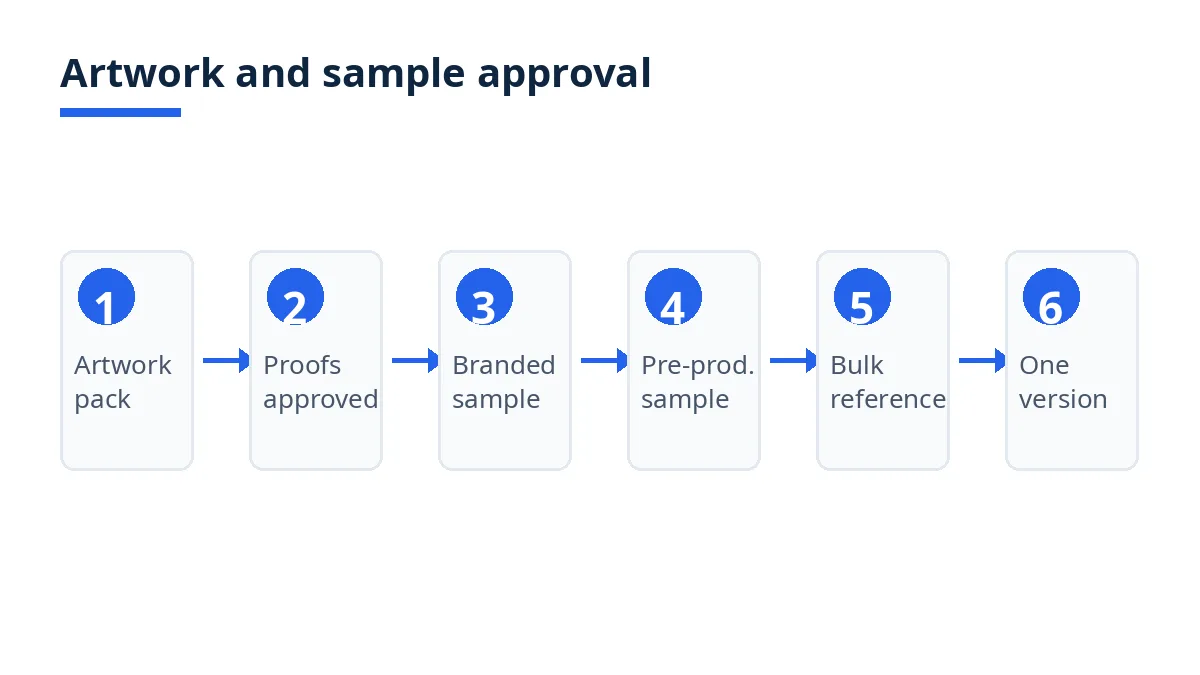
The sample sequence then proves the artwork on the shoe, not on paper. First, approve the artwork proofs: flat proofs of every label, print, and carton panel, checked against the certificate, the declaration, and the material specification for that model. Second, approve a branded sample pair: the full shoe, made to the approved specification, carrying the approved labels, prints, and leaflet, checked in hand for legibility, position, durability of print, and size-marking accuracy across the size range. Third, approve a pre-production sample from the bulk line: the same shoe, made with bulk materials and bulk processes, carrying bulk-printed labels and packaging, checked again before bulk is released. Fourth, hold a bulk reference: one sealed pair and one sealed carton from the first bulk lot, kept by the buyer, against which later lots and any complaint sample can be compared. If the branded sample and the pre-production sample differ in any marking, the difference is a finding, not a detail. Record it, correct the artwork or the process, and re-approve.
Three approval rules prevent the most common failures. First, no artwork change after the branded sample is approved without a new approval and a notified-body check where the change touches the approved type or the certificate. A logo colour change on a woven label may be a brand matter; a change of upper material to match a brand colour is a specification change, and it follows the change procedure in the previous section. Second, no substitution of a label supplier, print method, or label material without approval, because a label that fades, peels, or becomes illegible in use fails the legibility requirement even though the words were right on the proof. Third, no mixed versions in one shipment. If cartons from an earlier artwork version remain in the factory, they must be destroyed or segregated in writing before the new version ships, and the packing list must state the artwork version per model. A shipment that mixes two label versions is two different products in the eyes of anyone checking it.
How an own-brand run moves the minimum and the unit price
A private label does not create a separate minimum out of nothing. It adds brand-specific work to an order that already has a minimum, and that work has its own minimums and its own cost shape. The supplier's minimum may be counted per order, per style or product, or per colour, and a separate money floor may apply beside the piece count.6 No single minimum applies across Bangladesh or across safety shoes; read each supplier's stated figure on its own.6 The brand work sits on top of that counting: custom labels, printed packaging, branded cartons, and any tooling for a debossed or moulded logo each come from suppliers with minimums of their own, and the MOQ guide records that custom labels and packaging can drive the minimum even when the shoe quantity looks acceptable.6 Ask which element drives your minimum before you negotiate the number. If the label printer's run is the constraint, ordering more shoes does not remove it; if the shoe minimum is the constraint, a cheaper label does not remove that either.
Example figures only. The illustration below uses invented numbers to show the shape of the calculation, not market prices. Take an own-brand run of two models, each in two colours, with a minimum counted per model and colour of 240 pairs. The smallest order is 240 pairs multiplied by 4 model-colour combinations, which is 960 pairs. Suppose the brand setup charge for the run, covering artwork plates, label tooling, and carton printing plates, is USD 380 as an example figure, and the example unit price is USD 8.15 per pair. The goods value is 960 multiplied by USD 8.15, which is USD 7,824. Adding the setup charge gives USD 8,204, or USD 8.55 per pair once the setup charge is spread across the run. Cut the run to one model in two colours at the same 240-pair minimum and the arithmetic changes shape: 480 pairs at USD 8.15 is USD 3,912, plus the same USD 380 setup charge is USD 4,292, or USD 8.94 per pair. The setup charge did not change; the number of pairs carrying it halved, so the per-pair burden roughly doubled, from about USD 0.40 to about USD 0.79. That is the whole private label price lesson in one table: brand setup costs are fixed per run, and small own-brand runs carry them heavily. Check the arithmetic both ways before you accept it: 240 times 4 is 960; 960 times 8.15 is 7,824; 7,824 plus 380 is 8,204; 8,204 divided by 960 is 8.55. For the smaller run: 240 times 2 is 480; 480 times 8.15 is 3,912; 3,912 plus 380 is 4,292; 4,292 divided by 480 is 8.94. If any of those figures is a real charge in your quotation, it will appear there by name; the figures here are examples only, and the real numbers are the ones in the accepted quotation.
Own-brand run, example figures only | Pairs | Goods value at USD 8.15 | Setup charge | Total | Per pair |
|---|---|---|---|---|---|
Two models, two colours each, 240-pair minimum per model and colour | 960 | USD 7,824 | USD 380 | USD 8,204 | USD 8.55 |
One model, two colours, 240-pair minimum per model and colour | 480 | USD 3,912 | USD 380 | USD 4,292 | USD 8.94 |
Price tiers add a second shape to the same decision: with tiered pricing, a bigger quantity steps the unit price down, but only the price in the quotation you accept binds both sides.6 A larger run can lower the unit price twice, through the tier step and through spreading the setup charge, but it also raises the cash committed and the stock risk. Judge the run size on the total outlay and the stock you can sell, not on the per-pair figure alone. Where a smaller run is genuinely needed, ask about the levers the MOQ guide records: fewer colours, standard trims and packaging where the brand allows it, a small-order surcharge stated as a figure, stock materials, or an honest trial order with a realistic forecast.6 Each lever changes the brand result, so each one needs artwork approval again where it touches a label, a carton, or a material. A standard carton is not a neutral choice when your brand promise sits on the carton.
Name the delivery term in the quotation with the same precision. The sea and inland-waterway-only rules are four — FAS, FOB, CFR, CIF; CPT is any-mode; DPU is any-mode; DDP is any-mode (seller clears import customs, pays duty); FCA is any-mode.7 State the rule, the version, and the named place in the quotation, and confirm with your broker which party carries each leg for your market. The delivery term does not change the brand or certification analysis, but it decides who pays for the freight, insurance, and customs steps that move a branded shipment, and a private label order with an unclear delivery term is a brand launch with an unclear arrival date.
Trademark ownership, the factory licence, and the no-reuse clause
The brand on the shoe is a trade mark question before it is a printing question. A trade mark, in the European Union system, is a sign capable of distinguishing the goods or services of one business from those of another, obtained through registration, and the owner holds exclusive rights that prohibit third parties from using an identical sign for identical goods or services, or a sign where there is a likelihood of confusion.8 An EU trade mark is obtained by filing an application with the European Union Intellectual Property Office, EUIPO, listing the goods or services, and it is registered for 10 years from the filing date, renewable for further 10-year periods.8 Registration is territorial: an EU registration covers the EU, a national registration covers that country, and other markets need their own filings or an international route. This guide is not legal advice, and trade mark clearance and filing are matters for counsel in each market where you will sell. What follows is the contracting shape to take to counsel, not a substitute for it.
Ownership comes first, and it must be settled before artwork is sent. The buyer should own the mark, or hold a written right to use it that covers the goods, the territory, and the term of the factory order. Where the buyer owns the mark, the factory needs permission to apply it, and only for the buyer's orders. WIPO describes trademark licensing in exactly those terms: the owner, the licensor, grants permission to another, the licensee, to use the trademark on mutually agreed terms and conditions.9 Quality control is the essence of that permission: licensing became acceptable where the licensor remained in control of the nature and quality of the goods sold under the mark, so that the consumer receives essentially the same quality wherever the marked good is purchased.9 For a factory making your branded shoe, that means the licence and the quality agreement are the same conversation. The permission to print your mark should sit in the same document set as the specification, the sample approvals, and the inspection rights, so that withdrawing one withdraws the practical ability to keep producing under your name.
The factory licence should state, in writing: the exact mark and artwork files licensed, and no other mark or variant; the goods it may be applied to, named by model and specification; the territory and channels, where relevant; the term, tied to the order and any agreed repeat-order period, with a clear end date; the quality control the buyer may exercise; and what happens to artwork files, plates, labels, and printed packaging when the licence ends. Due diligence runs both ways: WIPO's licensing material notes that the licensee needs to know whether the licensor is indeed the owner of the mark or has the right to license it.9 Put both confirmations in the file.
The no-reuse clause is the clause buyers most often leave out and most often regret. It should state that the factory must not use the buyer's mark, artwork, or branded packaging on goods for any other buyer, must not sell branded overruns, seconds, or rejected pairs bearing the mark, must not offer the branded model in its catalogue or to other customers under the buyer's brand, and must destroy or return branded materials, including plates, labels, and cartons, at the end of the licence or the order, as the contract states. It should also state who owns the artwork files and any tooling paid for by the buyer, and whether tooling moves, stays, or is destroyed. These are contracting points to settle with counsel, because the remedies for breach, the governing law, and the evidence needed to prove reuse all depend on the contract and the jurisdiction. Do not rely on a general assurance in a chat message. If the factory will not sign a no-reuse clause, that is information about the order, and it should change the decision, not just the wording.
Two related risks deserve a line each. First, clearance: confirm with counsel that the mark does not collide with an earlier right in each market where you will sell, since the EU system allows third parties to oppose an application on the basis of earlier rights after publication.8 A factory printing the mark does not clear it. Second, genuine use: an EU trade mark may be revoked if it has not been subject to genuine use in the EU for five years.8 Keep sales and use evidence with the brand file, alongside the registration certificates.
The file you keep for every branded model
A private label buyer needs a file that answers three questions without a phone call to the factory: which model is this, under which brand, and what evidence supports the claim printed on it? Keep one file per branded model, not one file per factory and not one file per shipment. A shipment file proves one delivery. A model file proves the brand.
The model file should hold: the brand and trade mark record, including the registration details or the written right to use the mark, the artwork pack with version numbers, and the factory licence and no-reuse clause; the model identification, including the type number, the specification, the bill of materials, and the size range, stated exactly as they appear in the certificate and the declaration; the EU type-examination certificate, including any addition or own-brand extension naming your brand and model, with the notified body name and number, the standards and dates, the protection class, and the expiry date; the EU declaration of conformity for the model, identifying the model and showing whose responsibility it carries; the test evidence for the model, including the test reports from the finished shoe named by method and any batch test reports; the sample record, including the branded sample and pre-production approvals and the sealed bulk reference pair and carton; the labelling record, including the material label content, the instruction leaflet as shipped, and photographs of the labels and packaging as applied; and the shipment record, including the packing list by model, the artwork version shipped, and the batch identification tying the pairs to the test evidence for that lot.
The model file should also record the customs classification the broker confirmed for the model, marked as indicative until the broker confirms it against the tariff for the entry date. GOV.UK guidance classifies footwear by the material of the upper and outer sole, type and purpose, ankle coverage, insole length against 24 centimetres, heel height, and intended wearer, with waterproof rubber or plastics footwear under heading 6401, other rubber or plastics footwear under 6402, leather uppers under 6403, textile uppers under 6404, and other footwear under 6405.10 A brand change does not change the heading on its own, but a change of upper or sole material can, so the broker confirmation must follow the specification, not the brand. An Exportain badge does not settle any of this: verification on Exportain is a review of documents and photos by staff, not a factory visit and not a guarantee, and a certificate that matters to your order should be confirmed with the body that issued it as well.11
Retention is not a filing preference. The manufacturer must retain the technical documentation and the declaration for a decade after market placement, and must hold a copy of the type-examination certificate, its annexes and additions, together with the technical documentation, at the disposal of the national authorities for the same period.1 Importers must hold a copy of the declaration for a decade and ensure the technical documentation can be made available.1 Economic operators must be able to identify who supplied them with PPE and to whom they supplied it, for a decade after supply in each direction.1 Your file should therefore be kept for at least that period, in a form you can produce on request, and the factory contract should state who holds the technical documentation, who can produce it, and how quickly. A file held only by the factory, in a language you cannot read, with no contractual right of access, is not your file. It is the factory's file, and it may not be available when you need it.
The batch link is the part buyers most often miss. SATRA's guidance for ongoing conformity stresses that records should tie in with shipment details to provide a direct link to the imported goods, that key safety-critical features such as toe cap impact and compression and midsole penetration insert resistance should be batch tested, and that component and raw material purchases should come from the companies listed in the master materials file.3 The type-examination certificate confirms the manufacturer can make the product correctly and can apply the CE mark to bulk production that remains the same as the type-approval samples; it does not, on its own, confirm that a given bulk lot conforms, and purchasers should insist on an up-to-date test report on their actual batch.3 For your branded model, the file for each shipment should therefore name the batch, the test report for that batch, and the materials and components used in it. Where the certificate holder is not the factory, witnessed tests or representative-sample testing may be needed.3 Price that work into the order.
Brand-owner mistakes that surface after shipment
The mistakes below are not factory faults in the usual sense. They are brand-owner decisions, or omissions, that only become visible when the shoes are already in the market. Each one is avoidable at the quotation or artwork stage, and each one is expensive to fix at the complaint stage.
The first is borrowing the factory certificate as if it were yours. A certificate naming the factory, the factory model number, and the factory brand does not become your certificate because the shoes carry your logo. If the certificate has not been extended, supplemented, or reissued to cover your brand and model with the notified body's approval, your file has a gap no invoice can fill. Ask for the extension document by name and check the model, brand, and expiry date it names.
The second is approving artwork from a screen and never checking a branded pair in hand. Print size, label position, and legibility cannot be judged from a PDF. Approve the branded sample in hand, across more than one size, before bulk.
The third is changing a material to match the brand and calling it a brand change. A new upper colour that needs a new material, a new sole colour that needs a new compound, and a new insert supplier are specification changes. Report them to the notified body through the certificate holder, and wait for the additional approval before bulk. The cost of waiting is measured in days. The cost of shipping an unapproved type is measured in withdrawals.
The fourth is printing the full marking set before the declaration exists. The CE marking, the notified body number, the protection class, and the standard references on the shoe must match the declaration and the certificate for that model. If the artwork is printed while the declaration is still being drafted, the print run can outrun the paper. Freeze the marking content only when the declaration content is settled, and version-number both together.
The fifth is treating the instruction leaflet as packaging copy. The leaflet must carry the manufacturer's name and address, the storage, use, cleaning, and maintenance information, the performance recorded in the technical tests, the protection classes and limits of use, the significance of the markings, the risk, the Regulation reference, the notified body details, the standard references with dates, and the declaration address, in a language the end-user can easily understand.1 A leaflet that carries only the brand story has not done the job, however well it is designed.
The sixth is leaving reuse, overruns, and tooling to custom. If the contract does not state who owns the artwork and tooling, what happens to branded seconds, and whether the factory may show the branded model to other buyers, the default is whatever the factory does next. Write the clause before the first order, with counsel.
Questions brand owners ask about private label safety shoes
Can I put my brand on a factory model that already holds a type-examination certificate?
You can, but only through the certificate system, not by printing over it. Ask the certificate holder to seek an addition or extension from the notified body that names your brand and the model, and hold that document before bulk.1 3 The notified body decides whether the brand-only change needs an addition, and the Regulation requires the manufacturer to inform the notified body of modifications that may affect conformity or the conditions for the certificate's validity.1 Where the model, materials, and components are unchanged, the answer may be an extension; where anything in the specification has changed, expect additional approval and possible testing.
Does changing only the logo and tongue label require new testing?
Not necessarily, and never assume it does not. The Regulation's review procedure turns on whether the approved type, including its materials, sub-components, and sub-assemblies, or the relevant standards have changed, and the simplified review route applies only where no such modification or state-of-the-art change has occurred.1 A logo and label change that touches nothing else still needs the notified body's view on whether an addition to the certificate is required, because the certificate, the declaration, and the marking must all name the same model under the same brand. Put the exact artwork change to the notified body through the certificate holder in writing, and keep the written answer. If the label change also changes a material, a print method that affects legibility, or a size marking, say so in the same request.
Who signs the EU declaration of conformity for shoes sold under my brand?
The manufacturer, as the Regulation defines that role for your shipment, draws up the declaration and assumes responsibility for compliance by doing so.1 Where you place the shoes on the EU market under your own name or trade mark, Article 12 treats you as the manufacturer and attaches the Article 8 obligations to you, including drawing up the declaration and the technical documentation and affixing the CE marking.1 In practice, the declaration is often prepared with the factory and the notified body, but the signature must belong to the person the Regulation holds responsible, and the declaration must match the shoe. Confirm the arrangement with counsel and the notified body before the first shipment.
Can the factory sell the same shoe under my brand to another buyer?
Only if your contract allows it, and your contract should not. The factory's right to use your mark comes from your permission, and WIPO's licensing definition frames that permission as granted on mutually agreed terms and conditions, with the owner's control of nature and quality at its centre.9 Your licence should limit the mark to your models, your orders, and your term, and should prohibit use for other buyers, branded overruns and seconds, and catalogue display under your brand, with the fate of artwork, plates, labels, and cartons stated for the end of the licence. Confirm the position with counsel in each market, because trade mark rights are territorial and the remedies for misuse depend on the registration and the contract. If a factory refuses a no-reuse clause, treat that as a reason to choose a different factory, not as a clause to drop.
Next steps on Exportain
Start with the papers, not the catalogue. Read the inspection list for safety shoes to see what a bulk check should contain, confirm the counting and price shape of your run with the guide on how a minimum is counted and the heading walkthrough for safety shoes, and check what the badge meanings on Exportain do and do not tell you about a supplier before you shortlist. Take the brand file in this guide into your first quotation request: brand, model, certificate extension, artwork version, and file holder, all named in writing.
Post a free RFQ on Exportain and get quotes from verified Bangladeshi suppliers → https://exportain.com/rfqs
Sources
- Regulation (EU) 2016/425 of the European Parliament and of the Council of 9 March 2016 on personal protective equipment. European Union, (accessed )
- European conformity assessment of PPE. SATRA (accessed )
- Ensuring CE-marked compliance of PPE. SATRA (accessed )
- Footwear labelling. European Commission, EUR-Lex (accessed )
- Safety Standards. New Balance Industrial (accessed )
- MOQ Meaning (Minimum Order Quantity). Exportain (accessed )
- Incoterms 2026: Meaning, Chart & List Of Incoterms. Freightos, (accessed )
- European Union trade mark. EUR-Lex (accessed )
- Trademark Licensing. WIPO (accessed )
- Classifying footwear for import and export. GOV.UK (accessed )
- How Supplier Verification Works on Exportain. Exportain, (accessed )
About the author
Sourcing from Bangladesh?
Post a request for quotation and suppliers on Exportain can send you their quotes directly.
Post an RFQ