UK Solar Panel Imports From Bangladesh: Gateway, UKCA and Duty
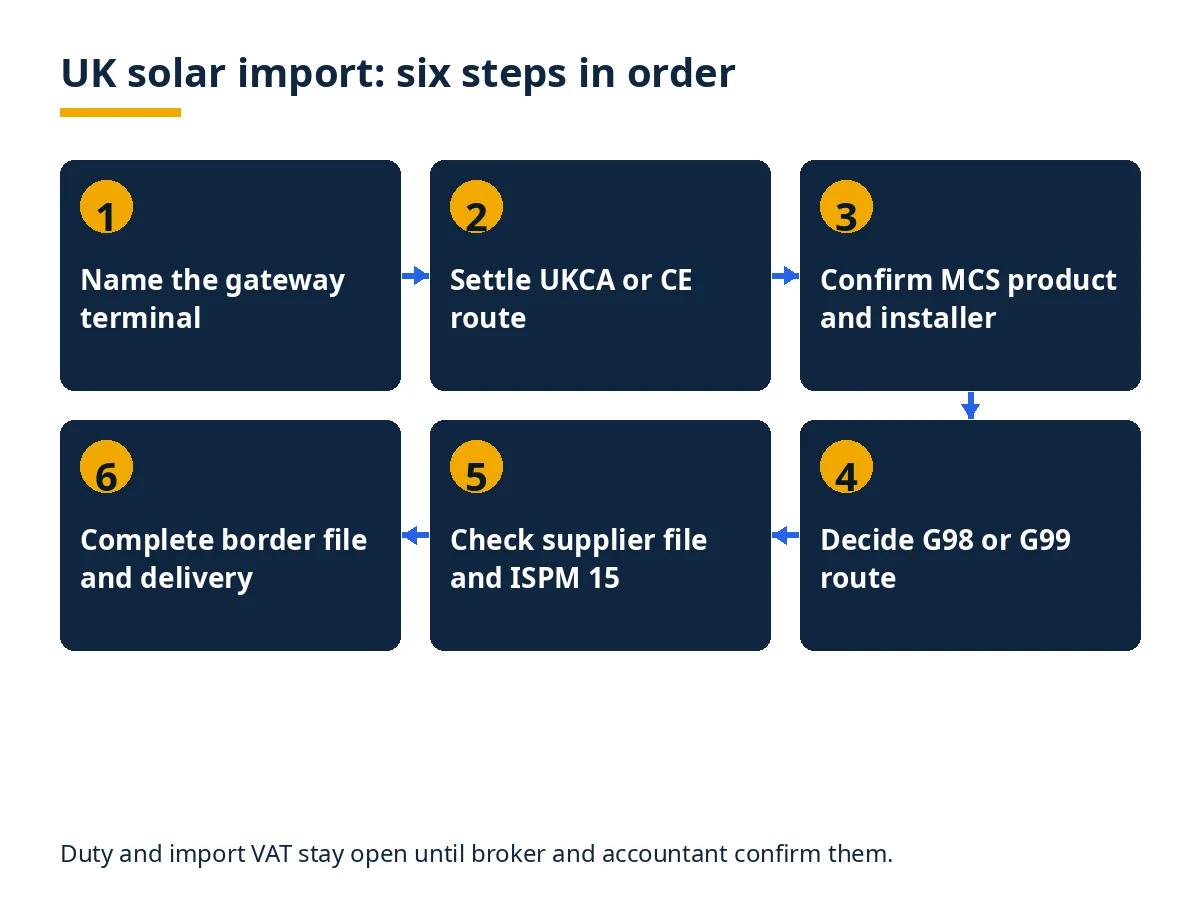
Work the UK file in gateway order: terminal, conformity, grid connection, supplier papers, then the border file. Duty and import VAT stay open until the broker and accountant confirm them.
Short answer
A UK buyer importing solar panels from Bangladesh should settle the UK end: name the gateway terminal, confirm whether UKCA or CE recognition covers the exact module and whether the installation route needs MCS certification, establish the G98 or G99 position with the distribution network operator, and have a broker confirm the commodity code and duty and an accountant confirm import VAT treatment. Price from a landed cost in pounds with duty and import VAT as open lines.

On this page
Key takeaways
Name the UK discharge terminal in the contract and confirm from the carrier which terminal the booked service calls at.
UKCA or CE recognition covers Great Britain, while MCS certification covers the product, the installer, and the installation separately.
G98 means notification within 28 days of commissioning under 16 amps per phase; G99 means prior permission above that threshold.
Solid wood pallets and crates must carry a legible ISPM 15 mark; a certificate alone does not replace the mark.
Have the broker confirm the full commodity code and duty and the accountant confirm import VAT before agreeing the price.
A solar panel shipment from Bangladesh reaches the UK in one piece only when the UK side of the file is settled before the order is placed. The terminal that will receive the container, the marking route that covers the exact module, the grid-connection route for the installation, and the border file all belong in the contract, not in a later email thread. This guide works that file in the order a UK buyer should work it: gateway, conformity, grid connection, supplier papers, receiving checks, delivery rule, and border file. It is written for Great Britain, meaning England, Scotland and Wales. Northern Ireland follows different product-marking and VAT arrangements in some places, so a buyer landing goods in Northern Ireland should have the broker confirm the Northern Ireland position separately.
Start at the UK gateway: name the terminal before you price the freight
Freight for a container is priced to a terminal, not to a country. A quote that says only "UK port" leaves the buyer exposed to a delivery point the contract never named, and to inland charges that follow from it. Name the terminal in the contract and in the carrier booking, and ask the carrier which terminal the booked service actually calls at, since a service may call at one terminal while a quote names another.
Felixstowe is the port whose container facilities are described in detail in the sources opened for this guide. The Port of Felixstowe states that it has nine berths across two container terminals, and that its Trinity Terminal is the largest container handling facility in the UK, with 2,354 metres of continuous quay.1 The same source describes Berths 8 and 9 as the newest and deepest container berths in the UK, at 18 metres alongside, and Berths 6, 7, 8 and 9 as handling the latest generation of 24,000 TEU vessels.1 Those dimensions matter to a buyer because they explain why a carrier can call Felixstowe with a large vessel, but they do not by themselves settle which terminal a given booking will use. Southampton and London Gateway are the other two terminals this guide names, and the buyer should confirm from the carrier or forwarder, for the specific sailing week, which of the three the booked service calls at. No transit time is stated in this guide, because none was taken from an opened official source, and a transit time quoted from a general web page would mislead the buyer about the specific sailing.
Before any price is compared, ask the carrier or forwarder for the following in writing: the named discharge terminal, the sailing schedule for the shipment week, the free-time period at that terminal, and the destination charges that apply there. Compare quotes on that same terminal basis. A lower ocean-freight figure that lands at a different terminal, with different onward charges, is not a lower landed cost.
UK conformity first: UKCA or CE recognition, and what MCS adds
Three different papers are often confused, and confusing them is where UK panel imports go wrong. The conformity marking file decides whether the module may be placed on the Great Britain market. The MCS position decides whether the product and the installation meet the Microgeneration Certification Scheme standards that apply to small-scale systems. The grid-connection file decides whether the installation may connect to the distribution network. Each has its own evidence, and none substitutes for another.
The marking route for Great Britain
The GOV.UK product-regulations table gives the marking position for Great Britain and for Northern Ireland side by side. For electrical equipment, the Great Britain column shows UKCA or CE, while the Northern Ireland column shows CE or UKNI and CE.2 The same UKCA-or-CE pattern in Great Britain applies to electromagnetic compatibility and to the restriction of hazardous substances in electrical and electronic equipment, and the table names the Department for Business and Trade as the responsible department for those rows.2 The corresponding UK legislation listed in the table includes the Electrical Equipment (Safety) Regulations 2016, the Electromagnetic Compatibility Regulations 2016, and the Restriction of the Use of Certain Hazardous Substances in Electrical and Electronic Equipment Regulations 2012.2
GOV.UK guidance on placing manufactured products on the market in Great Britain adds that legislation has been laid to continue recognition of current EU requirements, including CE marking, applying indefinitely for a range of product regulations, so businesses have flexibility to use either UKCA or CE marking to sell products in Great Britain.3 The continued recognition covers 21 product regulations, including the Electrical Equipment (Safety) Regulations, the Electromagnetic Compatibility Regulations, and the RoHS Regulations.3 Under the fast-track provision, a manufacturer may place a product on the Great Britain market where it meets EU essential requirements and, where required, has been conformity assessed by an EU-recognised body, but must affix the UKCA marking in an allowed way and draw up the UK declaration of conformity listing compliance with the relevant EU legislation.3 The UKCA marking shows that products comply with requirements in legislation applying in Great Britain, and importer responsibilities still apply when a product is placed on the Great Britain market from outside the UK.3
What the buyer should take from this is practical, not legal. Ask the supplier, for the exact module on the order, which marking route the module uses, UKCA or CE recognition, and request the declaration of conformity that belongs to that route. Check that the importer details appear in one of the places the guidance allows, namely on the product, on an accompanying document, on the packaging, or on a label. Do not accept a declaration that names a different module, a different wattage class, or a different manufacturer, and do not accept a CE certificate as evidence of UKCA marking, or the reverse. Where the module sits under more than one set of rules, the guidance notes that a product may need to comply with more than one set of regulations, so the file should cover each applicable set rather than stopping at one mark.3
The module standards behind the marking
Two IEC standards sit behind most module documentation a buyer will see, and the buyer should know what each one actually says. IEC 61215-1:2021 lays down design qualification for terrestrial photovoltaic modules for long-term operation in open-air climates, and it states that its test results are not a quantitative prediction of module lifetime.4 The standard applies to terrestrial flat-plate modules using crystalline silicon or thin-film technologies, and it does not apply to modules for short-term use, such as flexible modules in awnings or tenting.4 IEC 61730-1:2023 sets out the fundamental construction requirements for safe electrical and mechanical operation of terrestrial flat-plate modules, including prevention of shock, fire, and mechanical or environmental injury, and applies to modules whose DC system voltage does not exceed 1500 V.5 The same document coordinates with the IEC 61215 test sequences so that a single sample set can be used, and it states that any change to materials, design, or internal spacing is subject to re-evaluation under the IEC 61730 series and IEC TS 62915.5 It also states that it does not encompass all national or regional codes, and that installation codes can apply in addition.5
Ask for the test reports and certificates that name the exact module, and check that the module described in those documents matches the module on the proforma invoice, including cell technology, dimensions, and rated power. A certificate for a similar module from the same factory is not evidence for the module being ordered.
What MCS covers, and what it does not
MCS, the Microgeneration Certification Scheme, describes itself as the UK quality mark for small-scale renewable energy systems, including solar PV, solar heating, heat pumps, biomass, and battery storage, with two roles: setting and maintaining standards, and consumer protection.6 Its Product Standards define the requirements for MCS-certified products, covering performance and testing, technical documentation, and factory-production management systems, while its Installation Standards define how an MCS-certified installer should design and install a system, including the requirement that an MCS-certified product be installed.6 Certification under MCS therefore covers three distinct things: products, installers, and installations.6
The limits matter as much as the coverage. MCS certification is a quality and consumer-protection scheme for small-scale systems. It is not a customs clearance, it is not a tariff or duty determination, and it is not a substitute for the conformity marking file or for the distribution-network connection process. A product that carries MCS product certification still needs its marking file settled, and an installation that uses MCS-certified products still needs its grid-connection route settled, which is the next section. For a buyer whose panels are destined for installations that claim incentives or that are sold on the strength of MCS standing, the question to ask is specific: is this exact module MCS-certified as a product, and is the company that will install it MCS-certified as an installer for solar PV? Either answer alone is only half the position.
Grid connection: G98 notification or G99 permission, decided before installation
A panel shipment is not finished when the container clears the port. If the panels are destined for grid-connected installations in Great Britain, the installer must notify the relevant distribution network operator, and the timing of that notification depends on the size of the installation. MCS guidance on notifying network operators states that anyone planning to install solar PV must notify the relevant network operator, and that the operator can be found through the Energy Networks Association postcode search tool or from the MPAN, whose first two digits are the distributor identifier.7
The route splits on current per phase. Where EREC G98 applies and the solar PV installation is under 16 amps per phase, the installer notifies the distribution network operator within 28 days of commissioning, completing G98 Form B.7 Where EREC G99 applies and the solar PV installation is greater than 16 amps per phase, prior permission to connect is required, with G99 Form A3.1 applying where MCS scope for electricity generation, a maximum of 50 kW, means Type A G99 applies.7 G98 covers fully type-tested micro-generators up to and including 16 amps per phase in parallel with public low-voltage networks, while G99 covers generation equipment in parallel with distribution networks, and G99 Type A covers installations from 0.8 kW to below 1 MW at below 110 kV.7 Battery storage changes the forms, with G99 Form A1.1 required before installation in the cases MCS describes, and a fast-track form where eligible, so a buyer whose panels will be paired with storage should ask the installer to confirm the storage route as well.7 A particular distribution network operator may also require its own form, so the installer should check with the relevant operator first rather than assuming one form fits every region.7
Decide this route before the panels are ordered, not after they arrive. A G99 installation that needs prior permission cannot be commissioned on a G98 timetable, and a buyer who discovers the distinction at commissioning stage has already paid for panels that cannot yet be connected. Put the question to the installer in writing: G98 or G99, which form, and whether permission is needed before installation or notification is due within 28 days after commissioning.
The Smart Export Guarantee is sometimes raised in the same conversation, and it should be kept clearly apart from everything above. The Smart Export Guarantee, launched on 1 January 2020 and backed by government, requires some licensed electricity suppliers to pay small-scale generators for low-carbon electricity exported back to the National Grid, where eligibility criteria are met.8 It covers eligible technology types up to 5 MW, including solar PV, and the tariff rates, which must always be above zero, are determined by the licensee, with payments calculated from export meter readings.8 That is a payment for electricity an installed system later exports. It is not an import permission, it is not a customs step, and it does not change the duty or import VAT position of the shipment. Whether a given installation can take a Smart Export Guarantee tariff is a question for the chosen licensee and the eligibility criteria, settled after installation, separately from the import file.
Supplier checks that fit a UK installation file
A supplier file for the UK market is judged by whether its papers match the order and the installation, not by how polished the catalogue looks. Run the checks below against the exact module, and keep the evidence with the order file so the broker, the installer, and any later buyer of the panels can each see the same papers.
Check | What to ask for | Why it matters for a UK buyer |
|---|---|---|
Module identity | Datasheet and test reports naming the exact module, cell technology, dimensions, and rated power | The marking file, the MCS product position, and the installation design all rest on this module, not a similar one |
Conformity papers | Declaration of conformity for the marking route used, UKCA or CE recognition, covering the exact module | Settles the Great Britain market file before the goods ship |
MCS product position | Confirmation whether this exact module is MCS-certified as a product | Determines what the installation can claim on MCS standing |
MCS installer position | Confirmation whether the installing company is MCS-certified as an installer for solar PV | The installation file is separate from the product file |
Grid-connection route | Written G98 or G99 position from the installer, with the form and timing | Prevents a commissioning delay after the panels arrive |
Packing and marking | Pallet configuration, carton marks, and ISPM 15 marks on solid wood packaging | Decides whether the receiving check passes at the UK warehouse |
Delivery and documents | Named places for the delivery rule, and the full document list the broker needs | Removes ambiguity about where risk passes and what the border file contains |
Do not accept a supplier's word in place of a document. Where a document is in another language, ask for a translation of the passages that identify the module and the manufacturer, and keep the translation with the original. Where the supplier cannot produce a paper for the exact module, treat that as a gap in the file, not as a detail to be resolved after shipment.
Panels, pallets and ISPM 15: the receiving check at the UK warehouse
Panels are damaged more often in handling and storage than in manufacturing, and the receiving check is the last point at which a buyer can record that damage cleanly. Agree the packing terms before shipment: how many modules per pallet, how cartons are strapped and stacked, what marks appear on each carton, and how the pallet is protected against moisture and edge damage. Photograph each pallet on arrival before breaking it down, and record any carton damage against the delivery note at the time of receipt, not after the panels have been moved into stock.
Wood packaging brings its own border rule. GOV.UK guidance states that wood packaging material is known to introduce harmful tree and forestry pests and diseases, and that importers and exporters using it must follow rules meeting ISPM 15 international standards, applied from 1 January 2021, to move wood packaging material between Great Britain and other countries.9 Wood packaging material includes packing cases, boxes, crates, drums, pallets, box pallets, pallet collars, load boards, and dunnage, while the rules do not apply to processed, non-solid wood packaging such as plywood, raw wood 6 mm thick or less, wine or spirit barrels, or gift boxes of processed wood, sawdust, shavings, or cardboard.9 Solid wood packaging material imported into Great Britain must meet ISPM 15, and it may be checked at the border or at inland premises, with non-compliant material liable to be rejected or destroyed and alternative transport arrangements at the importer's cost.9 A legible ISPM 15 mark meets the standard, and no phytosanitary or treatment certificate is needed, while certification cannot be used instead of the ISPM 15 mark.9 The treatment behind the mark is debarked wood, heat-treated to 56 degrees Celsius for at least 30 continuous minutes throughout the profile including the core, or dielectric heating for wood under 20 cm wide to a minimum of 60 degrees Celsius for one continuous minute, or fumigation with methyl bromide or sulphuryl fluoride.9
The buyer's instruction to the supplier follows directly: every solid-wood pallet, crate, and dunnage piece in the shipment must carry a legible ISPM 15 mark, and the supplier should photograph the marks before loading. A certificate alone does not replace the mark, and unmarked solid wood risks rejection or destruction at the importer's cost.
The delivery rule and the freight file
Incoterms 2020 rules decide where delivery happens, where risk passes, and who arranges and pays for transport and insurance. The International Chamber of Commerce Academy explains that there are 11 Incoterms 2020 rules, and that delivery and risk transfer generally coincide.10 For container shipments, the Academy advises choosing FCA over FOB even for maritime transport, because FOB delivers when goods are placed on board at the named port of shipment, which fits a direct loading pattern rather than a container handed over at a terminal.10 Under the C-rules, the seller arranges and pays transport to the named destination, but risk passes earlier, on board under CFR and CIF, and on handover to the carrier under CPT and CIP, with CIP and CIF adding seller insurance while CPT and CFR do not.10 Under the D-rules, delivery happens at the named destination, with DAP placing goods at the buyer's disposal ready for unloading, DPU adding unloading by the seller, and DDP adding import clearance by the seller where applicable.10 The Academy also warns that vague named places cause disputes, giving the example of a contract naming only a port city when the seller may choose a different terminal.10
The sea and inland-waterway-only rules are four — FAS, FOB, CFR, CIF; CPT is any-mode; DPU is any-mode; DDP is any-mode (seller clears import customs, pays duty); FCA is any-mode.
Name the places precisely in the contract: the place of delivery, the discharge terminal, and, where the rule requires it, the destination for the seller's transport obligation. A contract that names only "UK" as the destination leaves the terminal, the inland leg, and the point at which risk passes all open to argument. Keep the freight file with the order: the booking confirmation naming the terminal, the bill of lading, the insurance certificate where the rule requires seller insurance, and the carrier's arrival notice.
Border file: commodity code, duty, import VAT and records
The border file is where an import either clears cleanly or stalls, and it is assembled before the vessel sails, not after it berths. GOV.UK guidance on importing goods into the UK sets out the sequence: check the sender can export to the UK, decide who makes the customs declarations and who arranges transport, find the commodity code, find out whether duty can be reduced or delayed, check licence or certificate needs, check labelling, marking, and marketing rules, get the goods through customs, claim a VAT refund if VAT-registered, and keep records of commercial invoices and customs paperwork including the C79 import VAT certificate.11
Commodity code and duty
The commodity code is needed on the import declaration, and it determines the rate of duty payable and whether an import licence is needed.11 For solar panels, the heading to start from is heading 8541 of the UK Integrated Online Tariff, which covers semiconductor devices, and its text expressly includes photovoltaic cells, in module and panel form as well as unassembled.12 Within that heading, commodity 8541 43 00 00 is the line for photovoltaic cells put together in modules or made up into panels.12 Treat that heading as indicative only, and have the broker confirm the full 10-digit commodity code for the exact module, the measures in force on the date of entry, and every other charge that applies, in writing. This guide states no duty rate and no duty-free claim, because the tariff edition opened for this guide is the 1 January 2023 edition of the heading page, and a rate taken from an old edition would mislead the buyer about the shipment's actual position. Ask the broker separately whether any duty-reduction route applies to this shipment and what origin evidence that route needs, since GOV.UK lists finding out whether duty can be reduced or delayed as a step in the import sequence.11 Origin evidence, preference position, and any other measure must come from the broker's written confirmation for the entry date, not from a general guide.
Import VAT
Import VAT is a separate line from duty, and it is settled with the accountant, not estimated in the price comparison. GOV.UK guidance on accounting for import VAT on the VAT Return explains that this route, also called postponed VAT accounting, means declaring and recovering import VAT on the same VAT Return, rather than paying upfront at import and recovering later.13 The business must be VAT-registered in the UK, and no approval is needed.13 The route applies to goods imported into Great Britain from anywhere outside the UK, and the goods must be for business use with the right of disposal, usually as owner, with the VAT registration number on the import declaration at Data Element 3/40, and method of payment G must not be used at Data Element 4/8.13 Where someone imports on the buyer's behalf, the buyer must tell them in writing to use postponed VAT accounting before the declaration is made, and keep a written record, since VAT is recorded against the EORI number and the postponed-VAT choice on a declaration cannot be changed once submitted.13 Monthly postponed import VAT statements through the Customs Declaration Service support the VAT Return.13 A VAT-registered buyer who does not use postponed VAT accounting claims a VAT refund using the C79 import VAT certificate.11 This guide states no VAT rate, because the guidance opened for this guide states the mechanism and not a rate, and the correct treatment for a given buyer depends on the buyer's VAT position, which only the accountant can confirm.
Records to keep
Keep the commercial invoice, the packing list, the bill of lading, the customs declaration, the broker's written confirmation of code and duty, the C79 or the postponed-VAT statements, the conformity declarations, the MCS papers where relied upon, and the grid-connection forms. GOV.UK lists keeping records of commercial invoices and customs paperwork including the C79 among the steps of importing goods into the UK.11 A complete file is also what a later buyer, insurer, or installer will ask for, and rebuilding it after the shipment has cleared is slower and less reliable than keeping it from the start.
Worked example: landed cost per panel in pounds, duty and VAT open
The example below is an illustration built from example figures, not a quotation. It shows how a UK buyer converts a module price into a landed cost per panel, with duty and import VAT left as open lines for the broker and the accountant to fill. The delivery basis used here is a cost-and-freight style illustration: the module price, ocean freight to Felixstowe, and cargo insurance are shown separately, and the remaining UK-side legs are added to reach a total before duty and import VAT.
Leg | Calculation | Amount |
|---|---|---|
Modules | 900 modules × £68.50 | £61,650.00 |
Ocean freight, Chattogram to Felixstowe | Flat leg | £3,920.00 |
Cargo insurance | Flat leg | £485.00 |
Subtotal before duty and import VAT | £61,650.00 + £3,920.00 + £485.00 | £66,055.00 |
Customs broker fee | Flat leg | £375.00 |
Destination port and terminal charges | Flat leg | £655.00 |
Inland delivery to the UK warehouse | Flat leg | £970.00 |
Inspection and testing | Flat leg | £720.00 |
Bank and currency costs | Flat leg | £165.00 |
Other legs total | £375.00 + £655.00 + £970.00 + £720.00 + £165.00 | £2,885.00 |
Total before duty and import VAT | £66,055.00 + £2,885.00 | £68,940.00 |
Landed cost per module before duty and import VAT | £68,940.00 ÷ 900 | £76.60 |
Import duty | Broker-confirmed figure | Your figure |
Import VAT | Accountant-confirmed treatment | Your figure |
The arithmetic checks as follows. The module line is 900 × £68.50 = £61,650.00. Adding freight of £3,920.00 and insurance of £485.00 gives £66,055.00. The other legs sum to £2,885.00, since £375.00 + £655.00 = £1,030.00, plus £970.00 = £2,000.00, plus £720.00 = £2,720.00, plus £165.00 = £2,885.00. The total before duty and import VAT is therefore £66,055.00 + £2,885.00 = £68,940.00, and £68,940.00 ÷ 900 = £76.60 per module. Against the quoted £68.50, that is an uplift of £8.10, or about 12 percent, before duty and import VAT. The final per-module figure is £76.60 plus the confirmed duty divided by 900, plus whatever import VAT treatment the accountant directs. Any supplier comparison that omits duty, import VAT, or the UK-side legs understates the true landed cost.
UK import checklist in the order to work it
Name the discharge terminal in the contract and confirm from the carrier which terminal the booked service calls at.
Obtain the carrier's written sailing schedule, free-time period, and destination charges for that terminal.
Confirm the marking route for the exact module, UKCA or CE recognition, and collect the matching declaration of conformity.
Confirm the exact module's test reports, and check that module identity matches the proforma invoice.
Establish the MCS product position for the exact module and the MCS installer position for the installing company.
Obtain the installer's written G98 or G99 position, with the form and timing, before ordering.
Agree packing terms, pallet configuration, carton marks, and ISPM 15 marks on all solid wood packaging.
Set the delivery rule with precisely named places, and keep the booking confirmation, bill of lading, and insurance certificate with the order.
Have the broker confirm the full commodity code, the duty, and any duty-reduction route, in writing, for the entry date.
Have the accountant confirm the import VAT treatment, and give any agent the written postponed-VAT instruction before the declaration is made.
Assemble the border file: invoice, packing list, bill of lading, declarations, conformity papers, and grid-connection forms.
On arrival, photograph pallets before breakdown, record damage on the delivery note, and file the C79 or postponed-VAT statements with the customs paperwork.
Questions UK buyers ask about solar panel imports
Do solar panels from Bangladesh need UKCA marking to be sold in Great Britain?
Not necessarily UKCA alone. The GOV.UK product-regulations table shows UKCA or CE for electrical equipment in Great Britain, with CE or UKNI and CE for Northern Ireland, and GOV.UK guidance confirms that legislation continues recognition of current EU requirements, including CE marking, indefinitely for a range of product regulations.2 3 What is required is a valid marking route for the exact module, with the declaration of conformity that belongs to that route, and importer details in one of the allowed places. A module with no valid marking file for Great Britain should not be ordered on the assumption that a certificate for another market will cover it.
Does MCS certification clear the panels through UK customs?
No. MCS certification covers products, installers, and installations under a quality and consumer-protection scheme for small-scale systems.6 Customs clearance depends on the border file: the commodity code, the duty position, the import VAT treatment, and the customs declaration. MCS papers belong in the installation file, and they do not replace the conformity marking file, the broker's duty confirmation, or the distribution-network connection route.
Should I notify the distribution network operator before or after the panels are installed?
It depends on the size of the installation. Under G98, where the installation is under 16 amps per phase, the installer notifies the operator within 28 days of commissioning, completing G98 Form B.7 Under G99, where the installation is greater than 16 amps per phase, prior permission to connect is required, with G99 Form A3.1 applying where MCS scope means Type A G99 applies.7 Ask the installer for the written G98 or G99 position before ordering, since a G99 installation cannot be commissioned on a G98 timetable.
What import duty and import VAT will I pay on panels from Bangladesh?
Neither figure is stated in this guide, because neither can be taken from a general article. The commodity code determines the rate of duty payable, and the broker must confirm the full code, the measures in force on the entry date, and any duty-reduction route, in writing.12 11 Import VAT treatment depends on the buyer's VAT position: a VAT-registered buyer may account for import VAT on the VAT Return under postponed VAT accounting, declaring and recovering it on the same return, while a buyer who does not use that route claims a refund using the C79 certificate.11 13 Have the broker and the accountant confirm both figures before the price is agreed.
Can the Smart Export Guarantee pay for the panels I import?
No. The Smart Export Guarantee requires some licensed electricity suppliers to pay small-scale generators for low-carbon electricity exported back to the National Grid, where eligibility criteria are met, with rates set by the licensee and payments calculated from export meter readings.8 It pays for electricity an installed system exports after installation. It does not fund the purchase, does not clear the shipment, and does not change duty or import VAT. Treat it as a post-installation question for the chosen licensee, not as part of the import file.
What happens if the pallets have no ISPM 15 mark?
Solid wood packaging material imported into Great Britain must meet ISPM 15, and it may be checked at the border or at inland premises.9 Non-compliant material could be rejected or destroyed, with alternative transport arrangements at the importer's cost, and a certificate cannot be used instead of the ISPM 15 mark.9 Instruct the supplier to mark every solid-wood pallet, crate, and dunnage piece legibly and to photograph the marks before loading, since the cost of a failed check falls on the importer.
Next steps on Exportain
Read the step-by-step primer on bringing goods in from Bangladesh before drafting the order terms, and work the landed-cost figures through the landed-cost method for Bangladesh shipments so the comparison uses the same legs for every supplier. Then browse the Exportain supplier directory for Bangladeshi suppliers in the solar and electrical categories, and ask each one for the exact-module papers listed in the supplier-checks table above.
Post a free RFQ on Exportain and get quotes from verified Bangladeshi suppliers: https://exportain.com/rfqs.
Sources
- Container Terminals Port of Felixstowe. Port of Felixstowe (accessed )
- Product regulations by sector and current approaches to product marking: UKCA and CE regimes. GOV.UK (accessed )
- Placing manufactured products on the market in Great Britain. GOV.UK (accessed )
- IEC 61215-1:2021 - Terrestrial photovoltaic (PV) modules - Design qualification and type approval - Part 1: Test requirements. International Electrotechnical Commission (accessed )
- IEC 61730-1:2023 - Photovoltaic (PV) module safety qualification - Part 1: Requirements for construction. NEN (accessed )
- Our Role. MCS (accessed )
- Notifying DNOs. MCS (accessed )
- Smart Export Guarantee (SEG). Ofgem (accessed )
- Wood packaging material for import and export. GOV.UK (accessed )
- Place of delivery & risk transfer in trade contracts. ICC Academy (accessed )
- Import goods into the UK: step by step. GOV.UK (accessed )
- Semiconductor devices; photosensitive semiconductor devices, including photovoltaic cells: UK Integrated Online Tariff, heading 8541. GOV.UK, HM Revenue and Customs (accessed )
- Check when you can account for import VAT on your VAT Return. GOV.UK (accessed )
About the author
Sourcing from Bangladesh?
Post a request for quotation and suppliers on Exportain can send you their quotes directly.
Post an RFQ