FCA vs DPU: Key Differences, Costs and Which One to Choose
One load of porcelain floor tiles, priced from Cumilla to a builder's merchant yard outside Leeds under FCA and under DPU, shows the lift bargain plainly: FCA ends at the carrier handover, DPU ends with the pallets on the ground, and the buyer still clears import under DPU.
Short answer
FCA hands goods to the carrier the buyer names at an agreed place, and the buyer pays carriage and carries risk from that handover, including the unloading at the destination. DPU keeps carriage and risk with the seller until the goods stand unloaded at a named destination, where the buyer takes delivery on the ground. Import clearance and duty stay with the buyer under both terms, and neither term obliges the seller to insure the buyer.
On this page
Key takeaways
FCA delivers at handover to the carrier the buyer named at the agreed place, and the buyer pays carriage and carries risk from there; DPU delivers unloaded at the named destination, with carriage, transit risk, and the lift on the seller until delivery.
DPU exists for the buyer with no lifting gear, crew, or rated forklift at the delivery point, and the seller must assess before quoting whether unloading can be ensured there; where it cannot, DAP is the better term.
The DPU named place must be a point a vehicle and its lifting gear can actually reach, with an address, bay, and window, because a city name alone lets the seller choose the cheapest point.
Under DPU the buyer still clears import and pays duty, bears the risk while clearance runs, and must give notice of the delivery point and time; no term in this pair obliges the seller to insure the buyer.
In the worked example the FCA buyer total is 15,311 dollars and the DPU buyer total is 15,376 dollars before duty, a 65 gap: the buyer's freight rates run 175 below the seller's, against 148 of whole-journey cover and 38 of short cover after delivery.
DPU is the only Incoterms 2020 rule that makes the seller unload. Every other rule in the set leaves the lift off the arriving vehicle to the buyer, or to a carrier contract that may or may not include it. DPU puts the lift on the seller, at the seller's risk and expense, at a named place the parties chose together. That single duty is the reason the rule exists, and it is the only difference between DPU and its neighbour DAP.1 A buyer choosing between FCA and DPU is therefore deciding two things at once: who runs the long journey from Bangladesh, and who performs the last physical act when the truck stops.
The decision matters most where the last act is hard. Porcelain floor tiles travel on heavy pallets. A builder's merchant yard outside Leeds may have no forklift that can lift them, no crew trained to guide them, and no hard standing where a loaded forklift can turn. A seller quoting DPU promises to solve all of that. A seller quoting FCA promises nothing past a yard in Bangladesh. This comparison tests the DPU promise against the FCA handover, follows one load of tiles from Cumilla to Leeds, and prices both routes, so the buyer can see what the lift costs, who pays for it, and what must be true at the yard before the promise is worth buying.
The comparison at a glance
Point | FCA | DPU |
|---|---|---|
Delivery | Handover to the buyer's carrier at the agreed place | Goods set down on the ground at the named place |
Risk passes | At that handover | Once unloaded and at the buyer's disposal |
Carriage | Buyer books and pays past the handover | Seller books and pays to the named place |
The lift | Buyer hires the gear and the crew | Seller unloads at its own risk and expense |
Import file and duty | Buyer | Buyer |
Policy for the buyer | None owed | None owed |
Modes | Any mode, alone or combined | Any mode, alone or combined |
DPU in one paragraph: delivery on the ground
DPU stands for Delivered at Place Unloaded. Under it, the seller delivers the goods and hands the risk of loss or damage to the buyer at a designated place and point of destination, after unloading the goods from the arriving vehicle and placing them at the buyer's disposal; that destination usually lies on the buyer's side of the border.1 Every loading and unloading movement on the way to that point is the seller's to answer for, at the seller's expense.1 The seller also contracts and pays for the carriage to the point, including the unloading charges, and completes export formalities and any transit customs procedures, while the buyer handles import formalities and takes the goods, with their risk and costs, once the seller has sent word that collection is possible.1 Carriage past the named place, usually on to the buyer's own premises, is for the buyer to book.1
The rule is new in its current form. DPU replaced DAT in the 2020 edition: DAT was confined to delivery at a terminal, while DPU lets the parties designate any place, not only a terminal.1 The 2010 rule had already been read more widely than its title suggested, covering any place from an open field to a covered warehouse, but the 2020 renaming removed the doubt.2 A DPU destination can be a yard, a warehouse door, a building site, or a container terminal, and the buyer may nominate anywhere it chooses, including a site it is building for its own client.2 Buyers who picture a port terminal every time they read DPU are picturing the old rule.
The sea and inland-waterway-only rules are four — FAS, FOB, CFR, CIF; CPT is any-mode; DPU is any-mode; DDP is any-mode (seller clears import customs, pays duty); FCA is any-mode.3 The eleven rules divide into seven for any mode and four for sea and inland waterway only.3 Both terms in this comparison sit in the seven, so a load moving by truck, vessel, and truck again can be written under either one, and mode never decides the choice. What decides it is the handover: early, to a carrier the buyer chose, or late, on the ground at a place the seller reached.
The yard test: gear, ground, access, and crew
Before any price is compared, the buyer should test the delivery point the way a carrier would. Five facts settle whether a DPU promise can be kept: the weight of the heaviest pallet, the lifting capacity the job needs, the gear standing at the point on the delivery day, the ground the gear must cross, and the people allowed to operate it. A forklift that cannot lift the pallet is decoration. A yard surface that breaks under a loaded forklift is a hazard. A gate too narrow for the arriving vehicle means the load stops on a public road. Overhead wires, a steep approach, or hours when the site forbids unloading can each defeat a delivery that looked simple on paper.
The seller should run this test before quoting, weighing whether the lift at that point can truly be carried out, and where it cannot, DAP is the more appropriate choice.1 For a container the test is demanding: unloading may require additional labour and a forklift plus a pallet jack for moving goods within the container, and insurance and workplace-safety questions arise when labour and machinery not employed or contracted by the buyer operate within the buyer's premises.2 A lone driver with a curtain-sided truck cannot set heavy pallets down safely, and a seller that prices DPU without asking about gear, ground, and access has sold a delivery its carrier may be unable to finish.
FCA buyers face the same five facts, with less time to fix them. Under FCA the buyer must have gear, crew, and an import file ready at the destination, because nobody in the seller's chain will solve the lift. Discovering at the gate that no forklift is available means hiring gear at short notice, paying waiting charges while it travels, and carrying the risk of the load throughout. The yard test belongs at the start of the buying process under either term. Under DPU it decides whether the seller's promise is real. Under FCA it decides whether the buyer's own plan is real.
FCA: the early handover, told from the carrier's side
Picture the carrier the buyer hired. It drives to a yard in Cumilla, on a day and at an hour the parties agreed, and presents itself to the seller. Where the place agreed is the seller's own yard, the seller loads the pallets onto the buyer's vehicle, and delivery is complete with that loading.4 Where it is somewhere else, a container terminal at a port for instance, the seller brings the goods to the carrier or person the buyer designated, ready to be taken off the vehicle that brought them, and delivery is complete there.4 Either way, the seller carries out export clearance, and the buyer takes over transport and import formalities from that moment.4
That handover is the whole of the seller's delivery duty under FCA, and everything after it belongs to the buyer: the road to Chattogram, the wait at the port, the ocean leg to Felixstowe, the road to Leeds, the lift at the yard, the import file, and the duty payment. The price the seller quotes reflects that short duty. It covers the goods and their packing, loading onto the collecting vehicle where delivery takes place at the seller's yard, and export clearance, while carriage past the delivery point, and import formalities, fall to the buyer.4 A buyer comparing an FCA quotation with a DPU quotation is therefore comparing a short duty with a long one, and the headline gap between them is mostly carriage and lifting that one side or the other has already bought.
Control follows the same line as the duty. The FCA buyer chooses the carrier, the route, and the sailing, and can put tiles from Cumilla together with other Bangladesh orders on a shared booking. The DPU buyer accepts the seller's carrier, route, and timetable, and receives the goods when the seller's plan allows. A buyer with negotiated ocean rates, a forwarder it trusts, and a sailing its stock plan depends on will usually value that control above the convenience of a single seller-managed run. A buyer ordering once, with no carrier relationships on the route, will usually value the single run above control it cannot exercise.
The named point: writing a place a driver and a forklift can both use
A DPU order needs more than a town. It needs a point: the yard name and full address, the bay or unloading position inside it, the ground conditions, the hours unloading is allowed, the contact who meets the vehicle, and the window the vehicle can use. Without that point, the choice falls to the seller, which may pick whichever point serves its own ends, commonly the lowest-cost one, a cargo terminal.2 The tiles would then stand unloaded at a terminal the buyer never chose, with clearance and onward carriage still to arrange, and the seller in no breach. Precision is the protection, and it costs nothing to write.
Keep the same spelling of the place everywhere: order, quotation, invoice, packing list, transport document. A broker working from one spelling and a carrier working from another will argue about the destination while the truck waits. Where the named place is a third-party yard, confirm before signing that the yard accepts deliveries from an unknown carrier, and state who pays the yard when the vehicle waits. Where the named place is the buyer's own premises, add the site rules: escorting, forklift routes, and what happens to pallets that cannot be placed at once.
The FCA order needs the same care for its single place. State the yard address, where collection happens, and the window, and send the carrier's name and phone details to the seller ahead of the collection. A city name, or a country name, tells no driver where to stop and no clerk where to sign, and under FCA the risk moment follows the handover, so a dispute about the place quickly becomes a dispute about who owned the load when damage happened.
Notices tie the two places together. The seller owes the buyer whatever warning the buyer needs in order to collect the goods, and the buyer owes the seller timely word of when delivery is wanted and at which point inside the destination, where the contract provides for that.2 Settle both routes before the truck is booked: an arrival notice carrying vehicle details and timing, and a buyer notice carrying the delivery point, the time, and the clearance position. A load that arrives at a point the seller chose, uncleared, with no crew booked, is an order written badly, not a term that failed.
Import clearance: the buyer's file, and the wait it can cause
DPU does not move the border. The seller completes export formalities and any transit customs procedures, and the buyer completes import formalities.1 The import file is the buyer's own work: the entry and the duty, any licences the destination requires, security screening, pre-shipment inspection, and every other official approval the goods need.2 The seller need not arrange any of it, and its only part is help the buyer asks for with import documents or information, paid for by the buyer and at the buyer's risk.2
The wait matters because delivery under DPU can follow clearance. Where the buyer must finish import formalities before delivery can happen, storage costs from slow formalities fall on the buyer, provided the seller supplied the necessary documents in time.2 Risk follows the same line: from the agreed delivery date or period, the buyer carries it where the buyer never told the seller precisely where to deliver, or never cleared the goods for import, including goods detained without end because a required import permit was never secured.2 The practical consequence is a timetable, not a slogan: broker appointed, duty money confirmed, and the import file ready before the vessel sails, so the arrival notice meets a file that is already built. A buyer that meets the truck with no broker, no duty money, and no crew in place will watch the pallets sit, at its own risk, with charges building.
Money: the lift, the wait, the proof, and the credit
Cost allocation under DPU follows delivery. The seller pays all costs until the goods have been delivered, except costs the buyer's own list assigns to the buyer, and the only difference from DAP is that the seller pays for unloading.2 In practice the seller pays transport costs under the carriage contract, including loading and transport-related security, the unloading costs, the cost of proving delivery, and export and transit duties and taxes.2 The buyer pays import duties, taxes, and other import-clearance costs, plus all costs relating to the goods from delivery onward, and reimburses the seller where the buyer asked for help with import-formality documents.2 Where the seller asks the buyer for information or documents for export clearance, the seller pays the buyer for those costs, and where the buyer fails to give a notice the contract requires, the buyer pays the extra costs that failure creates.2
Write three money points into the order that the rule leaves open. First, waiting time: how long the carrier waits at the named place without extra charge, what the rate is after that, and who pays it when the wait comes from slow clearance rather than from the carrier. Second, the yard: whether the yard charges the vehicle, the pallets, or both, and who settles it. Third, the proof of delivery: the seller must provide, at its own cost, any document the buyer needs to take over the goods, which may be as simple as a receipt the buyer signs, and a copy of the transport document may be needed as evidence of export and shipment date where the buyer must import-clear the goods.2 Agree the receipt form before arrival, so a driver is not negotiating paperwork at a busy gate.
Payment method can rule DPU out before price is discussed. DPU transactions are largely incompatible with payment by the typical letter of credit, because delivery happens only at the end of the transport chain, and a credit calling for a bill of lading consigned to order and blank endorsed contradicts a term whose delivery is a receipt at the named place.2 Where the issuing bank routinely demands bills of lading consigned to its order, the seller's security is at risk if the buyer fails to take delivery, with the seller's truck waiting at the delivery location while the bank settles its obligations.2 A buyer paying by letter of credit should ask the bank first what documents the credit will call for, and whether a delivery receipt at the named place satisfies it. Where the bank insists on a traditional bill of lading presentation, another term may fit the payment method better, and the lift must then be solved by hiring gear at the destination.
Cover: two start dates, and no seller policy
No D term asks the seller to insure the buyer. The insurance duty in the 2020 rules sits with two rules only, CIP and CIF, and none of the D terms requires the seller to insure the buyer; because the risk up to the destination lies with the seller, insuring its own interest is the seller's decision.5 Under DPU the position is stated in both directions: despite carrying the risk up to the delivery point, the seller owes the buyer no policy on the goods, and the buyer owes the seller none.2
The buyer's cover therefore starts on two different days, depending on the term. Under FCA it starts at the carrier handover in Cumilla, and must span the road leg, the terminal wait, the sea leg, the Felixstowe arrival, and the road leg to Leeds. Under DPU it starts when the pallets stand on the ground at Leeds, and must span the move into storage and any storage before it. A policy dated from sailing leaves the Cumilla road leg and the Chattogram wait bare in the FCA column. A policy dated from arrival at the buyer's warehouse leaves the Leeds lift and the yard-to-storage move bare in the DPU column. Confirm the start date with the insurer in writing, in each column, before the load moves.
Priced both ways: porcelain floor tiles from Cumilla to a Leeds yard
Every number in this section illustrates one load only. Before a real order, a forwarder, a lifting contractor, and a broker must price every leg afresh. A buyer in England orders one consignment of porcelain floor tiles on heavy pallets from a maker in Cumilla, for a builder's merchant yard outside Leeds. The route runs by truck to Chattogram, by vessel to Felixstowe, and by truck to the yard. On the FCA side, collection takes place at the maker's yard in Cumilla, where the carrier the buyer nominated picks the pallets up. On the DPU side, the destination named in the contract is the Leeds yard, at a named unloading bay, and the seller books the truck, the vessel, and the last road leg, then sets the pallets down on the ground. The two sides book ocean and inland carriage at different rates, and only the DPU price contains the lift.
Price element | FCA at the Cumilla yard | DPU at the Leeds yard |
|---|---|---|
Goods and export packing | 11,275 | 11,275 |
Palletising and export crating | 265 | 265 |
Export papers | 188 | 188 |
Loading at the maker's yard | 75 | 75 |
Inland carriage, Cumilla to Chattogram | Buyer pays 385 | 410 |
Port handling at Chattogram | Buyer pays 172 | 172 |
Loading on board at Chattogram | Buyer pays 118 | 118 |
Ocean freight, Chattogram to Felixstowe | Buyer pays 2,195 | 2,320 |
Inland carriage, Felixstowe to Leeds | Buyer pays 265 | 290 |
Unloading at the Leeds yard | Buyer pays 225 | 225 |
Transit premium, whole journey | Buyer pays 148 | No transit premium: seller carries the risk |
Cover for the move from the yard into storage | Not needed separately | Buyer pays 38 |
Seller's quoted price | 11,803 | 15,338 |
Buyer-paid legs after the price | 3,508 | 38 |
Buyer total before duty | 15,311 | 15,376 |
The chart underneath sets each seller figure beside the balance still owed by that buyer, marked as illustrations.
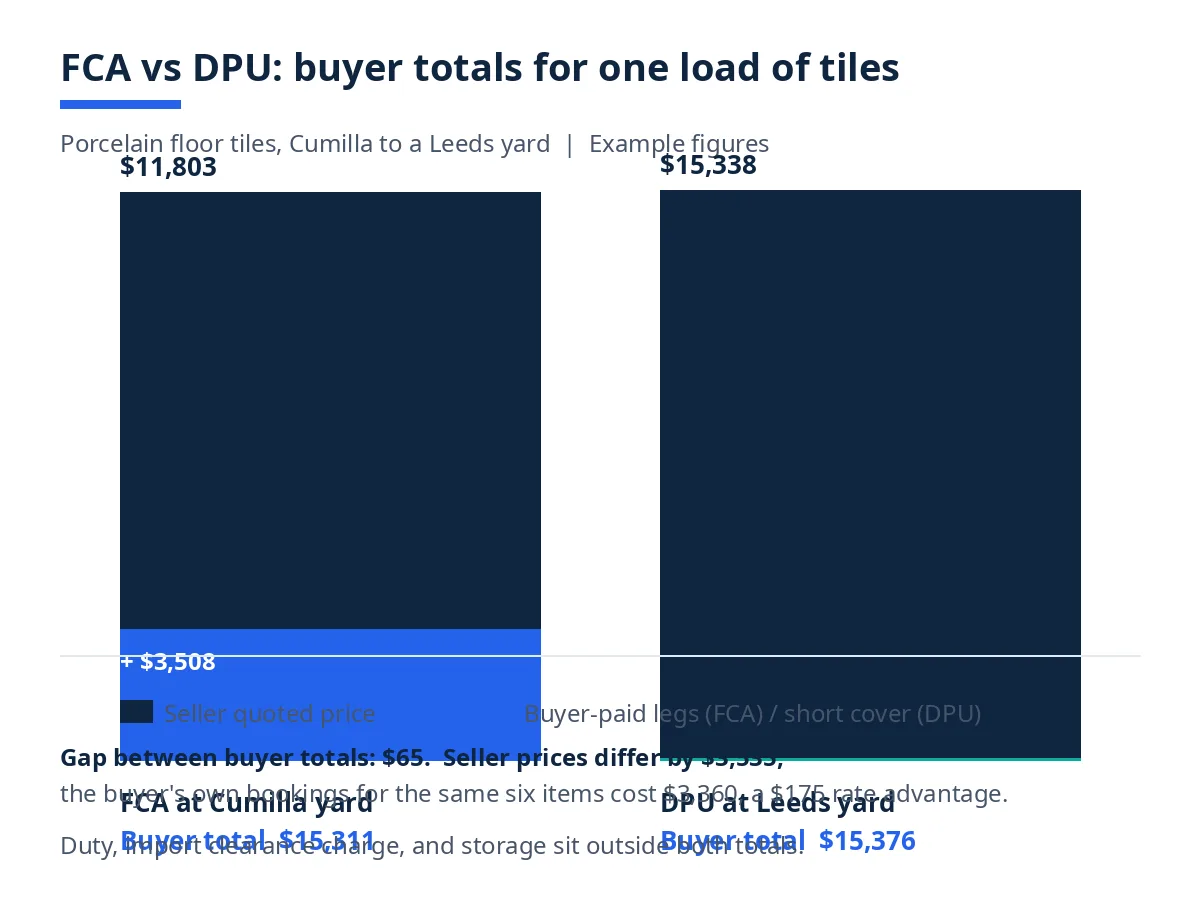
Adding the FCA column gives 11,803 plus 3,508, which is 15,311. Adding the DPU column gives 15,338 plus 38, which is 15,376. The difference between the buyer totals is 65, with DPU higher. The difference between the seller figures is 3,535, made of 410, 172, 118, 2,320, 290, and 225. The buyer's own bookings for the same six items come to 3,360, which is 175 lower: 25 lower on the first inland leg, 125 lower on the ocean leg, and 25 lower on the last inland leg, with port handling, loading, and the lift priced the same on both sides. Against that 175 advantage, the FCA buyer carries 148 for whole-journey cover, while the DPU buyer carries 38 for short cover after delivery. The net of those lines is 65 the other way: 175 minus 148 plus 38. Any single rate moving by more than that reverses the ranking. Judge the two quotations on buyer totals, with both sides' rates visible, and never on seller headlines alone.
Duty, the import clearance charge, and storage are absent from both totals. No duty rate appears anywhere in this article, because no tariff schedule for the destination was opened for it. Neither total can be judged until the broker who will clear the load provides that figure. The unloading line rests on a stated assumption in each column: the FCA buyer hires the gear, and the seller's carriage contract under DPU includes the lift. Where a real carriage contract excludes unloading, the DPU column needs re-pricing with the lift as a buyer cost, and both totals need adding again. Confirm the lift position in writing for each column, since the lift is the item this comparison exists to price.
Choosing: four buyers, four answers
The buyer with no gear at the yard should price on DPU, and should spend the saving from not hiring gear on the checks in the next section: the seller's gear, the ground, the access, and the notice route. The premium buys a delivered load on the ground, not a promise that the ground is suitable, and the buyer should verify suitability itself before signing.
The buyer with its own forklift, crew, and hard standing should price on FCA, and should keep the booking, the sailing, and the cover in its own hands. The lift becomes one more booked job, the ocean rate is the buyer's own, and the saving in the worked example comes from the rates themselves, not from the goods.
The buyer ordering once, with no carrier, forwarder, or broker on the route, should price on DPU and appoint the broker before the load moves. DPU removes the carriage and the lift, but it never removes the import file, and a single order with no broker is the order most likely to stall at the gate.
The buyer paying by letter of credit should settle the documents with the bank before choosing a term. Where the credit demands a bill of lading consigned to order, DPU delivery proof may not satisfy it, and the buyer must either amend the credit or choose a term whose documents fit it, solving the lift by hiring gear.2
Two neighbouring rules bound the choice. Where the seller can reach the named place but cannot be sure of the lift there, DAP is the fallback: the lift falls to the buyer, at the buyer's risk, and the charge for it follows the carriage contract, so the order must settle it in writing.1 Where a buyer asks the seller to take on import clearance and duty too, DDP is the rule, and it is open only where the seller can finish import clearance lawfully in the destination country.5 A DPU order naming a point the seller cannot work at is a DAP order waiting for an argument, and a DPU order assuming the seller clears import is a DDP order nobody agreed.
Five checks before the pallets move
Survey the lift and write it down. Heaviest pallet, capacity needed, gear the seller's carrier brings, ground, gate, turning room, permitted hours, and any site permit. Where the seller cannot confirm an item, change the term before signing. A lift the seller cannot truly carry out at the agreed point belongs under DAP, not DPU.1
Name the place and the point in full, and use one spelling everywhere. Yard name, address, bay, and window for DPU; yard address, collection point, and window for FCA; the edition cited beside the term.1 4 Confirm a third-party yard accepts the carrier, and state who pays waiting time.
Settle the lift, the wait, and the proof in the order. Unloading inside the DPU seller's price, waiting time without extra charge, the rate after that, who pays when clearance causes the wait, and the delivery receipt form.2 Under FCA, send the carrier details and collection window ahead of the collection, so the handover is dated by a carrier receipt.
Match the export papers to the pallets as packed, and settle notices in both directions. The seller completes export formalities under both terms; the buyer checks that term and place read identically on every document.1 4 Agree the seller's arrival notice and the buyer's point-and-time notice, so crew, broker, and file meet the same vehicle.2
Settle destination money and cover before sailing. Broker appointed, duty funds confirmed, onward carriage booked, and the policy start date confirmed with the insurer for the column chosen: handover day under FCA, delivery day under DPU. Where payment runs through a letter of credit, confirm with the bank that the DPU delivery proof satisfies the credit.2
Questions buyers ask about FCA and DPU
Does the seller clear import and pay duty when the term is DPU?
No. Import clearance and duty remain the buyer's under DPU, as under FCA. The seller completes export formalities and any transit customs procedures, while the buyer handles import formalities.1 The import file is the buyer's own work: the entry and the duty, any licences the destination requires, security screening, pre-shipment inspection, and every other official approval the goods need, with the seller helping only where the buyer asks, paid for by the buyer and at the buyer's risk.2 A buyer wanting the seller to clear import and pay duty needs DDP, and only where the seller can complete import clearance lawfully in the destination country. Never read a DPU price as a duty-paid price: the duty figure comes from the broker, and it joins both totals only once that figure exists.
How far apart do the two buyer totals land on the tiles load?
DPU lands 65 dollars above FCA, at 15,376 against 15,311, before duty. The seller figures differ by 3,535, the carriage and lift the DPU seller already bought, while the buyer's own bookings for the same six items cost 3,360, an advantage of 175 on freight rates. The FCA buyer spends that advantage on 148 of whole-journey cover, against 38 for the DPU buyer's short cover after delivery, leaving a net gap of 65. Another load can reverse it, if the seller's freight pricing undercuts the buyer's by more than the cover lines. Add the same lines to each column: the seller figure, the legs still owed, the broker's duty figure, the clearance charge, and the onward leg.
The truck is at the yard and the lift cannot happen. Has the seller delivered?
No. Under DPU the seller must unload the goods from the arriving mode of transport and make them available to the buyer, and risk stays with the seller until that delivery is complete.1 The vehicle waits, the risk stays with the seller, and the dispute turns on what the contract said about the point, the ground, and the gear. That is why the seller should weigh, before offering DPU, whether the lift at the agreed point can truly be carried out, and why DAP is the better choice where it cannot.1 The buyer should hold the seller to the written place and point, agree waiting charges in writing before the vehicle moves again, and rebook the lift with the gear the point actually needs. The seller should survey the point before quoting, and decline DPU for a point its carrier cannot work. Neither side should let the truck leave with the pallets still loaded and the delivery question unsettled: agree in writing where the load goes next, who pays for the move, and when delivery will be attempted again.
Can a purchase order move from FCA to DPU after signing?
Yes, while the pallets remain with the seller and both sides agree in writing. The change re-prices the deal and rewrites the paperwork set so every document names the new term: order, quotation, invoice, packing list, and transport document, checked in that order. Moving from FCA to DPU carries delivery on to the named destination, shifts the point where risk moves, from the carrier handover to the moment the goods stand on the ground, and adds the seller's carriage, export file, transit risk, and lift to the seller's price, while the buyer keeps import clearance, duty, and onward carriage. Moving the other way takes the carriage and the lift out of the seller's figure and hands back carrier nomination, freight booking, transit risk, and the lift to the buyer. A letter of credit still naming the old term needs amending separately through the bank, which tests documents against the credit, and a DPU delivery receipt may not satisfy a credit written for a bill of lading.2 Settle the new price, the named place and point, the lifting gear, and the date cover begins, all before the pallets move: a handover already made cannot be reversed.
Next steps on Exportain
Read the pair against the eleven-rule chart for Bangladesh shipments, with the unloading rule placed among the rest, then check the CIF page, which explains seller-bought cover for a different bargain before deciding who insures the voyage. Once term, named place and point, and lift are settled, put the requirement to suppliers through the buying guide, from first search to freight booking.
Sources
- DAP & DPU Incoterms 2020 explained: Key differences. ICC Academy, (accessed )
- DPU Delivered at Place Unloaded [Updated 2025] | Incoterms. Trade Finance Global (accessed )
- Incoterms 2020 Explained: All 11 Rules. Blue Ocean Academy (accessed )
- FCA & EXW Incoterms® 2020 explained: Key differences. ICC Academy (accessed )
- Incoterms® 2020 C rules vs D rules: Risk transfer explained. ICC Academy (accessed )
About the author
Sourcing from Bangladesh?
Post a request for quotation and suppliers on Exportain can send you their quotes directly.
Post an RFQ