

Quality Control Checklist for Safety Shoes From Bangladesh
Safety shoes quality control checklist for Bangladesh orders: toe-cap fit, puncture-resistant midsole, slip-resistant outsole, ankle support, heel and sole bonding, pair matching, measurements, buyer-specified tests, and shape-holding packing.
Short answer
This safety shoes quality control checklist covers toe-cap fit and attachment, metatarsal guard, puncture-resistant midsole, slip-resistant outsole pattern, ankle support, heel and sole bonding under load, materials, measurements, pair matching, labels, buyer-specified tests, and shape-holding packing, with a numbered checklist, failure fixes, and a summary table.
On this page
A safety shoe can look finished and still fail where protection is needed: the toe cap can sit out of place, the puncture-resistant layer can stop short of the forefoot, or the outsole pattern can be complete on one shoe and shallow on the other. Those faults hide inside the construction.
This checklist starts where protection starts: toe cap, metatarsal area, puncture-resistant midsole, slip-resistant outsole, ankle support, and heel and sole bonding under load, then materials, measurements, pair matching, labels, buyer-specified tests, and shape-holding packing. Record a result for every item, photograph every defect, and decide the lot on the agreed sampling plan.
Why this checklist matters
Footwear inspection evaluates workmanship, materials, measurements, construction, functionality, labeling, and packaging before shipment, and it checks the pair together because a visible difference between the shoes can make the pair unacceptable.1 For safety shoes, that pair check carries extra weight: protection depends on parts sitting in the right place on both shoes.
A hazard assessment asks, for each job, whether punctures, falling objects, or crush injuries, metatarsal protection, a protective sole, or grip on the actual flooring are needed.2 Safety shoes combine toe caps, puncture-resistant midsoles, slip-resistant outsoles, electrical-hazard protection, metatarsal guards, or chemical-resistant materials depending on the application, and no single pair provides every protection by default.3 Sole-bonding failures are the most frequent major finding.4
Before you start
Freeze the reference set before inspection starts: the sealed approved pair, tech pack, size chart with tolerances, material and color standards, protection list, artwork, labels, and packing specification. If the protection list is not frozen, an inspector cannot tell whether a missing metatarsal guard is a defect or a different model.
Agree four things in writing in the purchase order: the defect list, classed as critical, major, or minor, with reference photos for borderline cases;1 the sampling plan, where the AQL numbers are what buyer and supplier agree and write into the order;1 5 every buyer-specified test, named with its method and result; and the protection set, each item confirmed as required, not required, or optional. Book the final inspection for when production is complete and goods are mostly packed.6
The full checklist (numbered, printable)
Print this section and tick each item Pass, Fail, or Not applicable.
Toe-cap fit and position. Cap sits centered over the toes as on the approved pair, at the specified length and width, with no exposed edge, dent, or deformation.
Toe-cap attachment. Cap does not shift, rock, or lift when pressed and flexed by hand, and the cap seat holds its shape after flexing.
Impact and compression as buyer-specification items. Where specified, record each result against the named method and order value. No figure here is a universal pass mark.
Metatarsal guard as a buyer-specification option. Where required, the guard covers the specified area and does not slip when flexed; where not required, record it as not applicable. It covers the top of the foot, an area a toe cap does not cover.2
Puncture-resistant midsole as a buyer-specification item. Where required, check insert type, position, and coverage in both shoes. A toe cap does not protect the underside of the foot.2
Slip-resistant outsole pattern as a buyer-specification item. Pattern is complete, identical on both shoes, and matches the approved pair. Measure tread depth against the buyer-specified measurement.
Heel and sole bonding under load. Edges are bonded around the full perimeter with no gaps or lifting, and the bond holds when flexed by hand.1
Ankle support and closure. Shaft height and ankle fit match the approved pair, the shoe holds the ankle without collapsing, and closures work repeatedly without catching.2
Heel stability and attachment. Heel is centered, firmly attached, and holds the shoe upright on a flat surface, with no lean or rocking.
Upper material and lining. Upper and lining match the approved pair in material, texture, thickness, and color, with no cuts, tears, stains, or delamination.1
Stitching, seams, and edge finishing. Stitching is even, complete, and secure, with no loose, broken, or skipped stitches, and edges are finished cleanly.1
Eyelets, hardware, and logos. Eyelets are present in the specified count, aligned, firmly set, and free of sharp edges; logos match the approved artwork.1
Insole fit. Insole matches the shoe size, lies flat without curling, and is removable only where the order specifies it.
Electrical properties as buyer-specification items, confirmed in writing. Where required, confirm each property separately in writing, with its named method and recorded result.2 No rating, voltage, or test figure here states a universal pass mark.
Measurements and weight by size. Measure shoe length, outsole length and width, heel height, and shaft height in each size against the chart, and weigh sampled pairs against the buyer-specified range where set.1
Color and shade. Color is even within each pair and across the lot against the approved pair, under the agreed light, and re-checked under a second light if a split is suspected.
Left and right pair matching. The two shoes of each pair match in shade, size, shape, sole pattern, and toe-cap position.1
Foreign objects and metal detection. No debris, loose pins, or broken needle fragments remain inside the shoe, with metal detection where the order requires it.1
Labels, markings, and barcodes. Labels carry the correct content and spelling in position, any protective marking matches the order, and the box barcode scans correctly.1
Protection documents match the model. Test reports and any conformity document name the same model, style, and protection set as the order.
Buyer-specified lab tests. Where the order names impact, compression, puncture, slip, electrical, abrasion, flexing, or colorfastness tests, each is run by its named method and the result recorded.1
Shoe box and shape-holding packing. Box marking and barcode match the pair inside; tissue and stuffing support the toe-cap area and ankle so the shoe keeps its shape.
Carton assortment, marks, and quantity. Carton quantities, size and color ratios, gross weights, and shipping marks match the packing specification, finished quantities match the packing list, and cartons are dry and sealed.
Sampling decision on the finished, packed lot. As a published example only, a repeat order of 1,201 to 3,200 pairs at General Inspection Level II gives code letter K and a sample of 125.7 With buyer-specified AQL 1.0 for major and AQL 2.5 for minor defects, acceptance and rejection numbers are 3 and 4 for major and 7 and 8 for minor.7 Those are buyer-agreed order values.5
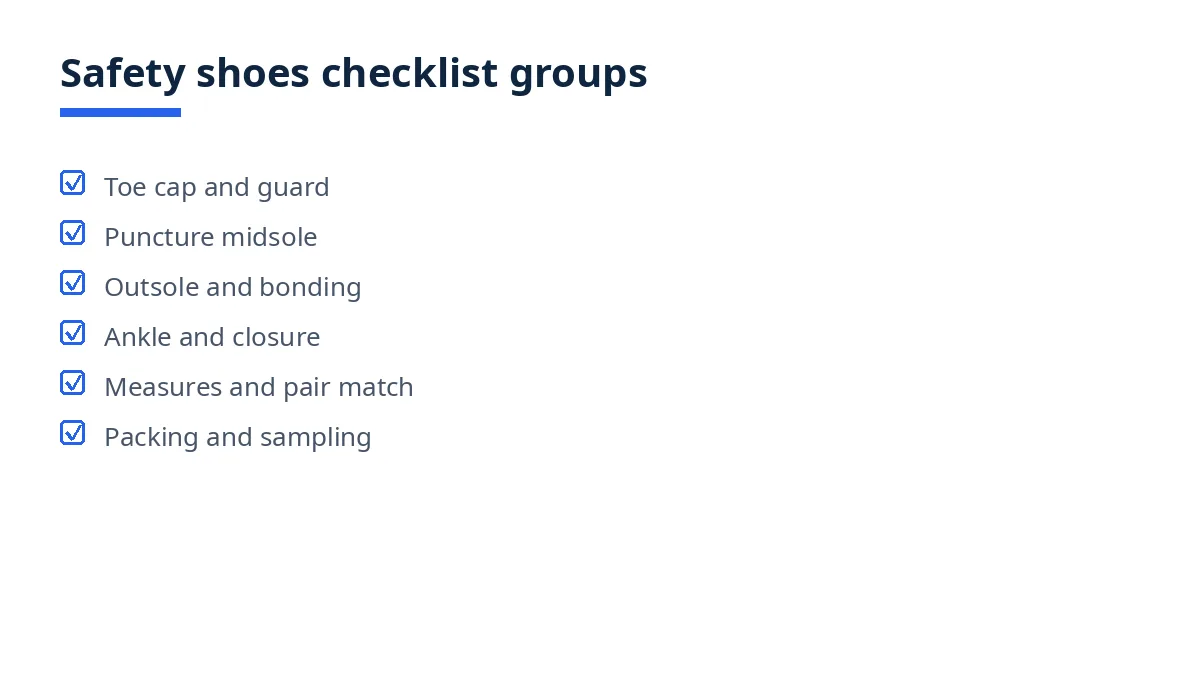
Diagram: safety shoe checklist groups.
Common failures and how to fix them
Toe cap shifting under pressure. A cap that rocks or slides when pressed points to a lasting or cap-seat problem. Hold the size run, re-seat the cap, and re-check after lasting.
Puncture-resistant insert stopping short. An insert that does not cover the specified sole area leaves part of the foot unprotected. Trace the insert batch, hold short pairs, and add an insert-position check in line.
Tread pattern shallow on one size. A pattern complete in one size and shallow in another points to a mold or pressing problem in that run. Isolate the size run and re-check after correction.
Metatarsal guard slipping out of position. A guard that slides when flexed will not cover the area it is meant to protect. Refix the guard and flex reworked pairs before re-packing.
Heel and sole bond opening under flex. A bond that opens when flexed points to surface preparation, adhesive application, curing, or production control.1 Hold the batch, rework the bond, and re-check after curing.
Crushed toe-cap area in packing. A toe cap arriving dented or flattened was packed without enough support, not made wrong. Re-pack with tissue and stuffing supporting the toe-cap area, in the correct box.
Downloadable template / summary table
No file download is offered with this article. The table below is the template.
Group | What to record | Result |
|---|---|---|
Toe cap and metatarsal guard | Cap fit, attachment, guard position | Pass/fail |
Puncture-resistant midsole | Insert type, position, coverage | Pass/fail |
Outsole and bonding | Grip pattern, tread, bond under flex | Pass/fail |
Ankle, heel, and closure | Shaft height, ankle hold, heel, closure | Pass/fail |
Upper, stitching, and hardware | Material, lining, stitching, eyelets, logos | Pass/fail |
Measurements and pair matching | Length, width, heights, shade, pair match | Pass/fail |
Labels, documents, and tests | Labels, barcode, documents, test results | Pass/fail |
Packing and sampling | Box, packing, cartons, quantities, sampling | Pass/fail |
For the sampling row, use the standard table values for your agreed plan; item 24 shows how a Level II plan reads for a large repeat order. Keep lot size, level, sample size, AQL values, defect counts, measurements, lab results, and packing findings with the decision.
How Exportain helps
Exportain connects international buyers with Bangladeshi sellers and service providers, and buyers can post a requirement describing the safety shoe, protection set, and inspection scope. The inspection services category page currently shows "No services published in this category yet", so confirm any provider, scope, and price directly before booking. The inspection contract is always between buyer and provider, and Exportain does not inspect goods.6 Use the AQL guide for your lot size and level, and the pre-shipment inspection guide for timing.5 6
FAQs
When should this checklist be used?
Use it when the approved pair is sealed, during production for protection parts that close inside the shoe, and at final inspection on the finished, packed lot.
Who should complete it?
The buyer writes the checklist, defect list, and protection set; an independent inspector or the buyer quality team completes the checks. Factory checks do not replace an independent sampling decision.6
What are the most common failures?
A shifting toe cap, an insert stopping short, a shallow tread pattern on one size, a guard slipping out of position, a bond opening under flex, and a crushed toe-cap area from packing.
Can a third party do it?
Yes. A third-party firm works to the buyer checklist and pass criteria, and the booking party receives the report.6 Agree scope, sampling plan, tests, and re-inspection payer before production.
Next steps on Exportain
Read the AQL acceptance quality limit guide to find the code letter and sample size for your lot size and inspection level.
Read the pre-shipment inspection guide to set the timing and scope of the final inspection.
Browse the inspection services category, which currently shows "No services published in this category yet", and confirm any provider directly.
Sources
- Footwear Inspection: Complete Guide to Quality Control and Inspection Standards. ECQA (accessed )
- Footwear - Assessment Checklist. CCOHS (accessed )
- Safety Shoes Requirements: OSHA, ASTM Standards, Selection, Inspection, and Maintenance Guide (2026). HSE Study Guide (accessed )
- Quality Control Shoes: Footwear QA & Defect Guide. Tetra Inspection (accessed )
- AQL Meaning: Acceptance Quality Limit, Tables. Exportain (accessed )
- Pre-Shipment Inspection (PSI). Exportain (accessed )
- AQL Calculator | Sample Size and ISO 2859-1 Tool. AQMBD (accessed )
About the author
Sourcing from Bangladesh?
Post a request for quotation and suppliers on Exportain can send you their quotes directly.
Post an RFQ


