Pre-Shipment Inspection (PSI): Process, Types and Checklist for Buyers
Definition
A pre-shipment inspection is an independent check of finished goods at the factory before shipment, carried out when production is complete and packing has begun. An inspector draws a random sample, checks quantity, specification, workmanship, measurements, labels, packing and shipping marks against your order, and applies your agreed AQL limits to decide whether the lot can ship.
By Naim Islam
Published 12 min read
On this page
Key takeaways
A PSI is a sampling inspection of finished, mostly packed goods, not a check of every piece and not a guarantee.
Book the inspection for when production is complete and at least 80 percent of the goods are packed, so the sample represents the shipment.
Lot size and inspection level set the sample size under ISO 2859-1, and your buyer-specified AQL sets the accept and reject numbers per defect class.
Buyers commonly specify AQL 0 for critical, 2.5 for major and 4.0 for minor defects in garments, agreed in writing before production.
On a fail, do not ship on a promise: agree rework, sort or remake, then book a re-inspection before shipment.
A pre-shipment inspection gives you an independent view of finished goods while they are still at the factory, where a problem can still be corrected, sorted or rejected. This guide explains where the inspection fits among earlier checks, how the process runs, what inspectors check, how AQL decides pass or fail, and what a garment inspection should cover.
What is a pre-shipment inspection, and what is it not?
A pre-shipment inspection, often shortened to PSI and also called a final random inspection (FRI), is a commercial quality inspection that a buyer arranges, usually through an independent third-party firm. Whoever books the inspection is the firm's client and receives the report, so if you book it, the inspector works to your checklist and your pass criteria.
A PSI is a sampling inspection, not a guarantee. Inspectors draw units at random under ISO 2859-1, which defines sampling schemes indexed by acceptance quality limit (AQL) for lot-by-lot inspection by attributes.1 In the United States, ANSI/ASQ Z1.4 provides a closely aligned system of sampling procedures and tables for inspection by attributes, with tightened, normal and reduced plans.2 A pass means the sampled lot met the agreed limits on the day. It does not mean every piece is perfect, and it does not replace clear specifications, approved samples or in-process control.
A commercial PSI is also not factory quality control, which is the supplier checking its own work. It is not a government-mandated preshipment inspection program either. The WTO Agreement on Preshipment Inspection covers government-contracted or government-mandated activities that check details such as price, quantity and quality of goods ordered overseas.3 It is not supplier verification. Exportain does not inspect goods, and its supplier verification is a document and photo review, not a factory inspection. You can find inspection providers listed on Exportain, but the inspection contract is always between you and the provider.
Types of inspection: PPI, DPI and final inspection
A PSI is the final stage in a family of inspections that follows production from raw materials to loading. For large, complex or first-time orders, buyers place lighter checks earlier, where problems are cheaper to fix.
Inspection type | When it happens | What it is for |
|---|---|---|
Pre-production inspection (PPI) | Before or just as production starts | Verify raw materials, components, trims and factory readiness before bulk production begins |
During production inspection (DPI) | When part of the order is finished and packed | Catch defects, delays and specification drift early enough to correct them in the remaining production |
Pre-shipment inspection (PSI) / Final random inspection (FRI) | When the order is complete or nearly complete and packing has begun | Give the final sampling verdict on quantity, quality, packing and labeling before shipment |
Container loading check (CLC) | During loading | Verify that the right goods, in the right quantities, are loaded correctly and the container is sealed |
Piece-by-piece inspection | As specified, often for higher-value goods | Check every unit rather than a sample, where sampling risk is not acceptable |
Factory audit | Before placing an order, or periodically | Assess a factory's capacity, systems, capability and compliance before you rely on it |
What does a pre-production inspection check?
A pre-production inspection, also called an initial production check, confirms that fabric, components, trims, colors and accessories match the order before cutting or assembly starts. That is the cheapest point to stop a wrong material from becoming a full defective order.
What does a during production inspection check?
A during production inspection, also called DUPRO, covers early finished units, work in progress, schedule status and whether defects appearing now are being corrected. It turns a late, failed PSI into an early warning.
Why is the final inspection called random?
Final means it is the last quality gate before shipment. Random means the sample is drawn at random from the finished, packed lot, rather than chosen by the factory.
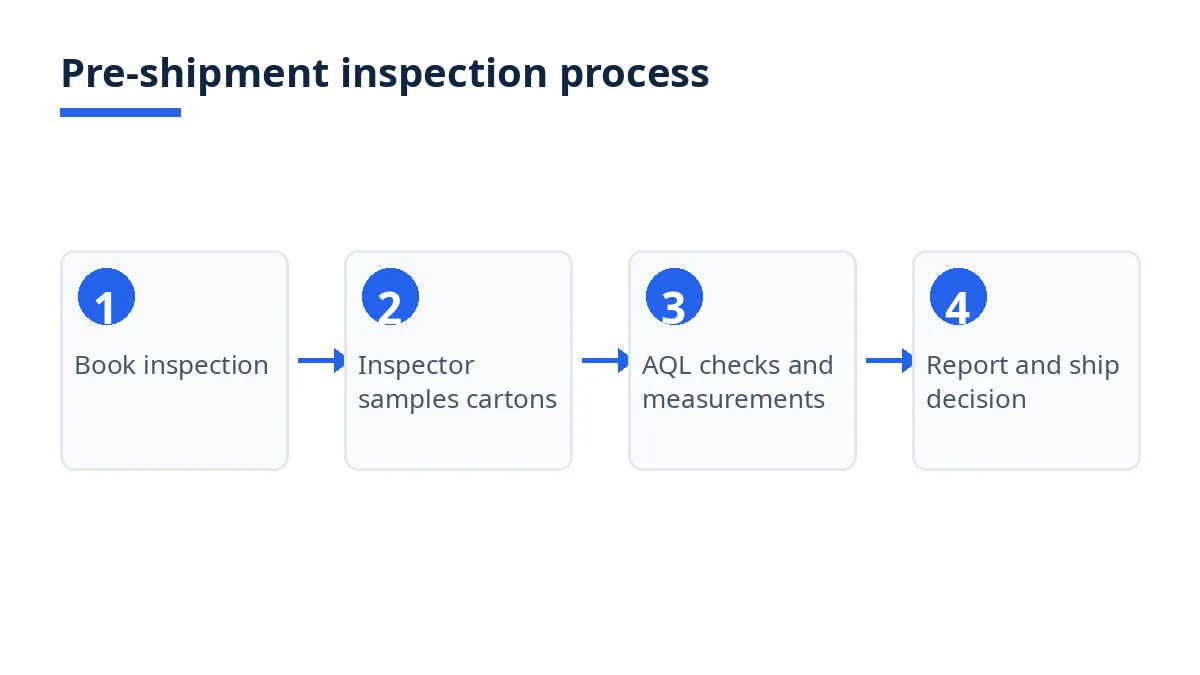
The pre-shipment inspection process, step by step
Agree inspection in the order. Before production starts, record in the purchase order that goods will be inspected before shipment, by whom, to which checklist, at which AQL per defect type, who pays, who pays for a re-inspection after a failure, and what happens after a fail: rework, replacement or a new shipment date.
Book the inspection. Book once the supplier confirms a realistic completion date. A PSI is generally conducted when 100 percent of production is complete and at least 80 percent of the goods are packed, so the sample represents the shipment, including its packing.4
Send the reference set. Send the purchase order, specification, approved sample details, measurement chart, artwork and labeling files, packing requirements and any agreed on-site tests. An inspector can only check against what you supply.
Confirm quantity and draw the sample. The inspector counts finished and packed goods, selects cartons at random across the lot, and draws the sample size set by the sampling plan for your lot size and inspection level.4
Perform the inspection. Every sampled unit is checked as detailed in the next section. Defects are classified as critical, major or minor and photographed.
Calculate the AQL verdict. Defect counts per class are compared with the acceptance and rejection numbers for your AQL. One failed class fails the lot.
Report and decide. The report records quantities, sample size, defects with photographs, measurements, packing findings and the result.4 On a pass, authorize shipment. On a fail, agree correction and re-inspection, and do not let failed goods ship on a promise.
What inspectors check during a PSI
A typical PSI scope covers quantity, workmanship, product specifications, dimensions and measurements, function and on-site tests, labels and markings, barcodes, retail packaging, export cartons and shipping marks.4
Quantity: finished and packed quantities against the order, by style, color and size, including shortages and overages.
Product specification: style, construction, material, color and assortment against the purchase order and approved sample.
Workmanship: defects and consistency across the sample. This is the core defect count that feeds the AQL verdict.
Measurements and size: sampled units measured against your size chart and its stated tolerances.
Artwork, labels and tags: main labels, care labels, size labels, hangtags and barcodes, including content, spelling, positioning and scanability where checked.
Function and on-site tests: simple product-specific checks agreed in advance. For garments, examples include button and zip operation and seam and attachment pulls by hand.
Packing: inner and outer packing, polybags and inserts, assortment per carton, export carton dimensions and gross weights, and carton drop or packing-integrity checks where specified.
Shipping marks: carton marks, side marks, carton numbering and handling marks against your instructions. Errors here cause customs and warehouse problems even when the product is correct.
Documentation on site: packing list consistency with the goods presented, so the documents your forwarder and bank receive describe what was actually inspected. Keep those documents aligned with the full set in our guide to export documents from Bangladesh.
For industrial equipment, the same logic applies with a different focus: specification and function, packing and loading condition, and complete shipping documentation.
How AQL decides pass or fail
The sampling plan, not an inspector's impression, decides the result. Under ISO 2859-1, lot size and inspection level set the sample size, and your AQL sets, per defect class, an acceptance number (Ac) and a rejection number (Re). At or below Ac, a class passes. At or above Re, it fails.5
ISO 2859-1 provides general inspection levels I, II and III and special levels S-1 to S-4. General level II is the usual starting point for commercial inspections, level I uses smaller samples, level III uses larger samples, and the special levels use very small samples for destructive or costly tests.5
What AQL values do buyers commonly specify for garments?
Buyers commonly specify AQL 0 for critical defects, 2.5 for major defects and 4.0 for minor defects in garments. That pattern is a common buyer-selected default, not a value ISO 2859-1 mandates for apparel. The standard defines how the sampling scheme works, and the AQL numbers are what you and your supplier agree and write into the purchase order.6
Critical defects are unsafe, illegal or make the product unusable. Buyers commonly hold them at AQL 0, so one critical defect rejects the lot.
Major defects are likely to cause a return or complaint, such as a broken zipper or an open seam. Buyers commonly specify AQL 2.5 for garments.
Minor defects are small imperfections unlikely to affect use, such as a loose thread. Buyers commonly specify AQL 4.0 for garments.
Read the full method in our AQL (Acceptance Quality Limit) guide before you set values for a new product.
Worked example: reading an AQL result
Worked example, using the standard table for general inspection level II, single sampling and normal inspection. A lot of 1,201 to 3,200 units gives code letter K and a sample size of 125. With buyer-specified AQL values of 0 for critical, 2.5 for major and 4.0 for minor defects, the inspector checks the 125 units against your defect list.5
Defect class | AQL | Lot passes with | Lot fails at |
|---|---|---|---|
Critical | 0 | 0 defects | 1 defect |
Major | 2.5 | 7 or fewer defects | 8 or more defects |
Minor | 4.0 | 10 or fewer defects | 11 or more defects |
Each class is judged on its own. Six major defects and twelve minor defects in this sample means the lot fails on minor defects, even though it would pass on major defects.5 A garment inspection report using the same sample size and AQL values applied the same accept and reject limits.6
Garment QC checklist: what a garment PSI should cover
Use this garment QC checklist as the product-specific layer on top of the general PSI scope above.
Appearance and workmanship
Fabric faults visible on sampled units: holes, slubs, shading variation between pieces and panels, stains, oil marks and dirt
Stitching: broken stitches, skipped stitches, open seams, uneven or puckered seams, loose threads and needle damage
Construction: symmetrical assembly, aligned pockets, plackets, collars and cuffs, correct button and buttonhole placement, and secure button, snap, zip and drawcord attachment
Printing and embroidery: position, color, spelling, registration and adhesion against the approved artwork
Pressing and presentation: creases, shine marks, untrimmed threads and overall finish
Measurements, materials and labeling
Key measurements on sampled units in each size against the size chart and tolerance, such as chest, length, sleeve and waist, or the points your chart specifies
Fabric type, composition and color against the order and approved sample, in the lighting available on site
Main label, care label, size label and fiber-content label: correct content, language, spelling and placement
Hangtags, price tickets and barcodes matching the order, with the correct assortment per unit
Packing and assortments
Size, color and style ratio per polybag and per carton exactly as ordered
Folding, polybag quality and sealing, inserts and other packing accessories where specified
Carton dimensions, gross weight, carton quality and shipping marks
Metal detection or needle-control records where your market, product or buyer program requires them. Confirm the requirement in your own compliance process rather than assuming it.
After the result: pass, fail and re-inspection
On a pass, authorize shipment in writing and keep the report with your shipment documents. If you pay by letter of credit, ask your bank in advance whether an inspection certificate should be listed among the credit's required documents.
On a fail, the report's photographs and defect counts are your evidence and your rework instruction in one document. Agree what the supplier will correct, sort or remake, and book a re-inspection before shipment. Decide in the purchase order who bears the re-inspection cost after a failure.
On a disputed result, go back to the agreed checklist, AQL and classifications. Most disputes are specification disputes, such as a tolerance that was never written down. Fix that gap in the next order's paperwork.
Keep inspection in proportion. Use a DPI plus a PSI for a first order with a new supplier, a PSI alone for a proven repeat order, and piece-by-piece inspection for very high-value or safety-sensitive units.
Frequently asked questions
What is a pre-shipment inspection?
A pre-shipment inspection (PSI) is an independent sampling inspection of finished, mostly packed goods at the factory before shipment. Inspectors check quantity, specification, workmanship, measurements, labeling, packing and shipping marks against your order, and the lot passes or fails under the AQL limits you agreed.
What is the difference between PPI, DPI and FRI?
A pre-production inspection (PPI) checks materials and readiness before production starts. A during production inspection (DPI, or DUPRO) checks early finished goods mid-production so problems can still be corrected. A final random inspection (FRI) is the pre-shipment inspection itself, the final random sampling check before shipment.
When should a pre-shipment inspection take place?
A pre-shipment inspection should take place when production is complete and packing has begun. Inspectors generally conduct a PSI when 100 percent of production is complete and at least 80 percent of the goods are packed, so the random sample, including packing and shipping marks, represents what will be shipped.4
Does the inspector check every piece?
No. A PSI is a sampling inspection under a standard such as ISO 2859-1 or ANSI/ASQ Z1.4.1 2 The lot size and inspection level set the sample size, and every sampled unit is checked. If you need every unit checked, book a piece-by-piece inspection instead.
How does AQL decide whether goods pass?
AQL decides pass or fail by comparing the defect count in each class with the acceptance and rejection numbers for your chosen AQL. Each defect found is classified as critical, major or minor. At or above the rejection number in any class, the lot fails. Buyers commonly specify 0 for critical, 2.5 for major and 4.0 for minor defects in garments, as buyer-specified values.6
Who pays for a pre-shipment inspection and a re-inspection?
Whoever books the inspection is the inspection firm's client and normally pays for it, usually the buyer, so the inspector works to the buyer's checklist. Who pays for a re-inspection after a failure should be agreed in the purchase order before production starts. Many buyers put that cost on the supplier after a fail, but it must be written down.
What happens if goods fail a pre-shipment inspection?
Do not ship the goods on the failed result. Use the report's defect counts and photographs to agree what the supplier will rework, sort or remake, then book a re-inspection of the corrected goods before shipment. Keep the fail, the correction and the re-inspection result in your shipment file.
Can a pre-shipment inspection guarantee my goods are perfect?
No. Sampling inspection controls risk to the level your AQL sets, and it cannot guarantee zero defects in units that were not sampled. Clear specifications, an approved sample, earlier inspections on larger or first-time orders, and a PSI together give stronger protection than any one check alone.
Next steps on Exportain
Exportain does not inspect goods itself and is not a party to your trade. Use Exportain to find and compare Bangladeshi suppliers, post an RFQ that states your inspection and AQL requirements, and follow the buyer journey in how to buy before you agree shipment and payment terms.
Sources
- ISO 2859-1:2026 - Sampling procedures for inspection by attributes — Part 1: Sampling schemes indexed by acceptance quality limit (AQL) for lot-by-lot inspection. ISO (accessed )
- ANSI/ASQ Z1.4 & Z1.9 Sampling Plan Standards for Quality Control. ASQ (accessed )
- Preshipment Inspection - gateway. World Trade Organization (accessed )
- Pre-Shipment Inspection (PSI) Explained. ECQA (accessed )
- AQL Table Explained: Sample Size and Accept/Reject. Westwood Sourcing, (accessed )
- AQL Garment Inspection: What AQL 2.5 & 4.0 Mean for Apparel. AQI Service, (accessed )
Reviewed by Nourin Tabassum
- pre-shipment inspection
- PSI
- AQL
- quality inspection
- garment quality control
- final random inspection
- during production inspection
About the author
Sourcing from Bangladesh?
Post a request for quotation and suppliers on Exportain can send you their quotes directly.
Post an RFQ