Typical MOQ for Safety Shoes in Bangladesh (and How to Negotiate It Down)
No standard safety shoe MOQ exists in Bangladesh. The binding figure is the counting basis in the accepted quotation: per order, style, colour or size group, sometimes with a minimum order value beside it. This guide rebuilds the smallest order under each basis, with example figures only.
Short answer
There is no standard safety shoe MOQ in Bangladesh. Each supplier states a minimum counted per order, per style, per colour, or per size group, sometimes combined with a minimum order value, and the accepted quotation is the binding record. Rebuild the smallest order under the stated basis, test it against any value floor, name every variant and size group in the quotation, and negotiate with fewer variants, stock materials, or a surcharge.
On this page
Key takeaways
A quoted minimum means nothing until its counting unit is known: per order, per style, per colour, or per size group, with more than one basis able to apply at once.
A piece count and a money floor are separate tests. An order can clear every pair count and still fail the value floor.
In safety shoes the counted unit also splits by protection set, insert type, and size group, because tests are judged by size on specimens cut from finished shoes.
Negotiate the count, not just the number: fewer variants, stock materials, standard trims, a surcharge, or an honest trial order, each confirmed in the accepted quotation.
A buyer who asks only "what is the MOQ?" will get a number that answers almost nothing. The number matters less than the unit it is counted in, the variants it covers, and the money floor that may sit beside it. This article is written for buyers importing into the USA, the UK, the EU, and the UAE who are sourcing safety shoes from Bangladesh. By the end, you will be able to take any quotation, rebuild the smallest order it actually describes, test that order against a value floor, and negotiate the count with specifics instead of a single lower number.
The number on the listing is not the order
MOQ stands for Minimum Order Quantity: the smallest order a supplier takes at its usual terms. On a listing, that quantity sits beside the price tiers and the price basis, and on Exportain a tiered listing may read "Unit price, FOB Chittagong Port. Minimum order 1,000 pcs."1 Read the unit as carefully as the number. A figure counted across a whole order and the same figure counted for every colour describe two very different commitments, and the listing alone does not settle which one you are looking at.
There is no standard minimum you can safely assume. Exportain's MOQ guide states this plainly for Bangladesh sourcing: minimums vary widely by product, factory size, fabric, and customisation, and each supplier's stated minimum must be read on its own.1 For safety shoes, treat that as the starting point rather than a gap in the market. The binding record is the quotation you accept, not the listing, and the quotation is where the counting basis, the variants, and the value floor must all appear in words.1
Three questions settle the meaning of any quoted minimum before you plan a size or colour mix. First, what is the counting unit: the order, the style, the colour, or a size group? Second, does a money floor apply alongside the piece count? Third, which variants does one counted unit contain: one protection set, one insert type, one upper material, or several? Until those three answers are in the quotation, the headline number is a label, not an order size.
Four ways one minimum is counted
A supplier can count the same minimum in four places, and can apply more than one at once. The four bases below follow the counting rules in Exportain's MOQ guide: per order, per style or product, per colour, and per size or size range.1 The guide's warning is worth repeating in your own planning: "1,000 pieces" may really mean "1,000 pieces per style, and at least a certain order value overall."1
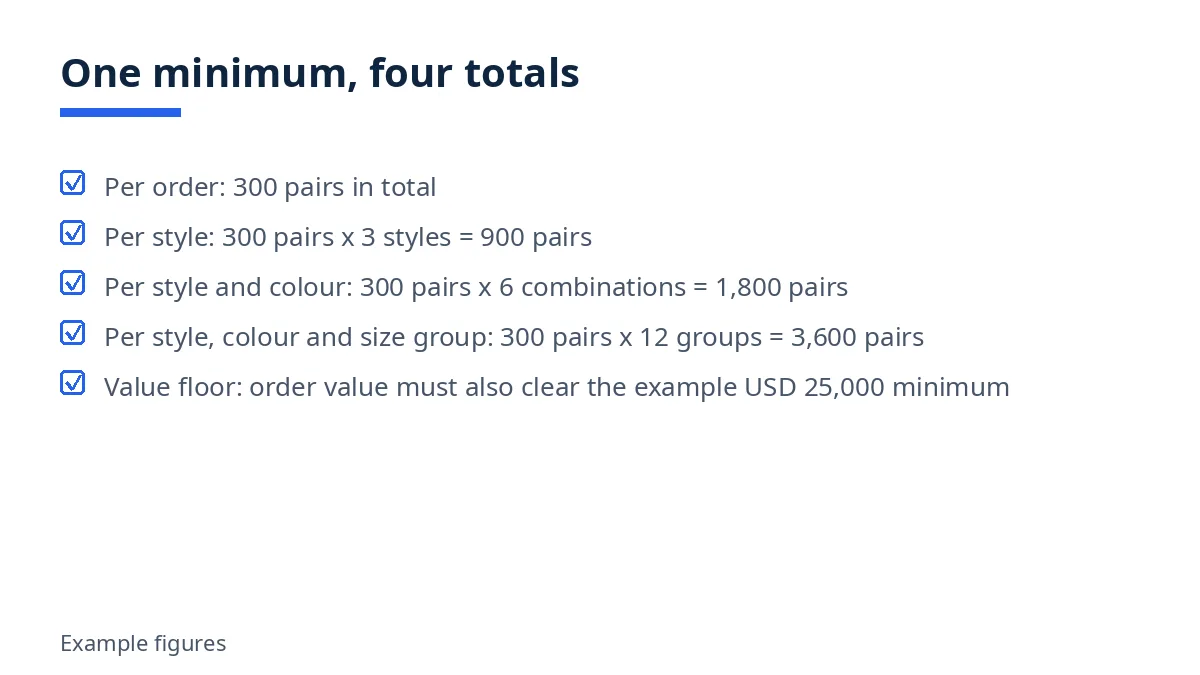
Example figures only. Take a minimum of 300 pairs and an assortment of three styles, each in two colours, split across two size groups. The table shows what that one figure demands under each counting basis.
Counting basis | Units the minimum applies to | Smallest order |
|---|---|---|
Per order | The whole order, mixed freely | 300 pairs |
Per style | Each of the 3 styles | 900 pairs |
Per style and colour | Each of the 6 style-colour combinations | 1,800 pairs |
Per style, colour, and size group | Each of the 12 style-colour-size-group combinations | 3,600 pairs |
The arithmetic is simple multiplication, and that is the point: 300 pairs times 3 styles is 900 pairs, times 6 combinations is 1,800 pairs, and times 12 groups is 3,600 pairs. Nothing about the shoe changed. Only the counting basis changed, and the smallest order grew twelvefold. When a quotation says only "MOQ: 300 pairs," ask in writing how it is counted before you fix the colour and size mix, because the answer decides whether you are planning 300 pairs or 3,600.
Two follow-up questions belong in the same message. Ask whether two styles that share an upper material or a sole unit can count together toward one minimum, and ask what the smallest accepted size breakdown is.1 A supplier who counts per colour may still allow a stock colour to replace a custom-dyed one, and a supplier who counts per size group may accept an uneven split across the range. Neither answer can be assumed from the listing. Both change the order you actually place, so both belong in the quotation thread rather than in a phone call nobody recorded.
When the money floor applies as well as the piece count
Some suppliers state a minimum order value instead of a piece count, and some apply both side by side: a minimum shipment value and a minimum number of pieces per product.1 The piece count and the money floor are two separate tests, and an order must pass both. A forwarder's minimum chargeable weight is a different floor again, a logistics charge rather than the supplier's minimum, and it should never be confused with either test.1
Example figures only. Keep the assortment from the previous section and put an example price of USD 7.80 per pair on an FOB basis beside an example minimum order value of USD 25,000. The 1,800-pair order, three styles in two colours in one size group, totals USD 14,040: 1,800 pairs times USD 7.80. That order clears the piece counts at the per-order, per-style, and per-style-and-colour bases, and still fails the money floor by more than USD 10,000. The 3,600-pair order, the same assortment across both size groups, totals USD 28,080: 3,600 pairs times USD 7.80. It clears the piece count at every basis and clears the money floor. The lesson is not that one order is better. The lesson is that a buyer who checks only pairs will approve an order the supplier cannot accept on value, and will discover the problem after the assortment is already fixed.
Ask which basis the value floor uses, because the answer changes the test. A floor stated on an FOB basis measures the goods value before international freight, while a floor that includes freight or other charges measures something else. Exportain's MOQ guide describes the value floor as often stated on an FOB basis, and its shipping section draws the same line: MOQ is a commercial condition set by the seller, not a shipping charge, and terms such as FOB, CIF, or EXW are agreed after it.1 Put the value basis in the quotation next to the piece-count basis, and test every assortment change against both figures before you send it.
Price tiers add a third check. With tiered pricing, the per-pair price drops at set quantity steps as the order grows, and the listed tiers are a starting point: the agreed price is the one in the accepted quotation.1 Because tiers step, an order just below a break can cost more in total than the break quantity itself, once the extra pairs are priced at the lower tier. Check both sides of every break in your assortment, and confirm which tier your final count lands in, rather than assuming the tier shown for the headline minimum.
Why safety shoes multiply the count: protection sets, inserts, and sizes
Safety shoes carry a complication that garments do not: the counted unit is rarely just a style and a colour. The protection marking, the insert inside the sole, and the size range each split the order further, and each split can carry its own minimum if the quotation counts it that way. Ask how the supplier counts before you assume a style-colour unit covers the whole shoe.
Start with the protection marking. Under EN ISO 20345:2022, a marking such as S3 names a bundle of tested protections: S3 builds on S2, which builds on S1, which builds on SB, with toe impact protection at 200 joules and toe compression protection at 15,000 newtons in the SB bundle, plus slip resistance on ceramic tile with detergent.2 Higher bundles add water penetration and absorption in the upper, a perforation requirement set by the insert fitted, and a cleated outsole, while S6 and S7 add water resistance of the whole footwear.2 Two shoes that share a class letter can still differ in the insert type, the added codes, and the tests behind them, so the class letter alone never describes the counted unit. Name the class, its added codes, and the edition of the standard for each style in the RFQ, and ask whether the minimum runs per protection set or across sets that share a last and a sole unit.
The insert type splits the count again, and the nail in the test is what tells the types apart. Each insert is a different component, tested differently, and a production run that switches insert type switches material, tooling, and test evidence with it.
Insert | Nail used in the test | Pass rule |
|---|---|---|
P, metallic | Lowest perforation value governs | Lowest perforation value 1,100 newtons or higher |
PL, non-metallic | 4.5 mm diameter | Withstands 1,100 newtons without perforation; no tent effect |
PS, non-metallic | 3.00 mm diameter | Holds on average at 1,100 newtons; no result below 950 newtons |
The values in the table come from the 2022 summary published by New Balance Industrial.2 If your order mixes a metallic-insert style with a non-metallic-insert style, ask whether each insert type counts separately toward the minimum. The same question applies to added codes that change the build: a metatarsal guard rated to 100 joules of impact energy, a heat-resistant outsole rated for one minute at 300 degrees Celsius, and a scuff cap that must survive 8,000 cycles of abrasion testing each describe a different shoe to make, even when the upper looks the same.2
Sizes split the count a third time, and the split has a technical reason rather than a commercial one. Test pieces are cut out of finished shoes, sole section and toe-area linings included, and the clearance recorded under the cap is judged against size-specific minima in the standard's tables: the cap's internal length is likewise specified by shoe size.3 A result at one size therefore does not establish the ends of the range, and a size curve is not one shoe repeated at different lengths. When the minimum counts per size group, ask how the supplier groups the range: which sizes sit in one group, how many pairs each group must carry, and whether the ends of the curve can run short while the middle runs long. An uneven size curve that satisfies the total but starves the extreme sizes will fail the workforce it was bought for, even though the pair count looks right.
The papers split the count a fourth time, quietly. Under Regulation (EU) 2016/425, a written EU declaration of conformity is drawn up for each PPE model, the manufacturer keeps it together with the technical documentation for 10 years after the PPE reaches the market, and drawing it up makes the manufacturer answerable for the PPE's compliance with the Regulation.4 An importer must keep a copy for the same 10 years and be able to make the technical documentation available to the authorities on request.4 Because the declaration identifies the model it covers, the model named in the quotation, the model named in the declaration, and the model in the count must be the same model, described the same way. Ask in writing how colour, size, and insert variants sit within the model identification on the declaration, and record the answer. A quotation that counts variants loosely while the papers name the model narrowly leaves a gap you will find at the border, not at the factory.
Classification adds one more reason to fix the variant list early. Classification turns on the type and purpose of the shoe, the materials of its upper and outer sole, ankle coverage, the intended wearer, heel height, and whether the insole runs longer or shorter than 24 centimetres.5 The upper counts by the material with the greatest external surface area, accessories and reinforcements set aside, and the outer sole by the material meeting the ground over the greatest area.5 A change of upper material or construction can therefore change the classification inputs, even when the safety marking stays the same. Get the heading checked by your customs broker for the exact variant list in the order, before shipment, and keep the broker's answer with the quotation. A heading settles classification, not the amount of duty, and a code borrowed from a different destination proves nothing about yours.
Seven moves that can change the count, and what each one costs you
A minimum can be negotiated, but none of the moves below is assured, and a smaller order usually costs more per unit.1 Each move changes the supplier's costs somewhere else, so raise them as questions, expect a trade-off, and record what was agreed. The seven moves adapt the negotiation options in Exportain's MOQ guide to a safety shoe order.1
Move | What you offer | What it can move | Confirm in the quotation |
|---|---|---|---|
Use a stock upper or a standard colour | A material or colour the supplier or its mill already carries | A custom-material minimum drops out of the calculation | The exact material, colour, and any substitute allowed |
Cut variants | Fewer colours, fewer sizes, one insert type | Fewer changeovers and fewer counted units | The final variant list and the basis each variant counts on |
Accept standard trims and packing | Standard labels, polybags, and cartons | A trim supplier's minimum stops driving your count | Which trims stay custom and which go standard |
Offer a small-order surcharge | Payment for the cost of a short run | A below-minimum quantity becomes workable | The surcharge amount and the quantity it covers |
Explain an honest trial order | A realistic forecast, no promised volumes | A first order below the normal minimum | The trial quantity, the forecast, and the bulk terms that follow |
Ask about small-run capacity | A fit with a sample room or modular setup | A short run on a line built for one | Whether the setup suits safety footwear and its tests |
Share material or a planned run | Timing that joins another order | A material minimum shared across orders | The shared material, the timing, and what happens if the other order moves |
Work the table from the top, because the top moves cost the least. A stock upper in a standard colour removes a material minimum without touching the shoe's protection set. Cutting a third colour removes a whole counted unit under a per-colour basis, which is why variant cuts move the total faster than any other concession. Standard trims matter more than buyers expect: labels, hang tags, printed polybags, and branded cartons are bought from other suppliers, each with its own floor, and a label printed only in bulk can set the floor for the entire order.1 Ask which trims are driving your count before you argue about pairs.
The surcharge question is the most useful single sentence in a negotiation, because it turns an argument about a number into a decision about money. Ask what the surcharge would be for the quantity you need, and decide on a concrete figure instead of asking the supplier to absorb a cost it cannot see.1 The trial-order explanation works the same way: buyers often want to test a supplier before placing large orders, and some exporters accept a first order below their normal minimum for that reason, but only an honest forecast earns that treatment.1 Do not promise volumes you cannot place. A promised second order that never arrives makes the next small order harder, not easier.1
Two mistakes undo good negotiation. The first is agreeing a number without its unit: "500 pairs" means one thing per order and another per colour, and the difference only appears when the assortment is built. The second is asking for the lowest minimum and the lowest tier price together: the top-tier price assumes the top-tier quantity, and a short run at a long-run price asks the supplier to carry both concessions at once.1 Keep the two discussions separate, settle the count first, and then settle the price for that count.
Write the count into the accepted quotation
Everything in this article converges on one document: the accepted quotation. Each Exportain quotation states the unit price, the MOQ, the lead time, the Incoterm, the payment terms, and the validity, and you can counter-offer in the same thread.1 Treat that list as the minimum contents of a settled count, and add the counting basis, the variant list, the size breakdown, the value floor and its basis, and the surcharge or trial terms to it. A listing is not a contract, and what binds both sides is the quotation you accept.1
Write the delivery term the same way: the rule, the year, and the named place, checked against the transport you will actually use. The sea and inland-waterway-only rules are four — FAS, FOB, CFR, CIF. CPT is any-mode. DPU is any-mode. DDP is any-mode (seller clears import customs, pays duty). FCA is any-mode.6 Freightos, which sets out the same grouping, adds that the named place should immediately follow the three-letter abbreviation in the sales contract, and that the set of rules in use must be specified clearly to avoid confusion.6 A sea-only rule quoted for an air shipment, or a delivered-duty rule with no place named, leaves the contract without a workable term. Have the forwarder check the chosen rule against the route before acceptance, and file the checked rule with the count.
The written record should also name the papers and the inspection. Ask for the EU declaration of conformity and the test reports for the exact model, with the method named for each result, and settle the defect list, the sampling plan, and any buyer-specified tests before production starts.4 3 Exportain's verification guide gives the same advice in general form: settle the delivery term, the payment schedule, inspection, and shipment in writing before paying, and when you accept a quotation the platform creates an order record and a proforma invoice carrying the quoted quantity, unit price, currency, and Incoterm.7 Check that record line by line against the quotation. If the count in the order record differs from the count in the quotation thread, the record is the document that will govern the shipment, so correct it before money moves.
Supplier badges help at the shortlist stage and go no further. Each badge names the checks behind it. The first badge covers identity, phone, email, and business registration; the second covers the Export Registration Certificate; Factory Verified and Trading Company Verified rest on reviewed photographs, of the factory in one case and of the office or warehouse in the other; and Trusted Trader records completed orders on Exportain with no disputes.7 Verification means Exportain staff examined documents and photographs. It is not a visit to the factory, it is not a search of a government database, and it promises nothing about capacity, quality, or delivery.7 Membership plans never grant a badge. Read the badge meanings on each profile, then ask the supplier for the company papers and the model papers yourself, and confirm the name and address on the papers are the same as those on the quotation and invoice.7
Trial lots and the minimum: proof sized to the count
A trial lot and a minimum answer different questions, and confusing them is expensive in both directions. The minimum decides the smallest commercial order. The trial decides whether the production line, across the whole size range, using the same cap, insert, upper material, and sole as bulk, makes the shoe the papers describe. Size the trial to the count: one trial pair per counted unit is the wrong measure, and one sample size is the wrong proof. Instead, agree a trial that covers each size group the minimum counts, each insert type in the order, and the same marking and packing as the bulk shipment.
Testing gives the trial its pass mark. Because impact and compression checks use pieces cut from finished shoes, the trial shoes must be production shoes, not hand-made samples built to pass a laboratory test.3 The impact check drops a striker of 20 kilograms, plus or minus 0.2 kilograms, to deliver 200 joules, plus or minus 4 joules, onto the test piece. A modelling clay cylinder sits inside the cap during the impact: clay holds its compressed height, so the cylinder shows how far the cap deflected, and the result is judged against the size-specific clearance minimum.3 The crush check presses the toe region between two parallel plates closing at 5 millimetres per minute, plus or minus 2, up to a load of 15 kilonewtons, with a clay cylinder again recording the lowest compressed height.3 Caps must come through without delamination and without through-cracks that let light pass.3 Agree before the trial which sizes will be tested, which reports will be supplied, and what happens if a size group fails: pause the affected group, find the production change behind the failure, and test again once it is corrected. Paying for one more trial round is cheaper than receiving a bulk shipment that cannot be sold at the destination.
The trial also settles the negotiation honestly. A supplier who accepts a first order below the normal minimum for trial purposes is accepting a cost, and the trial result is the return on that cost.1 Share the trial findings in the same thread as the count discussion, confirm the bulk quantity and terms that follow a passed trial, and put both in the accepted quotation. A trial that passes quietly and a bulk order that arrives with a different insert type, a different upper, or a narrower size range has proved nothing, because the shoes were never the same shoes.
Counting errors that force a second order
Most MOQ failures are not arguments about a number. They are counting errors discovered after the assortment is fixed, and each one forces either a second order or a renegotiation under pressure. The five below recur often enough to check by name.
First, counting the order total instead of the counted unit. A buyer plans 1,800 pairs across six combinations, the supplier counts per combination, and the real minimum is six times the planned figure. The fix is the table in the second section, rebuilt for every quotation, before the assortment is sent.
Second, adding a variant after the count is settled. A new colour, a new insert type, or a new size group added late is a new counted unit, and it carries the minimum with it. Freeze the variant list in the quotation, and treat every later addition as a recount, not a tweak.
Third, clearing the piece count and missing the money floor. The 1,800-pair example in the third section passes every piece test and fails the value test by more than USD 10,000. Test both figures on every assortment change, and test them again after any price change, because a price cut that helps the budget can push the order below the floor.
Fourth, treating a trial pair as bulk proof. A single sample in one size proves one size, in one build, on one day. It does not prove the ends of the size curve, the insert coverage, or the bulk line. Size the trial to the counted units, and hold bulk until the trial file covers them.
Fifth, letting the papers describe different shoes from the count. A declaration that names one model, a quotation that counts three variants loosely, and a shipment that mixes insert types will not reconcile at the border or in a dispute. Keep the model name, the variant list, and the declaration identification identical across all three documents, and correct any mismatch before shipment.4
Settle the count before you accept: a short checklist
Run this checklist on every safety shoe quotation, in order, and accept only when every line has a written answer.
Counting basis stated: per order, per style, per colour, per size group, or a stated combination, with the smallest order rebuilt from it.1
Variant list frozen: styles, colours, protection classes, added codes, insert types, and upper materials, each assigned to a counted unit.2
Size breakdown agreed: size groups named, pairs per group stated, and the ends of the range covered by the trial.3
Money floor tested: minimum order value stated with its basis, and the final assortment totalled against it.1
Price tier confirmed: the tier the final count lands in, checked on both sides of any break.1
Trial terms written: trial quantity, sizes and insert types covered, reports to be supplied, and the bulk terms that follow a pass.3
Papers named: declaration and test reports for the exact model, with methods named, and the model identification matching the quotation.4
Delivery term written: rule, year, and named place, confirmed by the forwarder against the route.6
Quotation record checked: quantity, unit price, currency, Incoterm, lead time, payment terms, and validity in the accepted quotation and the order record.1 7
Questions buyers ask about safety shoe MOQs in Bangladesh
Does every colour need its own minimum?
Only if the quotation counts that way. A minimum counted per order lets colours share one total, a minimum counted per colour makes each colour carry the figure on its own, and a minimum counted per style and colour multiplies the two.1 Ask the question in those words, and get the answer in the quotation. A stock colour can sometimes replace a custom-dyed one and remove a material minimum from the calculation, but that is a question to the supplier, not a right the buyer holds.1
Can a trial lot sit below the stated minimum?
Sometimes, as a first order honestly explained. Some exporters accept a first order below their normal minimum so a buyer can test the supplier before placing large orders, and a realistic forecast with no promised volumes is the way to ask.1 Expect a trade-off: a higher unit price, a simpler specification, standard trims, or a surcharge. Agree the trial quantity and the bulk terms that follow it in writing, and do not treat the trial concession as the bulk minimum.
What if my order clears the piece count but not the order value?
Then it does not clear the minimum. A supplier can apply a quantity minimum and a minimum order value at once, and your order must satisfy both.1 The remedy is one of three moves: add pairs, raise the value by changing the assortment, or ask what change would make the order workable, such as a surcharge or a specification change.1 Do not assume the supplier will waive the floor because the pair count looks large. The floor exists because fixed costs such as fabric, trims, line planning, quality checks, and export paperwork do not shrink with quantity.1
Who decides the counting basis: the listing or the quotation?
The quotation you accept decides it. The listing shows the minimum with the price tiers, but the quotation states the unit price, the MOQ, the lead time, the Incoterm, the payment terms, and the validity, and only the accepted quotation binds either side.1 If the listing and the quotation disagree on the counting basis, the quotation governs, and if the quotation is silent, ask before you accept. A counting basis agreed in messages but missing from the accepted quotation is a counting basis you cannot rely on.
Next steps on Exportain
Work the count for one live quotation using the table in this article, then check the MOQ counting explanation against the supplier's own words, the safety-shoes inspection checklist for the trial scope, and the safety-shoes classification guide before you ask your broker to confirm the heading. Browse the Bangladeshi supplier directory and read the trust and verification checklist on each profile before you send the RFQ.
Post a free RFQ on Exportain and get quotes from verified Bangladeshi suppliers → https://exportain.com/rfqs
Sources
- MOQ Meaning (Minimum Order Quantity). Exportain (accessed )
- Safety Standards. New Balance Industrial (accessed )
- Machines for safety footwear testing – part 2. SATRA (accessed )
- Regulation (EU) 2016/425 of the European Parliament and of the Council of 9 March 2016 on personal protective equipment. European Union, (accessed )
- Classifying footwear for import and export. GOV.UK (accessed )
- Incoterms 2026: Meaning, Chart & List Of Incoterms. Freightos, (accessed )
- How Supplier Verification Works on Exportain. Exportain, (accessed )
About the author
Sourcing from Bangladesh?
Post a request for quotation and suppliers on Exportain can send you their quotes directly.
Post an RFQ